A French Word to Live By
Translate Parc to English
/paʁk/
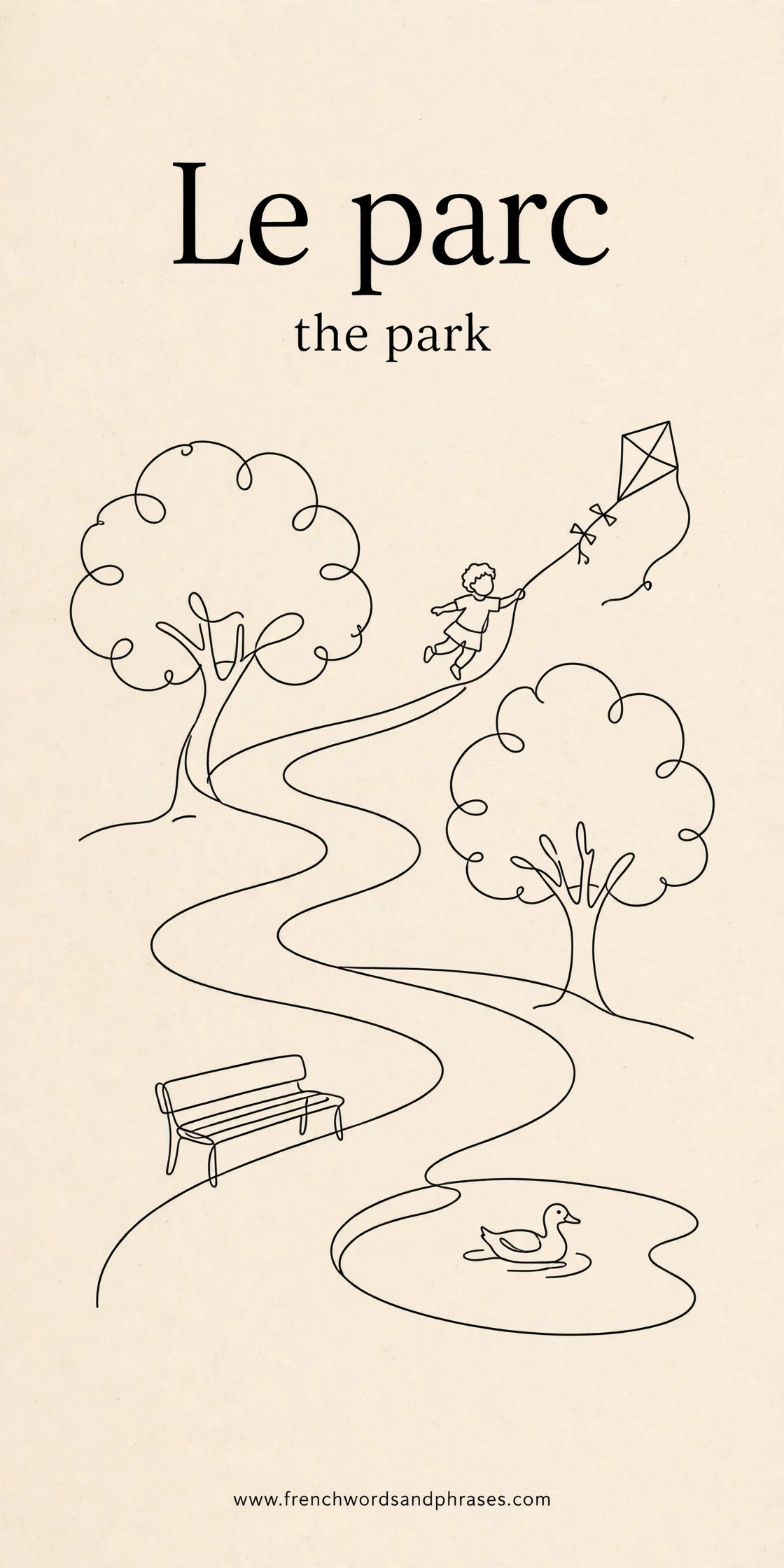
Le parc means the park.
Green lawns, chestnut trees and a bench in the shade: le parc, the park — the city’s open-air living room, where children chase pigeons, couples read on the grass and the whole neighbourhood breathes a little slower.
In this guide, you’ll learn what parc means in English, how to use it with its articles, how to form its plural, and how it appears in everyday French. Explore French examples, English translations, and practice quizzes.
Understanding the French Noun Parc
Parc is a masculine French noun, learned with its article: le parc, un parc. It came into French from the medieval Latin parricus, an enclosure for animals — the king’s deer park first, then the landscaped garden, and finally the public green space every French town now keeps at its heart.
It means a park — a public garden in a town or city: le parc de la mairie, the park by the town hall, se promener dans le parc, to walk in the park. French extends the word to enclosed grounds of every kind: un parc d’attractions, a funfair, un parc animalier, a safari park, un parc national, a national park — and, by a different road, un parc de voitures, a fleet of cars, and un parc informatique, a company’s stock of computers.
Gender: Masculine — le parc
Definite article: le — le parc (the park)
Indefinite article: un — un parc (a park)
Plural: les parcs — regular, with a simple -s
Spelling note: the final -c is pronounced: parc sounds like “park”
Close neighbour: un jardin — a garden; the parc is larger and usually public
English equivalents: The park.
You walk dans le parc or au parc — aller au parc, to go to the park, is the everyday phrase. For the great wild spaces, French keeps the full title: un parc national, un parc naturel régional. And when a town announces un parc de stationnement, that is not a garden at all but a car park — context, as always, decides.
Experience the Word
Parc is the city keeping a piece of countryside in trust for everyone.
Imagine Sunday morning in the parc: the gravel paths are full of joggers, the pond has its ducks, and every bench holds a reader, a lover or a grandfather with a baguette.
You have not just named some grass. You have named the town’s green heart — le parc, the park, open to all.
How to Use Parc in French: Complete Guide
Let’s explore how parc works in French, beginning with its articles — le parc, un parc, aller au parc.
Parc with the Definite Article (Le, Les)
Used for a specific park — the one in your neighbourhood, the one on the map.
| Form | French |
|---|---|
| Masculine singular | le parc |
| Plural | les parcs |
Example
Le parc ferme à la tombée de la nuit.
The park closes at nightfall.
Parc with the Indefinite Article (Un, Des)
Used for a park in general — any green space to spend an afternoon in.
| Form | French |
|---|---|
| Masculine singular | un parc |
| Plural | des parcs |
Example
Il y a un parc juste derrière l’école.
There is a park just behind the school.
Kinds of Parc (National, d’Attractions, Animalier…)
French uses parc for every kind of enclosed ground, from wilderness to funfairs.
| Kind | French |
|---|---|
| a national park | un parc national |
| an amusement park | un parc d’attractions |
| a safari park | un parc animalier |
| a theme park | un parc à thème |
| a car park (formal) | un parc de stationnement |
Example
Les enfants rêvent d’aller au parc d’attractions.
The children dream of going to the amusement park.
Quick Quiz 1
Complete the sentence:
______ parc est plein d’enfants le mercredi. (the)
Reveal the answer
Le
Le parc est plein d’enfants le mercredi.
The park is full of children on Wednesdays — parc is masculine, so le.
The Plural of Parc
Parc takes a regular plural in -s — the -c stays pronounced in both numbers.
| Number | French |
|---|---|
| Singular | le parc |
| Plural | les parcs |
Example
Les parcs de la ville sont ouverts dès l’aube.
The city’s parks open at dawn.
Parc with Possessive Adjectives (Mon, Ton, Son…)
Possessives agree with the noun: parc is masculine, so mon, ton, son in the singular.
| Owner | French |
|---|---|
| my | mon parc |
| your (tu) | ton parc |
| his / her | son parc |
| our | notre parc |
| your (vous) | votre parc |
| their | leur parc |
Example
Mon parc préféré est celui près de la rivière.
My favourite park is the one near the river.
Quick Quiz 2
Complete the sentence:
Ils promènent leur chien dans ______ parc tous les matins. (their)
Reveal the answer
leur
Ils promènent leur chien dans leur parc tous les matins.
They walk their dog in their park every morning — leur, for a singular possession shared by several owners.
Parc with Demonstrative Adjectives (Ce, Ces)
Used to point: ce parc, this park — this green space, here.
| Form | French |
|---|---|
| Masculine singular | ce parc |
| Plural | ces parcs |
Example
Ce parc a un étang avec des canards.
This park has a pond with ducks.
Parc with Adjectives
Adjectives agree with parc — masculine singular: un grand parc, un parc magnifique.
| Adjective | With Parc |
|---|---|
| grand (big) | un grand parc |
| magnifique (magnificent) | un parc magnifique |
| petit (small) | un petit parc |
| public (public) | un parc public |
| fleuri (flower-filled) | un parc fleuri |
Example
Un parc fleuri accueille les visiteurs au printemps.
A flower-filled park welcomes visitors in spring.
Quick Quiz 3
Complete the sentence:
C’est un très ______ parc, on peut s’y perdre. (big)
Reveal the answer
grand
C’est un très grand parc, on peut s’y perdre.
It’s a very big park, you can get lost in it — grand, masculine, to agree with parc.
Everyday Expressions with Parc
Sundays, ducks and funfairs — the parc phrases of daily life.
| Expression | In English |
|---|---|
| aller au parc | to go to the park |
| se promener dans le parc | to walk in the park |
| un parc d’attractions | an amusement park |
| un parc national | a national park |
| un parc pour enfants | a children’s playground area |
Example
Après l’école, les enfants vont au parc.
After school, the children go to the park.
Words from the Same Family as Parc
Green spaces and outings — the words that travel with parc.
| French | In English |
|---|---|
| un jardin | a garden |
| une pelouse | a lawn |
| un banc | a bench |
| un étang | a pond |
| une aire de jeux | a playground |
Example
Les enfants jouent sur la pelouse près de l’étang.
The children play on the lawn near the pond.
Quick Quiz 4
What is un parc d’attractions?
Reveal the answer
An amusement park — rides, stalls and candyfloss.
Le parc d’attractions ouvre ses portes en avril.
The amusement park opens its gates in April.
Parc in Everyday French: Real-Life Examples
Now that you know the word, let’s see how parc appears in everyday French.
Example 1 — Sunday walk
Nous nous promenons dans le parc après le déjeuner.
We walk in the park after lunch.
Example 2 — With children
Le parc est plein d’enfants le samedi.
The park is full of children on Saturdays.
Example 3 — Reading
Elle lit sur un banc, à l’ombre des arbres.
She reads on a bench, in the shade of the trees.
Example 4 — The pond
Les canards nagent sur l’étang du parc.
The ducks are swimming on the park pond.
Example 5 — Jogging
Il court dans le parc tous les matins.
He runs in the park every morning.
Example 6 — A picnic
Nous pique-niquons sur la pelouse du parc.
We are having a picnic on the park lawn.
Beyond Translation: The Meaning of Parc
The parc began as a cage for privilege: a walled ground where kings kept deer no one else could hunt. The Revolution and the great city rebuilds of the 1800s broke the walls open — Paris under Haussmann turned royal grounds into public gardens, and the parc became a promise: nature, held in common, in the middle of the city. French towns still keep that promise fiercely; a mayor who touches a parc touches a nerve.
To say parc is to claim your share of the green.
It evokes the chestnut avenue, the pond, the Sunday bench — the countryside, democratised.
How to Remember the French Noun Parc
Remember it this way: Parc is the park — masculine: le parc, and you go au parc. The final -c is pronounced, just like English park.
- Always masculine — le parc, un parc, mon parc.
- The outing phrase — aller au parc, to go to the park.
- The big family — un parc national, un parc d’attractions: every enclosed ground is a parc.
The key idea is le parc — the park, masculine; aller au parc = to go to the park.
Test Your Knowledge of Parc
Let’s see how much you’ve learned. Try answering these questions before revealing the answers.
Question 1
Is parc masculine or feminine?
Reveal the answer
Masculine — le parc, un parc.
Question 2
How do you say to go to the park?
Reveal the answer
Aller au parc.
Question 3
Translate: The park is full of children on Saturdays.
Reveal the answer
Le parc est plein d’enfants le samedi.
Question 4
What is un parc d’attractions?
Reveal the answer
An amusement park — a funfair with rides and stalls.
Question 5
Complete the sentence:
______ parcs de la ville ouvrent à l’aube. (the)
Reveal the answer
Les
Les parcs de la ville ouvrent à l’aube.
The city’s parks open at dawn.
Your Final Challenge
Can You Use It?
How would you say this in French?
“We walk in the park after lunch.”
Reveal the answer
Nous nous promenons dans le parc après le déjeuner.
We walk in the park after lunch.
A little French. A little curiosity. A richer everyday life.
LEARN FRENCH ONE WORD AT A TIME