A French Word to Live By
Translate Singe to English
/sɛ̃ʒ/
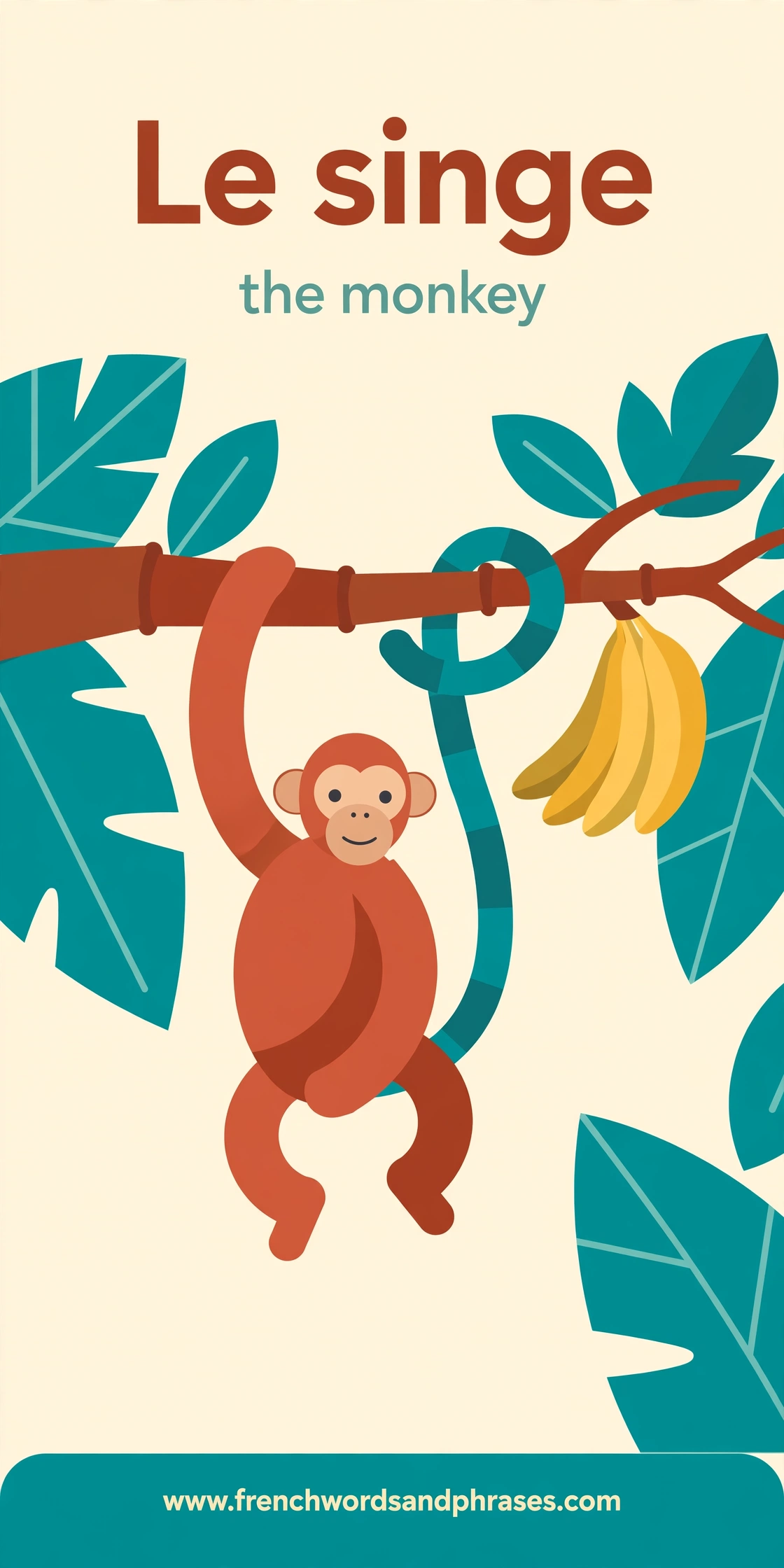
Le singe means the monkey.
Swinging by one arm, stealing the show and imitating everything it sees: le singe, the monkey — the animal French children watch longest at the zoo, and the verb singer, to mimic, is hiding inside its name.
In this guide, you’ll learn what singe means in English, how to use it with its articles, how to form its plural, and how it appears in everyday French. Explore French examples, English translations, and practice quizzes.
Understanding the French Noun Singe
Singe is a masculine French noun, learned with its article: le singe, un singe. It comes from the Latin simius. The word doubles as a verb family: singer means to ape, to mimic — the monkey is the born imitator, and French never forgot it. The great apes are les grands singes — gorillas, chimpanzees and orangutans, the monkey’s imposing cousins without tails.
It means a monkey — the climbing, swinging primate of jungles and zoo enclosures: un singe agile, an agile monkey, les singes du zoo, the monkeys at the zoo, malin comme un singe, cunning as a monkey. The female is la guenon, a word mostly met in books. In everyday French the animal stands for mischief and imitation: a child who copies everyone is un petit singe, and exaggerated antics are des singeries.
Gender: Masculine — le singe
Definite article: le — le singe (the monkey)
Indefinite article: un — un singe (a monkey)
Plural: les singes — regular, with a simple -s
Spelling note: from Latin simius — and the verb singer, to mimic, is built on it
The great apes: les grands singes — gorillas, chimpanzees, orangutans
English equivalents: The monkey.
The compliment hidden in the word is malin comme un singe — clever, cunning as a monkey; say it of a resourceful child with a smile. For the imitations themselves, French uses singer quelqu’un, to ape someone, and faire des singeries, to monkey around. At the zoo, the enclosure everyone crowds is la cage aux singes.
Experience the Word
Singe is the mirror animal: it watches you watching it, copies your wave, and seems one joke away from talking.
Imagine the zoo at feeding time — a young monkey somersaulting for the crowd, stealing a banana with the timing of a stage comedian while the children shriek with laughter.
You have not just named an animal. You have named mischief with a face — le singe, the monkey, our almost-portrait.
How to Use Singe in French: Complete Guide
Let’s explore how singe works in French, beginning with its articles — le singe, un singe, malin comme un singe.
Singe with the Definite Article (Le, Les)
Used for a specific monkey — the one performing, the one that stole the banana.
| Form | French |
|---|---|
| Masculine singular | le singe |
| Plural | les singes |
Example
Le singe grimpe en haut de l’arbre.
The monkey is climbing to the top of the tree.
Singe with the Indefinite Article (Un, Des)
Used for a monkey in general — one acrobat among the troop.
| Form | French |
|---|---|
| Masculine singular | un singe |
| Plural | des singes |
Example
Un singe se balance de branche en branche.
A monkey is swinging from branch to branch.
Kinds of Singe (Grand singe, en peluche, bébé…)
Monkeys are sorted by size and by species — and by whether they are made of plush.
| Kind | French |
|---|---|
| a great ape | un grand singe |
| a baby monkey | un bébé singe |
| a toy monkey | un singe en peluche |
| the monkeys at the zoo | les singes du zoo |
| monkey antics | des singeries |
Example
Le gorille est un grand singe impressionnant.
The gorilla is an impressive great ape.
Quick Quiz 1
Complete the sentence:
______ singe fait des grimaces aux enfants. (the)
Reveal the answer
Le
Le singe fait des grimaces aux enfants.
The monkey is pulling faces at the children — singe is masculine, so le.
The Plural of Singe
Singe takes a regular plural in -s — monkeys travel in troops and in noise.
| Number | French |
|---|---|
| Singular | le singe |
| Plural | les singes |
Example
Les singes crient dans les arbres de la jungle.
The monkeys are calling in the jungle trees.
Singe with Possessive Adjectives (Mon, Ton, Son…)
Possessives agree with the noun: singe is masculine, so mon, ton, son in the singular.
| Owner | French |
|---|---|
| my | mon singe |
| your (tu) | ton singe |
| his / her | son singe |
| our | notre singe |
| your (vous) | votre singe |
| their | leur singe |
Example
Mon singe en peluche ne me quitte jamais.
My toy monkey never leaves my side.
Quick Quiz 2
Complete the sentence:
L’enfant serre ______ singe en peluche contre lui. (his)
Reveal the answer
son
L’enfant serre son singe en peluche contre lui.
The child hugs his toy monkey tight — son, because singe is masculine.
Singe with Demonstrative Adjectives (Ce, Ces)
Used to point: ce singe, this monkey — the one doing somersaults.
| Form | French |
|---|---|
| Masculine singular | ce singe |
| Plural | ces singes |
Example
Ce singe imite tous les visiteurs du zoo.
This monkey imitates all the zoo visitors.
Singe with Adjectives
Adjectives agree with singe — masculine singular: un singe malin, un petit singe.
| Adjective | With Singe |
|---|---|
| malin (cunning) | un singe malin |
| petit (small) | un petit singe |
| agile (agile) | un singe agile |
| drôle (funny) | un singe drôle |
| savant (learned, performing) | un singe savant |
Example
Un singe savant faisait des tours au cirque.
A performing monkey was doing tricks at the circus.
Quick Quiz 3
Complete the sentence:
C’est un singe très ______, il comprend tout. (cunning)
Reveal the answer
malin
C’est un singe très malin, il comprend tout.
He’s a very cunning monkey, he understands everything — malin, masculine, to agree with singe.
Everyday Expressions with Singe
Zoos, compliments and imitations — the singe phrases of daily life.
| Expression | In English |
|---|---|
| malin comme un singe | cunning as a monkey — very clever |
| singer quelqu’un | to ape someone, to mimic them |
| faire des singeries | to monkey around |
| un grand singe | a great ape |
| la cage aux singes | the monkey enclosure at the zoo |
Example
Ce garçon est malin comme un singe.
That boy is as cunning as a monkey.
Words from the Same Family as Singe
Mimicry and jungles — the words that travel with singe.
| French | In English |
|---|---|
| singer | to mimic, to ape (the verb) |
| la banane | the banana — the famous reward |
| le zoo | the zoo |
| la jungle | the jungle |
| grimper | to climb (the verb) |
Example
Le petit singe singe son grand frère en tout.
The little monkey copies his big brother in everything.
Quick Quiz 4
What does malin comme un singe mean?
Reveal the answer
Cunning as a monkey — very clever and resourceful.
Elle est maligne comme un singe, elle trouve toujours une solution.
She is as cunning as a monkey, she always finds a solution.
Singe in Everyday French: Real-Life Examples
Now that you know the word, let’s see how singe appears in everyday French.
Example 1 — At the zoo
Les singes sont les préférés des enfants.
The monkeys are the children’s favourites.
Example 2 — Climbing
Le singe grimpe plus vite que nous.
The monkey climbs faster than we do.
Example 3 — The compliment
Ce petit est malin comme un singe.
That little one is as cunning as a monkey.
Example 4 — Mimicry
Arrête de singer ton professeur !
Stop copying your teacher!
Example 5 — The great apes
Le chimpanzé est un grand singe intelligent.
The chimpanzee is an intelligent great ape.
Example 6 — The toy
Bébé dort avec son singe en peluche.
The baby sleeps with his toy monkey.
Beyond Translation: The Meaning of Singe
Singe is one of those words where French keeps the animal and the idea in a single skin: the monkey imitates, so singer is to imitate, and singeries are the antics of anyone clowning for a crowd. The compliment malin comme un singe has been paid to clever children for centuries — the monkey as the animal nearest to us, close enough to mock us gently. In the age of science the grands singes, the great apes, took the word into laboratories and law courts, but at the zoo rail it remains what it always was: the face that makes faces back.
To say singe is to hold up a small, furry mirror.
It evokes the somersault, the stolen banana and the child at the rail, waving at a wave returned.
How to Remember the French Noun Singe
Remember it this way: Singe is the monkey — masculine: le singe, un singe. Remember singer, to mimic — the monkey is the imitator.
- Always masculine — le singe, un singe, mon singe.
- The verb inside — singer, to ape, to mimic.
- The compliment — malin comme un singe, cunning as a monkey.
The key idea is le singe — the monkey, masculine; singer = to mimic.
Test Your Knowledge of Singe
Let’s see how much you’ve learned. Try answering these questions before revealing the answers.
Question 1
Is singe masculine or feminine?
Reveal the answer
Masculine — le singe, un singe.
Question 2
How do you say a great ape?
Reveal the answer
Un grand singe.
Question 3
Translate: The monkey is climbing to the top of the tree.
Reveal the answer
Le singe grimpe en haut de l’arbre.
Question 4
What does the verb singer mean?
Reveal the answer
To mimic, to ape — built on singe, the born imitator.
Question 5
Complete the sentence:
______ singes du zoo amusent les visiteurs. (the)
Reveal the answer
Les
Les singes du zoo amusent les visiteurs.
The monkeys at the zoo amuse the visitors.
Your Final Challenge
Can You Use It?
How would you say this in French?
“That boy is as cunning as a monkey.”
Reveal the answer
Ce garçon est malin comme un singe.
That boy is as cunning as a monkey.
A little French. A little curiosity. A richer everyday life.
LEARN FRENCH ONE WORD AT A TIME