A French Word to Live By
Translate Rue to English
/ʁy/
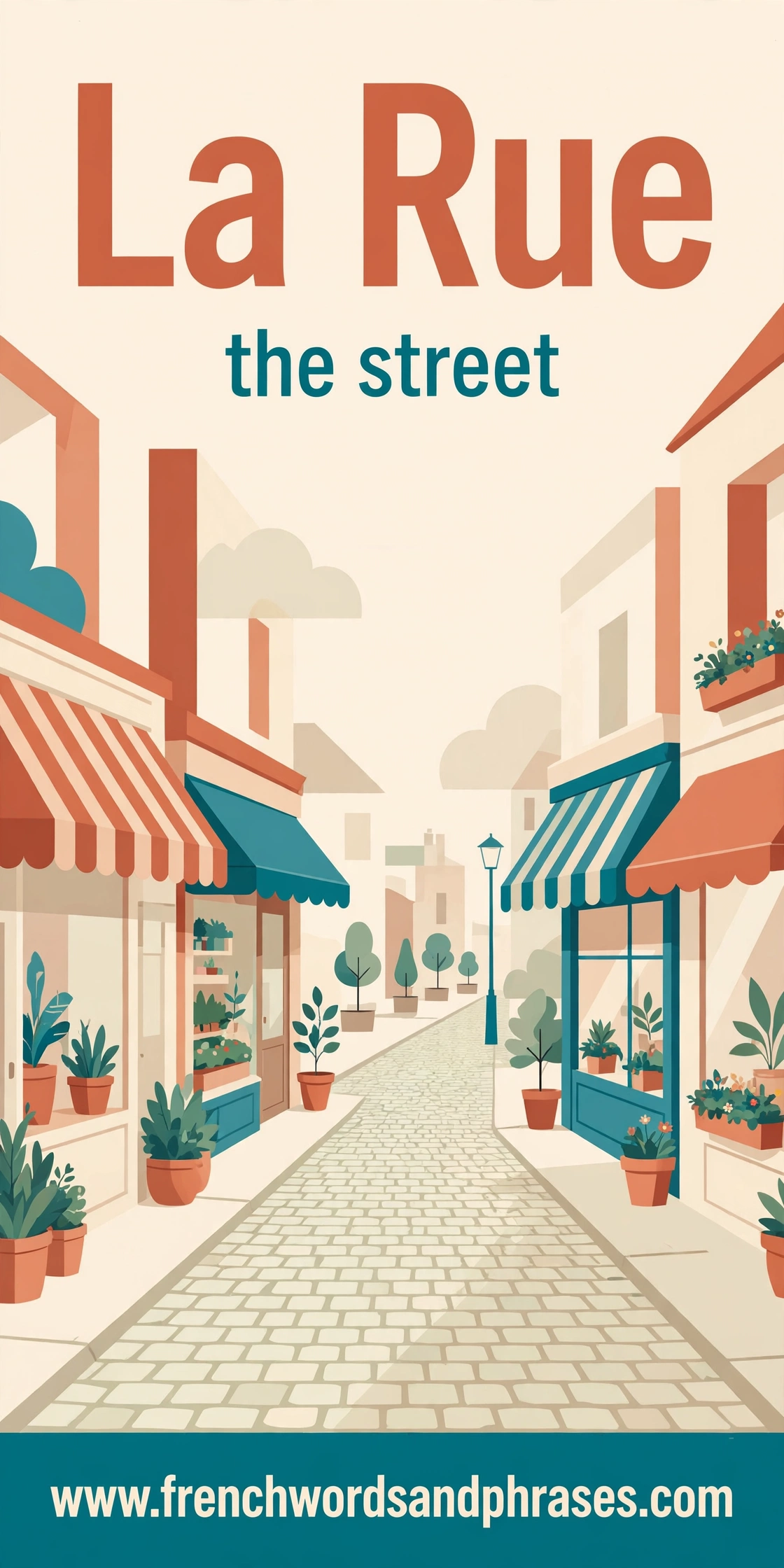
La rue means a street.
Shutters open above the bakery, a bicycle rattles over the cobblestones, and the whole village wakes along one narrow line of houses — that is la rue.
In this guide, you’ll learn what rue means in English, how to use it with its articles, how to form its plural, and how it appears in everyday French. Explore French examples, English translations, and practice quizzes.
Understanding the French Noun Rue
Rue is a feminine French noun. Like every French noun, it has a gender, and it is learned together with its article: la rue.
It means a street — the street of a town or a village, with houses and shops along it. It is the word of addresses and directions: you live dans une rue, you walk dans la rue, and you cross it at the passage piéton.
Gender: Feminine
Definite article: la — la rue (the street)
Indefinite article: une — une rue (a street)
Plural: les rues (the streets)
English equivalents: A street.
One important usage detail: do not confuse rue with route. A rue is a street inside a town, lined with buildings; a route is a road that leaves town and crosses the countryside. In addresses, the number comes first: le 12 rue des Lilas.
Experience the Word
Rue is more than tarmac and pavements. It is the stage of daily life: neighbours greeting each other, children walking to school, the café chairs turned to the sun.
Imagine your own street at seven in the morning — the baker’s van, the cat on the doorstep, the first bus sighing at the corner.
You have not just named a road. You have named the heart of the neighbourhood.
How to Use Rue in French: Complete Guide
Let’s explore how rue works in French, beginning with its articles.
Rue and Its Articles
French nouns are almost never used alone. The small word in front of the noun — the article — does a great deal of work.
Rue with the Definite Article (La, Les)
Used for a particular street both speakers know about, or for the street as a place in general.
| Number | French |
|---|---|
| Singular | la rue |
| Plural | les rues |
Example
La rue est calme le dimanche matin.
The street is quiet on Sunday morning.
Rue with the Indefinite Article (Une, Des)
Used to introduce a street for the first time: one street, or some streets.
| Number | French |
|---|---|
| Singular | une rue |
| Plural | des rues |
Example
C’est une rue très ancienne du village.
It is a very old street in the village.
Rue with Numbers and Quantities
Rue is a count noun — you count streets one by one, so instead of a partitive article, French uses numbers and quantity words.
| Quantity | French |
|---|---|
| deux (two) | deux rues |
| trois (three) | trois rues |
| plusieurs (several) | plusieurs rues |
| beaucoup de (a lot of) | beaucoup de rues |
| toutes les (all the) | toutes les rues |
| chaque (each) | chaque rue |
Example
Toutes les rues du village mènent à la place.
All the streets in the village lead to the square.
Quick Quiz 1
How do you say the streets in French?
Reveal the answer
les rues
Les rues du village sont calmes.
The streets of the village are quiet.
The Plural of Rue
Like most French nouns, rue simply adds an -s in the plural — a letter you see but do not hear.
| Number | French |
|---|---|
| Singular | la rue |
| Plural | les rues |
Example
Au printemps, les rues se remplissent de fleurs.
In spring, the streets fill with flowers.
Rue with Possessive Adjectives (Ma, Ta, Sa…)
Possessives agree with the noun, not with the owner — and rue is feminine, so it takes ma, ta, sa in the singular.
| Owner | French |
|---|---|
| my | ma rue |
| your (tu) | ta rue |
| his / her | sa rue |
| our | notre rue |
| your (vous) | votre rue |
| their | leur rue |
Example
Ma rue est longue et étroite.
My street is long and narrow.
Quick Quiz 2
Complete the sentence:
______ rue est étroite, mais charmante. (my)
Reveal the answer
Ma
Ma rue est étroite, mais charmante.
My street is narrow, but charming.
Rue with Demonstrative Adjectives (Cette, Ces)
Used to point: this street here, those streets there. Feminine singular takes cette.
| Number | French |
|---|---|
| Singular | cette rue |
| Plural | ces rues |
Example
Cette rue monte vers l’église.
This street climbs up towards the church.
Rue with Adjectives
Adjectives agree with the noun, so they take feminine forms with rue. Most come after the noun: la rue étroite, la rue animée.
| Adjective | With Rue |
|---|---|
| étroite (narrow) | la rue étroite |
| longue (long) | la rue longue |
| principale (main) | la rue principale |
| calme (quiet) | la rue calme |
| animée (busy, lively) | la rue animée |
| piétonne (pedestrian) | la rue piétonne |
Example
La rue principale est très animée le samedi.
The main street is very busy on Saturdays.
Quick Quiz 3
Complete the sentence:
C’est une rue ______ (narrow).
Reveal the answer
étroite
C’est une rue étroite.
It is a narrow street. (Étroite is feminine and comes after the noun.)
Everyday Expressions with Rue
Rue appears wherever people give directions, meet friends and cross the town.
| Expression | In English |
|---|---|
| dans la rue | in the street |
| au coin de la rue | at the street corner |
| traverser la rue | to cross the street |
| une rue piétonne | a pedestrian street |
| descendre la rue | to walk down the street |
| la rue principale | the main street |
Example
Au coin de la rue, il y a une boulangerie.
At the street corner, there is a bakery.
Words from the Same Family as Rue
Learn these together and the whole town falls into place.
| French | In English |
|---|---|
| le trottoir | the pavement (sidewalk) |
| le passage piéton | the pedestrian crossing |
| le carrefour | the crossroads |
| l’avenue | the avenue |
| le boulevard | the boulevard |
| l’adresse | the address |
Example
Les enfants traversent au passage piéton.
The children cross at the pedestrian crossing.
Quick Quiz 4
What does au coin de la rue mean?
Reveal the answer
At the street corner
Au coin de la rue, il y a une boulangerie.
At the street corner, there is a bakery.
Rue in Everyday French: Real-Life Examples
Now that you know the word, let’s see how rue appears in everyday French.
Example 1 — An address
J’habite au 12 rue des Lilas.
I live at 12 Rue des Lilas.
Example 2 — A quiet street
Cette rue est très calme le dimanche.
This street is very quiet on Sundays.
Example 3 — Crossing safely
Les enfants traversent la rue au passage piéton.
The children cross the street at the pedestrian crossing.
Example 4 — At the corner
Au coin de la rue, il y a une boulangerie.
At the street corner, there is a bakery.
Example 5 — Describing your street
Sa rue est longue et étroite.
Her street is long and narrow.
Example 6 — On foot
Nous descendons la rue à pied.
We walk down the street on foot.
Beyond Translation: The Meaning of Rue
English says street for the meaning of rue — but the French word is where life happens in public. The rue is the market and the demonstration, the café terrace and the school run, all sharing the same few metres of stone.
To say rue is to say the town itself.
It evokes the corner bakery, the chestnut trees along the pavement, and the address you give without thinking — the street that means home ground.
How to Remember the French Noun Rue
Remember it this way: Rue is the street of the town, feminine — never the open road, which is route.
- You give your address — j’habite au 12 rue des Lilas.
- You meet a friend — au coin de la rue.
- You cross with the children — tu traverses la rue au passage piéton.
The key idea is la rue for the street in town, la route for the road out of town.
Test Your Knowledge of Rue
Let’s see how much you’ve learned. Try answering these questions before revealing the answers.
Question 1
Is rue masculine or feminine?
Reveal the answer
Feminine — la rue.
Question 2
How do you say my street in French?
Reveal the answer
Ma rue.
Question 3
Translate: The children cross the street at the pedestrian crossing.
Reveal the answer
Les enfants traversent la rue au passage piéton.
Question 4
What is the difference between une rue and une route?
Reveal the answer
Une rue is a street in a town; une route is a road between places.
Question 5
Complete the sentence:
______, il y a une boulangerie. (At the street corner)
Reveal the answer
Au coin de la rue
Au coin de la rue, il y a une boulangerie.
At the street corner, there is a bakery.
Your Final Challenge
Can You Use It?
How would you say this in French?
“I live in a quiet street.”
Reveal the answer
J’habite dans une rue calme.
I live in a quiet street.
A little French. A little curiosity. A richer everyday life.
LEARN FRENCH ONE WORD AT A TIME