A French Word to Live By
Translate Déjeuner to English
/de.ʒœ.ne/
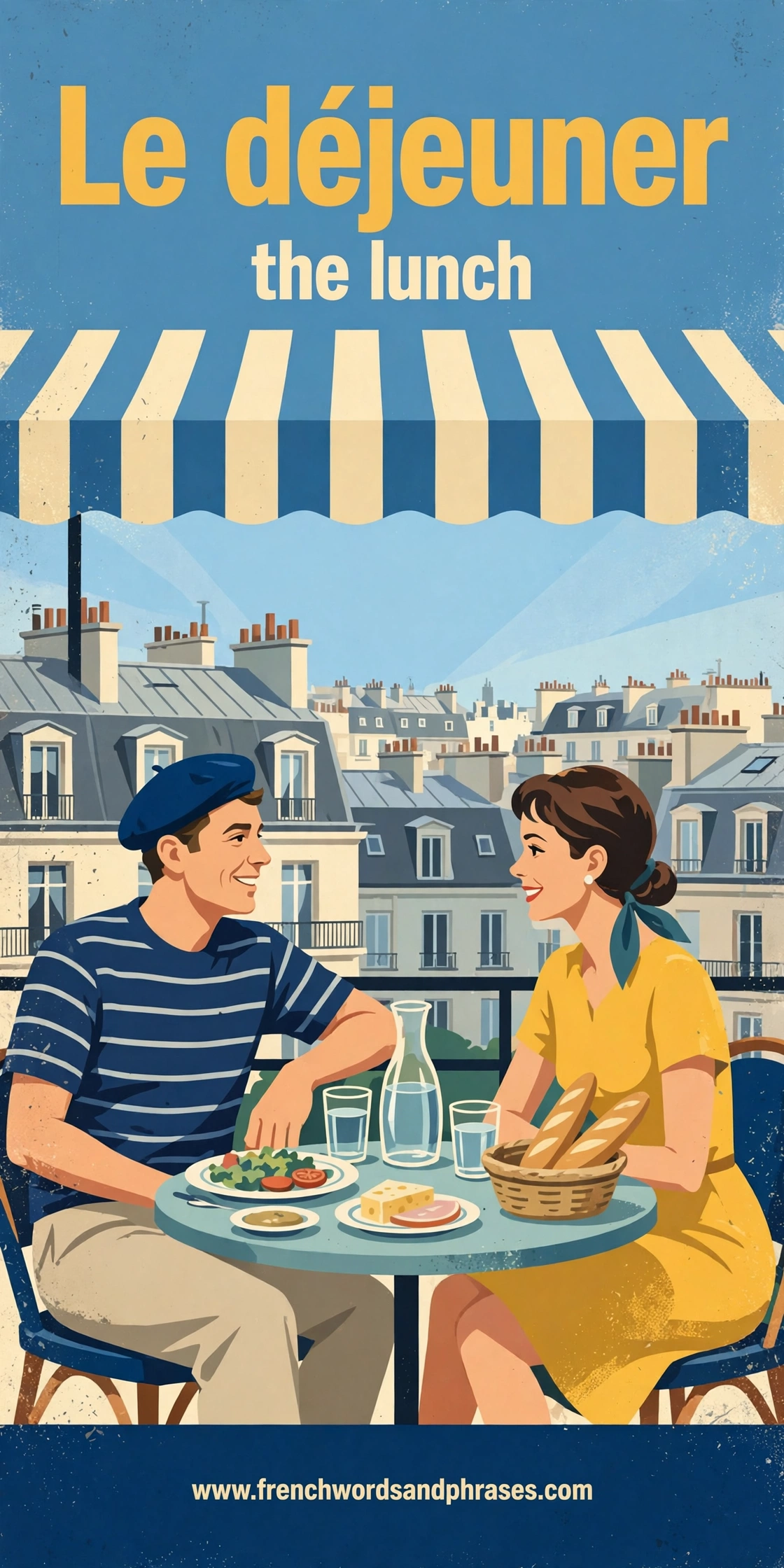
Le déjeuner means the lunch.
At noon the offices empty, the bistros fill, and France sits down properly — knife, fork, bread, and time: le déjeuner, the lunch, the sacred middle of the French day, and a word that is also the verb to have lunch.
In this guide, you’ll learn what déjeuner means in English, how to use it with its articles, how to form its plural, and how it appears in everyday French. Explore French examples, English translations, and practice quizzes.
Understanding the French Noun Déjeuner
Déjeuner is a masculine French noun, learned with its article: le déjeuner, un déjeuner. It is the verb déjeuner (to have lunch) turned noun, and both come from breaking the fast — dé- undoing the jeûne, the fast: déjeuner is literally the un-fasting. In most of France it is the midday meal; its morning twin, le petit-déjeuner, is breakfast — the little lunch.
It means lunch — the midday meal: l’heure du déjeuner, lunchtime, un déjeuner d’affaires, a business lunch, le déjeuner de famille, the family lunch, the great Sunday institution. The word is also the verb: nous déjeunons à midi, we have lunch at noon. At work there is la pause déjeuner, the lunch break, and the voucher that pays for it, le ticket-restaurant.
Gender: Masculine — le déjeuner
Definite article: le — le déjeuner (the lunch)
Indefinite article: un — un déjeuner (a lunch)
Plural: les déjeuners — regular, with a simple -s
Spelling note: dé- + jeûne (a fast): déjeuner is the breaking of the fast
Two lives: also a verb — déjeuner, to have lunch; le petit-déjeuner is breakfast
English equivalents: The lunch.
Déjeuner is sacred time: shops close, and the formule du déjeuner — the set lunch menu — is the best-value eating in France. The verb and noun are twins: on déjeune (verb) au déjeuner (noun). In Belgium, Switzerland and Québec the day’s meals shift: déjeuner there can mean breakfast, and lunch is le dîner — a famous trap for travellers, solved by context and by le petit-déjeuner, which means breakfast everywhere.
Experience the Word
Déjeuner is France stopping at noon and meaning it: not a sandwich over a keyboard, but a table, a menu, and a pause the whole country takes together.
Imagine a small bistro in Lyon at half past twelve on a Tuesday — workers, students, two old friends, all at their tables, the formule du déjeuner arriving in courses, and nobody, nobody at all, in a hurry to be anywhere else.
You have not just named a meal. You have named the midday institution — le déjeuner, the lunch, France’s daily act of civilisation.
How to Use Déjeuner in French: Complete Guide
Let’s explore how déjeuner works in French, beginning with its articles — le déjeuner, un déjeuner, l’heure du déjeuner.
Déjeuner with the Definite Article (Le, Les)
Used for a specific lunch — today’s, Sunday’s, the family one.
| Form | French |
|---|---|
| Masculine singular | le déjeuner |
| Plural | les déjeuners |
Example
Le déjeuner est prêt, tout le monde à table !
Lunch is ready, everyone to the table!
Déjeuner with the Indefinite Article (Un, Des)
Used for a lunch in general — a business lunch, a long lunch.
| Form | French |
|---|---|
| Masculine singular | un déjeuner |
| Plural | des déjeuners |
Example
Nous avons eu un déjeuner délicieux au bord de la rivière.
We had a delicious lunch by the river.
Kinds of Déjeuner (De famille, D’affaires, Petit-déjeuner…)
Lunches are named by their company — family, business, or the little morning one.
| Kind | French |
|---|---|
| a family lunch | un déjeuner de famille |
| a business lunch | un déjeuner d’affaires |
| breakfast (the little lunch) | le petit-déjeuner |
| lunchtime | l’heure du déjeuner |
| the lunch break | la pause déjeuner |
Example
Le déjeuner de famille du dimanche dure trois heures.
The Sunday family lunch lasts three hours.
Quick Quiz 1
Complete the sentence:
______ déjeuner commence à midi et demi. (the)
Reveal the answer
Le
Le déjeuner commence à midi et demi.
Lunch starts at half past twelve — déjeuner is masculine, so le.
The Plural of Déjeuner
Déjeuner takes a regular plural in -s — a week of them structures French working life.
| Number | French |
|---|---|
| Singular | le déjeuner |
| Plural | les déjeuners |
Example
Les déjeuners de travail sont souvent au même restaurant.
Working lunches are often at the same restaurant.
Déjeuner with Possessive Adjectives (Mon, Ton, Son…)
Possessives agree with the noun: déjeuner is masculine, so mon, ton, son in the singular.
| Owner | French |
|---|---|
| my | mon déjeuner |
| your (tu) | ton déjeuner |
| his / her | son déjeuner |
| our | notre déjeuner |
| your (vous) | votre déjeuner |
| their | leur déjeuner |
Example
Mon déjeuner est dans le réfrigérateur, au bureau.
My lunch is in the refrigerator, at the office.
Quick Quiz 2
Complete the sentence:
Elle prend ______ déjeuner à la cantine. (her)
Reveal the answer
son
Elle prend son déjeuner à la cantine.
She has her lunch in the canteen — son, because déjeuner is masculine.
Déjeuner with Demonstrative Adjectives (Ce, Ces)
Used to point: ce déjeuner, this lunch — this one, on the terrace.
| Form | French |
|---|---|
| Masculine singular | ce déjeuner |
| Plural | ces déjeuners |
Example
Ce déjeuner en terrasse était parfait.
This lunch on the terrace was perfect.
Déjeuner with Adjectives
Adjectives agree with déjeuner — masculine singular: un déjeuner délicieux, un long déjeuner.
| Adjective | With Déjeuner |
|---|---|
| délicieux (delicious) | un déjeuner délicieux |
| long (long) | un long déjeuner |
| rapide (quick) | un déjeuner rapide |
| copieux (hearty, filling) | un déjeuner copieux |
| léger (light) | un déjeuner léger |
Example
Un déjeuner copieux demande une petite sieste.
A hearty lunch calls for a little nap.
Quick Quiz 3
Complete the sentence:
C’était un déjeuner très ______, merci ! (delicious)
Reveal the answer
délicieux
C’était un déjeuner très délicieux, merci !
It was a very delicious lunch, thank you — délicieux, masculine, to agree with déjeuner.
Everyday Expressions with Déjeuner
Noon across France — the déjeuner phrases of daily life.
| Expression | In English |
|---|---|
| l’heure du déjeuner | lunchtime |
| la formule du déjeuner | the set lunch menu |
| le ticket-restaurant | the luncheon voucher |
| déjeuner sur le pouce | to grab a quick lunch (on the thumb) |
| bon appétit ! | enjoy your meal! (said at déjeuner) |
Example
À midi, la formule du déjeuner coûte quinze euros.
At noon, the set lunch menu costs fifteen euros.
Words from the Same Family as Déjeuner
The day’s meals — the words that travel with déjeuner.
| French | In English |
|---|---|
| le petit-déjeuner | breakfast |
| le dîner | dinner, the evening meal |
| le goûter | the afternoon snack |
| un repas | a meal |
| déjeuner (verbe) | to have lunch |
Example
Le petit-déjeuner, le déjeuner, le dîner : trois repas par jour.
Breakfast, lunch, dinner: three meals a day.
Quick Quiz 4
What is le petit-déjeuner?
Reveal the answer
Breakfast — the little déjeuner, taken in the morning; le déjeuner alone is lunch.
Le petit-déjeuner est servi à sept heures.
Breakfast is served at seven o’clock.
Déjeuner in Everyday French: Real-Life Examples
Now that you know the word, let’s see how déjeuner appears in everyday French.
Example 1 — At noon
C’est l’heure du déjeuner, le restaurant est plein.
It’s lunchtime, the restaurant is full.
Example 2 — Inviting
Tu viens déjeuner avec nous demain ?
Are you coming to lunch with us tomorrow?
Example 3 — At work
La pause déjeuner dure une heure.
The lunch break lasts an hour.
Example 4 — Sunday
Le déjeuner chez grand-mère commence à une heure.
Lunch at grandmother’s starts at one o’clock.
Example 5 — Quick one
Aujourd’hui, déjeuner sur le pouce : un sandwich.
Today, a quick lunch: a sandwich.
Example 6 — After
Après le déjeuner, une petite promenade ?
After lunch, a little walk?
Beyond Translation: The Meaning of Déjeuner
Déjeuner is a fast undone: jeûner is to fast, and déjeuner breaks it — the same idea as English breakfast, a break-fast, wearing French clothes. The meal then walked through the day through history: once the morning meal, it settled at noon, leaving its little brother, le petit-déjeuner, holding the morning. France built an institution on it — the two-hour pause, the formule, the ticket-restaurant — and a geography trap besides: in Brussels, Geneva and Québec, déjeuner still means breakfast and lunch answers to dîner.
To say déjeuner is to break the fast at noon, seated, properly, with bread.
It evokes full bistros at half past twelve, the Sunday table at grandmother’s, and the sacred pause of the French day.
How to Remember the French Noun Déjeuner
Remember it this way: Déjeuner is the lunch — masculine: le déjeuner. It is also the verb to have lunch, and its little brother le petit-déjeuner is breakfast.
- Always masculine — le déjeuner, un déjeuner, mon déjeuner.
- Two lives — the noun (lunch) and the verb déjeuner, to have lunch.
- The pair — le petit-déjeuner is breakfast; le déjeuner is lunch.
The key idea is le déjeuner — the lunch, masculine; also the verb to have lunch.
Test Your Knowledge of Déjeuner
Let’s see how much you’ve learned. Try answering these questions before revealing the answers.
Question 1
Is déjeuner masculine or feminine?
Reveal the answer
Masculine — le déjeuner, un déjeuner.
Question 2
How do you say lunchtime?
Reveal the answer
L’heure du déjeuner.
Question 3
Translate: Lunch is ready, everyone to the table!
Reveal the answer
Le déjeuner est prêt, tout le monde à table !
Question 4
What is le petit-déjeuner?
Reveal the answer
Breakfast — the little lunch, in the morning.
Question 5
Complete the sentence:
______ déjeuners de famille sont les meilleurs. (the)
Reveal the answer
Les
Les déjeuners de famille sont les meilleurs.
Family lunches are the best.
Your Final Challenge
Can You Use It?
How would you say this in French?
“Lunch is ready, everyone to the table!”
Reveal the answer
Le déjeuner est prêt, tout le monde à table !
Lunch is ready, everyone to the table!
A little French. A little curiosity. A richer everyday life.
LEARN FRENCH ONE WORD AT A TIME