A French Word to Live By
Translate Vase to English
/vaz/
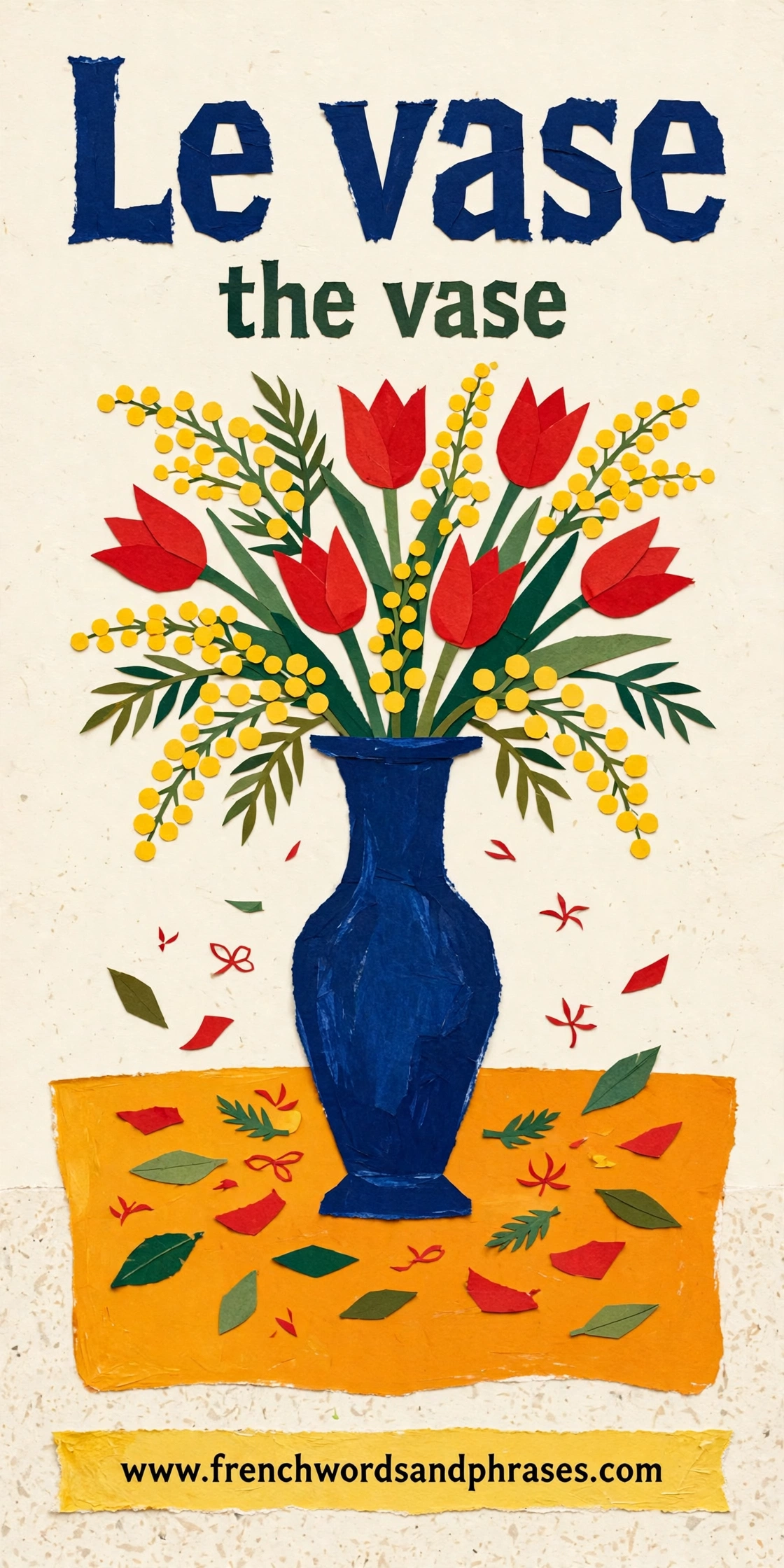
Le vase means the vase.
Glass or porcelain, holding water and a week’s worth of colour on the sideboard: le vase, the vase — the flowers’ home in the house, and a word with a muddy twin that has trapped more than one learner.
In this guide, you’ll learn what vase means in English, how to use it with its articles, how to form its plural, and how it appears in everyday French. Explore French examples, English translations, and practice quizzes.
Understanding the French Noun Vase
Vase is a masculine French noun, learned with its article: le vase, un vase. It comes straight from the Latin vas, a vessel. Beware the homonym: la vase, feminine, is the mud and silt at the bottom of a pond — le vase holds the flowers, la vase swallows your boots.
It means a vase — the vessel for cut flowers and for show: un vase en verre, a glass vase, un vase en porcelaine, a porcelain vase, mettre des fleurs dans un vase, to put flowers in a vase. Antique vases are treasures — un vase grec, a Greek vase — and the broken one is a small domestic tragedy: casser un vase.
Gender: Masculine — le vase
Definite article: le — le vase (the vase)
Indefinite article: un — un vase (a vase)
Plural: les vases — regular, with a simple -s
Spelling note: from Latin vas, a vessel — unchanged for two thousand years
The trap: la vase (feminine) is mud, silt — the opposite of the elegant vessel
English equivalents: The vase.
Flowers go dans un vase, with fresh water — change l’eau du vase to keep them alive. The pair to learn by heart is the gender trap: le vase on the table, la vase in the pond. A tall decorative one is sometimes une potiche, but vase covers nearly everything with a neck and a bouquet.
Experience the Word
Vase is the flowers’ address in the house: the bouquet arrives homeless, and the vase gives it a room with water.
Imagine a Saturday market in Aix — a woman carries home roses wrapped in paper, and before the shopping is unpacked, the roses are in le vase bleu on the sideboard, and the whole room has changed its mood.
You have not just named a vessel. You have named the bouquet’s home — le vase, the vase, where flowers live their second life.
How to Use Vase in French: Complete Guide
Let’s explore how vase works in French, beginning with its articles — le vase, un vase, mettre des fleurs dans un vase.
Vase with the Definite Article (Le, Les)
Used for a specific vase — the blue one, the antique one.
| Form | French |
|---|---|
| Masculine singular | le vase |
| Plural | les vases |
Example
Le vase bleu contient des roses du jardin.
The blue vase holds roses from the garden.
Vase with the Indefinite Article (Un, Des)
Used for a vase in general — any vessel waiting for flowers.
| Form | French |
|---|---|
| Masculine singular | un vase |
| Plural | des vases |
Example
Elle cherche un vase pour ce grand bouquet.
She is looking for a vase for this big bouquet.
Kinds of Vase (En verre, En porcelaine, Grec…)
Vases are named by material and by age — kitchen glass to museum treasure.
| Kind | French |
|---|---|
| a glass vase | un vase en verre |
| a porcelain vase | un vase en porcelaine |
| a Greek vase | un vase grec |
| a tall vase | un grand vase |
| a flower vase | un vase à fleurs |
Example
Ce vase en porcelaine vient de Limoges.
This porcelain vase comes from Limoges.
Quick Quiz 1
Complete the sentence:
______ vase est tombé et s’est cassé. (the)
Reveal the answer
Le
Le vase est tombé et s’est cassé.
The vase fell and broke — vase is masculine, so le.
The Plural of Vase
Vase takes a regular plural in -s — shelves of them fill every antique shop.
| Number | French |
|---|---|
| Singular | le vase |
| Plural | les vases |
Example
Les vases de la vitrine sont très anciens.
The vases in the window are very old.
Vase with Possessive Adjectives (Mon, Ton, Son…)
Possessives agree with the noun: vase is masculine, so mon, ton, son in the singular.
| Owner | French |
|---|---|
| my | mon vase |
| your (tu) | ton vase |
| his / her | son vase |
| our | notre vase |
| your (vous) | votre vase |
| their | leur vase |
Example
Mon vase préféré est un cadeau de ma tante.
My favourite vase is a present from my aunt.
Quick Quiz 2
Complete the sentence:
Il a mis les tulipes dans ______ vase en verre. (his)
Reveal the answer
son
Il a mis les tulipes dans son vase en verre.
He put the tulips in his glass vase — son, because vase is masculine.
Vase with Demonstrative Adjectives (Ce, Ces)
Used to point: ce vase, this vase — this one, in the shop window.
| Form | French |
|---|---|
| Masculine singular | ce vase |
| Plural | ces vases |
Example
Ce vase coûte deux cents euros.
This vase costs two hundred euros.
Vase with Adjectives
Adjectives agree with vase — masculine singular: un vase ancien, un grand vase.
| Adjective | With Vase |
|---|---|
| ancien (old, antique) | un vase ancien |
| grand (tall, big) | un grand vase |
| bleu (blue) | un vase bleu |
| fragile (fragile) | un vase fragile |
| grec (Greek) | un vase grec |
Example
Un vase fragile ne doit pas rester au bord de la table.
A fragile vase must not stay at the edge of the table.
Quick Quiz 3
Complete the sentence:
C’est un vase très ______, ne le touche pas. (fragile)
Reveal the answer
fragile
C’est un vase très fragile, ne le touche pas.
It’s a very fragile vase, don’t touch it — fragile has the same form for masculine and feminine.
Everyday Expressions with Vase
Bouquets and breakages — the vase phrases of daily life.
| Expression | In English |
|---|---|
| mettre des fleurs dans un vase | to put flowers in a vase |
| changer l’eau du vase | to change the water in the vase |
| casser un vase | to break a vase |
| un vase à fleurs | a flower vase |
| la vase (féminin) | mud, silt — the trap twin |
Example
Change l’eau du vase, les fleurs dureront plus longtemps.
Change the water in the vase, the flowers will last longer.
Words from the Same Family as Vase
Flowers and vessels — the words that travel with vase.
| French | In English |
|---|---|
| une fleur | a flower |
| un bouquet | a bunch of flowers |
| la porcelaine | porcelain |
| le verre | glass (the material) |
| un pot | a pot, a jar |
Example
Le bouquet attend un vase assez grand.
The bouquet is waiting for a big enough vase.
Quick Quiz 4
What is la vase, with the feminine article?
Reveal the answer
Mud, silt — the soft mud at the bottom of a pond; le vase (masculine) is the vessel.
Attention, la vase au bord de l’étang est glissante.
Careful, the mud at the edge of the pond is slippery.
Vase in Everyday French: Real-Life Examples
Now that you know the word, let’s see how vase appears in everyday French.
Example 1 — At home
Mets les roses dans le vase bleu.
Put the roses in the blue vase.
Example 2 — At the market
Ce vase en verre coûte dix euros.
This glass vase costs ten euros.
Example 3 — Care
Change l’eau du vase tous les deux jours.
Change the vase water every two days.
Example 4 — Accident
Le chat a cassé le vase de grand-mère.
The cat broke grandmother’s vase.
Example 5 — At the museum
Ce vase grec a deux mille cinq cents ans.
This Greek vase is two thousand five hundred years old.
Example 6 — The gift
Elle a reçu un vase en porcelaine pour son anniversaire.
She received a porcelain vase for her birthday.
Beyond Translation: The Meaning of Vase
Vase is Latin vas, unchanged, a vessel — but French split it into twins by gender: le vase rose to elegance, holding flowers in every salon; la vase sank to the pond bottom as mud and silt, the stuff that swallows boots and smells of low water. The pair is a famous learner’s trap and a small poem in itself: the same four letters, one for the bouquet and one for the bog, separated only by an article.
To say le vase is to give the flowers a home; to say la vase is to watch your step.
It evokes blue glass, fresh water and roses changing the mood of a room.
How to Remember the French Noun Vase
Remember it this way: Vase is the vase — masculine: le vase. Its feminine twin la vase means mud, so the article is everything.
- Always masculine for the vessel — le vase, un vase, mon vase.
- The trap — la vase (feminine) is mud and silt, not a vase.
- The care phrase — changer l’eau du vase, to change the water in the vase.
The key idea is le vase — the vase, masculine; la vase = mud.
Test Your Knowledge of Vase
Let’s see how much you’ve learned. Try answering these questions before revealing the answers.
Question 1
Is vase (the vessel) masculine or feminine?
Reveal the answer
Masculine — le vase, un vase.
Question 2
How do you say to put flowers in a vase?
Reveal the answer
Mettre des fleurs dans un vase.
Question 3
Translate: The blue vase holds roses from the garden.
Reveal the answer
Le vase bleu contient des roses du jardin.
Question 4
What does la vase mean?
Reveal the answer
Mud, silt — the feminine twin is the pond-bottom mud.
Question 5
Complete the sentence:
______ vases de la boutique sont en porcelaine. (the)
Reveal the answer
Les
Les vases de la boutique sont en porcelaine.
The shop’s vases are porcelain.
Your Final Challenge
Can You Use It?
How would you say this in French?
“Put the roses in the blue vase.”
Reveal the answer
Mets les roses dans le vase bleu.
Put the roses in the blue vase.
A little French. A little curiosity. A richer everyday life.
LEARN FRENCH ONE WORD AT A TIME