A French Word to Live By
Translate Parfum to English
/paʁ.fœ̃/
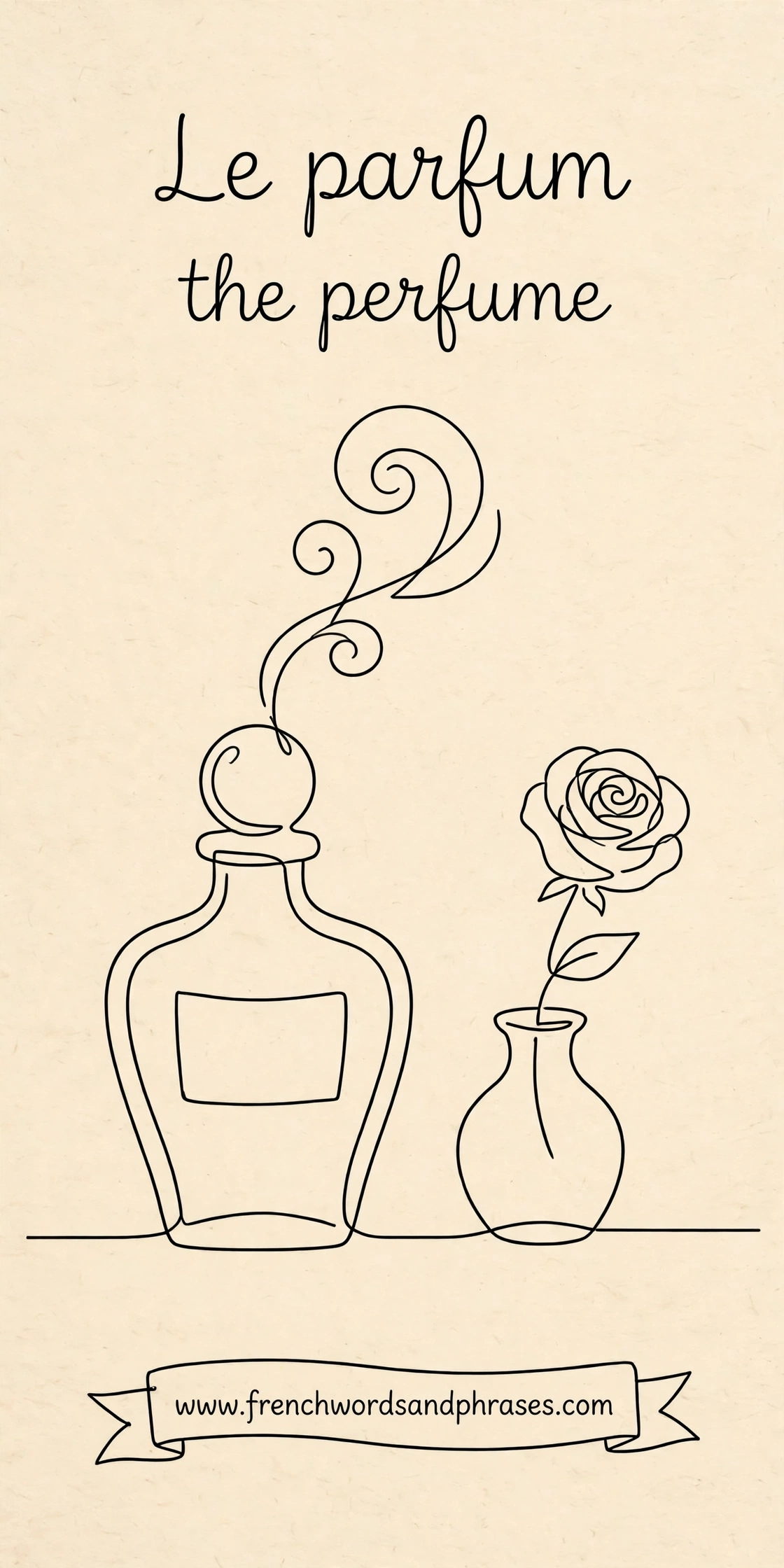
Le parfum means the perfume.
A small glass bottle on the dressing table, two drops behind the ears before the evening begins: le parfum, the perfume — France’s most famous invisible export, and a word that also names the flavour of your ice cream.
In this guide, you’ll learn what parfum means in English, how to use it with its articles, how to form its plural, and how it appears in everyday French. Explore French examples, English translations, and practice quizzes.
Understanding the French Noun Parfum
Parfum is a masculine French noun, learned with its article: le parfum, un parfum. It comes from the Latin per fumum, through smoke — perfume was once incense rising. The word does double duty in French: a scent worn on the skin, and the flavour of anything sweet — la glace au parfum vanille is not wearing anything.
It means perfume, a scent: un parfum célèbre, a famous perfume, mettre du parfum, to put on perfume, une bouteille de parfum, a bottle of perfume, quel est ton parfum ? — what scent are you wearing? Then the second life: un parfum de glace, an ice-cream flavour — parfum vanille, chocolat, fraise — and any fragrance in the air: le parfum des roses, the scent of roses.
Gender: Masculine — le parfum
Definite article: le — le parfum (the perfume)
Indefinite article: un — un parfum (a perfume)
Plural: les parfums — regular, with a simple -s
Spelling note: from Latin per fumum, through smoke — perfume began as incense
The second life: parfum also means a flavour: glace au parfum vanille, vanilla ice cream
English equivalents: The perfume, the scent; also a flavour.
Perfume is worn with mettre du parfum and chosen in une parfumerie, a perfume shop; the strength ladder runs eau de Cologne, eau de toilette, eau de parfum, parfum. At the ice-cream counter the question quel parfum ? asks which flavour — answer vanille, fraise, pistache. Context tells you which parfum is meant: skin or scoop.
Experience the Word
Parfum is the only clothing you cannot see: it enters the room a second before you and stays a minute after you leave.
Imagine the old town of Grasse in Provence in August, the perfume capital of the world — fields of jasmine picked at dawn, and in a small shop a woman testing parfums on paper strips, waving each one like a fan, France bottling its summer.
You have not just named a scent. You have named France’s invisible signature — le parfum, the perfume, worn on skin and served in scoops.
How to Use Parfum in French: Complete Guide
Let’s explore how parfum works in French, beginning with its articles — le parfum, un parfum, mettre du parfum.
Parfum with the Definite Article (Le, Les)
Used for a specific perfume — hers, the famous one, the scent of roses.
| Form | French |
|---|---|
| Masculine singular | le parfum |
| Plural | les parfums |
Example
Le parfum des roses emplit le jardin le soir.
The scent of roses fills the garden in the evening.
Parfum with the Indefinite Article (Un, Des)
Used for a perfume in general — a new scent, a gift bottle.
| Form | French |
|---|---|
| Masculine singular | un parfum |
| Plural | des parfums |
Example
Il lui a offert un parfum pour son anniversaire.
He gave her a perfume for her birthday.
The Two Lives of Parfum (Scent and Flavour)
One word for the bottle and the scoop — context decides.
| Sense | French |
|---|---|
| to put on perfume | mettre du parfum |
| a bottle of perfume | une bouteille de parfum |
| vanilla flavour (ice cream) | parfum vanille |
| strawberry flavour | parfum fraise |
| what flavour? / what scent? | quel parfum ? |
Example
Pour la glace, je prends parfum vanille et parfum café.
For the ice cream, I’ll have vanilla flavour and coffee flavour.
Quick Quiz 1
Complete the sentence:
______ parfum qu’elle porte est très doux. (the)
Reveal the answer
Le
Le parfum qu’elle porte est très doux.
The perfume she wears is very soft — parfum is masculine, so le.
The Plural of Parfum
Parfum takes a regular plural in -s — counters of them glitter in every parfumerie.
| Number | French |
|---|---|
| Singular | le parfum |
| Plural | les parfums |
Example
Les parfums français sont célèbres dans le monde entier.
French perfumes are famous all over the world.
Parfum with Possessive Adjectives (Mon, Ton, Son…)
Possessives agree with the noun: parfum is masculine, so mon, ton, son in the singular.
| Owner | French |
|---|---|
| my | mon parfum |
| your (tu) | ton parfum |
| his / her | son parfum |
| our | notre parfum |
| your (vous) | votre parfum |
| their | leur parfum |
Example
Son parfum préféré coûte très cher.
Her favourite perfume is very expensive.
Quick Quiz 2
Complete the sentence:
Tu aimes ______ parfum ? Je l’ai acheté à Grasse. (my)
Reveal the answer
mon
Tu aimes mon parfum ? Je l’ai acheté à Grasse.
Do you like my perfume? I bought it in Grasse — mon, because parfum is masculine.
Parfum with Demonstrative Adjectives (Ce, Ces)
Used to point: ce parfum, this perfume — this one, on the paper strip.
| Form | French |
|---|---|
| Masculine singular | ce parfum |
| Plural | ces parfums |
Example
Ce parfum sent la fleur d’oranger.
This perfume smells of orange blossom.
Parfum with Adjectives
Adjectives agree with parfum — masculine singular: un parfum célèbre, un parfum doux.
| Adjective | With Parfum |
|---|---|
| célèbre (famous) | un parfum célèbre |
| doux (soft, gentle) | un parfum doux |
| cher (expensive) | un parfum cher |
| léger (light) | un parfum léger |
| français (French) | un parfum français |
Example
Un parfum léger convient mieux en été.
A light perfume is better in summer.
Quick Quiz 3
Complete the sentence:
C’est un parfum très ______, il coûte deux cents euros. (expensive)
Reveal the answer
cher
C’est un parfum très cher, il coûte deux cents euros.
It’s a very expensive perfume, it costs two hundred euros — cher, masculine, to agree with parfum.
Everyday Expressions with Parfum
Dressing tables and ice-cream counters — the parfum phrases of daily life.
| Expression | In English |
|---|---|
| mettre du parfum | to put on perfume |
| une parfumerie | a perfume shop |
| une eau de toilette | an eau de toilette (lighter scent) |
| quel parfum ? | which flavour? / which scent? |
| sentir bon | to smell nice |
Example
Elle met du parfum avant de sortir le soir.
She puts on perfume before going out in the evening.
Words from the Same Family as Parfum
Scents and flavours — the words that travel with parfum.
| French | In English |
|---|---|
| une odeur | a smell, an odour |
| la vanille | vanilla |
| la fraise | the strawberry |
| sentir | to smell (the verb) |
| la parfumerie | the perfume shop, the perfume trade |
Example
La parfumerie vend des parfums de Grasse.
The perfume shop sells perfumes from Grasse.
Quick Quiz 4
At an ice-cream counter, what does quel parfum ? ask?
Reveal the answer
Which flavour — parfum is the ice-cream word: vanille, fraise, chocolat…
Quel parfum pour ta glace ?
Which flavour for your ice cream?
Parfum in Everyday French: Real-Life Examples
Now that you know the word, let’s see how parfum appears in everyday French.
Example 1 — Getting ready
Elle met du parfum avant la soirée.
She puts on perfume before the evening out.
Example 2 — At the shop
Je cherche un parfum léger pour l’été.
I’m looking for a light perfume for summer.
Example 3 — Ice cream
Une glace au parfum fraise, s’il vous plaît.
A strawberry-flavour ice cream, please.
Example 4 — The gift
Il a reçu une bouteille de parfum à Noël.
He received a bottle of perfume at Christmas.
Example 5 — In the garden
Le parfum du jasmin est partout ce soir.
The scent of jasmine is everywhere this evening.
Example 6 — The compliment
Ton parfum sent très bon.
Your perfume smells lovely.
Beyond Translation: The Meaning of Parfum
Parfum began as smoke: per fumum, through the smoke of incense, and rose to become the glory of Grasse, the Provençal town where jasmine and roses are picked at dawn for the great Paris houses. Then the word slipped deliciously sideways: the flavour of an ice cream is its parfum, so a child ordering parfum fraise is using the vocabulary of high perfumery for a scoop of strawberry. Few words travel so well between the dressing table and the dessert menu.
To say parfum is to bottle a scent — or to choose a flavour.
It evokes paper strips in Grasse, two drops behind the ears, and a cone of vanilla on a summer square.
How to Remember the French Noun Parfum
Remember it this way: Parfum is the perfume — masculine: le parfum. Remember its second life: at the ice-cream counter, parfum means flavour.
- Always masculine — le parfum, un parfum, mon parfum.
- The wearing phrase — mettre du parfum, to put on perfume.
- The flavour sense — quel parfum ? at the glacier means which flavour.
The key idea is le parfum — the perfume, masculine; also an ice-cream flavour.
Test Your Knowledge of Parfum
Let’s see how much you’ve learned. Try answering these questions before revealing the answers.
Question 1
Is parfum masculine or feminine?
Reveal the answer
Masculine — le parfum, un parfum.
Question 2
How do you say to put on perfume?
Reveal the answer
Mettre du parfum.
Question 3
Translate: She puts on perfume before going out in the evening.
Reveal the answer
Elle met du parfum avant de sortir le soir.
Question 4
What does parfum mean at an ice-cream counter?
Reveal the answer
A flavour — parfum vanille, parfum fraise, parfum chocolat.
Question 5
Complete the sentence:
______ parfums de cette boutique sont célèbres. (the)
Reveal the answer
Les
Les parfums de cette boutique sont célèbres.
This shop’s perfumes are famous.
Your Final Challenge
Can You Use It?
How would you say this in French?
“She puts on perfume before the evening out.”
Reveal the answer
Elle met du parfum avant la soirée.
She puts on perfume before the evening out.
A little French. A little curiosity. A richer everyday life.
LEARN FRENCH ONE WORD AT A TIME