
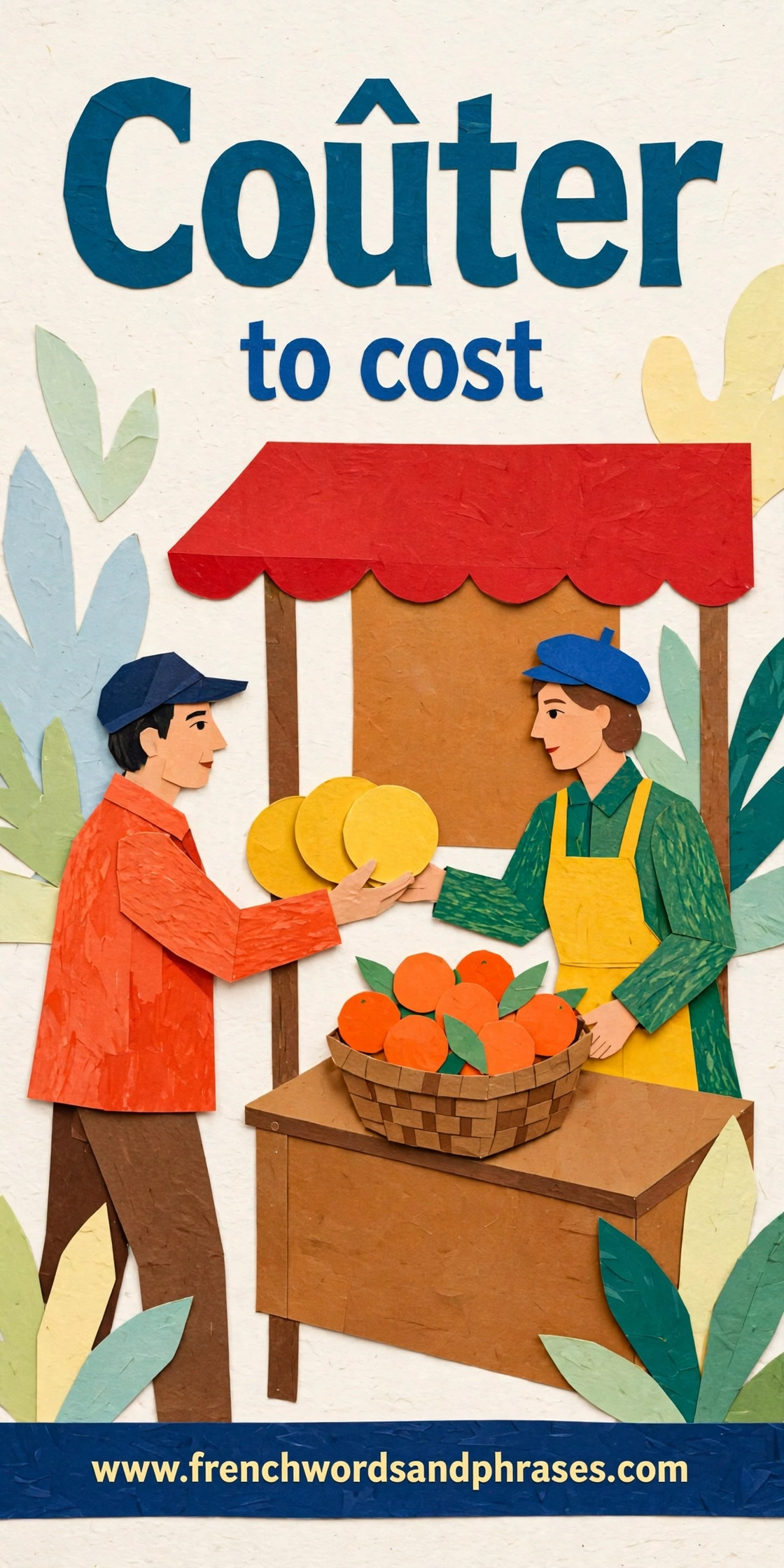
A French Word to Live By
How to Conjugate Coûter in French
/ku.te/
Coûter means to cost — to have a price in money, in effort or in suffering: the ticket’s euros, the victory’s sweat, the mistake’s tears.
A price tag in a shop window, a marathon in the legs, a lie that ends a friendship — coûter is the verb of prices in every currency: money, time, pain and regret.
In this guide, you’ll learn how to conjugate coûter in all the major French tenses and moods. Explore complete conjugation tables, French examples, English translations, and practice quizzes.
Understanding the French Verb Coûter
Coûter is a regular French verb belonging to the first group of verbs, those ending in-er.
It means to cost. Coûter stretches far beyond money: coûter du temps (to cost time), coûter des efforts (to cost effort), coûter la vie (to cost a life). Its noun is le coût, the cost. The everyday question of every shopper is combien ça coûte ? — and the answer for anything expensive is the fixed lament: ça coûte les yeux de la tête, it costs the eyes from your head — an idiom this site teaches on its own page.
Verb classification: First group (-er)
Auxiliary verb: Avoir
Past participle: coûté
Present participle: coûtant
English equivalents: To cost; coûter cher — to be expensive; coûter dix euros — to cost ten euros; coûter la vie à quelqu’un — to cost someone their life; coûter les yeux de la tête — to cost an arm and a leg; combien ça coûte ? — how much does it cost?
One important detail: coûter keeps its circumflex on the û in every form — je coûte, nous coûtons, ils coûtent, past participle coûté. The verb usually has the thing as its subject and the price after it: le livre coûte dix euros. For the person who pays the price, French adds an indirect object: cela m’a coûté une fortune — that cost me a fortune.
Experience the Word
Coûter is the verb of the reckoning — every pleasure, every error and every victory arrives with its bill.
Imagine the old fisherman mending his nets at dusk, counting what the sea has taken this year: a boat repair, a bad season, a friend. Tout coûte, dit-il — everything costs — mais la mer coûte plus cher que tout, the sea costs more than anything.
Money is only its smallest currency. Coûter — the price of things, counted in euros, in hours and in scars.
How to Conjugate Coûter: Complete French Conjugation Guide
Let’s explore every major conjugation of coûter, beginning with the indicative mood.
How to Conjugate Coûter in the Indicative Mood
The indicative mood is used to express facts, observations, actions, and events.
How to Conjugate Coûter in the Present Tense (Présent)
Used for actions happening now, habitual actions, and general truths.
| Subject | Conjugation |
|---|---|
| je | coûte |
| tu | coûtes |
| il / elle | coûte |
| nous | coûtons |
| vous | coûtez |
| ils / elles | coûtent |
Example
Ce manteau coûte deux cents euros.
This coat costs two hundred euros.
Quick Quiz 1
Complete the sentence:
Ces chaussures ______ quatre-vingts euros.
Reveal the answer
coûtent
Ces chaussures coûtent quatre-vingts euros.
These shoes cost eighty euros.
How to Conjugate Coûter in the Passé Composé
Used for completed actions in the past. Coûter takes the auxiliary verb avoir.
| Subject | Conjugation |
|---|---|
| j’ | ai coûté |
| tu | as coûté |
| il / elle | a coûté |
| nous | avons coûté |
| vous | avez coûté |
| ils / elles | ont coûté |
Example
La réparation a coûté une fortune.
The repair cost a fortune.
How to Conjugate Coûter in the Imparfait (Imperfect Tense)
Used for habitual past actions, descriptions, and ongoing situations in the past.
| Subject | Conjugation |
|---|---|
| je | coûtais |
| tu | coûtais |
| il / elle | coûtait |
| nous | coûtions |
| vous | coûtiez |
| ils / elles | coûtaient |
Example
Autrefois, le pain coûtait quelques centimes.
In the old days, bread used to cost a few cents.
Quick Quiz 2
Choose the correct form:
The repair cost a fortune.
La réparation ______ une fortune. (a coûté / est coûtée)
Reveal the answer
a coûté
La réparation a coûté une fortune.
Coûter takes avoir.
How to Conjugate Coûter in the Plus-que-parfait
Used to describe an action that had already been completed before another past event.
| Subject | Conjugation |
|---|---|
| j’ | avais coûté |
| tu | avais coûté |
| il / elle | avait coûté |
| nous | avions coûté |
| vous | aviez coûté |
| ils / elles | avaient coûté |
Example
La guerre avait coûté la vie à des milliers de soldats.
The war had cost thousands of soldiers their lives.
How to Conjugate Coûter in the Passé Simple
Primarily used in formal writing, literature, and historical narratives. It is rarely used in everyday conversation.
| Subject | Conjugation |
|---|---|
| je | coûtai |
| tu | coûtas |
| il / elle | coûta |
| nous | coûtâmes |
| vous | coûtâtes |
| ils / elles | coûtèrent |
Example
La victoire coûta cher aux deux armées.
The victory cost both armies dearly.
How to Conjugate Coûter in the Passé Antérieur
A literary tense used to express an action completed immediately before another past action, generally in the passé simple.
| Subject | Conjugation |
|---|---|
| j’ | eus coûté |
| tu | eus coûté |
| il / elle | eut coûté |
| nous | eûmes coûté |
| vous | eûtes coûté |
| ils / elles | eurent coûté |
Example
Quand la fête eut coûté tout leur budget, ils rirent quand même.
When the party had cost their whole budget, they laughed anyway.
How to Conjugate Coûter in the Future Tense (Futur Simple)
Used to describe actions that will take place in the future.
| Subject | Conjugation |
|---|---|
| je | coûterai |
| tu | coûteras |
| il / elle | coûtera |
| nous | coûterons |
| vous | coûterez |
| ils / elles | coûteront |
Example
Le voyage coûtera moins cher en septembre.
The trip will cost less in September.
How to Conjugate Coûter in the Futur Antérieur (Future Perfect)
Used for an action that will have been completed before a particular point in the future.
| Subject | Conjugation |
|---|---|
| j’ | aurai coûté |
| tu | auras coûté |
| il / elle | aura coûté |
| nous | aurons coûté |
| vous | aurez coûté |
| ils / elles | auront coûté |
Example
À la fin des travaux, la maison aura coûté le double du devis.
By the end of the works, the house will have cost double the estimate.
How to Conjugate Coûter in the Near Future (Futur Proche)
Used to describe something that is going to happen soon. Formed with aller + infinitive.
| Subject | Conjugation |
|---|---|
| je | vais coûter |
| tu | vas coûter |
| il / elle | va coûter |
| nous | allons coûter |
| vous | allez coûter |
| ils / elles | vont coûter |
Example
Attention, cette erreur va coûter cher.
Careful, this mistake is going to cost dearly.
How to Conjugate Coûter in the Conditional Mood
The conditional mood expresses what would happen under certain circumstances. It is also frequently used to make polite requests or express wishes.
How to Conjugate Coûter in the Present Conditional
| Subject | Conjugation |
|---|---|
| je | coûterais |
| tu | coûterais |
| il / elle | coûterait |
| nous | coûterions |
| vous | coûteriez |
| ils / elles | coûteraient |
Example
Sans les frais, le séjour coûterait moitié moins.
Without the fees, the stay would cost half as much.
How to Conjugate Coûter in the Past Conditional
| Subject | Conjugation |
|---|---|
| j’ | aurais coûté |
| tu | aurais coûté |
| il / elle | aurait coûté |
| nous | aurions coûté |
| vous | auriez coûté |
| ils / elles | auraient coûté |
Example
Le billet aurait coûté moins cher en le prenant tôt.
The ticket would have cost less if bought early.
Coûter in the Literary Past Conditional Form
This less common literary form uses the imperfect subjunctive of avoir.
| Subject | Conjugation |
|---|---|
| j’ | eusse coûté |
| tu | eusses coûté |
| il / elle | eût coûté |
| nous | eussions coûté |
| vous | eussiez coûté |
| ils / elles | eussent coûté |
Example
Le silence du roi eût coûté moins cher que sa colère.
The king’s silence would have cost less than his anger.
How to Conjugate Coûter in the Subjunctive Mood
The subjunctive is used to express wishes, emotions, doubts, necessity, and uncertainty. It frequently follows expressions such as il faut que (it is necessary that) or bien que (although).
How to Conjugate Coûter in the Present Subjunctive
| Subject | Conjugation |
|---|---|
| que je | coûte |
| que tu | coûtes |
| qu’il / qu’elle | coûte |
| que nous | coûtions |
| que vous | coûtiez |
| qu’ils / qu’elles | coûtent |
Example
Je doute que ce sac coûte vraiment mille euros.
I doubt this bag really costs a thousand euros.
Quick Quiz 3
Complete the sentence using the subjunctive:
Je suis étonné que la réparation ______ si peu.
Reveal the answer
ait coûté
Je suis étonné que la réparation ait coûté si peu.
I am surprised the repair cost so little.
How to Conjugate Coûter in the Imperfect Subjunctive
A literary tense, rarely encountered in modern spoken French.
| Subject | Conjugation |
|---|---|
| que je | coûtasse |
| que tu | coûtasses |
| qu’il / qu’elle | coûtât |
| que nous | coûtassions |
| que vous | coûtassiez |
| qu’ils / qu’elles | coûtassent |
Example
Il fallait un cadeau qui coûtât peu mais fît plaisir.
What was needed was a gift that cost little but gave pleasure.
How to Conjugate Coûter in the Pluperfect Subjunctive
A literary construction used to express an action completed before another past action.
| Subject | Conjugation |
|---|---|
| que j’ | eusse coûté |
| que tu | eusses coûté |
| qu’il / qu’elle | eût coûté |
| que nous | eussions coûté |
| que vous | eussiez coûté |
| qu’ils / qu’elles | eussent coûté |
Example
On racontait que le tableau eût coûté une somme folle.
People said the painting had cost a mad sum.
How to Conjugate Coûter in the Past Subjunctive
| Subject | Conjugation |
|---|---|
| que j’ | aie coûté |
| que tu | aies coûté |
| qu’il / qu’elle | ait coûté |
| que nous | ayons coûté |
| que vous | ayez coûté |
| qu’ils / qu’elles | aient coûté |
Example
Je suis étonné que la réparation ait coûté si peu.
I am surprised the repair cost so little.
How to Conjugate Coûter in the Imperative
The imperative is used to give commands, instructions, invitations, or suggestions. Subject pronouns are omitted.
How to Conjugate Coûter in the Present Imperative
| Person | Conjugation |
|---|---|
| (tu) | coûte |
| (nous) | coûtons |
| (vous) | coûtez |
Example
Coûte que coûte, finis ce travail avant demain !
Whatever it costs, finish this work before tomorrow!
Quick Quiz 4
How would you say Whatever it costs, finish it (tu form)?
Reveal the answer
Coûte que coûte, finis-le !
French Participles of Coûter
Participles are verb forms that can be used in compound tenses and other grammatical constructions.
Present Participle of Coûter
coûtant
Coûtant une fortune, la robe n’a pas trouvé d’acheteur.
Costing a fortune, the dress found no buyer.
Past Participle of Coûter
coûté
Les efforts coûtés par ce projet en valaient la peine.
The efforts this project cost were worth it.
Coûter in Everyday French: Real-Life Examples
Now that you know the conjugations, let’s see how coûter appears in everyday French.
Example 1 — Present
Ce manteau coûte deux cents euros.
This coat costs two hundred euros.
Example 2 — Passé composé
La réparation a coûté une fortune.
The repair cost a fortune.
Example 3 — Imparfait
Le pain coûtait quelques centimes.
Bread used to cost a few cents.
Example 4 — Future
Le voyage coûtera moins cher en septembre.
The trip will cost less in September.
Example 5 — Conditional
Le séjour coûterait moitié moins sans les frais.
The stay would cost half as much without the fees.
Example 6 — Imperative
Coûte que coûte, finis ce travail !
Whatever it costs, finish this work!
Beyond Translation: The Meaning of Coûter
Coûter comes from the Latin constare — to stand firm, to stand at a price: a thing’s cost is where it stands and does not move. French kept the firmness and widened the currency: a thing can coûter time, sleep, a friendship, a life.
And its great idiom prices the body itself:
Ça coûte les yeux de la tête — it costs the eyes out of your head, the French arm and a leg.
How to Remember the French Verb Coûter
Remember it this way: Coûter is about the old fisherman counting what the sea has taken, in euros and in scars.
- The û never moves: je coûte, nous coûtons, coûté.
- The thing is the subject: le livre coûte dix euros; the payer is indirect: ça m’a coûté cher.
- Beyond money: coûter du temps, coûter la vie; the noun is le coût.
The key idea is the old fisherman counting what the sea has taken, in euros and in scars.
Test Your Knowledge of Coûter
Let’s see how much you’ve learned. Try answering these questions before revealing the answers.
Question 1
How do you ask How much does it cost? in French?
Reveal the answer
Combien ça coûte ? — the shopper’s first question.
Question 2
How do you say This coat costs two hundred euros in French?
Reveal the answer
Ce manteau coûte deux cents euros.
Question 3
Translate: The repair cost a fortune.
Reveal the answer
La réparation a coûté une fortune.
Question 4
What is the past participle of coûter?
Reveal the answer
Coûté.
Question 5
Complete the sentence:
Je doute que ce sac ______ vraiment mille euros.
Reveal the answer
coûte
Je doute que ce sac coûte vraiment mille euros.
I doubt this bag really costs a thousand euros.
Your Final Challenge
Can You Use It?
How would you say this in French?
The car repair cost a fortune, but it runs like new.
Reveal the answer
La réparation de la voiture a coûté une fortune, mais elle roule comme neuve.
The car repair cost a fortune, but it runs like new.
A little French. A little curiosity. A richer everyday life.
LEARN FRENCH ONE WORD AT A TIME




