A French Word to Live By
Translate Belgique to English
/bɛl.ʒik/
La Belgique means Belgium.
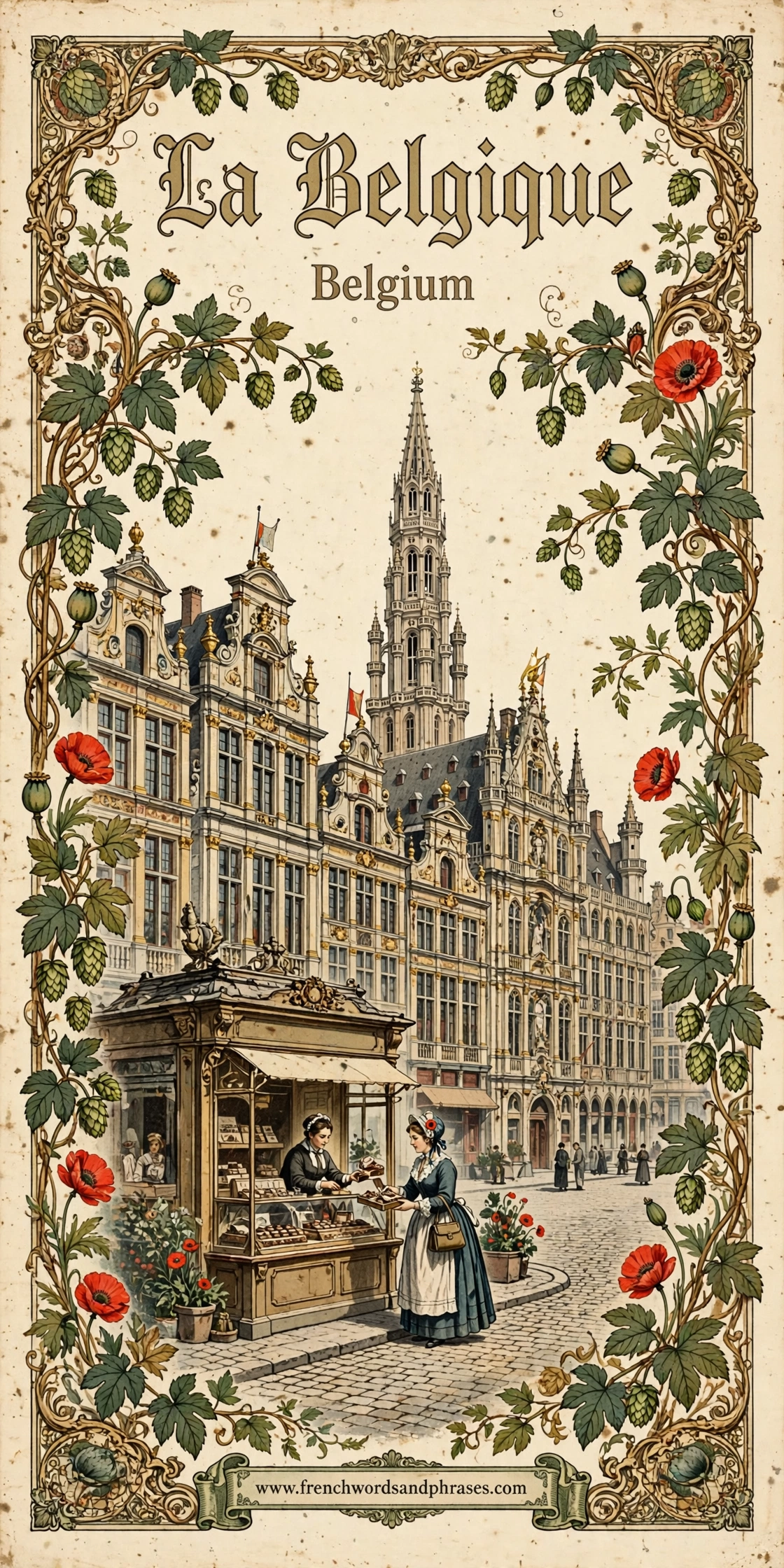
Chocolate, waffles, comic strips and the capital of Europe: la Belgique, Belgium — France’s small northern neighbour, where French is one of the national languages and the humour is a national sport.
In this guide, you’ll learn what Belgique means in English, how to use it with its articles, how to form its plural, and how it appears in everyday French. Explore French examples, English translations, and practice quizzes.
Understanding the French Noun Belgique
Belgique is a feminine proper noun, learned with its article: la Belgique. Countries ending in -e are feminine (Belgique keeps the rule, unlike its look-alike Mexique), so it takes en for in/to and de for from: en Belgique, de Belgique. The name remembers the Belgae, the Celtic tribes of the north whom Caesar called the bravest of all the Gauls.
It means Belgium — the small, dense kingdom between France, Germany and the Netherlands, with Bruxelles, Brussels, as its capital and as the seat of the European Union. Its people are les Belges — one form for men and women, un Belge, une Belge. Belgium speaks three languages: le français in Wallonia and Brussels, le néerlandais (Dutch) in Flanders, and a little allemand in the east — a country that proves language borders need not be state borders.
Gender: Feminine — la Belgique
Definite article: la — la Belgique (Belgium)
Saying in / to: en — en Belgique
Saying from: de — venir de Belgique
Capital: Bruxelles
The people: les Belges — un Belge, une Belge
English equivalents: Belgium.
Belgique behaves like France: en Belgique, de Belgique, and la Belgique as subject or object. The people are another epicene gift: Belge never changes — un Belge, une Belge, les Belges. And Belgium holds a beloved place in French humour: les blagues belges, Belgian jokes, are a genre of their own — told, Belgians reply, with better jokes about the French.
Experience the Word
Belgique is the neighbour who speaks your language with a twist: the numbers change (septante, nonante), the fries are a religion, and lunch is never a small affair.
Imagine Brussels in the rain — the Grand-Place glittering wet gold, the smell of waffles and chocolate from every doorway, and three languages on the street signs: bienvenue en Belgique.
You have not just named a country. You have named Europe’s crossroads — la Belgique, Belgium, small and central.
How to Use Belgique in French: Complete Guide
Let’s explore how Belgique works in French, beginning with its article and prepositions — la Belgique, en Belgique, de Belgique.
Belgique with the Definite Article (La)
As subject or object, Belgique keeps her article: la Belgique.
| Form | French |
|---|---|
| The country | la Belgique |
| The south of Belgium | le sud de la Belgique |
| All of Belgium | toute la Belgique |
Example
La Belgique est un petit pays d’Europe.
Belgium is a small country in Europe.
Saying In, To and From: En Belgique, De Belgique
Feminine countries take en for in/to and de for from — the article disappears after both.
| Meaning | French |
|---|---|
| in Belgium, to Belgium | en Belgique |
| from Belgium | de Belgique |
| across Belgium | dans toute la Belgique |
| to the capital | à Bruxelles |
Example
Nous allons en Belgique ce week-end.
We’re going to Belgium this weekend.
The People of Belgium: Les Belges
The inhabitants are epicene: Belge keeps one form for men and women — only the article changes.
| Person | French |
|---|---|
| a Belgian man | un Belge |
| a Belgian woman | une Belge |
| Belgian men / the Belgians | les Belges |
| Belgian women | les Belges |
Example
Les Belges adorent les frites et le chocolat.
Belgians love fries and chocolate.
Quick Quiz 1
Complete the sentence:
Nous allons ______ Belgique ce week-end. (to)
Reveal the answer
en
Nous allons en Belgique ce week-end.
We’re going to Belgium this weekend — feminine countries take en, with no article.
The Languages and the Adjective: Belge
Belgium has three official languages; the adjective belge, like the people, never changes form.
| Use | French |
|---|---|
| the languages | le français, le néerlandais, l’allemand |
| masculine adjective | un chocolat belge |
| feminine adjective | une gaufre belge |
| French-speaking Belgium | la Wallonie et Bruxelles |
Example
Le français est une des langues de la Belgique.
French is one of the languages of Belgium.
Belgique at a Glance
The facts every beginner meets first — capital, currency, languages.
| Point | Belgique |
|---|---|
| Capital | Bruxelles — also capital of the EU |
| Currency | l’euro |
| Languages | le français, le néerlandais, l’allemand |
| Famous foods | les frites, les gaufres, le chocolat |
| Comics | Tintin — the Belgian reporter |
Example
Bruxelles est la capitale de la Belgique.
Brussels is the capital of Belgium.
Quick Quiz 2
What is the capital of Belgium?
Reveal the answer
Bruxelles
Bruxelles est la capitale de la Belgique.
Brussels is the capital of Belgium.
Belgique and Its Neighbours
Belgium sits at the crossroads — France to the south, the Netherlands to the north.
| Direction | French |
|---|---|
| to the south | la France |
| to the north | les Pays-Bas |
| to the east | l’Allemagne |
| to the west | la mer du Nord |
Example
La France est au sud de la Belgique.
France is south of Belgium.
Belgique with Adjectives
Adjectives agree with Belgique — feminine singular: la Belgique entière, the whole of Belgium.
| Adjective | With Belgique |
|---|---|
| entière (whole) | la Belgique entière |
| petite (small) | la petite Belgique |
| belle (beautiful) | la belle Belgique |
| pluvieuse (rainy) | la Belgique pluvieuse des chansons |
Example
La Belgique entière fête le 21 juillet.
The whole of Belgium celebrates on 21 July.
Quick Quiz 3
Complete the sentence:
C’est une gaufre ______, chaude et sucrée. (Belgian)
Reveal the answer
belge
C’est une gaufre belge, chaude et sucrée.
It’s a Belgian waffle, hot and sweet — belge never changes form.
Everyday Expressions with Belgique
Fries, waffles and jokes — the Belgique phrases of daily life.
| Expression | In English |
|---|---|
| en Belgique | in Belgium |
| de Belgique | from Belgium; Belgian (of origin) |
| une blague belge | a Belgian joke — a French genre |
| les frites belges | Belgian fries |
| il pleut comme en Belgique | it’s raining cats and dogs (joking) |
Example
Les frites belges sont les meilleures du monde, disent les Belges.
Belgian fries are the best in the world, say the Belgians.
Words from the Same Family as Belgique
Belgians and Belgium — the words that travel with Belgique.
| French | In English |
|---|---|
| belge | Belgian — the adjective, invariable |
| un Belge | a Belgian man |
| la Wallonie | Wallonia — the French-speaking south |
| la Flandre | Flanders — the Dutch-speaking north |
| Bruxelles | Brussels — the capital |
Example
La Wallonie est la partie française de la Belgique.
Wallonia is the French-speaking part of Belgium.
Quick Quiz 4
How do you say a Belgian woman?
Reveal the answer
Une Belge — Belge keeps one form for men and women; the article carries the gender.
Une Belge de Bruxelles parle trois langues.
A Belgian woman from Brussels speaks three languages.
Belgique in Everyday French: Real-Life Examples
Now that you know the word, let’s see how Belgique appears in everyday French.
Example 1 — Travel
Nous allons en Belgique ce week-end.
We’re going to Belgium this weekend.
Example 2 — Food
Le chocolat de Belgique est délicieux.
Chocolate from Belgium is delicious.
Example 3 — Languages
En Belgique, on parle français et néerlandais.
In Belgium, people speak French and Dutch.
Example 4 — Geography
La Belgique est au nord de la France.
Belgium is north of France.
Example 5 — Comics
Tintin vient de Belgique.
Tintin comes from Belgium.
Example 6 — Europe
Bruxelles est la capitale de l’Europe.
Brussels is the capital of Europe.
Beyond Translation: The Meaning of Belgique
Belgique is France’s mirror in miniature: a country split by language where France is one, and united by everything else — food, humour, comic strips and rain jokes. French speakers in Wallonia watch the same television debates as Paris, with Belgian numbers (septante for seventy) that French ears find charmingly logical. Brussels, bilingual and European, hosts the institutions of the Union — which makes Belgium, modestly, the capital of the continent France helped found.
To say Belgique is to greet the small neighbour with the big table.
It evokes the Grand-Place in the rain, waffle steam and three languages on one street sign — Belgium, Europe in one small country.
How to Remember the French Noun Belgique
Remember it this way: Belgique is feminine: la Belgique — en Belgique and de Belgique, with no article, for in and from.
- Feminine with her article — la Belgique as subject: la Belgique est petite.
- The prepositions — en Belgique (in, to), de Belgique (from).
- The people — un Belge, une Belge: the word never changes, only the article.
The key idea is la Belgique — Belgium, feminine; en Belgique, de Belgique.
Test Your Knowledge of Belgique
Let’s see how much you’ve learned. Try answering these questions before revealing the answers.
Question 1
Is Belgique masculine or feminine in French?
Reveal the answer
Feminine — la Belgique.
Question 2
How do you say in Belgium?
Reveal the answer
En Belgique — feminine countries take en, without the article.
Question 3
Translate: We’re going to Belgium this weekend.
Reveal the answer
Nous allons en Belgique ce week-end.
Question 4
What three languages are official in Belgium?
Reveal the answer
Le français, le néerlandais et l’allemand — French, Dutch and German.
Question 5
Complete the sentence:
______ Belgique est au nord de la France. (the)
Reveal the answer
La
La Belgique est au nord de la France.
Belgium is north of France.
Your Final Challenge
Can You Use It?
How would you say this in French?
“We’re going to Belgium this weekend.”
Reveal the answer
Nous allons en Belgique ce week-end.
We’re going to Belgium this weekend.
A little French. A little curiosity. A richer everyday life.
LEARN FRENCH ONE WORD AT A TIME