A French Word to Live By
Translate Nom to English
/nɔ̃/
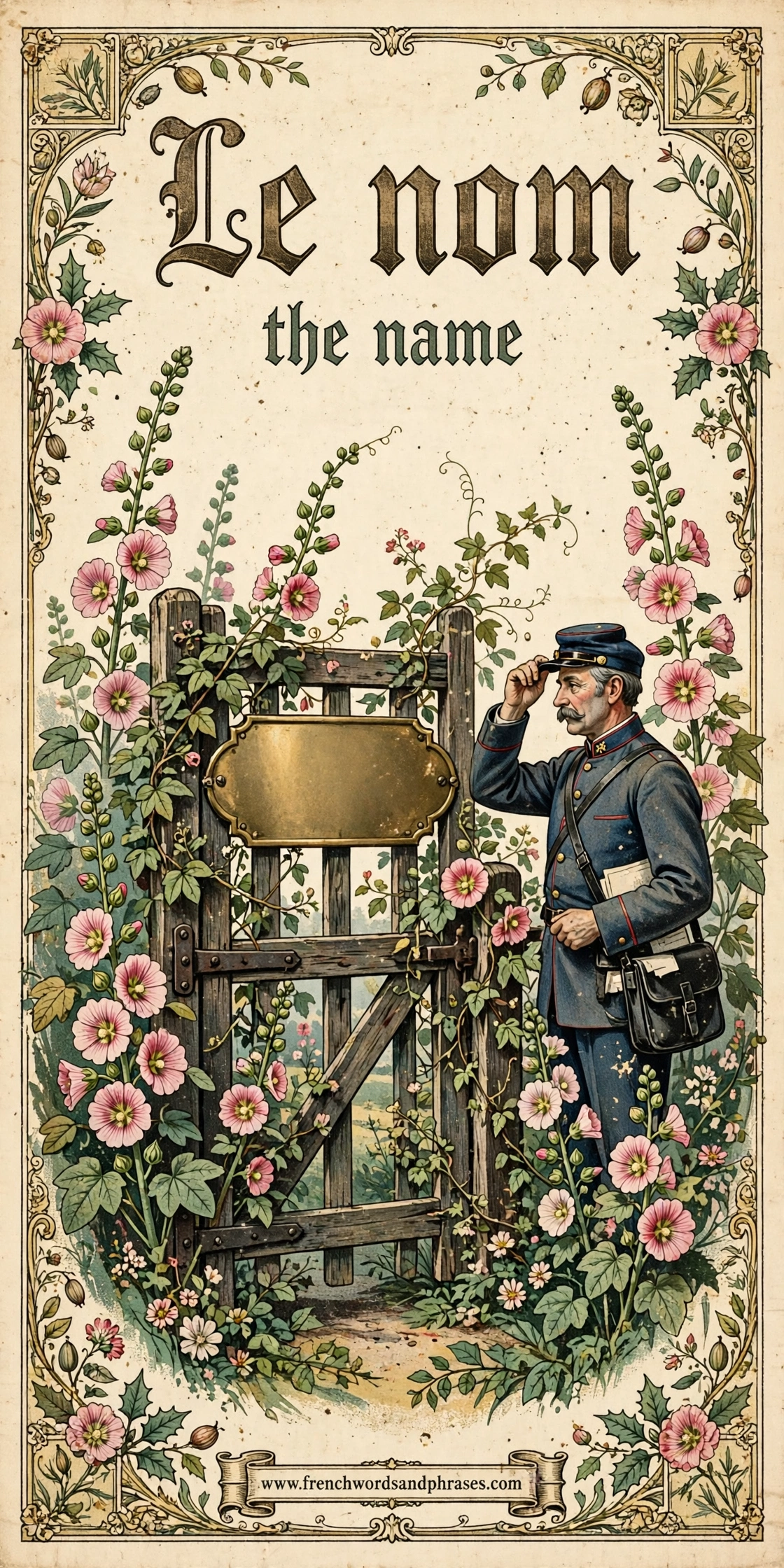
Le nom means the name.
Written at the top of every form, called out across every classroom, signed at the bottom of every letter: le nom, the name — the word the French administration asks for first, before it asks for anything else about you.
In this guide, you’ll learn what nom means in English, how to use it with its articles, how to form its plural, and how it appears in everyday French. Explore French examples, English translations, and practice quizzes.
Understanding the French Noun Nom
Nom is a masculine French noun, learned with its article: le nom, un nom. It comes from the Latin nomen, a name — the same root English keeps in noun, nominate and nominal. In everyday French, le nom most often means your surname or full name: on a form, the box marked NOM wants your family name, and the box marked PRÉNOM wants your first name.
It means a name — first the name of a person: le nom de famille, the surname, un nom d’artiste, a stage name, signer de son nom, to sign with one’s name. Then the name of anything at all: le nom d’une rue, the name of a street, je ne connais pas son nom, I don’t know its name. Grammar gives the word a second career: un nom is also a noun, the naming word itself — un nom commun, a common noun, un nom propre, a proper noun.
Gender: Masculine — le nom
Definite article: le — le nom (the name)
Indefinite article: un — un nom (a name)
Plural: les noms — regular, with a simple -s
Spelling note: from Latin nomen — the root of noun and nominate
On a form: NOM = surname or full name; PRÉNOM = first name — do not swap them
English equivalents: The name; in grammar, a noun.
Forms are where nom earns its keep: French paperwork prints NOM in capitals for the family name and asks for the prénom separately. To ask someone’s name you say Quel est votre nom ? or, warmer, Comment vous appelez-vous ? And things have names too — au nom de means in the name of: au nom de la loi, in the name of the law.
Experience the Word
Nom is the smallest biography you own: a few letters that carry your family, your region and your whole official existence.
Imagine the first day of school — the teacher reads the list aloud, name after name, and each child answers présent to a nom they did not choose but will sign ten thousand times.
You have not just named a label. You have named identity itself — le nom, the name, the first word of every form and every introduction.
How to Use Nom in French: Complete Guide
Let’s explore how nom works in French, beginning with its articles — le nom, un nom, au nom de.
Nom with the Definite Article (Le, Les)
Used for a specific name — yours, hers, the one on the list.
| Form | French |
|---|---|
| Masculine singular | le nom |
| Plural | les noms |
Example
Le nom sur la liste est le mien.
The name on the list is mine.
Nom with the Indefinite Article (Un, Des)
Used for a name in general — any name, a new name, a borrowed name.
| Form | French |
|---|---|
| Masculine singular | un nom |
| Plural | des noms |
Example
Elle a choisi un nom pour son chien.
She chose a name for her dog.
Nom on Forms and Papers (De famille, De jeune fille…)
The administration sorts names into kinds — the vocabulary of every French form.
| Kind | French |
|---|---|
| surname, family name | le nom de famille |
| first name | le prénom |
| maiden name | le nom de jeune fille |
| stage name | un nom d’artiste |
| full name | le nom complet |
Example
Écrivez votre nom de famille en majuscules.
Write your surname in capital letters.
Quick Quiz 1
Complete the sentence:
______ nom de cette rue est très long. (the)
Reveal the answer
Le
Le nom de cette rue est très long.
The name of this street is very long — nom is masculine, so le.
The Plural of Nom
Nom takes a regular plural in -s — lists of names, pages of names.
| Number | French |
|---|---|
| Singular | le nom |
| Plural | les noms |
Example
Tous les noms des élèves sont sur la liste.
All the pupils’ names are on the list.
Nom with Possessive Adjectives (Mon, Ton, Son…)
Possessives agree with the noun: nom is masculine, so mon, ton, son in the singular.
| Owner | French |
|---|---|
| my | mon nom |
| your (tu) | ton nom |
| his / her | son nom |
| our | notre nom |
| your (vous) | votre nom |
| their | leur nom |
Example
Il a oublié mon nom dès la première minute.
He forgot my name within the first minute.
Quick Quiz 2
Complete the sentence:
Elle signe ______ nom en bas de la lettre. (her)
Reveal the answer
son
Elle signe son nom en bas de la lettre.
She signs her name at the bottom of the letter — son, because nom is masculine.
Nom with Demonstrative Adjectives (Ce, Ces)
Used to point: ce nom, this name — the one on the envelope, the one in the book.
| Form | French |
|---|---|
| Masculine singular | ce nom |
| Plural | ces noms |
Example
Ce nom me dit quelque chose.
This name rings a bell.
Nom with Adjectives
Adjectives agree with nom — masculine singular: un nom français, un grand nom.
| Adjective | With Nom |
|---|---|
| français (French) | un nom français |
| complet (full) | un nom complet |
| grand (great, famous) | un grand nom |
| faux (false) | un faux nom |
| nouveau (new) | un nouveau nom |
Example
Victor Hugo est un grand nom de la littérature.
Victor Hugo is a great name in literature.
Quick Quiz 3
Complete the sentence:
Sur le formulaire, écris ton nom ______. (full)
Reveal the answer
complet
Sur le formulaire, écris ton nom complet.
On the form, write your full name — complet, masculine, to agree with nom.
Everyday Expressions with Nom
Forms, signatures and grammar lessons — the nom phrases of daily life.
| Expression | In English |
|---|---|
| au nom de | in the name of |
| le nom de famille | the surname |
| signer de son nom | to sign with one’s name |
| un nom propre | a proper noun (grammar) |
| un nom commun | a common noun (grammar) |
Example
Au nom de toute l’équipe, merci !
In the name of the whole team, thank you!
Words from the Same Family as Nom
Naming and being named — the words that travel with nom.
| French | In English |
|---|---|
| le prénom | the first name |
| nommer | to name, to appoint (the verb) |
| un surnom | a nickname |
| la nomination | an appointment, a nomination |
| anonyme | anonymous — without a name |
Example
On l’a nommé directeur au printemps.
He was appointed director in the spring.
Quick Quiz 4
What does au nom de mean?
Reveal the answer
In the name of — on behalf of, by the authority of.
Au nom de la loi, ouvrez cette porte.
In the name of the law, open this door.
Nom in Everyday French: Real-Life Examples
Now that you know the word, let’s see how nom appears in everyday French.
Example 1 — On a form
Nom : Dupont. Prénom : Marie.
Surname: Dupont. First name: Marie.
Example 2 — Introductions
Quel est votre nom, s’il vous plaît ?
What is your name, please?
Example 3 — At school
Écrivez votre nom en haut de la page.
Write your name at the top of the page.
Example 4 — A street
Je ne me souviens plus du nom de la rue.
I can’t remember the name of the street any more.
Example 5 — Grammar
« Chien » est un nom commun.
“Dog” is a common noun.
Example 6 — A signature
Elle a signé la lettre de son nom.
She signed the letter with her name.
Beyond Translation: The Meaning of Nom
Nom does double duty in French in a way English splits in two: it is both the name a person carries and the grammar word for a noun — the category of words that name things. The Latin root, nomen, also gave English nominate and nominal, and French keeps the family close: nommer is to name and to appoint, as if giving the name gave the job. On French forms the word turns quietly bureaucratic — NOM in capitals for the family name, a convention every newcomer learns exactly once, the hard way.
To say nom is to hold the label the world files you under.
It evokes the classroom list, the signed letter and the street sign — every place a name stands for a person or a thing.
How to Remember the French Noun Nom
Remember it this way: Nom is the name — masculine: le nom. On forms, NOM is the surname and PRÉNOM is the first name.
- Always masculine — le nom, un nom, mon nom.
- The form rule — le nom de famille is the surname; the first name is le prénom.
- The grammar twin — un nom is also a noun: un nom commun, un nom propre.
The key idea is le nom — the name, masculine; nom de famille = surname.
Test Your Knowledge of Nom
Let’s see how much you’ve learned. Try answering these questions before revealing the answers.
Question 1
Is nom masculine or feminine?
Reveal the answer
Masculine — le nom, un nom.
Question 2
On a French form, what does the box NOM ask for?
Reveal the answer
Your surname (family name) — the first name goes in the PRÉNOM box.
Question 3
Translate: What is your name, please?
Reveal the answer
Quel est votre nom, s’il vous plaît ?
Question 4
In grammar, what is un nom?
Reveal the answer
A noun — un nom commun is a common noun, un nom propre a proper noun.
Question 5
Complete the sentence:
______ noms des gagnants sont dans le journal. (the)
Reveal the answer
Les
Les noms des gagnants sont dans le journal.
The winners’ names are in the newspaper.
Your Final Challenge
Can You Use It?
How would you say this in French?
“Write your name at the top of the page.”
Reveal the answer
Écrivez votre nom en haut de la page.
Write your name at the top of the page.
A little French. A little curiosity. A richer everyday life.
LEARN FRENCH ONE WORD AT A TIME