A French Word to Live By
Translate Oncle to English
/ɔ̃kl/
L’oncle means the uncle.
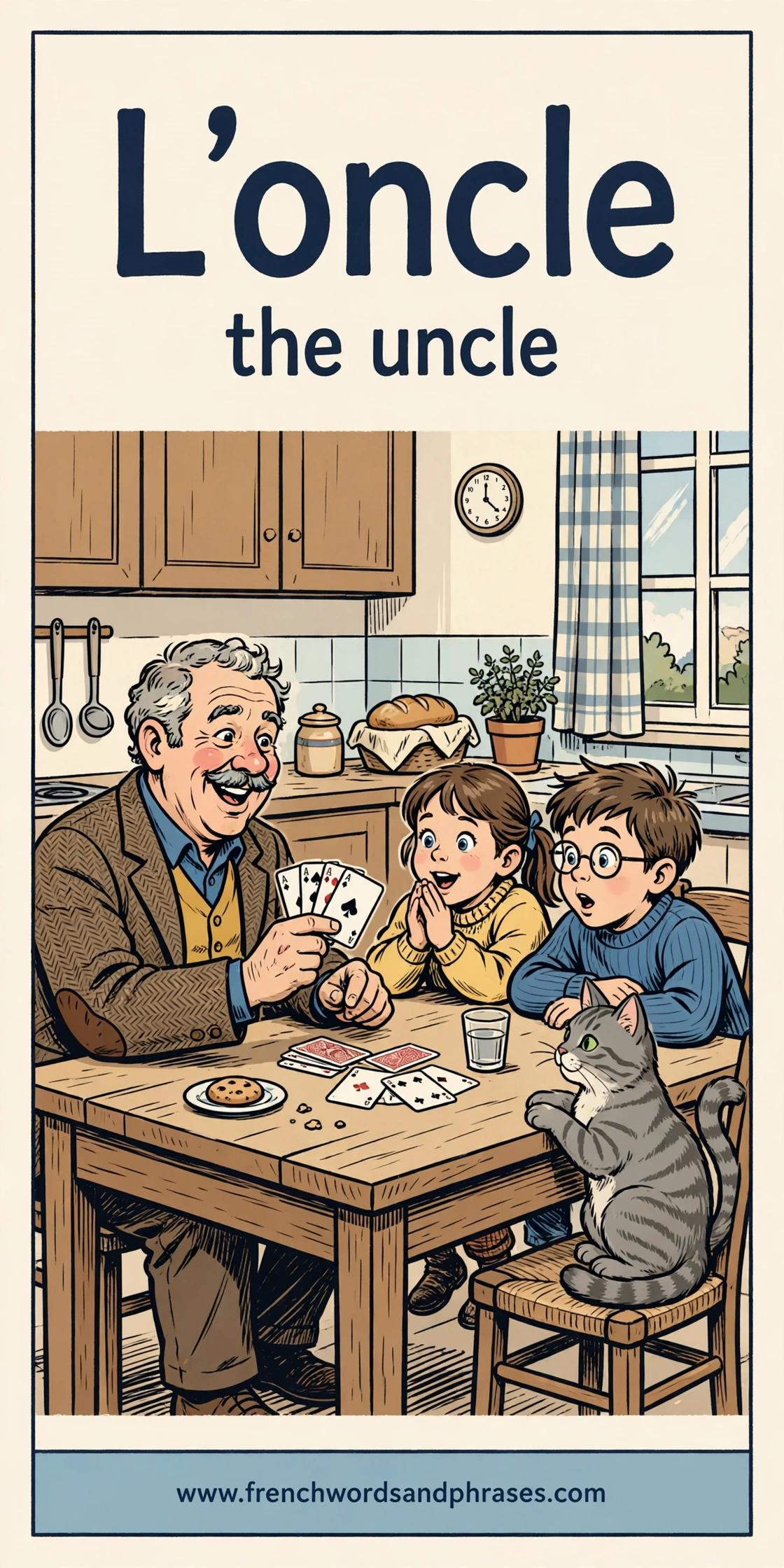
He turns up with a football under his arm, a joke nobody else dares tell, and permission — somehow — for everything: l’oncle, the uncle — the parent’s brother, the family’s licensed joker, the adult who teaches children the interesting, slightly forbidden things.
In this guide, you’ll learn what oncle means in English, how to use it with its articles, how to form its plural, and how it appears in everyday French. Explore French examples, English translations, and practice quizzes.
Understanding the French Noun Oncle
Oncle is a masculine French noun, learned with its article: l’oncle, un oncle — the article elides before the vowel: l’oncle, never le oncle. It comes from the Latin avunculus, the mother’s brother, a word that began as a diminutive — the « little grandfather ». Its plural is regular: les oncles. In the family he is often tonton, the affectionate name.
It means uncle — the brother of one’s father or mother, or the husband of an aunt: mon oncle travaille à Paris, my uncle works in Paris. Like tante, the word extends to honourary family: a close friend of the parents may be oncle to their children. One step up stands le grand-oncle, the great-uncle.
Gender: Masculine — l’oncle
Definite article: l’ — l’oncle (the uncle), elided before the vowel
Indefinite article: un — un oncle (an uncle)
Plural: les oncles — regular, with a simple -s
Spelling note: from Latin avunculus — the article is always l’ in the singular
Family name: tonton — the affectionate name children use
English equivalents: The uncle.
Oncle is the word for speaking of an uncle; to his face, the family name is tonton, kept by many adults for life. Because oncle begins with a vowel, every article and adjective leans on it: l’oncle, cet oncle, mon oncle — and the liaison sings in les oncles. Do not write le oncle: the elision is compulsory.
Experience the Word
Oncle is childhood’s co-conspirator — the adult who winks at the rules, teaches the card trick, and keeps the secret of the broken vase forever.
Imagine the family lunch where l’oncle arrives late, as always, with a story that makes the whole table helpless — the children first, then, despite themselves, the grandparents — his lateness forgiven before he has even sat down.
You have not just named a relative. You have named the family’s licensed laughter — l’oncle, the uncle, the joker with a heart of gold.
How to Use Oncle in French: Complete Guide
Let’s explore how oncle works in French, beginning with its articles — l’oncle, un oncle, mon oncle.
Oncle with the Definite Article (L’, Les)
The article elides before the vowel: l’oncle — and opens out in the plural, les oncles.
| Form | French |
|---|---|
| Masculine singular | l’oncle |
| Plural | les oncles |
Example
L’oncle arrive ce soir par le train.
The uncle is arriving this evening by train.
Oncle with the Indefinite Article (Un, Des)
Used for an uncle in general — any family’s tonton.
| Form | French |
|---|---|
| Masculine singular | un oncle |
| Plural | des oncles |
Example
C’est un oncle formidable, toujours prêt à jouer.
He is a wonderful uncle, always ready to play.
Oncle with Quantities (Un, Deux, Beaucoup de…)
Uncles are counted across the family tree — by birth, by marriage, by adoption of the heart.
| Quantity | French |
|---|---|
| one uncle | un oncle |
| two uncles | deux oncles |
| both uncles | les deux oncles |
| many uncles | beaucoup d’oncles |
| every uncle | chaque oncle |
Example
J’ai deux oncles et trois tantes.
I have two uncles and three aunts.
Quick Quiz 1
Complete the sentence:
______ oncle de Hugo est médecin. (the)
Reveal the answer
L’
L’oncle de Hugo est médecin.
Hugo’s uncle is a doctor — the article elides before the vowel: l’oncle.
The Plural of Oncle
Oncle takes a regular plural in -s — les oncles, with the liaison singing.
| Number | French |
|---|---|
| Singular | l’oncle |
| Plural | les oncles |
Example
Les oncles racontent leurs histoires de jeunesse.
The uncles are telling stories of their youth.
Oncle with Possessive Adjectives (Mon, Ton, Son…)
Possessives agree with the noun: oncle is masculine, so mon, ton, son in the singular.
| Owner | French |
|---|---|
| my | mon oncle |
| your (tu) | ton oncle |
| his / her | son oncle |
| our | notre oncle |
| your (vous) | votre oncle |
| their | leur oncle |
Example
Mon oncle m’apprend la guitare.
My uncle is teaching me the guitar.
Quick Quiz 2
Complete the sentence:
Elle va chez ______ oncle pendant les vacances. (her)
Reveal the answer
son
Elle va chez son oncle pendant les vacances.
She goes to her uncle’s during the holidays — son, because oncle is masculine.
Oncle with Demonstrative Adjectives (Cet, Ces)
Before a vowel, ce becomes cet: cet oncle, this uncle.
| Form | French |
|---|---|
| Masculine singular | cet oncle |
| Plural | ces oncles |
Example
Cet oncle, à droite sur la photo, est le frère de papa.
This uncle, on the right in the photo, is Dad’s brother.
Oncle with Adjectives
Adjectives agree with oncle — masculine singular: un oncle drôle, un vieil oncle (vieil before the vowel).
| Adjective | With Oncle |
|---|---|
| drôle (funny) | un oncle drôle |
| vieux (old) | un vieil oncle |
| jeune (young) | un jeune oncle |
| gentil (kind) | un oncle gentil |
| célèbre (famous) | un oncle célèbre |
Example
C’est un oncle drôle, il fait rire toute la famille.
He is a funny uncle, he makes the whole family laugh.
Quick Quiz 3
Complete the sentence:
Mon oncle est très ______, il connaît mille blagues. (funny)
Reveal the answer
drôle
Mon oncle is very funny, he knows a thousand jokes — drôle, masculine, to agree with oncle.
Everyday Expressions with Oncle
Jokes, guitars and summer visits — the oncle phrases of daily life.
| Expression | In English |
|---|---|
| mon oncle | my uncle |
| un oncle par alliance | an uncle by marriage |
| le grand-oncle | the great-uncle |
| tonton | uncle — the family’s affectionate name |
| chez mon oncle | at my uncle’s (house) |
Example
Les enfants adorent aller chez leur oncle.
The children love going to their uncle’s.
Words from the Same Family as Oncle
The family circle — the words that travel with oncle.
| French | In English |
|---|---|
| la tante | the aunt |
| le neveu | the nephew — what you are to him |
| la nièce | the niece |
| le cousin | the (male) cousin |
| la famille | the family |
Example
L’oncle joue au foot avec son neveu.
The uncle plays football with his nephew.
Quick Quiz 4
What is le grand-oncle?
Reveal the answer
The great-uncle — the uncle of one’s parent.
Mon grand-oncle habite en Bretagne.
My great-uncle lives in Brittany.
Oncle in Everyday French: Real-Life Examples
Now that you know the word, let’s see how oncle appears in everyday French.
Example 1 — A visit
Nous allons chez mon oncle dimanche.
We’re going to my uncle’s on Sunday.
Example 2 — In Paris
Mon oncle travaille dans un musée.
My uncle works in a museum.
Example 3 — Learning
Mon oncle m’apprend la guitare.
My uncle is teaching me the guitar.
Example 4 — The joker
Les oncles racontent des blagues au dessert.
The uncles tell jokes at dessert.
Example 5 — Arrival
L’oncle arrive ce soir, les enfants l’attendent.
The uncle is arriving this evening, the children are waiting for him.
Example 6 — By marriage
C’est mon oncle par alliance, le mari de ma tante.
He’s my uncle by marriage, my aunt’s husband.
Beyond Translation: The Meaning of Oncle
Oncle began life as avunculus — Latin’s word for the mother’s brother, built as a diminutive of avus, grandfather: the little grandfather. French simplified the clan’s precision into one word, but kept the warmth of the diminutive in the role itself: the uncle as a younger, lighter grandfather-figure, authority with the sternness removed. The family name tonton, doubled from the nursery, says the rest — some relatives are named by law, and some by love.
To say oncle is to name the family’s laughter department — authority on holiday.
It evokes the card tricks, the forbidden sweets before dinner, and the stories that begin « quand j’avais ton âge ».
How to Remember the French Noun Oncle
Remember it this way: Oncle is the uncle — masculine, with the elided article l’oncle, regular plural oncles, and tonton at home.
- Always l’ — l’oncle, jamais « le oncle » : la voyelle commande l’élision.
- The home name — chez lui, c’est tonton ; oncle, c’est pour parler de lui.
- Both sides, one word — le frère de maman ou de papa, c’est toujours l’oncle.
The key idea is l’oncle — the uncle, masculine; tonton at home; le grand-oncle = the great-uncle.
Test Your Knowledge of Oncle
Let’s see how much you’ve learned. Try answering these questions before revealing the answers.
Question 1
Is oncle masculine or feminine?
Reveal the answer
Masculine — l’oncle, un oncle.
Question 2
How do you say my uncle?
Reveal the answer
Mon oncle.
Question 3
Translate: My uncle is teaching me the guitar.
Reveal the answer
Mon oncle m’apprend la guitare.
Question 4
Complete the sentence:
______ oncles arrivent pour Noël. (the)
Reveal the answer
Les
Les oncles arrivent pour Noël.
The uncles are arriving for Christmas.
Question 5
What do children often call their oncle?
Reveal the answer
Tonton — the affectionate family name.
Your Final Challenge
Can You Use It?
How would you say this in French?
“My uncle is teaching me the guitar.”
Reveal the answer
Mon oncle m’apprend la guitare.
My uncle is teaching me the guitar.
A little French. A little curiosity. A richer everyday life.
LEARN FRENCH ONE WORD AT A TIME