A French Word to Live By
Translate Grand-père to English
/ɡʁɑ̃.pɛʁ/
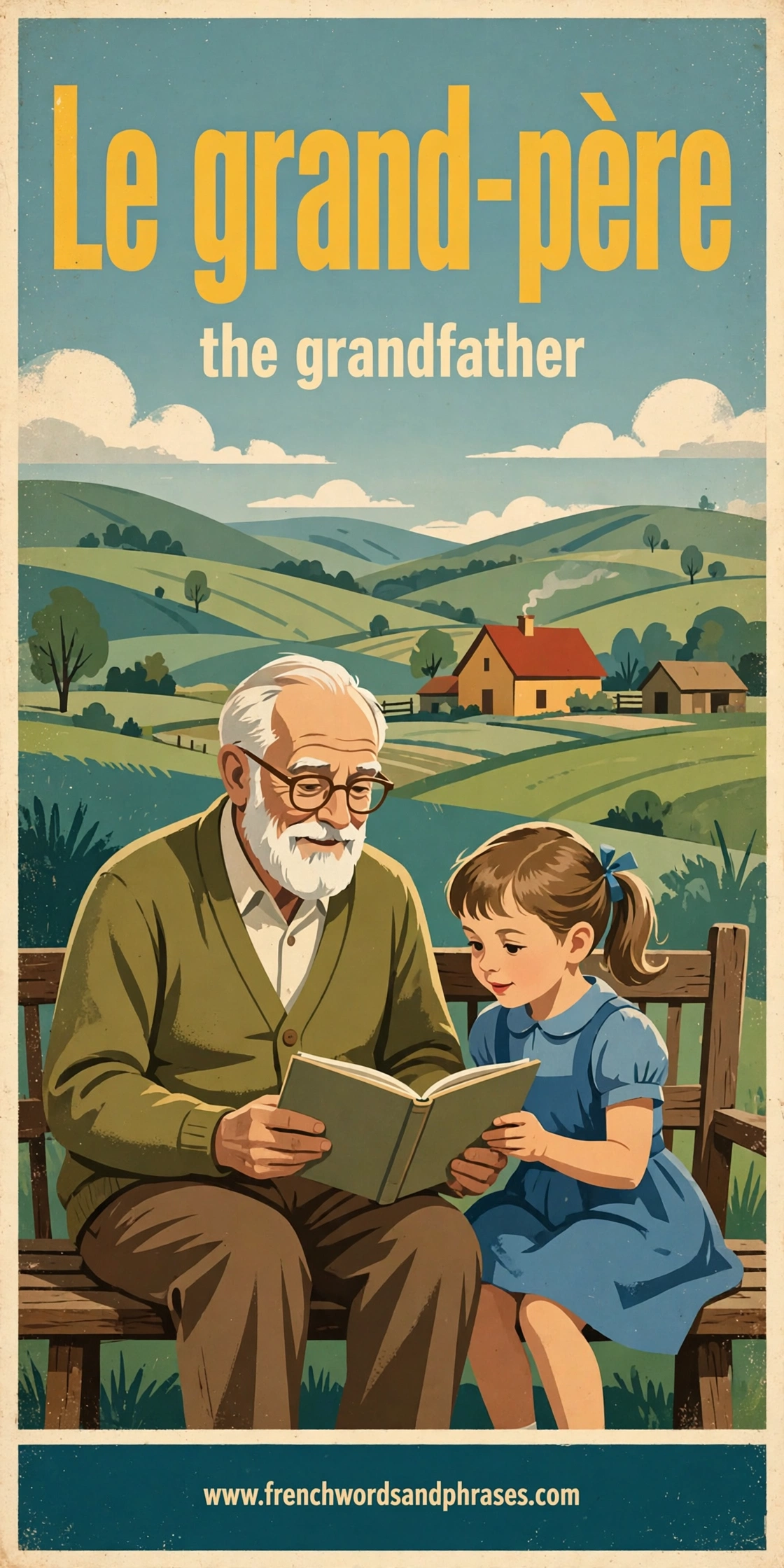
Le grand-père means the grandfather.
He keeps sweets in his coat pocket, stories in his head from before you were born, and all the time in the world for a small person’s questions: le grand-père, the grandfather — the father grown grand, the family’s living memory, the man who was young in another century and tells you about it.
In this guide, you’ll learn what grand-père means in English, how to use it with its articles, how to form its plural, and how it appears in everyday French. Explore French examples, English translations, and practice quizzes.
Understanding the French Noun Grand-père
Grand-père is a masculine French noun, learned with its article: le grand-père, un grand-père. It is a compound of grand (great, big) and père (father) — the « great father », the father one step up. Its plural is a small spelling lesson: les grands-pères, where grand takes an s because it is a real adjective here, unlike in grand-mère’s cousin grand-maman.
It means grandfather — the father of one’s father or mother: mon grand-père était marin, my grandfather was a sailor. French children often call him papi, the affectionate everyday name, while grand-père remains the word of introductions, stories and documents. One step further up stands l’arrière-grand-père, the great-grandfather.
Gender: Masculine — le grand-père
Definite article: le — le grand-père (the grandfather)
Indefinite article: un — un grand-père (a grandfather)
Plural: les grands-pères — note the s on grands
Spelling note: a hyphen joins grand and père; both parts live in the plural
Family name: papi — the affectionate name children use
English equivalents: The grandfather.
Grand-père is the formal, full word; at home most children say papi, and many grandfathers are known by nothing else. In writing and in speaking of someone else’s grandfather, grand-père is the safe form. Watch the plural: les grands-pères — French writes the s on grand here, a detail examiners love and grandmothers forgive.
Experience the Word
Grand-père is time made kind — a man who has seen the world change twice and kept the best stories from both versions.
Imagine the garden at the end of summer: the grand-père in his chair, a grandchild on each arm of it, demanding the story of the war, the boat, the first bicycle — history, not from a book, but from a voice that was there.
You have not just named a relative. You have named the family’s archive — le grand-père, the grandfather, memory with a moustache.
How to Use Grand-père in French: Complete Guide
Let’s explore how grand-père works in French, beginning with its articles — le grand-père, un grand-père, mon grand-père.
Grand-père with the Definite Article (Le, Les)
Used for a specific grandfather — yours, theirs, the one in the photograph.
| Form | French |
|---|---|
| Masculine singular | le grand-père |
| Plural | les grands-pères |
Example
Le grand-père lit le journal après le déjeuner.
The grandfather reads the newspaper after lunch.
Grand-père with the Indefinite Article (Un, Des)
Used for a grandfather in general — any old gentleman of the family rank.
| Form | French |
|---|---|
| Masculine singular | un grand-père |
| Plural | des grands-pères |
Example
C’est un grand-père très patient avec les enfants.
He is a very patient grandfather with children.
Grand-père with Quantities (Un, Deux, Beaucoup de…)
Grandfathers are counted in family trees — two by birth, more by marriage and love.
| Quantity | French |
|---|---|
| one grandfather | un grand-père |
| two grandfathers | deux grands-pères |
| both grandfathers | les deux grands-pères |
| many grandfathers | beaucoup de grands-pères |
| every grandfather | chaque grand-père |
Example
Mes deux grands-pères étaient marins.
Both my grandfathers were sailors.
Quick Quiz 1
Complete the sentence:
______ grand-père de Léa raconte de belles histoires. (the)
Reveal the answer
Le
Le grand-père de Léa raconte de belles histoires.
Léa’s grandfather tells beautiful stories — grand-père is masculine, so le.
The Plural of Grand-père
Grand-père takes its plural on both parts: les grands-pères.
| Number | French |
|---|---|
| Singular | le grand-père |
| Plural | les grands-pères |
Example
Les grands-pères jouent aux cartes au parc.
The grandfathers play cards in the park.
Grand-père with Possessive Adjectives (Mon, Ton, Son…)
Possessives agree with the noun: grand-père is masculine, so mon, ton, son in the singular.
| Owner | French |
|---|---|
| my | mon grand-père |
| your (tu) | ton grand-père |
| his / her | son grand-père |
| our | notre grand-père |
| your (vous) | votre grand-père |
| their | leur grand-père |
Example
Mon grand-père m’apprend à pêcher.
My grandfather is teaching me to fish.
Quick Quiz 2
Complete the sentence:
Elle adore ______ grand-père, il est si drôle. (her)
Reveal the answer
son
Elle adore son grand-père, il est si drôle.
She adores her grandfather, he is so funny — son, because grand-père is masculine.
Grand-père with Demonstrative Adjectives (Ce, Ces)
Used to point: ce grand-père, this grandfather — in the photograph, on the bench.
| Form | French |
|---|---|
| Masculine singular | ce grand-père |
| Plural | ces grands-pères |
Example
Ce grand-père, sur la photo, avait vingt ans.
This grandfather, in the photo, was twenty.
Grand-père with Adjectives
Adjectives agree with grand-père — masculine singular: un grand-père gentil, un vieux grand-père.
| Adjective | With Grand-père |
|---|---|
| gentil (kind) | un grand-père gentil |
| vieux (old) | un vieux grand-père |
| drôle (funny) | un grand-père drôle |
| formidable (wonderful) | un grand-père formidable |
| fatigué (tired) | un grand-père fatigué |
Example
C’est un grand-père formidable, il sait tout réparer.
He is a wonderful grandfather, he can fix anything.
Quick Quiz 3
Complete the sentence:
Mon grand-père est très ______, il rit tout le temps. (funny)
Reveal the answer
drôle
Mon grand-père est très drôle, il rit tout le temps.
My grandfather is very funny, he laughs all the time — drôle, masculine, to agree with grand-père.
Everyday Expressions with Grand-père
Gardens, photographs and Sunday lunches — the grand-père phrases of daily life.
| Expression | In English |
|---|---|
| mon grand-père | my grandfather |
| grand-père paternel / maternel | paternal / maternal grandfather |
| devenir grand-père | to become a grandfather |
| l’arrière-grand-père | the great-grandfather |
| papi | grandpa — the family’s affectionate name |
Example
Il devient grand-père pour la première fois.
He is becoming a grandfather for the first time.
Words from the Same Family as Grand-père
The generations — the words that travel with grand-père.
| French | In English |
|---|---|
| le père | the father |
| la grand-mère | the grandmother |
| les grands-parents | the grandparents |
| le petit-fils | the grandson |
| la petite-fille | the granddaughter |
Example
Le grand-père promène son petit-fils au parc.
The grandfather walks his grandson in the park.
Quick Quiz 4
What is l’arrière-grand-père?
Reveal the answer
The great-grandfather — one generation above the grand-père.
Mon arrière-grand-père était né en 1900.
My great-grandfather was born in 1900.
Grand-père in Everyday French: Real-Life Examples
Now that you know the word, let’s see how grand-père appears in everyday French.
Example 1 — At home
Mon grand-père lit son journal dans le jardin.
My grandfather reads his newspaper in the garden.
Example 2 — Stories
Grand-père raconte la guerre aux enfants.
Grandfather tells the children about the war.
Example 3 — A visit
Nous allons chez mon grand-père dimanche.
We’re going to my grandfather’s on Sunday.
Example 4 — Learning
Mon grand-père m’apprend les cartes.
My grandfather is teaching me cards.
Example 5 — The photograph
Sur la photo, mon grand-père a vingt ans.
In the photo, my grandfather is twenty.
Example 6 — Becoming
Mon père devient grand-père cette année.
My father becomes a grandfather this year.
Beyond Translation: The Meaning of Grand-père
Grand-père is built like a promotion: père, father, raised by grand — great — to the rank above. English did the same with grand-father, and both languages borrowed the ladder from family law, where each generation up adds another grand. What the compound cannot hold is the affection, which French stores in the other word, papi: grand-père for the world and the documents, papi for the kitchen, the garden, and the small arms round the neck.
To say grand-père is to honour the family’s memory-keeper.
It evokes the chair by the window, the pocket full of sweets, and the voice that can say « quand j’étais petit » and open a door into another century.
How to Remember the French Noun Grand-père
Remember it this way: Grand-père is the grandfather — masculine, plural grands-pères with an s on both parts, and papi at home.
- Always masculine — le grand-père, un grand-père, mon grand-père.
- The plural doubles the s — les grands-pères, grands et pères ensemble.
- The home name — à la maison, c’est papi ; grand-père, c’est pour le monde.
The key idea is le grand-père — the grandfather, masculine; plural les grands-pères; papi at home.
Test Your Knowledge of Grand-père
Let’s see how much you’ve learned. Try answering these questions before revealing the answers.
Question 1
Is grand-père masculine or feminine?
Reveal the answer
Masculine — le grand-père, un grand-père.
Question 2
How do you say my grandfather?
Reveal the answer
Mon grand-père.
Question 3
Translate: My grandfather was a sailor.
Reveal the answer
Mon grand-père était marin.
Question 4
Complete the sentence:
______ grands-pères jouent aux cartes. (the)
Reveal the answer
Les
Les grands-pères jouent aux cartes.
The grandfathers are playing cards.
Question 5
What do children usually call their grand-père at home?
Reveal the answer
Papi — the affectionate family name.
Your Final Challenge
Can You Use It?
How would you say this in French?
“My grandfather is teaching me to fish.”
Reveal the answer
Mon grand-père m’apprend à pêcher.
My grandfather is teaching me to fish.
A little French. A little curiosity. A richer everyday life.
LEARN FRENCH ONE WORD AT A TIME