A French Word to Live By
Translate Non to English
/nɔ̃/
Non means no.
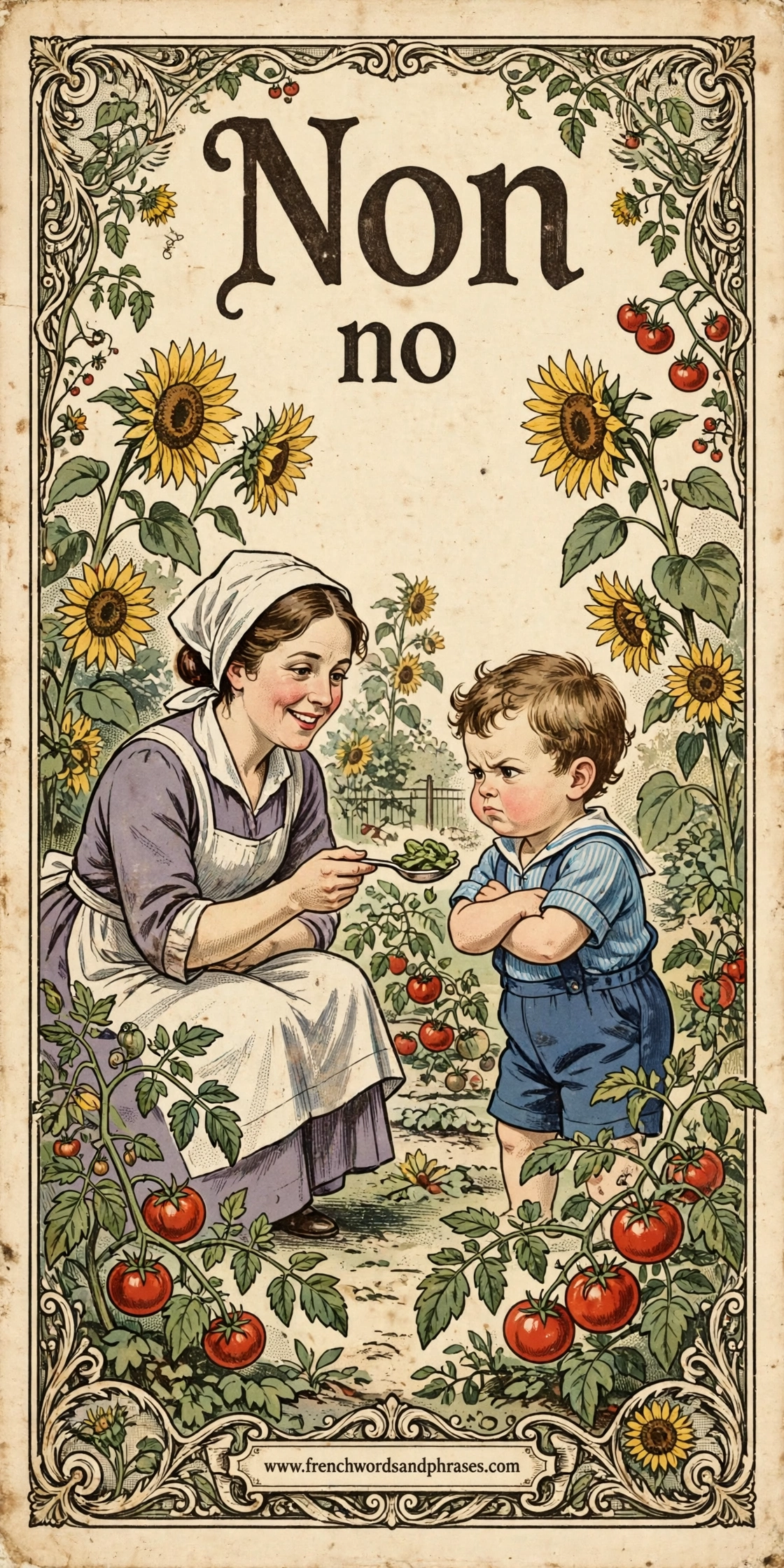
The toddler plants his feet in the middle of the kitchen, folds his arms, and delivers the most complete sentence of his young life: « Non ! » Non is the French no — the word of refusal, of correction, of the answer that closes a question — and, in the mouths of the French, sometimes a whole philosophy of glorious resistance.
Let’s explore how non works in French, beginning with the whole word on one card.
Understanding the French Interjection Non
Non is a French interjection and adverb of negation — the word that answers no. It stands alone as a complete answer, and it also works inside sentences as the plain negative for nouns, adjectives and quantities (non loin, not far; un non-fumeur, a non-smoker). Its twin oui answers yes; where English needs a whole phrase — no, I don’t, not really — non often does the whole job.
It means no. « Tu viens ? — Non. » — Are you coming? — No. It refuses (« Non, merci » — no, thank you), it corrects (« Non, c’est mardi, pas lundi » — no, it’s Tuesday, not Monday), and it protests (« Mais non ! » — oh no, of course not). Tone shapes it entirely: the flat non of fact, the laughing mais non of reassurance, the towering non of the toddler and the general.
Type: Interjection and negation adverb — the answer no
Answers the need: Refusing, correcting, denying, protesting — kindly or firmly
Register: Neutral — safe everywhere; softened by mais, merci, or a smile
Strength: As strong as its tone: from a murmur to a barricade
One important usage detail: French non often travels with company. Mais non ! softens a denial into reassurance — of course not, don’t worry. Non merci refuses politely. And non answers questions about facts, while si is the special yes that contradicts a negative question: « Tu ne viens pas ? — Si, je viens ! » — You’re not coming? — Yes, I am. Non alone could never do si’s job.
Experience the Word
Non is the shortest complete sentence in French — one syllable that can hold a door, end an argument, or start a revolution.
Imagine the village meeting about the new road: the mayor finishes his speech, looks round the hall, and from the back, calmly, an old farmer delivers the verdict of the whole valley in one word — « Non. » Nothing else is needed; nothing else would be stronger.
You have not just answered a question. You have drawn a line — and the line is the meaning.
How to Use Non in French: Complete Guide
Let’s explore how non works in French, beginning with the whole word on one card.
Non at a Glance
The Whole Word on One Card
Meaning, job, register and strength — non in four lines.
| Point | Non |
|---|---|
| Meaning | no — the answer, the refusal, the correction |
| Job | closes questions, refuses offers, corrects facts |
| Register | neutral — everywhere; tone sets the temperature |
| Strength | total: a complete sentence in one syllable |
Example
Tu veux du café ? — Non, merci.
Would you like some coffee? — No, thank you.
Word by Word: Building the Word
One syllable, one nasal vowel — and a family of strengthened forms around it.
| Word | Literal meaning | Its job |
|---|---|---|
| non | no, not | the whole answer, alone |
| mais non | but no | the softener: of course not, don’t worry |
| non merci | no thank you | the polite refusal of an offer |
Example
Mais non, ce n’est pas grave.
Oh no, it’s not serious, don’t worry.
Quick Quiz 1
What does mais non ! usually do to a plain non?
Reveal the answer
It softens it — mais non reassures: of course not, don’t worry.
Mais non, je ne suis pas fâché.
Of course not, I’m not angry.
When You Say It: The Refusal Moments
Non fires wherever life offers, asks, or asserts — and a line must be drawn.
| Situation | Example |
|---|---|
| Answering a question | tu viens ? — Non, je reste. |
| Refusing an offer | encore du gâteau ? — Non, merci. |
| Correcting a fact | non, c’est mardi, pas lundi |
| Reassuring | mais non, ce n’est rien |
| Protesting | non, ce n’est pas juste ! |
Example
Non, ce n’est pas mon sac, c’est le sien.
No, that’s not my bag, it’s his.
Make It Yours: Non in Its Frames
Non stands alone, takes company, and works inside sentences as a building block.
| Form | French | In English |
|---|---|---|
| Alone | non | no |
| Polite refusal | non, merci | no, thank you |
| Reassurance | mais non | of course not, don’t worry |
| Firm | non, vraiment pas | no, really not |
| Inside a phrase | un non-fumeur | a non-smoker |
Example
Non, vraiment pas, je ne peux pas ce soir.
No, really not, I can’t this evening.
Quick Quiz 2
Complete the polite refusal: Encore un peu de soupe ? — ______ , merci, c’était délicieux.
Reveal the answer
Non — with merci riding behind it, the refusal stays warm.
Non, merci, c’était délicieux.
No, thank you, it was delicious.
Everyday Expressions with Non
Non slots into these frames — each one ready to use as it stands.
| Frame | In English |
|---|---|
| non, merci | no, thank you |
| mais non | of course not, don’t worry |
| non, pas encore | no, not yet |
| non loin d’ici | not far from here |
| dire non | to say no |
Example
Il faut savoir dire non, parfois.
You have to know how to say no, sometimes.
Close Cousins: The Other Negative Words
French negates in a family — non is the answer; its cousins work inside sentences.
| Expression | The difference |
|---|---|
| non | no — the standalone answer |
| ne… pas | not — the two-part negation inside sentences: je ne viens pas |
| si | yes — the special yes that contradicts a negative question |
| oui | yes — the plain affirmative twin |
| jamais | never — the strongest of the family |
Example
Tu ne viens pas ? — Si, je viens !
You’re not coming? — Yes, I am coming!
Quick Quiz 3
« Tu n’as pas faim ? » — you ARE hungry. Which word answers — non, oui, or si?
Reveal the answer
Si — si is the yes that contradicts a negative question.
Si, j’ai très faim !
Yes, I’m very hungry!
Non and Its Neighbours
The words around non — yes in its two forms, and the sentence negation.
| French | In English |
|---|---|
| oui | yes |
| si | yes — against a negative question |
| pas | not — the second half of ne… pas |
| jamais | never |
| un refus | a refusal |
Example
Oui, non, si : trois petits mots, trois réponses.
Yes, no, yes-against-no: three little words, three answers.
Watch Out: The Traps Around Non
The traps: the bare non that lands too hard, and non asked to do si’s job.
| Trap | The truth |
|---|---|
| A bare non to an offer | add merci — non, merci refuses without wounding |
| Non against a negative question | to say yes-I-do against « tu ne viens pas ? », the word is si, not oui or non |
| Non for ‘not’ everywhere | inside sentences French uses ne… pas: je ne sais pas, not a bare non |
| The toddler tone | a shouted non is a barricade; among adults, tone and company do the diplomacy |
Example
Je ne sais pas — pas : « je non sais ».
I don’t know — pas: never ‘je non sais’.
Quick Quiz 4
Correct this fact politely: your friend says the museum opens on Monday; it opens on Tuesday.
Reveal the answer
Non, il ouvre mardi
Non corrects as cleanly as it refuses — the fact follows immediately.
Non, il ouvre mardi, pas lundi. — No, it opens on Tuesday, not Monday.
Non in Everyday French: Real-Life Examples
Now that you know the word, let’s see how non appears in everyday French.
Example 1 — An offer refused
Encore du café ? — Non, merci.
More coffee? — No, thank you.
Example 2 — A plain answer
Tu viens demain ? — Non, je travaille.
Are you coming tomorrow? — No, I’m working.
Example 3 — Reassurance
Mais non, ce n’est pas grave.
Oh no, it’s not serious.
Example 4 — A correction
Non, la gare est à gauche, pas à droite.
No, the station is on the left, not the right.
Example 5 — A protest
Non, ce n’est pas juste.
No, that’s not fair.
Example 6 — The si answer
Tu n’aimes pas le fromage ? — Si, je l’adore.
You don’t like cheese? — Yes, I love it.
Beyond Translation: The Meaning of Non
Non is a word with a national monument: in 1940, from London, General de Gaulle’s Appel du 18 juin turned refusal into resistance, and non became, in the French imagination, the word of dignity — the refusal that saves honour. The language keeps the lighter side too: mais non is among the warmest phrases in French, the sound of a friend waving your worry away. Between the barricade and the embrace, non covers the whole emotional register of no, in a single nasal syllable.
Non is the line French draws — around a fact, an offer, a worry, or a country.
Learn it with its twin oui and its secret third sibling si, and you hold the complete French answer kit.
How to Remember the French Interjection Non
Remember it this way: Non is the complete answer no — softened by mais or merci, and never to be confused with si, the yes that fights a negative question.
- You soften it with company — mais non rassure, non merci refuse en douceur.
- You keep si in reserve — question négative, réponse si : si, je viens !
- You negate sentences otherwise — dedans, c’est ne… pas ; non répond, il ne conjugue pas.
The key idea is non = no; mais non = of course not; si = yes, against a negative question.
Test Your Knowledge of Non
Let’s see how much you’ve learned. Try answering these questions before revealing the answers.
Question 1
What does non mean?
Reveal the answer
No — the standalone answer of refusal, correction and denial.
Question 2
How do you refuse an offer politely?
Reveal the answer
Non, merci — no, thank you: the refusal with its courtesy attached.
Question 3
Translate: Of course not, don’t worry.
Reveal the answer
Mais non, ne t’inquiète pas.
Question 4
Complete the exchange:
Tu ne viens pas ? — ______ , je viens !
Reveal the answer
Si
Tu ne viens pas ? — Si, je viens !
You’re not coming? — Yes, I am!
Question 5
How does French say ‘I don’t know’ — with non or with ne… pas?
Reveal the answer
With ne… pas — je ne sais pas; non is the standalone answer, not the sentence negation.
Your Final Challenge
Can You Use It?
How would you say this in French?
“No, thank you, I’m not hungry.”
Reveal the answer
Non, merci, je n’ai pas faim.
No, thank you, I’m not hungry.
A little French. A little curiosity. A richer everyday life.
LEARN FRENCH ONE WORD AT A TIME