
A French Word to Live By
Translate S’il te plaît to English
/sil tə plɛ/
S’il te plaît means please.
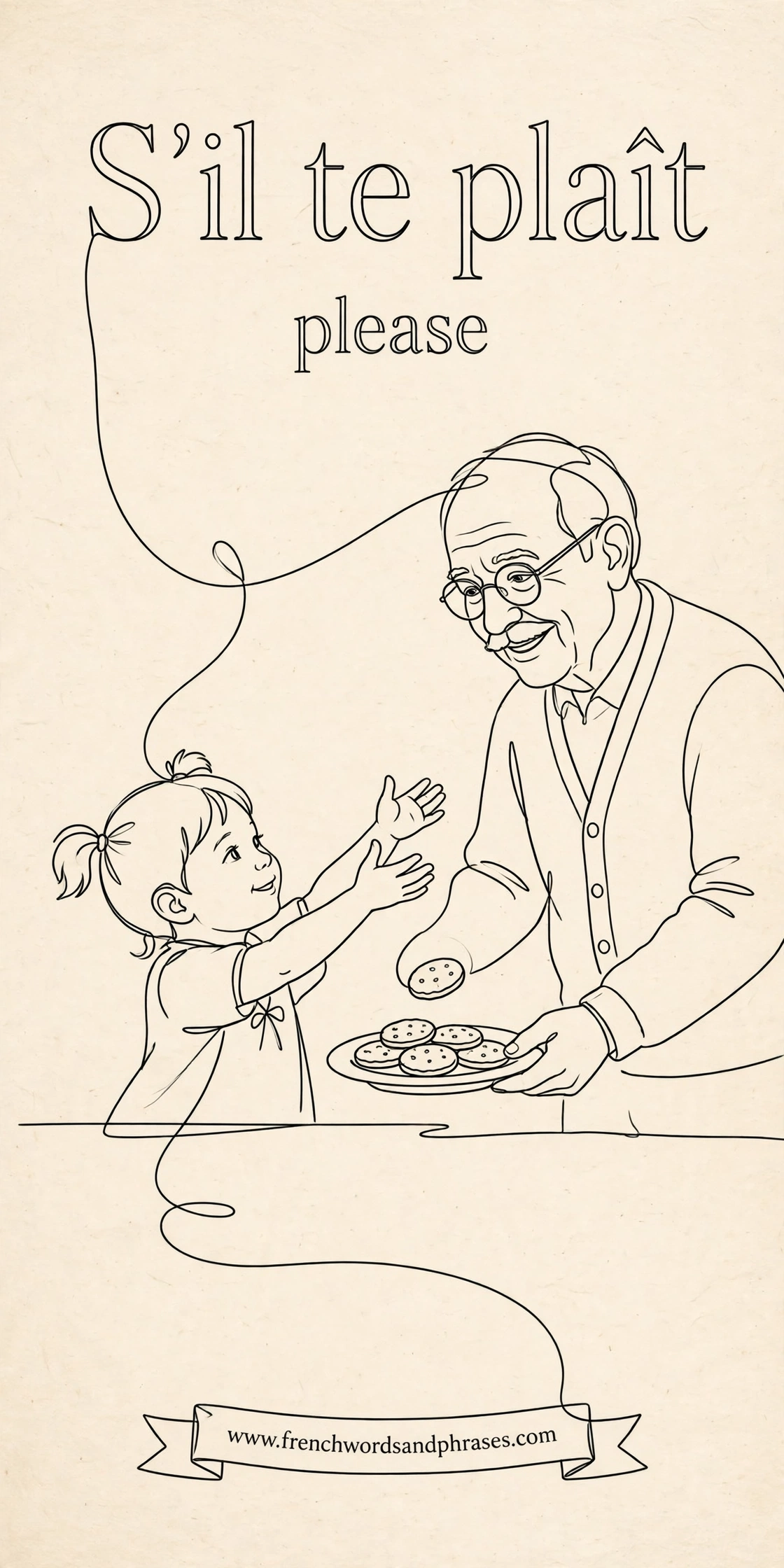
A small hand reaches across the breakfast table, stops, and remembers: « Le beurre, s’il te plaît. » S’il te plaît is the please of the tu world — the magic word French children learn before almost any other, the please said to parents, friends, and everyone you love and call tu.
Let’s explore how s’il te plaît works in French, beginning with the whole phrase on one card.
Understanding the French Phrase S’il te plaît
S’il te plaît is a French set phrase — the familiar form of please — built from s’il (if it) and te plaît (pleases you), from plaire, to please: literally « if it pleases you ». It is the tu-form, for friends, family and children; the vous world, and all polite requests to strangers, use s’il vous plaît. The machinery is a small conditional: the request is made to depend on the other person’s pleasure.
It means please — softening requests, offers and questions inside the tu world. « Passe-moi le sel, s’il te plaît » — pass me the salt, please. « Un café, s’il te plaît » — a coffee, please. It can stand at the start or the end of the request, and children are taught that without it, the request simply does not work: le mot magique, the magic word.
Type: Set phrase — please, in the tu form
Answers the need: Softening requests to friends, family and children
Register: Familiar — the tu world; strangers take s’il vous plaît
Strength: Gentle and essential — the magic word of French childhood
One important usage detail: match the please to the pronoun of the relationship. S’il te plaît to anyone you call tu; s’il vous plaît to everyone else — the waiter, the elder, the official. A request in the tu world without its please sounds like an order; French parents correct it on the spot: « On dit s’il te plaît. » Note the spelling: plaît carries a circumflex on the î, a souvenir of an old lost s (plaire, from Latin placere).
Experience the Word
S’il te plaît is the first key a French child is given — the discovery that words can open hands, doors and biscuit tins, if they are the right words.
Imagine the family kitchen: the little brother points at the jam and orders, « La confiture ! » Nothing moves. His sister whispers the formula, he adds « …s’il te plaît », and the jar crosses the table like a boat launched by a spell.
You have not weakened the request. You have handed the other person the pleasure of granting it.
How to Use S’il te plaît in French: Complete Guide
Let’s explore how s’il te plaît works in French, beginning with the whole phrase on one card.
S’il te plaît at a Glance
The Whole Phrase on One Card
Real meaning, literal picture, English twin and register — s’il te plaît in five lines.
| Point | S’il te plaît |
|---|---|
| What it really means | please — the familiar form, for the tu world |
| Word for word | if it pleases you (s’il + te + plaît, from plaire) |
| English equivalent | please |
| Register | familiar — friends, family, children |
| Use it for | every request inside the tu world |
Example
Passe-moi le pain, s’il te plaît.
Pass me the bread, please.
Word by Word: Building the Phrase
Three pieces — a condition, a person, and a pleasing.
| Word | Literal meaning | Its job in the phrase |
|---|---|---|
| s’il | if it (si + il, joined) | the condition: the request hangs on… |
| te | you (familiar) | the person whose pleasure decides — tu world |
| plaît | pleases (from plaire, to please) | …your pleasure: if it pleases you |
Example
Un verre d’eau, s’il te plaît.
A glass of water, please.
Quick Quiz 1
What is the polite, vous form of s’il te plaît?
Reveal the answer
S’il vous plaît — for strangers, elders and officials.
Un café, s’il vous plaît.
A coffee, please.
When You Say It: The Request Moments
S’il te plaît rides on every familiar request — tables, homes, playgrounds, messages.
| Situation | Example |
|---|---|
| At the family table | le sel, s’il te plaît |
| Asking a friend | tu peux m’aider, s’il te plaît ? |
| Ordering from a parent | un jus d’orange, s’il te plaît, maman |
| In a text | appelle-moi, s’il te plaît |
| A child’s request | je peux sortir, s’il te plaît ? |
Example
Tu peux fermer la fenêtre, s’il te plaît ?
Can you close the window, please?
Make It Yours: S’il te plaît in Its Frames
The please can open or close the request — and it shortens in quick speech.
| Form | French | In English |
|---|---|---|
| At the end | passe-moi le livre, s’il te plaît | pass me the book, please |
| At the start | s’il te plaît, écoute-moi | please, listen to me |
| Shortened in speech | s’te plaît | please — quick, spoken form |
| With a name | maman, s’il te plaît | mum, please |
| The vous twin | s’il vous plaît | please — polite |
Example
S’il te plaît, papa, raconte une histoire.
Please, Dad, tell a story.
Quick Quiz 2
Complete the child’s request: Le beurre, ______ , maman.
Reveal the answer
s’il te plaît — the magic word that makes the request work.
Le beurre, s’il te plaît, maman.
The butter, please, Mum.
Everyday Expressions with S’il te plaît
S’il te plaît slots into these frames — each one ready to use as it stands.
| Frame | In English |
|---|---|
| s’il te plaît | please (familiar) |
| s’il vous plaît | please (polite) |
| s’te plaît | please — the spoken shortcut |
| on dit s’il te plaît | we say please — the parent’s correction |
| le mot magique | the magic word — what children call it |
Example
On dit s’il te plaît, et merci après.
We say please, and thank you afterwards.
Close Cousins: The Other Softening Words
French softens requests in several ways — s’il te plaît is the essential one.
| Expression | The difference |
|---|---|
| s’il te plaît | please — familiar, for tu |
| s’il vous plaît | please — polite, for vous and strangers |
| merci | thank you — the partner word, after the favour |
| excuse-moi | excuse me — before disturbing a friend |
| tu peux… ? | can you…? — the request softened by its shape |
Example
S’il te plaît d’abord, merci ensuite.
Please first, thank you afterwards.
Quick Quiz 3
You are asking the waiter for the bill. Which please — s’il te plaît or s’il vous plaît?
Reveal the answer
S’il vous plaît — the waiter is a stranger, and strangers live in the vous world.
L’addition, s’il vous plaît.
The bill, please.
S’il te plaît and Its Neighbours
The words around the phrase — pleasing, asking, and the magic pair of childhood.
| French | In English |
|---|---|
| plaire | to please (the verb inside plaît) |
| le plaisir | pleasure |
| demander | to ask (for) |
| le mot magique | the magic word — please itself, to a child |
| merci | thank you — the other half of the pair |
Example
Ce cadeau va lui plaire, j’en suis sûr.
This present will please her, I’m sure of it.
Watch Out: The Traps Around S’il te plaît
The traps: the wrong please for the person, and the request with no please at all.
| Trap | The truth |
|---|---|
| S’il te plaît to a stranger | too familiar — the vous world requires s’il vous plaît |
| No please at all | in the tu world a bare request sounds like an order |
| The spelling | plaît keeps its circumflex: î — and te, never tu, inside the phrase |
| Only for children? | no — adults use it all day with everyone they call tu |
Example
S’il te plaît aux proches, s’il vous plaît aux autres.
S’il te plaît to your own people, s’il vous plaît to everyone else.
Quick Quiz 4
Your little brother shouts « La confiture ! » at the table. What is missing?
Reveal the answer
S’il te plaît
The magic word — without it, the request is an order, and the jam does not move.
La confiture, s’il te plaît ! — The jam, please!
S’il te plaît in Everyday French: Real-Life Examples
Now that you know the word, let’s see how s’il te plaît appears in everyday French.
Example 1 — At the table
Passe-moi le pain, s’il te plaît.
Pass me the bread, please.
Example 2 — A child asks
Je peux avoir un biscuit, s’il te plaît ?
Can I have a biscuit, please?
Example 3 — Asking a friend
Tu peux m’aider, s’il te plaît ?
Can you help me, please?
Example 4 — In a message
Rappelle-moi ce soir, s’il te plaît.
Call me back this evening, please.
Example 5 — At home
Ferme la porte, s’il te plaît, il fait froid.
Close the door, please, it’s cold.
Example 6 — The magic word
On dit s’il te plaît, mon petit.
We say please, my little one.
Beyond Translation: The Meaning of S’il te plaît
S’il te plaît is a whole philosophy of asking packed into a condition: if it pleases you. The request is not presented as a right but offered to the other person’s pleasure — the grammar itself performs the courtesy. Its circumflex tells an older story: plaît once had an s (the Latin placere family), and the little hat on the î marks the grave of the vanished letter. And its childhood name, le mot magique, is exact: it is the first proof every French child meets that language, rightly used, moves the world.
S’il te plaît is asking turned into an offering — the request that leaves the other person free.
Learn the pair as one lesson: s’il te plaît at home, s’il vous plaît in the world, merci on the way back.
How to Remember the French Phrase S’il te plaît
Remember it this way: S’il te plaît is please for the tu world — literally if it pleases you — the magic word of every French childhood.
- You hear the condition — s’il te plaît : si cela te fait plaisir, la demande devient une offre.
- You match the person — te pour les proches, vous pour les autres.
- You never drop it — sans s’il te plaît, la demande sonne comme un ordre.
The key idea is s’il te plaît = please (familiar); s’il vous plaît is the polite form.
Test Your Knowledge of S’il te plaît
Let’s see how much you’ve learned. Try answering these questions before revealing the answers.
Question 1
What does s’il te plaît mean?
Reveal the answer
Please — literally, if it pleases you; the familiar form.
Question 2
What is the polite form for strangers?
Reveal the answer
S’il vous plaît — the vous form of the same phrase.
Question 3
Translate: Pass me the salt, please (to your sister).
Reveal the answer
Passe-moi le sel, s’il te plaît.
Question 4
Complete the sentence:
Un café, ______ , maman.
Reveal the answer
s’il te plaît
Un café, s’il te plaît, maman.
A coffee, please, Mum.
Question 5
What do French children call s’il te plaît?
Reveal the answer
Le mot magique — the magic word: the request does not work without it.
Your Final Challenge
Can You Use It?
How would you say this in French?
“Pass me the bread, please, Dad.”
Reveal the answer
Passe-moi le pain, s’il te plaît, papa.
Pass me the bread, please, Dad.
A little French. A little curiosity. A richer everyday life.
LEARN FRENCH ONE WORD AT A TIME




