A French Word to Live By
Translate Bonne journée to English
/bɔn ʒuʁ.ne/
Bonne journée means have a nice day.
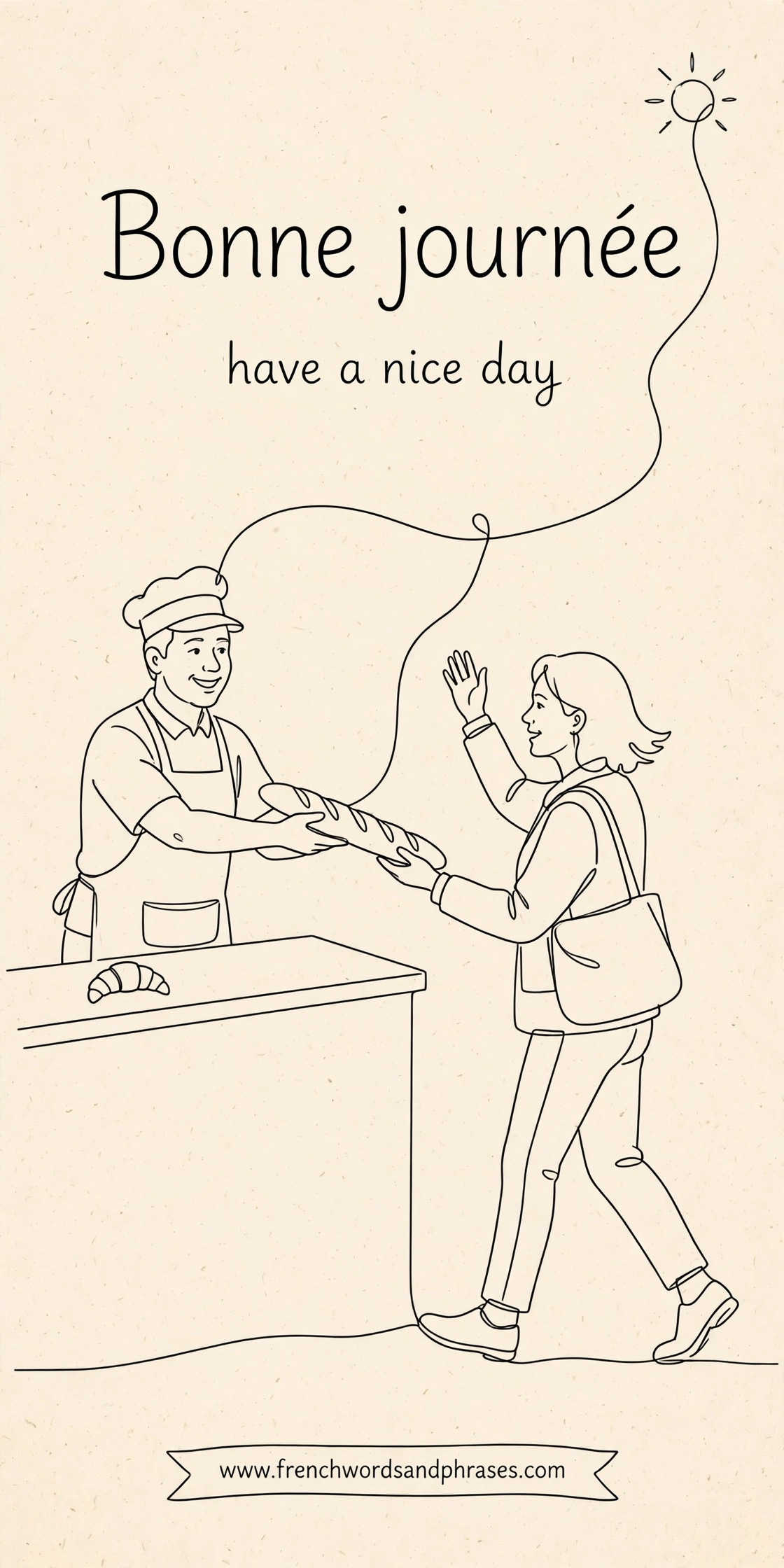
The customer pays for her bread, the baker hands over the change with a smile, and the exchange ends with the wish that travels all over France a million times a day: « Merci, bonne journée ! » Bonne journée is have a good day — the bright farewell of mornings and middays, the wish you hand to people as they walk out into their day.
Let’s explore how bonne journée works in French, beginning with the whole phrase on one card.
Understanding the French Phrase Bonne journée
Bonne journée is a French farewell wish built from bonne (good, feminine) and journée (the day as a stretch of lived time, a feminine noun): literally « good day ». Where bonjour greets the day on arrival, bonne journée blesses it on departure — said when someone leaves in the morning or early afternoon, with the whole day still ahead of them.
It means have a good day, have a nice day. « Au revoir, bonne journée ! » — goodbye, have a good day. It is the exit line of shops, offices, schools and phone calls before evening. Bonne journée is feminine because journée is feminine — and note the subtle French choice: le jour counts the day on the calendar, la journée fills it with hours and life.
Type: Farewell wish — for the day ahead
Answers the need: Sending someone warmly into their day
Register: Neutral and bright — safe with absolutely everyone
Strength: Warm and light — the standard music of every shop door
One important usage detail: bonne journée belongs to departures before the evening. Said in the morning it covers the whole day; said at two in the afternoon it shades into bon après-midi; by evening it must retire in favour of bonne soirée. And like all the bonne- wishes, it is never a greeting: you arrive with bonjour, you leave with bonne journée.
Experience the Word
Bonne journée is a coin of sunshine slipped into a stranger’s pocket at the door — it costs nothing and it spends all day.
Imagine the Paris métro at eight in the morning: the kiosk keeper calls « Bonne journée ! » after every customer, and a hundred days start a fraction brighter, one wish at a time.
You have not said goodbye exactly. You have sent the other person’s day off with a blessing on it.
How to Use Bonne journée in French: Complete Guide
Let’s explore how bonne journée works in French, beginning with the whole phrase on one card.
Bonne journée at a Glance
The Whole Phrase on One Card
Real meaning, literal picture, English twin and register — bonne journée in five lines.
| Point | Bonne journée |
|---|---|
| What it really means | have a good day — a parting wish for the hours ahead |
| Word for word | good day (bonne + journée, the lived day) |
| English equivalent | have a good day; have a nice day |
| Register | neutral, bright — everyone, at daytime departures |
| Use it for | leaving shops, offices, calls — until the evening begins |
Example
Merci, au revoir, bonne journée.
Thank you, goodbye, have a good day.
Word by Word: Building the Phrase
Two pieces — the wish, and the day measured as lived time.
| Word | Literal meaning | Its job in the phrase |
|---|---|---|
| bonne | good (feminine) | the wish: may it be good — feminine for journée |
| journée | the day as a stretch of hours | the span: the whole lived day ahead |
| bonne journée | good day | the daytime farewell wish in two words |
Example
Bonne journée, et bon courage pour le travail.
Have a good day, and good luck with the work.
Quick Quiz 1
What is the difference between le jour and la journée?
Reveal the answer
Le jour counts the calendar day; la journée is the day as lived time — its hours, its work, its weather.
Bonne journée !
Have a good day!
When You Say It: The Parting Moments
Bonne journée fires at daytime exits — tills, doors, the ends of morning calls.
| Situation | Example |
|---|---|
| Leaving a shop in the morning | merci, bonne journée ! |
| A colleague leaving at noon | bon appétit, et bonne journée |
| Ending a morning call | parfait, merci, bonne journée |
| Children leaving for school | bonne journée, les enfants, travaillez bien |
| A guest leaving after breakfast | bonne journée, et bon retour |
Example
Bonne journée, madame, à demain.
Have a good day, madam, see you tomorrow.
Make It Yours: Bonne journée in Its Frames
The wish pairs with thanks, goodbyes and the people you send it to.
| Form | French | In English |
|---|---|---|
| Simple | bonne journée | have a good day |
| With thanks | merci, bonne journée | thank you, have a good day |
| To a group | bonne journée à tous | have a good day, everyone |
| With au revoir | au revoir, bonne journée | goodbye, have a good day |
| Very warm | très bonne journée | have a very good day |
Example
Bonne journée à tous, et à ce soir.
Have a good day everyone, and see you this evening.
Quick Quiz 2
Complete it: Merci, au revoir, ______ ! (said at ten in the morning)
Reveal the answer
bonne journée — the daytime farewell wish.
Merci, au revoir, bonne journée !
Thank you, goodbye, have a good day!
Everyday Expressions with Bonne journée
Bonne journée slots into these frames — each one ready to use as it stands.
| Frame | In English |
|---|---|
| souhaiter une bonne journée à quelqu’un | to wish someone a good day |
| passer une bonne journée | to have (spend) a good day |
| une journée bien remplie | a full, busy day |
| toute la journée | all day long |
| en pleine journée | in broad daylight, in the middle of the day |
Example
Nous avons passé une bonne journée à la mer.
We had a good day at the seaside.
Close Cousins: The Other Day-Part Wishes
The wishes pass the day between them like a relay baton.
| Expression | The difference |
|---|---|
| bonne journée | have a good day — morning to early afternoon |
| bon après-midi | have a good afternoon — after lunch until evening |
| bonne soirée | have a good evening — the evening’s wish |
| bonne nuit | good night — bedtime only |
| bonjour | hello — the arrival greeting, not a wish |
Example
Le matin on souhaite bonne journée, le soir bonne soirée.
In the morning you wish bonne journée, in the evening bonne soirée.
Quick Quiz 3
It is eight in the evening and a guest is leaving. Which wish — bonne journée or bonne soirée?
Reveal the answer
Bonne soirée — the day-wish retires when the evening begins.
Bonne soirée, à bientôt !
Have a good evening, see you soon!
Bonne journée and Its Neighbours
The words around the phrase — the day in its two genders, and its hours.
| French | In English |
|---|---|
| le jour | the day — the calendar unit |
| la journée | the day as lived time |
| aujourd’hui | today |
| le matin | the morning |
| quotidien | daily, everyday |
Example
Aujourd’hui, la journée sera longue.
Today, the day will be a long one.
Watch Out: The Traps Around Bonne journée
The traps: the wish used as a hello, and the hello’s twin used as the wish.
| Trap | The truth |
|---|---|
| Bonne journée as hello | never a greeting — arrivals take bonjour |
| Bonjour as farewell | bonjour can close a shop visit, but the warm exit wish is bonne journée |
| Bon journée | wrong gender: journée is feminine, so bonne journée |
| In the evening | after about six, bonne journée must give way to bonne soirée |
Example
On entre avec bonjour, on sort avec bonne journée.
You come in with bonjour, you go out with bonne journée.
Quick Quiz 4
A customer is leaving your shop at eleven in the morning. Give the full warm exit.
Reveal the answer
Merci, au revoir, bonne journée !
Thanks, goodbye, and the wish for the day — the complete shop-door ceremony.
Merci, au revoir, bonne journée ! — Thank you, goodbye, have a good day!
Bonne journée in Everyday French: Real-Life Examples
Now that you know the word, let’s see how bonne journée appears in everyday French.
Example 1 — At the bakery
Merci, bonne journée, au revoir.
Thank you, have a good day, goodbye.
Example 2 — Leaving for work
Bonne journée, chéri, à ce soir.
Have a good day, darling, see you this evening.
Example 3 — At school
Bonne journée, maîtresse, à demain.
Have a good day, teacher, see you tomorrow.
Example 4 — Ending a call
Merci pour votre aide, bonne journée.
Thank you for your help, have a good day.
Example 5 — A colleague at noon
Bon appétit, et bonne journée.
Enjoy your lunch, and have a good day.
Example 6 — At the market
Voilà votre monnaie, bonne journée, madame.
Here’s your change, have a good day, madam.
Beyond Translation: The Meaning of Bonne journée
French owns two words where English has one: le jour, the day as a date, a unit, a number on the calendar — trois jours, three days — and la journée, the day as a vessel: what fills it, work, weather, walking, light. The wishes choose the vessel every time: bonne journée, bonne soirée, because a wish is about lived hours, not about dates. It is a tiny grammar lesson hidden in a courtesy: you cannot bless a number, but you can bless a day someone is about to live.
Bonne journée is France blessing the hours, not the date.
Learn it in the relay of wishes — bonne journée, bon après-midi, bonne soirée, bonne nuit — and you can send anyone off at any hour of the French day.
How to Remember the French Phrase Bonne journée
Remember it this way: Bonne journée is the have-a-good-day wish — said when leaving, in the daytime, with bonne feminine for la journée, the lived day.
- You say it at the door — bonne journée en partant, bonjour en arrivant.
- You bless the lived day — la journée, les heures, pas le jour du calendrier.
- You stop at evening — après le jour, c’est bonne soirée qui prend le relais.
The key idea is bonne journée = have a good day (a parting wish); bonne + journée, the lived day.
Test Your Knowledge of Bonne journée
Let’s see how much you’ve learned. Try answering these questions before revealing the answers.
Question 1
What does bonne journée mean?
Reveal the answer
Have a good day — the parting wish for the day ahead.
Question 2
Is bonne journée a greeting or a farewell?
Reveal the answer
A farewell wish — said when leaving; the greeting on arrival is bonjour.
Question 3
Translate: Thank you, goodbye, have a good day.
Reveal the answer
Merci, au revoir, bonne journée.
Question 4
Complete the sentence:
______ , les enfants, travaillez bien à l’école.
Reveal the answer
Bonne journée
Bonne journée, les enfants, travaillez bien à l’école.
Have a good day, children, work hard at school.
Question 5
Which wish replaces bonne journée in the evening?
Reveal the answer
Bonne soirée — have a good evening, once the evening has begun.
Your Final Challenge
Can You Use It?
How would you say this in French?
“Have a good day, children, and work hard at school.”
Reveal the answer
Bonne journée, les enfants, et travaillez bien à l’école.
Have a good day, children, and work hard at school.
A little French. A little curiosity. A richer everyday life.
LEARN FRENCH ONE WORD AT A TIME