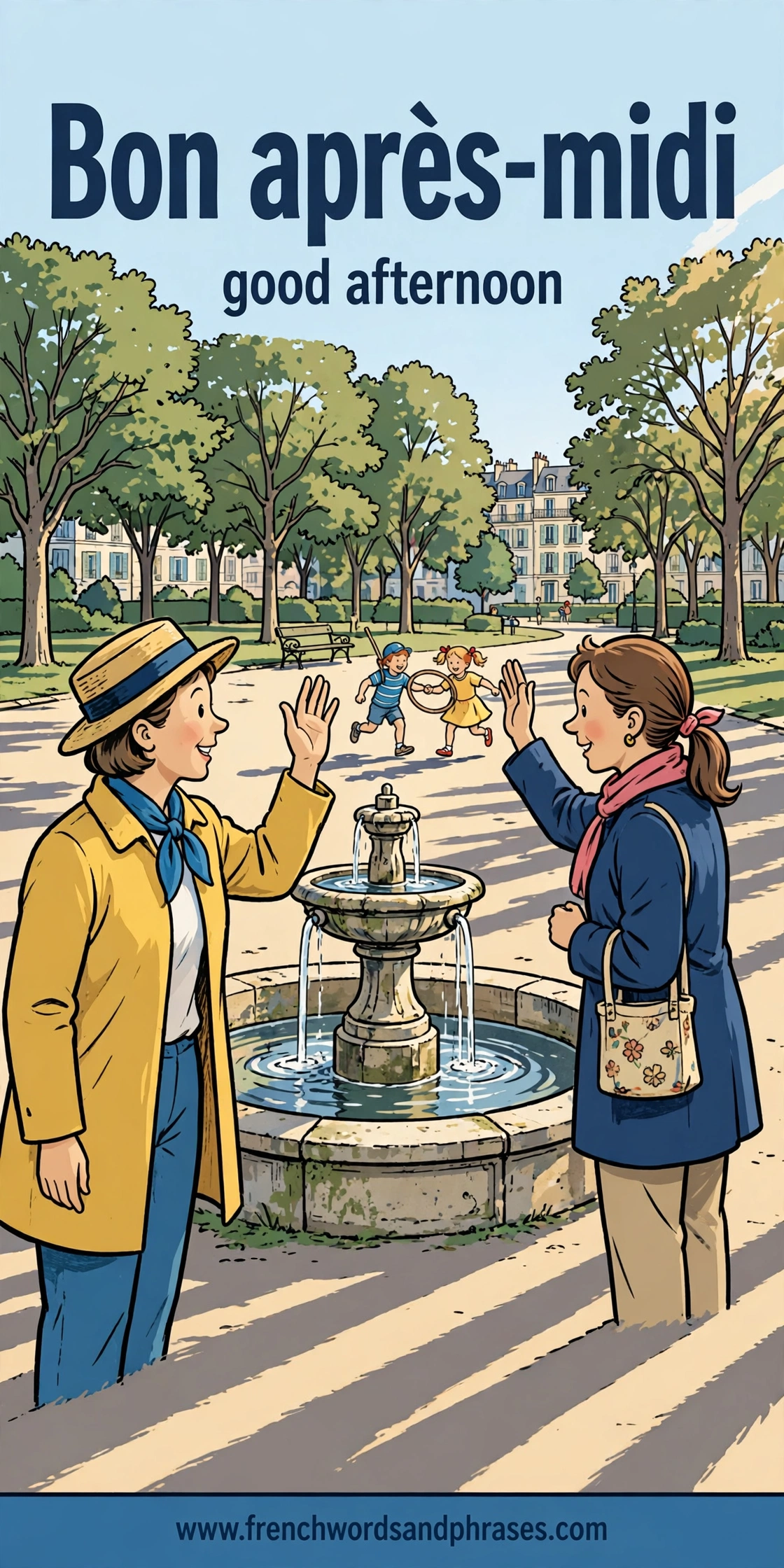
A French Word to Live By
Translate Bon après-midi to English
/bɔ̃ a.pʁɛ.mi.di/
Bon après-midi means good afternoon.
Lunch is over, the café terrace is full, and a friend stands up, gathers her bag and smiles at the table: « Bon après-midi à tous ! » Bon après-midi is the wish for the second half of the day — have a good afternoon — said not on arrival, like bonjour, but as a warm send-off into the hours after lunch.
Let’s explore how bon après-midi works in French, beginning with the whole phrase on one card.
Understanding the French Phrase Bon après-midi
Bon après-midi is a French farewell wish built from bon (good) and après-midi (afternoon — literally « after-noon »). Unlike bonjour, it is not the standard arrival greeting of the afternoon: French arrives with bonjour all day long, and bon après-midi is the wish you give someone as they leave into the afternoon, or at the end of a morning meeting that spills past lunch.
It means have a good afternoon — a wish, not a hello. « Merci pour le déjeuner, bon après-midi ! » — thank you for lunch, have a good afternoon. Said at the end of a call or a visit in the early afternoon, it blesses the hours until evening. Using it as an opening greeting is a learner’s calque of English; a French ear hears it as a goodbye.
Type: Farewell wish — for the afternoon hours
Answers the need: Sending someone warmly into the second half of the day
Register: Neutral and warm — safe with everyone
Strength: Gentle and bright — a wish, never a greeting on arrival
One important usage detail: après-midi is invariable and of debated gender — un bel après-midi or une belle après-midi are both heard and both accepted; the phrase itself never changes: bon après-midi for everyone, at every departure after lunch. Pair it with merci or au revoir: « Au revoir, bon après-midi ! »
Experience the Word
Bon après-midi is a packed lunch of sunshine handed to someone at the door — take this, the hours until evening are yours.
Imagine the office emptying for a long summer lunch: shutters half-closed against the heat, and the last colleague at the door calls back « Bon après-midi ! » — the siesta hours begin with the wish.
You have not greeted anyone. You have blessed the rest of their day.
How to Use Bon après-midi in French: Complete Guide
Let’s explore how bon après-midi works in French, beginning with the whole phrase on one card.
Bon après-midi at a Glance
The Whole Phrase on One Card
Real meaning, literal picture, English twin and register — bon après-midi in five lines.
| Point | Bon après-midi |
|---|---|
| What it really means | have a good afternoon — a parting wish |
| Word for word | good after-noon (bon + après-midi) |
| English equivalent | have a good afternoon |
| Register | neutral, warm — everyone, at afternoon departures |
| Use it for | leaving after lunch, ending afternoon calls and visits |
Example
Merci pour le café, bon après-midi, à demain.
Thank you for the coffee, have a good afternoon, see you tomorrow.
Word by Word: Building the Phrase
Two pieces — the wish, and the half-day it covers.
| Word | Literal meaning | Its job in the phrase |
|---|---|---|
| bon | good | the wish: may it be good |
| après | after | the hinge: after the middle of the day |
| midi | noon, midday | the landmark the afternoon follows |
Example
Bon après-midi, profitez du soleil.
Have a good afternoon, enjoy the sun.
Quick Quiz 1
What does après-midi literally say?
Reveal the answer
After-noon — après, after, plus midi, noon.
Bon après-midi !
Have a good afternoon!
When You Say It: The Parting Moments
Bon après-midi fires at afternoon exits — after lunch, at the end of visits and calls.
| Situation | Example |
|---|---|
| After lunch with a friend | merci pour le déjeuner, bon après-midi ! |
| Leaving the office early | je pars, bon après-midi à tous |
| Ending a call at two | parfait, merci, bon après-midi |
| Leaving a shop after lunch | au revoir, bon après-midi |
| Sending children out to play | bon après-midi, les enfants, soyez sages |
Example
Au revoir, bon après-midi, et à ce soir.
Goodbye, have a good afternoon, and see you this evening.
Make It Yours: Bon après-midi in Its Frames
The wish pairs with thanks, goodbyes and names of the hours that follow.
| Form | French | In English |
|---|---|---|
| With thanks | merci, bon après-midi | thank you, have a good afternoon |
| With au revoir | au revoir, bon après-midi | goodbye, have a good afternoon |
| To a group | bon après-midi à tous | have a good afternoon, everyone |
| With a plan | bon après-midi, et bon travail | have a good afternoon, and good work |
| Very warm | très bon après-midi | have a very good afternoon |
Example
Bon après-midi à tous, on se retrouve à cinq heures.
Have a good afternoon everyone, we’ll meet again at five.
Quick Quiz 2
Complete it: Merci pour le déjeuner, ______ , à demain !
Reveal the answer
bon après-midi — the wish that sends a friend into the afternoon.
Merci pour le déjeuner, bon après-midi, à demain !
Thank you for lunch, have a good afternoon, see you tomorrow!
Everyday Expressions with Bon après-midi
Bon après-midi slots into these frames — each one ready to use as it stands.
| Frame | In English |
|---|---|
| souhaiter un bon après-midi | to wish someone a good afternoon |
| bon après-midi à tous | have a good afternoon, everyone |
| passer un bon après-midi | to have (spend) a good afternoon |
| un bel après-midi | a beautiful afternoon |
| cet après-midi | this afternoon |
Example
Nous avons passé un bon après-midi au parc.
We spent a good afternoon in the park.
Close Cousins: The Other Day-Part Wishes
French wishes each stretch of the day well as you leave it — here is the full set.
| Expression | The difference |
|---|---|
| bonne journée | have a good day — the morning’s parting wish, covers the whole day |
| bon après-midi | have a good afternoon — from lunch until evening |
| bonne soirée | have a good evening — the evening’s parting wish |
| bonne nuit | good night — the bedtime wish |
| bonjour | hello — the arrival greeting bon après-midi is often confused with |
Example
Le matin, bonne journée ; après le déjeuner, bon après-midi.
In the morning, bonne journée; after lunch, bon après-midi.
Quick Quiz 3
A colleague leaves at two in the afternoon. Which wish fits — bonne journée or bon après-midi?
Reveal the answer
Bon après-midi — the day is half gone; the wish now covers the afternoon.
Bon après-midi, à demain !
Have a good afternoon, see you tomorrow!
Bon après-midi and Its Neighbours
The words around the phrase — noon, the afternoon, and the day’s landmarks.
| French | In English |
|---|---|
| midi | noon, midday |
| l’après-midi | the afternoon |
| le déjeuner | lunch — the meal that opens the afternoon |
| la sieste | the nap — the afternoon’s quiet hour |
| cet après-midi | this afternoon |
Example
On se voit cet après-midi à trois heures.
We’ll see each other this afternoon at three.
Watch Out: The Traps Around Bon après-midi
The traps: the greeting that is really a goodbye, and the gender nobody can settle.
| Trap | The truth |
|---|---|
| Using it as hello | bon après-midi is a parting wish; arrivals all day take bonjour |
| The gender of après-midi | un bel or une belle après-midi — both are accepted; the phrase bon après-midi never changes |
| Confusing midi | midi is noon (and also the south of France); après-midi is the afternoon |
| Too early | before lunch, the wish is bonne journée, not bon après-midi |
Example
On arrive avec bonjour, on part avec bon après-midi.
You arrive with bonjour, you leave with bon après-midi.
Quick Quiz 4
You walk INTO a café at three in the afternoon. What do you say?
Reveal the answer
Bonjour
Bon après-midi is for leaving; the arrival greeting, all day long, is bonjour.
Bonjour, un thé, s’il vous plaît. — Hello, a tea, please.
Bon après-midi in Everyday French: Real-Life Examples
Now that you know the word, let’s see how bon après-midi appears in everyday French.
Example 1 — After lunch
Merci pour le déjeuner, bon après-midi.
Thank you for lunch, have a good afternoon.
Example 2 — Leaving work early
Je pars à deux heures, bon après-midi à tous.
I’m leaving at two, have a good afternoon everyone.
Example 3 — Ending a call
Parfait, merci pour tout, bon après-midi.
Perfect, thank you for everything, have a good afternoon.
Example 4 — At the school gate
Bon après-midi, les enfants, à demain.
Have a good afternoon, children, see you tomorrow.
Example 5 — Leaving a shop
Au revoir, bon après-midi, merci.
Goodbye, have a good afternoon, thank you.
Example 6 — A sunny send-off
Bon après-midi, profitez bien du soleil.
Have a good afternoon, make the most of the sun.
Beyond Translation: The Meaning of Bon après-midi
Après-midi is one of French’s honest compounds: the day measured from its middle, après midi, after noon. English built the same word — afternoon — and then made it a greeting; French kept bonjour on duty for arrivals and gave the afternoon its own blessing at the door instead. The phrase also carries a small grammatical mystery: après-midi is one of the rare French nouns whose gender speakers happily dispute, un après-midi or une après-midi, with the Academy tolerating both.
Bon après-midi is the day’s second blessing — the wish that covers the golden hours.
Learn the whole relay of wishes: bonne journée hands over to bon après-midi, bon après-midi to bonne soirée, and bonne soirée to bonne nuit.
How to Remember the French Phrase Bon après-midi
Remember it this way: Bon après-midi is the parting wish for the hours after lunch — never the hello; arrivals take bonjour all day.
- You say it leaving — bon après-midi au départ, bonjour à l’arrivée.
- You hear its clock — après midi: the wish starts after noon, pas avant.
- You never change it — bon après-midi pour tous, toujours pareil.
The key idea is bon après-midi = have a good afternoon (a parting wish); bon + après-midi, after-noon.
Test Your Knowledge of Bon après-midi
Let’s see how much you’ve learned. Try answering these questions before revealing the answers.
Question 1
What does bon après-midi mean?
Reveal the answer
Have a good afternoon — a wish said when someone leaves into the afternoon.
Question 2
Is bon après-midi a greeting on arrival?
Reveal the answer
No — arrivals take bonjour all day; bon après-midi is a farewell wish.
Question 3
Translate: Thank you for lunch, have a good afternoon.
Reveal the answer
Merci pour le déjeuner, bon après-midi.
Question 4
Complete the sentence:
Au revoir, ______ , et à ce soir.
Reveal the answer
bon après-midi
Au revoir, bon après-midi, et à ce soir.
Goodbye, have a good afternoon, and see you this evening.
Question 5
What does après-midi literally mean?
Reveal the answer
After-noon — après (after) + midi (noon).
Your Final Challenge
Can You Use It?
How would you say this in French?
“Thank you for lunch, have a good afternoon, see you tomorrow.”
Reveal the answer
Merci pour le déjeuner, bon après-midi, à demain.
Thank you for lunch, have a good afternoon, see you tomorrow.
A little French. A little curiosity. A richer everyday life.
LEARN FRENCH ONE WORD AT A TIME