A French Word to Live By
Translate Pluriel to English
/ply.ʁjɛl/
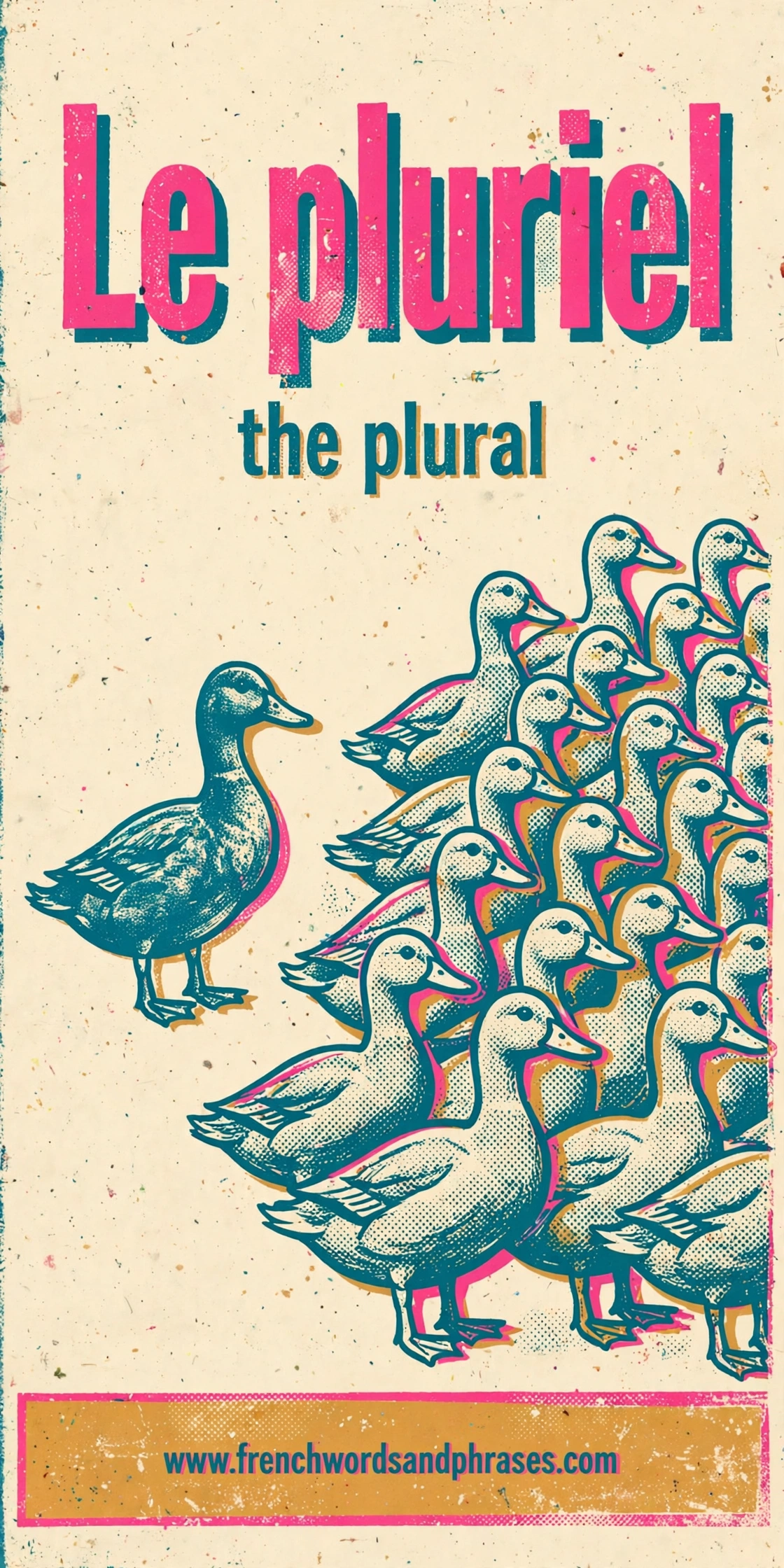
Le pluriel means the plural.
One chair, two chairs; un œil, les yeux; the class chanting the endings together: le pluriel, the plural — grammar’s word for more-than-one, the form every French noun, adjective and verb must learn to wear.
In this guide, you’ll learn what pluriel means in English, how to use it with its articles, how to form its plural, and how it appears in everyday French. Explore French examples, English translations, and practice quizzes.
Understanding the French Noun Pluriel
Pluriel is a masculine French noun, learned with its article: le pluriel, au pluriel. It comes from the Latin pluralis, relating to many, from plus, more. It is also an adjective — un nom pluriel — but its home is the grammar lesson, standing opposite its eternal partner, le singulier, the singular.
It means the plural — the form of a word that speaks of two or more: le pluriel de chaise est chaises, the plural of chaise is chaises, mettre au pluriel, to put into the plural, un accord au pluriel, agreement in the plural. French plurals are mostly written, not heard: the -s of les chats is silent, and the ear relies on the article — le, la become les. The famous rebels are learned by heart: les yeux for les œils that never existed, les chevaux, les travaux, and the -x plurals of les bijoux, les genoux, les hiboux.
Gender: Masculine — le pluriel
Definite article: le — le pluriel (the plural)
Indefinite article: un — un pluriel (a plural, one plural form)
Plural: les pluriels — the word itself takes a regular -s
Spelling note: from Latin plus, more — the plural is the ‘more’ form
The partner: le singulier — the singular, one; le pluriel, more than one
English equivalents: The plural.
The classroom phrases are fixed: au pluriel, in the plural, mettre ce mot au pluriel, put this word in the plural, quel est le pluriel de… ? Agreement is the plural’s daily work: l’adjectif s’accorde au pluriel, the adjective agrees in the plural. Watch the article do the talking — in speech, le chat and les chats differ only in the article’s sound, which is why French children learn to listen for les.
Experience the Word
Pluriel is grammar’s crowd scene: the moment one becomes many, and every word in the sentence — article, noun, adjective, verb — must change its clothes together.
Imagine the dictée in a village school, thirty pens pausing at the same word while the teacher asks, à voix haute: « Et au pluriel, ça s’écrit comment ? » — and thirty -s fall silently onto the page.
You have not just named a form. You have named multiplicity itself — le pluriel, the plural, the grammar of more.
How to Use Pluriel in French: Complete Guide
Let’s explore how pluriel works in French, beginning with its articles — le pluriel, au pluriel, mettre au pluriel.
Pluriel with the Definite Article (Le, Les)
Used for the plural as a thing itself — the form, the rule, the lesson.
| Form | French |
|---|---|
| Masculine singular | le pluriel |
| Plural | les pluriels |
Example
Le pluriel des noms en -al fait souvent -aux.
The plural of nouns in -al often becomes -aux.
Pluriel with the Indefinite Article (Un, Des)
Used for one plural form among others — a regular plural, an irregular plural.
| Form | French |
|---|---|
| Masculine singular | un pluriel |
| Plural | des pluriels |
Example
Œil a un pluriel très irrégulier : yeux.
Œil has a very irregular plural: yeux.
Pluriel in Its Classroom Phrases (Au pluriel, Mettre au…)
Pluriel lives in the grammar lesson’s fixed phrases — put it in the plural, agree in the plural.
| Expression | French |
|---|---|
| in the plural | au pluriel |
| to put into the plural | mettre au pluriel |
| the plural of chaise | le pluriel de chaise |
| agreement in the plural | l’accord au pluriel |
| the singular (the partner) | le singulier |
Example
Mettez la phrase au pluriel, s’il vous plaît.
Put the sentence into the plural, please.
Quick Quiz 1
Complete the sentence:
______ pluriel de « cheval » est « chevaux » . (the)
Reveal the answer
Le
Le pluriel de « cheval » est « chevaux ».
The plural of cheval is chevaux — pluriel is masculine, so le.
The Plural of Pluriel
Pluriel practises what it teaches — a regular plural in -s: les pluriels.
| Number | French |
|---|---|
| Singular | le pluriel |
| Plural | les pluriels |
Example
Certains pluriels français sont célèbres : yeux, chevaux, travaux.
Some French plurals are famous: yeux, chevaux, travaux.
Pluriel with Possessive Adjectives (Mon, Ton, Son…)
Possessives agree with the noun: pluriel is masculine, so mon, ton, son in the singular.
| Owner | French |
|---|---|
| my | mon pluriel |
| your (tu) | ton pluriel |
| his / her | son pluriel |
| our | notre pluriel |
| your (vous) | votre pluriel |
| their | leur pluriel |
Example
Chaque élève écrit son pluriel au tableau.
Each pupil writes his plural on the board.
Quick Quiz 2
Complete the sentence:
Vérifie ______ pluriel dans le dictionnaire. (your)
Reveal the answer
ton
Vérifie ton pluriel dans le dictionnaire.
Check your plural in the dictionary — ton, because pluriel is masculine.
Pluriel with Demonstrative Adjectives (Ce, Ces)
Used to point: ce pluriel, this plural — this ending, this exception.
| Form | French |
|---|---|
| Masculine singular | ce pluriel |
| Plural | ces pluriels |
Example
Ce pluriel en -aux surprend tous les élèves.
This plural in -aux surprises all the pupils.
Pluriel with Adjectives
Adjectives agree with pluriel — masculine singular: un pluriel régulier, un pluriel irrégulier.
| Adjective | With Pluriel |
|---|---|
| régulier (regular) | un pluriel régulier |
| irrégulier (irregular) | un pluriel irrégulier |
| simple (simple) | un pluriel simple |
| rare (rare) | un pluriel rare |
| correct (correct) | le pluriel correct |
Example
« Travaux » est un pluriel irrégulier de « travail ».
Travaux is an irregular plural of travail.
Quick Quiz 3
Complete the sentence:
C’est un pluriel ______, il ajoute simplement un -s. (regular)
Reveal the answer
régulier
C’est un pluriel régulier, il ajoute simplement un -s.
It is a regular plural, it simply adds an -s — régulier, masculine, to agree with pluriel.
Famous French Plurals (Yeux, Chevaux, Bijoux…)
The plurals every learner meets — the rebels and the -x family, learned by heart.
| Singular | Plural |
|---|---|
| un œil (an eye) | les yeux |
| un cheval (a horse) | les chevaux |
| un travail (a work) | les travaux |
| un bijou (a jewel) | les bijoux |
| un genou (a knee) | les genoux |
Example
Les enfants retiennent : bijou, caillou, chou, genou, hibou, joujou, pou.
The children memorise: bijou, caillou, chou, genou, hibou, joujou, pou — the -x plurals.
Words from the Same Family as Pluriel
Grammar’s counting words — the words that travel with pluriel.
| French | In English |
|---|---|
| le singulier | the singular — the partner word |
| pluriel (adjective) | plural — un nom au pluriel |
| l’accord | agreement (of adjective and noun) |
| la terminaison | the ending of a word |
| le nombre | number — singular or plural in grammar |
Example
En grammaire, le nombre oppose le singulier et le pluriel.
In grammar, number sets the singular against the plural.
Quick Quiz 4
What is the plural of œil?
Reveal the answer
Yeux — the most famous irregular plural in French.
Elle a les yeux bleus.
She has blue eyes.
Pluriel in Everyday French: Real-Life Examples
Now that you know the word, let’s see how pluriel appears in everyday French.
Example 1 — In class
Mettez ces mots au pluriel.
Put these words into the plural.
Example 2 — The question
Quel est le pluriel de « journal » ?
What is the plural of journal?
Example 3 — Agreement
L’adjectif s’accorde au pluriel.
The adjective agrees in the plural.
Example 4 — Listening
Au pluriel, on entend surtout l’article : les.
In the plural, you mainly hear the article: les.
Example 5 — The exception
« Yeux » est un pluriel à apprendre par cœur.
Yeux is a plural to learn by heart.
Example 6 — Dictation
Attention, ce mot prend un -x au pluriel.
Careful, this word takes an -x in the plural.
Beyond Translation: The Meaning of Pluriel
The French plural is a written conspiracy: the -s that marks it is almost never pronounced, so the plural lives in the article — le becomes les — and in the liaison that suddenly sounds the sleeping consonant: les‿enfants, les‿yeux. The exceptions are national treasures, rhymed in schoolyards: bijou, caillou, chou, genou, hibou, joujou, pou — the seven nouns that take -x. Every French child has stumbled on yeux, and every learner joins a nine-hundred-year-old club by stumbling too.
To say pluriel is to count in French — silently, in writing, together.
It evokes the dictée, the raised hand, and the small triumph of writing chevaux without hesitating.
How to Remember the French Noun Pluriel
Remember it this way: Pluriel is the plural — masculine: le pluriel, au pluriel, the partner of le singulier.
- Always masculine — le pluriel, au pluriel, mon pluriel.
- The classroom phrase — mettre au pluriel, to put into the plural.
- The famous rebels — les yeux, les chevaux, les travaux, and the -x family: bijoux, genoux, hiboux.
The key idea is le pluriel — the plural, masculine; opposite le singulier.
Test Your Knowledge of Pluriel
Let’s see how much you’ve learned. Try answering these questions before revealing the answers.
Question 1
Is pluriel masculine or feminine?
Reveal the answer
Masculine — le pluriel, au pluriel.
Question 2
How do you say to put a word into the plural?
Reveal the answer
Mettre un mot au pluriel.
Question 3
Translate: What is the plural of journal?
Reveal the answer
Quel est le pluriel de « journal » ? — journaux.
Question 4
How is the French plural usually heard in speech?
Reveal the answer
In the article — the written -s is silent; le/la become les, and liaisons sound the rest.
Question 5
Complete the sentence:
______ pluriels en -x sont sept : bijou, caillou, chou… (the)
Reveal the answer
Les
Les pluriels en -x sont sept : bijou, caillou, chou…
The plurals in -x are seven: bijou, caillou, chou…
Your Final Challenge
Can You Use It?
How would you say this in French?
“Put this sentence into the plural, please.”
Reveal the answer
Mettez cette phrase au pluriel, s’il vous plaît.
Put this sentence into the plural, please.
A little French. A little curiosity. A richer everyday life.
LEARN FRENCH ONE WORD AT A TIME