
A French Word to Live By
How to Conjugate Préparer in French
/pʁe.pa.ʁe/
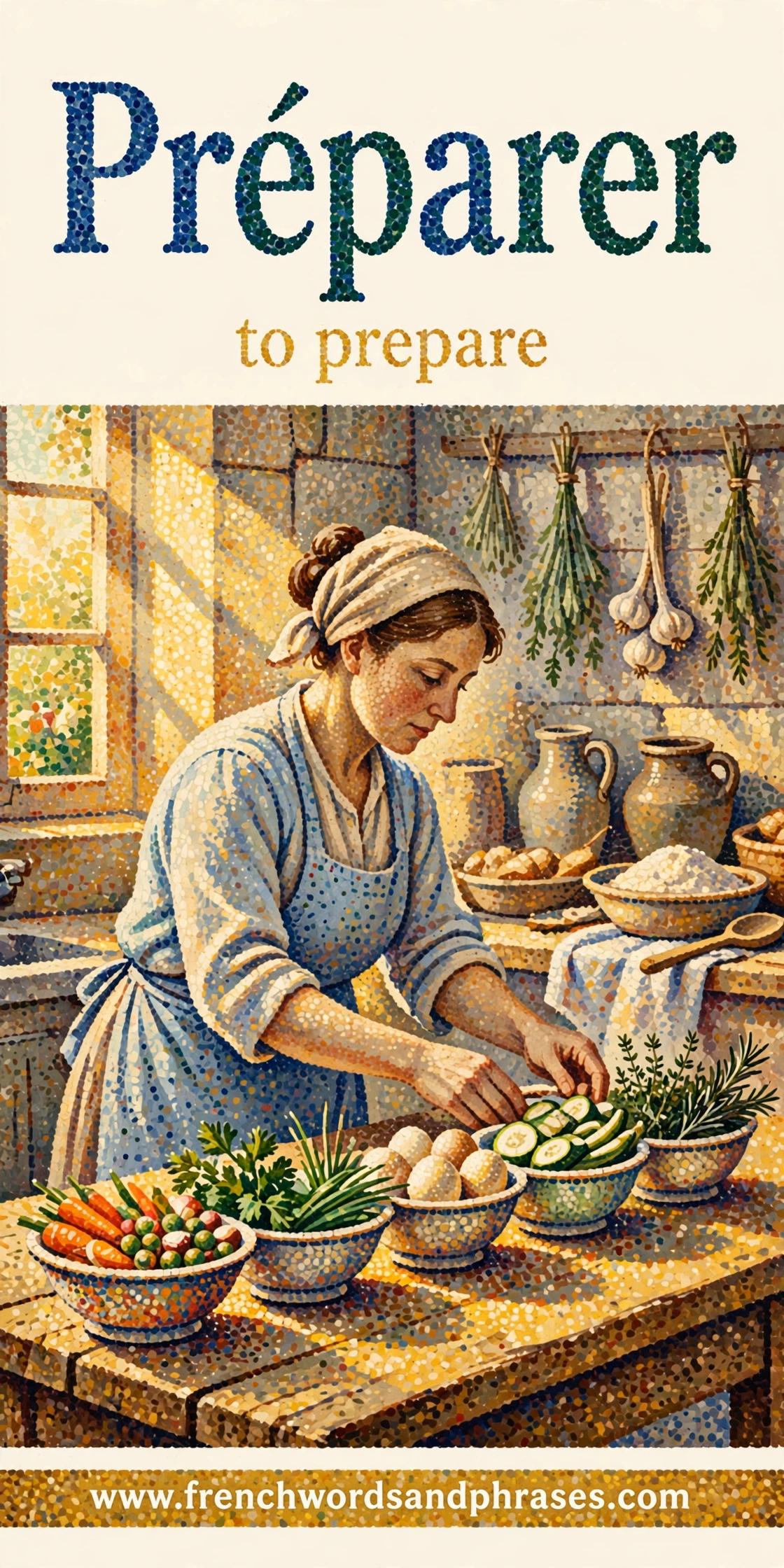
Préparer means to prepare — to get something ready before it is needed: a meal in the morning for the evening, a lesson before the class, a journey before the train, oneself before the test.
The cook lining up her ingredients before the guests arrive, the student spreading his notes the night before the exam, the mother folding small clothes into a small suitcase — préparer is the verb of the hour before, of everything made ready in calm so that the moment itself can be easy.
In this guide, you’ll learn how to conjugate préparer in all the major French tenses and moods. Explore complete conjugation tables, French examples, English translations, and practice quizzes.
Understanding the French Verb Préparer
Préparer is a regular French verb belonging to the first group of verbs, those ending in-er.
It means to prepare. Préparer covers both the kitchen and the calendar: on prépare un repas, une réunion, une surprise, un voyage. Followed by à, it braces someone for what is coming: préparer les enfants à un déménagement, to prepare the children for a move. And se préparer à plus an infinitive means to get ready to do something: elle se prépare à partir, she is getting ready to leave.
Verb classification: First group (-er)
Auxiliary verb: Avoir
Past participle: préparé
Present participle: préparant
English equivalents: To prepare, to get ready, to make; préparer le dîner — to prepare dinner; préparer un examen — to prepare for an exam; se préparer — to get (oneself) ready; préparer quelqu’un à une nouvelle — to prepare someone for news.
One important detail: préparer is perfectly regular — despite its é, it is NOT an espérer-type verb: the é never opens to è. Say je prépare, tu prépares, nous préparons, future je préparerai, past participle préparé. Its reflexive twin doubles the work: se préparer, to get oneself ready — je me prépare, nous nous préparons — with être in the compound tenses.
Experience the Word
Préparer is the quiet work that makes the visible moment look effortless — the table laid before the bell, the speech smooth because the night before was not.
Imagine the village schoolteacher on Sunday evening, windows lit, the week’s lessons written in a careful hand while the village sleeps. Elle prépare sa classe — and on Monday, thirty children will think teaching is simply what happens when she opens her mouth.
The lesson unfolds like a ribbon. That is préparer — tomorrow’s ease, built tonight.
How to Conjugate Préparer: Complete French Conjugation Guide
Let’s explore every major conjugation of préparer, beginning with the indicative mood.
How to Conjugate Préparer in the Indicative Mood
The indicative mood is used to express facts, observations, actions, and events.
How to Conjugate Préparer in the Present Tense (Présent)
Used for actions happening now, habitual actions, and general truths.
| Subject | Conjugation |
|---|---|
| je | prépare |
| tu | prépares |
| il / elle | prépare |
| nous | préparons |
| vous | préparez |
| ils / elles | préparent |
Example
Elle prépare le dîner pour huit personnes.
She is preparing dinner for eight people.
Quick Quiz 1
Complete the sentence:
Elle ______ le dîner pour huit personnes.
Reveal the answer
prépare
Elle prépare le dîner pour huit personnes.
She is preparing dinner for eight people — préparer is regular, its é never changes.
How to Conjugate Préparer in the Passé Composé
Used for completed actions in the past. Préparer takes the auxiliary verb avoir.
| Subject | Conjugation |
|---|---|
| j’ | ai préparé |
| tu | as préparé |
| il / elle | a préparé |
| nous | avons préparé |
| vous | avez préparé |
| ils / elles | ont préparé |
Example
Nous avons préparé la salle avant la réunion.
We prepared the room before the meeting.
How to Conjugate Préparer in the Imparfait (Imperfect Tense)
Used for habitual past actions, descriptions, and ongoing situations in the past.
| Subject | Conjugation |
|---|---|
| je | préparais |
| tu | préparais |
| il / elle | préparait |
| nous | préparions |
| vous | prépariez |
| ils / elles | préparaient |
Example
Chaque dimanche, il préparait sa semaine.
Every Sunday, he used to prepare his week.
Quick Quiz 2
Choose the correct form:
We prepared the room before the meeting.
Nous ______ la salle avant la réunion. (avons préparé / sommes préparés)
Reveal the answer
avons préparé
Nous avons préparé la salle avant la réunion.
Préparer takes avoir.
How to Conjugate Préparer in the Plus-que-parfait
Used to describe an action that had already been completed before another past event.
| Subject | Conjugation |
|---|---|
| j’ | avais préparé |
| tu | avais préparé |
| il / elle | avait préparé |
| nous | avions préparé |
| vous | aviez préparé |
| ils / elles | avaient préparé |
Example
Elle avait préparé ses valises la veille.
She had prepared her suitcases the day before.
How to Conjugate Préparer in the Passé Simple
Primarily used in formal writing, literature, and historical narratives. It is rarely used in everyday conversation.
| Subject | Conjugation |
|---|---|
| je | préparai |
| tu | préparas |
| il / elle | prépara |
| nous | préparâmes |
| vous | préparâtes |
| ils / elles | préparèrent |
Example
Le cuisinier prépara un festin pour le village.
The cook prepared a feast for the village.
How to Conjugate Préparer in the Passé Antérieur
A literary tense used to express an action completed immediately before another past action, generally in the passé simple.
| Subject | Conjugation |
|---|---|
| j’ | eus préparé |
| tu | eus préparé |
| il / elle | eut préparé |
| nous | eûmes préparé |
| vous | eûtes préparé |
| ils / elles | eurent préparé |
Example
Quand elle eut préparé le discours, elle se coucha.
When she had prepared the speech, she went to bed.
How to Conjugate Préparer in the Future Tense (Futur Simple)
Used to describe actions that will take place in the future.
| Subject | Conjugation |
|---|---|
| je | préparerai |
| tu | prépareras |
| il / elle | préparera |
| nous | préparerons |
| vous | préparerez |
| ils / elles | prépareront |
Example
Demain, je préparerai les documents du voyage.
Tomorrow, I will prepare the travel documents.
How to Conjugate Préparer in the Futur Antérieur (Future Perfect)
Used for an action that will have been completed before a particular point in the future.
| Subject | Conjugation |
|---|---|
| j’ | aurai préparé |
| tu | auras préparé |
| il / elle | aura préparé |
| nous | aurons préparé |
| vous | aurez préparé |
| ils / elles | auront préparé |
Example
À six heures, ils auront préparé la fête.
By six o’clock, they will have prepared the party.
How to Conjugate Préparer in the Near Future (Futur Proche)
Used to describe something that is going to happen soon. Formed with aller + infinitive.
| Subject | Conjugation |
|---|---|
| je | vais préparer |
| tu | vas préparer |
| il / elle | va préparer |
| nous | allons préparer |
| vous | allez préparer |
| ils / elles | vont préparer |
Example
Je vais préparer du thé pour les invités.
I am going to prepare some tea for the guests.
How to Conjugate Préparer in the Conditional Mood
The conditional mood expresses what would happen under certain circumstances. It is also frequently used to make polite requests or express wishes.
How to Conjugate Préparer in the Present Conditional
| Subject | Conjugation |
|---|---|
| je | préparerais |
| tu | préparerais |
| il / elle | préparerait |
| nous | préparerions |
| vous | prépareriez |
| ils / elles | prépareraient |
Example
Avec un peu d’aide, tu préparerais le repas plus vite.
With a little help, you would prepare the meal faster.
How to Conjugate Préparer in the Past Conditional
| Subject | Conjugation |
|---|---|
| j’ | aurais préparé |
| tu | aurais préparé |
| il / elle | aurait préparé |
| nous | aurions préparé |
| vous | auriez préparé |
| ils / elles | auraient préparé |
Example
Nous aurions préparé plus de places si nous avions su.
We would have prepared more seats if we had known.
Préparer in the Literary Past Conditional Form
This less common literary form uses the imperfect subjunctive of avoir.
| Subject | Conjugation |
|---|---|
| j’ | eusse préparé |
| tu | eusses préparé |
| il / elle | eût préparé |
| nous | eussions préparé |
| vous | eussiez préparé |
| ils / elles | eussent préparé |
Example
Elle eût préparé la salle sans ce retard.
She would have prepared the room if not for this delay.
How to Conjugate Préparer in the Subjunctive Mood
The subjunctive is used to express wishes, emotions, doubts, necessity, and uncertainty. It frequently follows expressions such as il faut que (it is necessary that) or bien que (although).
How to Conjugate Préparer in the Present Subjunctive
| Subject | Conjugation |
|---|---|
| que je | prépare |
| que tu | prépares |
| qu’il / qu’elle | prépare |
| que nous | préparions |
| que vous | prépariez |
| qu’ils / qu’elles | préparent |
Example
Il faut que tu prépares ton sac ce soir.
You must prepare your bag tonight.
Quick Quiz 3
Complete the sentence using the subjunctive:
Il faut que tu ______ ton sac ce soir.
Reveal the answer
prépares
Il faut que tu prépares ton sac ce soir.
You must prepare your bag tonight.
How to Conjugate Préparer in the Imperfect Subjunctive
A literary tense, rarely encountered in modern spoken French.
| Subject | Conjugation |
|---|---|
| que je | préparasse |
| que tu | préparasses |
| qu’il / qu’elle | préparât |
| que nous | préparassions |
| que vous | préparassiez |
| qu’ils / qu’elles | préparassent |
Example
Il fallait qu’il préparât son discours avec soin.
He had to prepare his speech carefully.
How to Conjugate Préparer in the Pluperfect Subjunctive
A literary construction used to express an action completed before another past action.
| Subject | Conjugation |
|---|---|
| que j’ | eusse préparé |
| que tu | eusses préparé |
| qu’il / qu’elle | eût préparé |
| que nous | eussions préparé |
| que vous | eussiez préparé |
| qu’ils / qu’elles | eussent préparé |
Example
Je doutais qu’elle eût préparé la surprise seule.
I doubted she had prepared the surprise alone.
How to Conjugate Préparer in the Past Subjunctive
| Subject | Conjugation |
|---|---|
| que j’ | aie préparé |
| que tu | aies préparé |
| qu’il / qu’elle | ait préparé |
| que nous | ayons préparé |
| que vous | ayez préparé |
| qu’ils / qu’elles | aient préparé |
Example
Je suis content que vous ayez préparé ce rapport.
I am glad you prepared this report.
How to Conjugate Préparer in the Imperative
The imperative is used to give commands, instructions, invitations, or suggestions. Subject pronouns are omitted.
How to Conjugate Préparer in the Present Imperative
| Person | Conjugation |
|---|---|
| (tu) | prépare |
| (nous) | préparons |
| (vous) | préparez |
Example
Prépare tes affaires pour demain.
Prepare your things for tomorrow.
Quick Quiz 4
How would you say Prepare your things (tu form)?
Reveal the answer
Prépare tes affaires !
French Participles of Préparer
Participles are verb forms that can be used in compound tenses and other grammatical constructions.
Present Participle of Préparer
préparant
En préparant le thé, elle écoute la radio.
While preparing the tea, she listens to the radio.
Past Participle of Préparer
préparé
Le discours préparé a ému toute la salle.
The prepared speech moved the whole hall.
Préparer in Everyday French: Real-Life Examples
Now that you know the conjugations, let’s see how préparer appears in everyday French.
Example 1 — Present
Elle prépare le dîner pour huit personnes.
She is preparing dinner for eight people.
Example 2 — Passé composé
Nous avons préparé la salle à l’avance.
We prepared the room in advance.
Example 3 — Imparfait
Il préparait sa semaine chaque dimanche.
He used to prepare his week every Sunday.
Example 4 — Future
Je préparerai les documents demain.
I will prepare the documents tomorrow.
Example 5 — Conditional
Tu préparerais le repas plus vite avec de l’aide.
You would prepare the meal faster with help.
Example 6 — Imperative
Prépare tes affaires pour demain !
Prepare your things for tomorrow!
Beyond Translation: The Meaning of Préparer
Préparer comes from Latin praeparare — to make ready beforehand — and the pré-, the before, is the soul of the word: all of préparer happens in advance of the moment it serves. French culture honours that hour before: the mise en place of the kitchen, the teacher’s Sunday evening, the valise faite la veille. Its reflexive, se préparer, is the daily ceremony of becoming ready — and its warning form is just as common: prépare-toi, get ready, something is coming.
To préparer is to borrow calm from today and spend it tomorrow.
It evokes the laid table before the guests, the underlined notes before the exam, and the suitcase closed the night before the train.
How to Remember the French Verb Préparer
Remember it this way: Préparer is about je prépare — regular -er, é never changes; se préparer = to get ready.
- Regular, not espérer-type: je prépare, nous préparons, past participle préparé — the é stays everywhere.
- The twin — se préparer, to get oneself ready, with être: elle s’est préparée.
- Bracing phrase — préparer quelqu’un à une nouvelle, to prepare someone for news.
The key idea is je prépare — regular -er, é never changes; se préparer = to get ready.
Test Your Knowledge of Préparer
Let’s see how much you’ve learned. Try answering these questions before revealing the answers.
Question 1
Does the é of préparer ever change to è?
Reveal the answer
Never — préparer is regular, not an espérer-type verb: je prépare, je préparerai, préparé.
Question 2
How do you say She is preparing dinner in French?
Reveal the answer
Elle prépare le dîner.
Question 3
Translate: We prepared the room before the meeting.
Reveal the answer
Nous avons préparé la salle avant la réunion.
Question 4
What is the past participle of préparer?
Reveal the answer
Préparé.
Question 5
Complete the sentence:
Il faut que vous ______ la salle avant midi.
Reveal the answer
prépariez
Il faut que vous prépariez la salle avant midi.
You must prepare the room before noon.
Your Final Challenge
Can You Use It?
How would you say this in French?
She prepares dinner while the guests arrive.
Reveal the answer
Elle prépare le dîner pendant que les invités arrivent.
She prepares dinner while the guests arrive.
A little French. A little curiosity. A richer everyday life.
LEARN FRENCH ONE WORD AT A TIME




