A French Word to Live By
Translate Poème to English
/pɔ.ɛm/
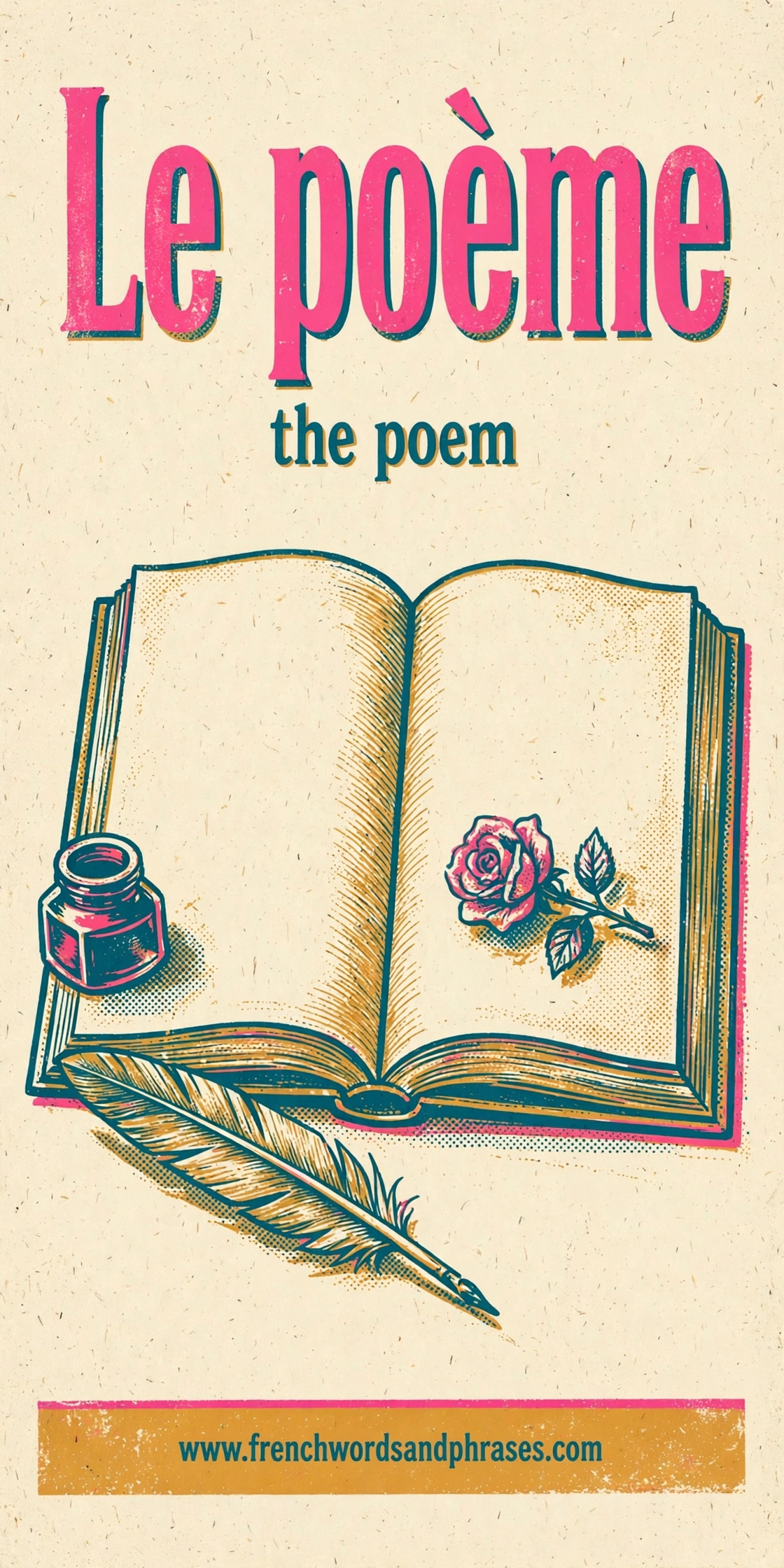
Le poème means the poem.
Twelve lines on a school notebook page, learned by heart and recited standing, hands behind the back: le poème, the poem — the text French children meet before almost any other literature.
In this guide, you’ll learn what poème means in English, how to use it with its articles, how to form its plural, and how it appears in everyday French. Explore French examples, English translations, and practice quizzes.
Understanding the French Noun Poème
Poème is a masculine French noun, learned with its article: le poème, un poème. Like several French words ending in -ème (un problème, un thème), it is masculine despite the final -e. It comes from the Greek poiêma, a thing made — a poem is literally a piece of making, and its maker is un poète, a poet.
It means a poem — a text in verse, or in poetic prose: un poème d’amour, a love poem, réciter un poème, to recite a poem, apprendre un poème par cœur, to learn a poem by heart. The art itself is la poésie, poetry, and one short poem among a poet’s works sits in un recueil de poèmes, a collection of poems. A long narrative poem can grow into un poème épique, an epic poem.
Gender: Masculine — le poème
Definite article: le — le poème (the poem)
Indefinite article: un — un poème (a poem)
Plural: les poèmes — regular, with a simple -s
Spelling note: masculine despite the final -e, like problème and thème — from Greek poiêma, a thing made
Key verbs: réciter un poème (recite), écrire un poème (write), apprendre par cœur (learn by heart)
English equivalents: The poem.
Do not let the -e fool you: poème is masculine — un beau poème, never une poème. French schoolchildren récitent poems standing in front of the class, a ritual that has filled generations of memories with Hugo, Prévert and La Fontaine. The person is un poète (or une poétesse, in older usage), the art is la poésie, and the adjective is poétique.
Experience the Word
Poème is language keeping only what shines: every word weighed, every line earning its place.
Imagine the classroom in June, windows open, a small voice rising over the desks: « Demain, dès l’aube… » — Hugo’s poème crossing a century and a half to land, intact, in a nine-year-old’s memory.
You have not just named a text. You have named the made thing — le poème, the poem, words built to outlast their maker.
How to Use Poème in French: Complete Guide
Let’s explore how poème works in French, beginning with its articles — le poème, un poème, réciter un poème.
Poème with the Definite Article (Le, Les)
Used for a specific poem — the one in the book, the one learned at school.
| Form | French |
|---|---|
| Masculine singular | le poème |
| Plural | les poèmes |
Example
Le poème de Hugo est écrit sur la première page.
Hugo’s poem is written on the first page.
Poème with the Indefinite Article (Un, Des)
Used for a poem in general — one poem among all the poems of the world.
| Form | French |
|---|---|
| Masculine singular | un poème |
| Plural | des poèmes |
Example
Elle a écrit un poème pour l’anniversaire de sa mère.
She wrote a poem for her mother’s birthday.
Poème with Quantities and Kinds (D’amour, Épique, En vers…)
Poems are sorted by subject and shape — the vocabulary of anthologies.
| Quantity | French |
|---|---|
| a love poem | un poème d’amour |
| an epic poem | un poème épique |
| a poem in verse | un poème en vers |
| a collection of poems | un recueil de poèmes |
| a short poem | un court poème |
Example
Ce recueil de poèmes date de 1856.
This collection of poems dates from 1856.
Quick Quiz 1
Complete the sentence:
______ poème de Prévert est très célèbre. (the)
Reveal the answer
Le
Le poème de Prévert est très célèbre.
Prévert’s poem is very famous — poème is masculine, so le, despite the final -e.
The Plural of Poème
Poème takes a regular plural in -s — the è stays, the word simply multiplies.
| Number | French |
|---|---|
| Singular | le poème |
| Plural | les poèmes |
Example
Les poèmes de ce recueil parlent tous de la mer.
The poems in this collection all speak of the sea.
Poème with Possessive Adjectives (Mon, Ton, Son…)
Possessives agree with the noun: poème is masculine, so mon, ton, son in the singular.
| Owner | French |
|---|---|
| my | mon poème |
| your (tu) | ton poème |
| his / her | son poème |
| our | notre poème |
| your (vous) | votre poème |
| their | leur poème |
Example
Il a lu son poème devant toute la classe.
He read his poem in front of the whole class.
Quick Quiz 2
Complete the sentence:
Elle récite ______ poème par cœur. (her)
Reveal the answer
son
Elle récite son poème par cœur.
She recites her poem by heart — son, because poème is masculine.
Poème with Demonstrative Adjectives (Ce, Ces)
Used to point: ce poème, this poem — the one on the page in front of you.
| Form | French |
|---|---|
| Masculine singular | ce poème |
| Plural | ces poèmes |
Example
Ce poème parle d’un voyage en mer.
This poem speaks of a voyage at sea.
Poème with Adjectives
Adjectives agree with poème — masculine singular: un poème célèbre, un beau poème.
| Adjective | With Poème |
|---|---|
| célèbre (famous) | un poème célèbre |
| beau (beautiful) | un beau poème |
| long (long) | un long poème |
| court (short) | un court poème |
| épique (epic) | un poème épique |
Example
Les enfants apprennent un court poème pour la fête de l’école.
The children are learning a short poem for the school fête.
Quick Quiz 3
Complete the sentence:
C’est un ______ poème, tout le monde le connaît. (beautiful)
Reveal the answer
beau
C’est un beau poème, tout le monde le connaît.
It is a beautiful poem, everyone knows it — beau, masculine, before the noun.
Everyday Expressions with Poème
Classrooms, anthologies and birthdays — the poème phrases of daily life.
| Expression | In English |
|---|---|
| réciter un poème | to recite a poem |
| apprendre un poème par cœur | to learn a poem by heart |
| écrire un poème | to write a poem |
| un poème d’amour | a love poem |
| un recueil de poèmes | a collection of poems |
Example
Chaque élève récite un poème devant la classe.
Each pupil recites a poem in front of the class.
Words from the Same Family as Poème
Poets and poetry — the words that travel with poème.
| French | In English |
|---|---|
| un poète | a poet |
| la poésie | poetry — the art itself |
| poétique | poetic (adjective) |
| un vers | a line of verse |
| une rime | a rhyme |
Example
La poésie de Prévert plaît beaucoup aux enfants.
Prévert’s poetry is much loved by children.
Quick Quiz 4
What does apprendre un poème par cœur mean?
Reveal the answer
To learn a poem by heart — to memorise it completely.
Il a appris le poème par cœur en une soirée.
He learned the poem by heart in one evening.
Poème in Everyday French: Real-Life Examples
Now that you know the word, let’s see how poème appears in everyday French.
Example 1 — At school
Les élèves récitent un poème de La Fontaine.
The pupils recite a poem by La Fontaine.
Example 2 — Homework
Apprends ce poème par cœur pour vendredi.
Learn this poem by heart for Friday.
Example 3 — A gift
Il a écrit un poème pour sa grand-mère.
He wrote a poem for his grandmother.
Example 4 — In the bookshop
Ce recueil de poèmes vient de paraître.
This collection of poems has just come out.
Example 5 — Love
Un poème d’amour glissé dans une poche, voilà son secret.
A love poem slipped into a pocket, that is his secret.
Example 6 — At the ceremony
Elle a lu un poème de Hugo au mariage.
She read a poem by Hugo at the wedding.
Beyond Translation: The Meaning of Poème
Poème is an honest word: from the Greek poiêma, a thing made, it admits that a poem is manufactured — weighed, fitted, polished — before it can look effortless. France built a national ritual on it: la récitation, the child standing to recite Hugo or Prévert while the class holds its breath, so that whole generations carry the same poems in memory like furniture in a shared house.
To say poème is to name the smallest made thing that can outlive an empire.
It evokes the school notebook, the anthology on the nightstand, and twelve lines that refuse to be forgotten.
How to Remember the French Noun Poème
Remember it this way: Poème is the poem — masculine despite its final -e: le poème, un beau poème, and you réciter it par cœur.
- Always masculine — le poème, un poème, mon poème, like problème and thème.
- The school ritual — réciter un poème, apprendre par cœur.
- The family — un poète writes it, la poésie is the art.
The key idea is le poème — the poem, masculine despite the -e; from Greek poiêma, a thing made.
Test Your Knowledge of Poème
Let’s see how much you’ve learned. Try answering these questions before revealing the answers.
Question 1
Is poème masculine or feminine?
Reveal the answer
Masculine — le poème, un poème, despite the final -e.
Question 2
How do you say to learn a poem by heart?
Reveal the answer
Apprendre un poème par cœur.
Question 3
Translate: She wrote a poem for her mother.
Reveal the answer
Elle a écrit un poème pour sa mère.
Question 4
What is the difference between un poème and la poésie?
Reveal the answer
Un poème is one poem; la poésie is poetry, the art as a whole.
Question 5
Complete the sentence:
______ poèmes de ce livre sont très courts. (the)
Reveal the answer
Les
Les poèmes de ce livre sont très courts.
The poems in this book are very short.
Your Final Challenge
Can You Use It?
How would you say this in French?
“The children are learning a short poem for the school fête.”
Reveal the answer
Les enfants apprennent un court poème pour la fête de l’école.
The children are learning a short poem for the school fête.
A little French. A little curiosity. A richer everyday life.
LEARN FRENCH ONE WORD AT A TIME