A French Word to Live By
Translate Surprise to English
/syʁ.pʁiz/
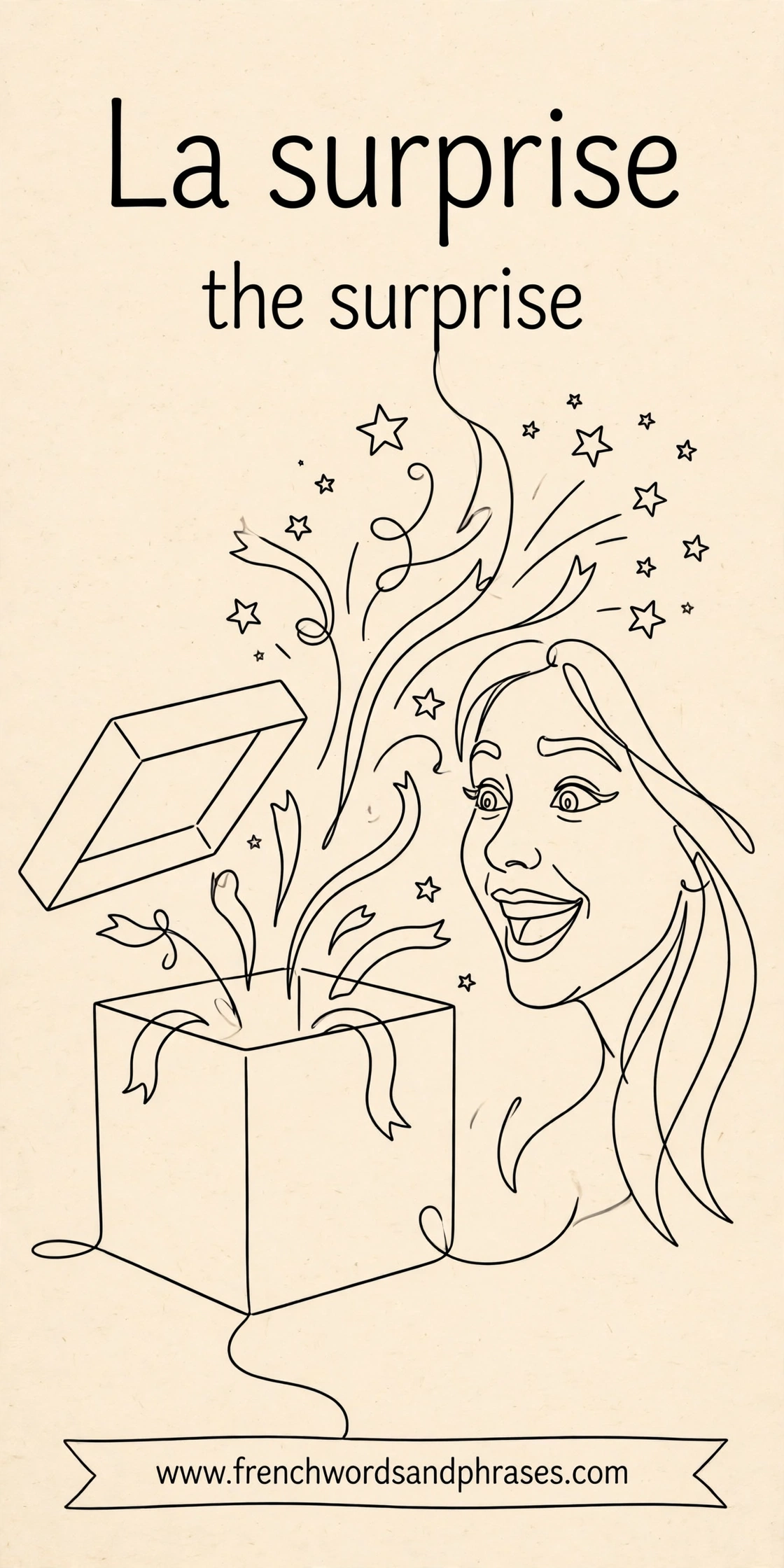
La surprise means the surprise.
The lights are off, the room is holding its breath, the door opens — « Surprise ! » La surprise, the surprise: the word French shouts at birthday parties and whispers over wrapped boxes.
In this guide, you’ll learn what surprise means in English, how to use it with its articles, how to form its plural, and how it appears in everyday French. Explore French examples, English translations, and practice quizzes.
Understanding the French Noun Surprise
Surprise is a feminine French noun, learned with its article: la surprise, une surprise. It is the past participle of the verb surprendre, to surprise — literally, to catch someone from above, unprepared. As a noun it names both the feeling and the thing that causes it: the unexpected gift, the hidden guest, the twist in the story.
It means a surprise — first the emotion: à ma grande surprise, to my great surprise, quelle surprise !, what a surprise! Then the event itself: une surprise d’anniversaire, a birthday surprise, une mauvaise surprise, a nasty surprise, une visite surprise, a surprise visit. French organises them with faire une surprise à quelqu’un, to give someone a surprise, and keeps them with garder la surprise, to keep the surprise secret. The adjective for the person caught out is surpris — il a été surpris, he was surprised.
Gender: Feminine — la surprise
Definite article: la — la surprise (the surprise)
Indefinite article: une — une surprise (a surprise)
Plural: les surprises — regular, with a simple -s
Spelling note: the past participle of surprendre — a surprise is what catches you unprepared
Key verbs: faire une surprise à quelqu’un (to surprise someone), garder la surprise (to keep it secret)
English equivalents: The surprise.
French shouts the word itself at parties: when the guest of honour walks in, everyone cries « Surprise ! » To say you were surprised, the everyday phrase is à ma grande surprise or simply j’ai eu une surprise. Beware the false friend in reverse: an English surprise party is une fête surprise, and a surprise visit is une visite surprise — surprise works as an invariable adjective after the noun in these phrases.
Experience the Word
Surprise is the only gift that cannot be wrapped: the gasp, the hands over the mouth, the laugh a second later.
Imagine the grandmother who thinks she is having a quiet birthday lunch — and behind the restaurant door, thirty years of family are standing in the dark with a cake, waiting for the word: « Surprise ! »
You have not just named an emotion. You have named the ambush of joy — la surprise, the surprise, planned in secret and sprung with love.
How to Use Surprise in French: Complete Guide
Let’s explore how surprise works in French, beginning with its articles — la surprise, une surprise, faire une surprise.
Surprise with the Definite Article (La, Les)
Used for a specific surprise — the one everyone is hiding.
| Form | French |
|---|---|
| Feminine singular | la surprise |
| Plural | les surprises |
Example
La surprise est cachée dans le garage.
The surprise is hidden in the garage.
Surprise with the Indefinite Article (Une, Des)
Used for a surprise in general — welcome or unwelcome.
| Form | French |
|---|---|
| Feminine singular | une surprise |
| Plural | des surprises |
Example
Elle nous a préparé une surprise pour le dessert.
She has prepared a surprise for us for dessert.
Surprise with Kinds (Bonne, Mauvaise, Grande…)
French grades its surprises — the vocabulary of birthdays and bad news alike.
| Quantity | French |
|---|---|
| a nice surprise | une bonne surprise |
| a nasty surprise | une mauvaise surprise |
| a big surprise | une grande surprise |
| a birthday surprise | une surprise d’anniversaire |
| a surprise visit | une visite surprise |
Example
Quelle bonne surprise de te voir ici !
What a nice surprise to see you here!
Quick Quiz 1
Complete the sentence:
______ surprise commence à huit heures, ne sois pas en retard. (the)
Reveal the answer
La
La surprise commence à huit heures, ne sois pas en retard.
The surprise starts at eight, don’t be late — surprise is feminine, so la.
The Plural of Surprise
Surprise takes a regular plural in -s — some days are full of them.
| Number | French |
|---|---|
| Singular | la surprise |
| Plural | les surprises |
Example
La vie est pleine de surprises.
Life is full of surprises.
Surprise with Possessive Adjectives (Ma, Ta, Sa…)
Possessives agree with the noun: surprise is feminine, so ma, ta, sa in the singular.
| Owner | French |
|---|---|
| my | ma surprise |
| your (tu) | ta surprise |
| his / her | sa surprise |
| our | notre surprise |
| your (vous) | votre surprise |
| their | leur surprise |
Example
Je garde ma surprise pour la fin de la soirée.
I’m keeping my surprise for the end of the evening.
Quick Quiz 2
Complete the sentence:
Il a découvert ______ surprise avant la fête. (his)
Reveal the answer
sa
Il a découvert sa surprise avant la fête.
He found out about his surprise before the party — sa, because surprise is feminine.
Surprise with Demonstrative Adjectives (Cette, Ces)
Used to point: cette surprise, this surprise — the one nobody expected.
| Form | French |
|---|---|
| Feminine singular | cette surprise |
| Plural | ces surprises |
Example
Cette surprise, je ne l’oublierai jamais.
This surprise, I will never forget it.
Surprise with Adjectives
Adjectives agree with surprise — feminine singular: une surprise agréable, une énorme surprise.
| Adjective | With Surprise |
|---|---|
| agréable (pleasant) | une surprise agréable |
| mauvaise (bad) | une mauvaise surprise |
| énorme (huge) | une énorme surprise |
| totale (complete) | une surprise totale |
| petite (small) | une petite surprise |
Example
C’était une surprise totale, personne ne savait rien.
It was a complete surprise, nobody knew anything.
Quick Quiz 3
Complete the sentence:
Quelle ______ surprise de trouver la porte fermée ! (nasty)
Reveal the answer
mauvaise
Quelle mauvaise surprise de trouver la porte fermée !
What a nasty surprise to find the door locked! — mauvaise, feminine, to agree with surprise.
Everyday Expressions with Surprise
Parties, visits and twists — the surprise phrases of daily life.
| Expression | In English |
|---|---|
| faire une surprise à quelqu’un | to give someone a surprise |
| à ma grande surprise | to my great surprise |
| quelle surprise ! | what a surprise! |
| une fête surprise | a surprise party |
| garder la surprise | to keep the surprise (secret) |
Example
À ma grande surprise, il a accepté tout de suite.
To my great surprise, he accepted straight away.
Words from the Same Family as Surprise
Catching people unawares — the words that travel with surprise.
| French | In English |
|---|---|
| surprendre | to surprise (the verb) |
| surpris | surprised (the adjective) |
| étonné | astonished, amazed |
| un cadeau | a present, a gift |
| un secret | a secret |
Example
Il a été très surpris par la nouvelle.
He was very surprised by the news.
Quick Quiz 4
What do the guests shout when the birthday person walks in?
Reveal the answer
« Surprise ! » — the word itself is the shout at every French surprise party.
Elle a ouvert la porte et tout le monde a crié : « Surprise ! »
She opened the door and everyone shouted: “Surprise!”
Surprise in Everyday French: Real-Life Examples
Now that you know the word, let’s see how surprise appears in everyday French.
Example 1 — The party
Tout le monde crie « Surprise ! » quand elle entre.
Everyone shouts “Surprise!” when she comes in.
Example 2 — A gift
J’ai une petite surprise pour toi dans mon sac.
I have a little surprise for you in my bag.
Example 3 — Good news
À ma grande surprise, j’ai réussi l’examen.
To my great surprise, I passed the exam.
Example 4 — Bad luck
Quelle mauvaise surprise : le train est annulé.
What a nasty surprise: the train is cancelled.
Example 5 — A visit
Ses amis lui ont fait une visite surprise.
Her friends paid her a surprise visit.
Example 6 — Secrets
Chut, garde la surprise jusqu’à samedi !
Shh, keep the surprise until Saturday!
Beyond Translation: The Meaning of Surprise
Surprise is a military word in party clothes: surprendre meant to catch an enemy unprepared, from above — sur- — and the noun kept the ambush but changed the weapons to cake and confetti. French grammar adds a small gift of its own: in une fête surprise and une visite surprise, the noun surprise stands after another noun and never changes, a surprise frozen in place like the guests behind the door.
To say surprise is to plan joy in secret and spring it all at once.
It evokes the dark room, the held breath, the shouted word — and, on the other days, the letter you never expected to receive.
How to Remember the French Noun Surprise
Remember it this way: Surprise is the surprise — feminine: la surprise, and the word itself is what everyone shouts at the party.
- Always feminine — la surprise, une surprise, ma surprise.
- The party shout — « Surprise ! » when the door opens.
- The reaction phrase — à ma grande surprise, to my great surprise.
The key idea is la surprise — the surprise, feminine; faire une surprise à quelqu’un.
Test Your Knowledge of Surprise
Let’s see how much you’ve learned. Try answering these questions before revealing the answers.
Question 1
Is surprise masculine or feminine?
Reveal the answer
Feminine — la surprise, une surprise.
Question 2
How do you say to my great surprise?
Reveal the answer
À ma grande surprise.
Question 3
Translate: Life is full of surprises.
Reveal the answer
La vie est pleine de surprises.
Question 4
What is une fête surprise?
Reveal the answer
A surprise party — surprise stays unchanged after the noun.
Question 5
Complete the sentence:
______ surprises de la journée n’étaient pas finies. (the)
Reveal the answer
Les
Les surprises de la journée n’étaient pas finies.
The day’s surprises were not over.
Your Final Challenge
Can You Use It?
How would you say this in French?
“To my great surprise, I passed the exam.”
Reveal the answer
À ma grande surprise, j’ai réussi l’examen.
To my great surprise, I passed the exam.
A little French. A little curiosity. A richer everyday life.
LEARN FRENCH ONE WORD AT A TIME