A French Word to Live By
Translate Lac to English
/lak/
Le lac means the lake.
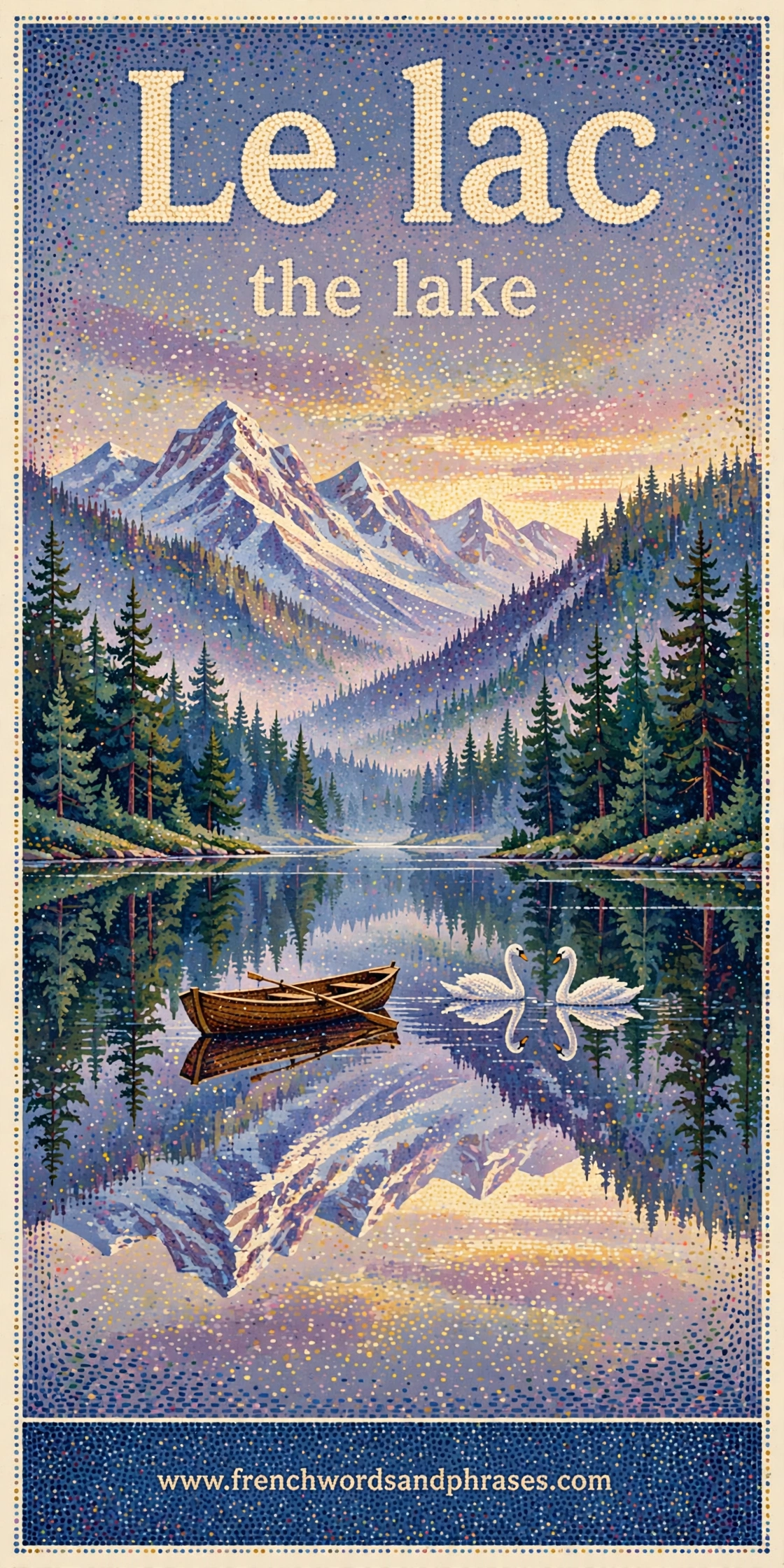
Still water at dawn, mountains standing in it upside down, a single rowing boat drawing a silver line: le lac, the lake — France’s calm inland seas, from the great Lac Léman to the dark little mountain lakes of the Pyrenees.
In this guide, you’ll learn what lac means in English, how to use it with its articles, how to form its plural, and how it appears in everyday French. Explore French examples, English translations, and practice quizzes.
Understanding the French Noun Lac
Lac is a masculine French noun, learned with its article: le lac, un lac. It comes from the Latin lacus, a basin, a reservoir — the same word that gives English lake through Old French. Short, deep and still: three letters holding a great deal of water.
It means a lake — a large body of fresh water surrounded by land: le lac Léman, Lake Geneva, le lac d’Annecy, un lac de montagne, a mountain lake, au bord du lac, at the lakeside. France counts its lakes by the hundred: glacial lakes in the Alps, volcanic lakes in the Auvergne, and the flat étangs of the coast, which are smaller cousins. You swim dans le lac, you walk autour du lac, you cross it en bateau.
Gender: Masculine — le lac
Definite article: le — le lac (the lake)
Indefinite article: un — un lac (a lake)
Plural: les lacs — regular, with a simple -s
Spelling note: the final c is pronounced: lac = “lak”, unlike many silent French endings
The great one: le lac Léman — Lake Geneva, France’s largest natural lake (shared with Switzerland)
English equivalents: The lake.
The frame is au bord du lac, at the lakeside, and le lac de + name for most French lakes: le lac du Bourget, le lac de Sainte-Croix. Do not confuse un lac with un étang, a pond or small lake — the étang is smaller and often artificial — nor with la mer, the sea: a lake is sweet water, eau douce, held by land on every side.
Experience the Word
Lac is the sea’s quiet brother: all that water, and no waves to speak of — a mirror the mountains keep for looking at themselves.
Imagine the Lac d’Annecy at seven in the morning, before the cafés open: the water is glass, the Alps are doubled in it, and one old man rows out into the reflection as if rowing across the sky. Voilà le lac — the landscape admiring itself.
You have not just named water. You have named stillness with shores — le lac, the lake, the mountains’ mirror.
How to Use Lac in French: Complete Guide
Let’s explore how lac works in French, beginning with its articles — le lac, un lac, au bord du lac.
Lac with the Definite Article (Le, Les)
Used for a specific lake — the one in the valley, the one on the map.
| Form | French |
|---|---|
| Masculine singular | le lac |
| Plural | les lacs |
Example
Le lac est gelé en hiver.
The lake is frozen in winter.
Lac with the Indefinite Article (Un, Des)
Used for a lake in general — any lake the road may find.
| Form | French |
|---|---|
| Masculine singular | un lac |
| Plural | des lacs |
Example
Près du village, il y a un lac magnifique.
Near the village, there is a magnificent lake.
Lac with Its Landscapes (Montagne, Bord, Tour…)
Lakes are walked round, lived beside and swum in — the phrases of the shore.
| Quantity | French |
|---|---|
| a mountain lake | un lac de montagne |
| at the lakeside | au bord du lac |
| the tour of the lake | le tour du lac |
| Lake Geneva | le lac Léman |
| a glacial lake | un lac glaciaire |
Example
Nous avons fait le tour du lac à pied.
We walked all the way round the lake.
Quick Quiz 1
Complete the sentence:
______ lac d’Annecy est célèbre pour son eau claire. (the)
Reveal the answer
Le
Le lac d’Annecy est célèbre pour son eau claire.
Lake Annecy is famous for its clear water — lac is masculine, so le.
The Plural of Lac
Lac takes a regular plural in -s — the lakes of a whole region.
| Number | French |
|---|---|
| Singular | le lac |
| Plural | les lacs |
Example
Les lacs des Pyrénées sont petits et profonds.
The lakes of the Pyrenees are small and deep.
Lac with Possessive Adjectives (Mon, Ton, Son…)
Possessives agree with the noun: lac is masculine, so mon, ton, son in the singular.
| Owner | French |
|---|---|
| my | mon lac |
| your (tu) | ton lac |
| his / her | son lac |
| our | notre lac |
| your (vous) | votre lac |
| their | leur lac |
Example
De sa fenêtre, il voit son lac préféré.
From his window, he can see his favourite lake.
Quick Quiz 2
Complete the sentence:
Ils nagent dans ______ lac tous les matins. (their)
Reveal the answer
leur
Ils nagent dans leur lac tous les matins.
They swim in their lake every morning — leur, because lac is masculine singular.
Lac with Demonstrative Adjectives (Ce, Ces)
Used to point: ce lac, this lake — the one in the photograph.
| Form | French |
|---|---|
| Masculine singular | ce lac |
| Plural | ces lacs |
Example
Ce lac est le plus profond de la région.
This lake is the deepest in the region.
Lac with Adjectives
Adjectives agree with lac — masculine singular: un lac profond, un grand lac.
| Adjective | With Lac |
|---|---|
| profond (deep) | un lac profond |
| grand (big) | un grand lac |
| de montagne (mountain) | un lac de montagne |
| calme (calm) | un lac calme |
| gelé (frozen) | un lac gelé |
Example
Un lac calme reflète les montagnes.
A calm lake reflects the mountains.
Quick Quiz 3
Complete the sentence:
C’est un lac très ______, attention en bateau. (deep)
Reveal the answer
profond
C’est un lac très profond, attention en bateau.
It is a very deep lake, be careful in the boat — profond, masculine, to agree with lac.
Everyday Expressions with Lac
Shores, swims and great names — the lac phrases of daily life.
| Expression | In English |
|---|---|
| au bord du lac | at the lakeside |
| le tour du lac | the walk round the lake |
| le lac Léman | Lake Geneva |
| un lac de montagne | a mountain lake |
| nager dans le lac | to swim in the lake |
Example
Nous pique-niquons au bord du lac.
We are having a picnic at the lakeside.
Words from the Same Family as Lac
Waters and shores — the words that travel with lac.
| French | In English |
|---|---|
| un étang | a pond, a small lake |
| une rive | a shore, a bank |
| la mer | the sea — salt water, no shore all round |
| une rivière | a river |
| l’eau douce | fresh water — literally, sweet water |
Example
La rive du lac est bordée de roseaux.
The lake shore is lined with reeds.
Quick Quiz 4
What is the difference between un lac and un étang?
Reveal the answer
The étang is smaller — a pond or small, often artificial lake; the lac is the true, larger lake.
Le village a un étang, la vallée a un lac.
The village has a pond, the valley has a lake.
Lac in Everyday French: Real-Life Examples
Now that you know the word, let’s see how lac appears in everyday French.
Example 1 — The walk
Faisons le tour du lac à pied.
Let’s walk round the lake.
Example 2 — Swimming
Les enfants nagent dans le lac.
The children are swimming in the lake.
Example 3 — The view
La maison donne sur le lac.
The house overlooks the lake.
Example 4 — Winter
En janvier, le lac est gelé.
In January, the lake is frozen.
Example 5 — The picnic
Nous déjeunons au bord du lac.
We are having lunch at the lakeside.
Example 6 — The great lake
Le lac Léman est entre la France et la Suisse.
Lake Geneva is between France and Switzerland.
Beyond Translation: The Meaning of Lac
Lac is Latin lacus, a basin — a word for any hollow that holds water, from a Roman reservoir to an Alpine giant. France wears its lakes like jewels of stillness: the Léman, shared with Switzerland and big enough for storms; Annecy, boasting the clearest water in Europe; the black volcanic lakes of the Auvergne, round as coins. The French landscape is loud with rivers and seas — the lac is where it lowers its voice.
To say lac is to stand at the shore of a held silence.
It evokes the doubled mountains at dawn, the rowing boat’s silver line, the winter ice — water at rest, in the middle of the land.
How to Remember the French Noun Lac
Remember it this way: Lac is the lake — masculine: le lac, and au bord du lac is at the lakeside.
- Always masculine — le lac, un lac, mon lac.
- The shore phrase — au bord du lac, at the lakeside; le tour du lac, the walk round it.
- Not the pond — un étang is smaller; le lac Léman is Lake Geneva.
The key idea is le lac — the lake, masculine; au bord du lac = at the lakeside.
Test Your Knowledge of Lac
Let’s see how much you’ve learned. Try answering these questions before revealing the answers.
Question 1
Is lac masculine or feminine?
Reveal the answer
Masculine — le lac, un lac.
Question 2
How do you say at the lakeside?
Reveal the answer
Au bord du lac.
Question 3
Translate: The lake is frozen in winter.
Reveal the answer
Le lac est gelé en hiver.
Question 4
What is the largest natural lake in France called?
Reveal the answer
Le lac Léman — Lake Geneva, shared with Switzerland.
Question 5
Complete the sentence:
______ lacs de montagne sont profonds. (the)
Reveal the answer
Les
Les lacs de montagne sont profonds.
Mountain lakes are deep.
Your Final Challenge
Can You Use It?
How would you say this in French?
“Let’s walk round the lake.”
Reveal the answer
Faisons le tour du lac à pied.
Let’s walk round the lake.
A little French. A little curiosity. A richer everyday life.
LEARN FRENCH ONE WORD AT A TIME