A French Word to Live By
Translate Sauvage to English
/so.vaʒ/
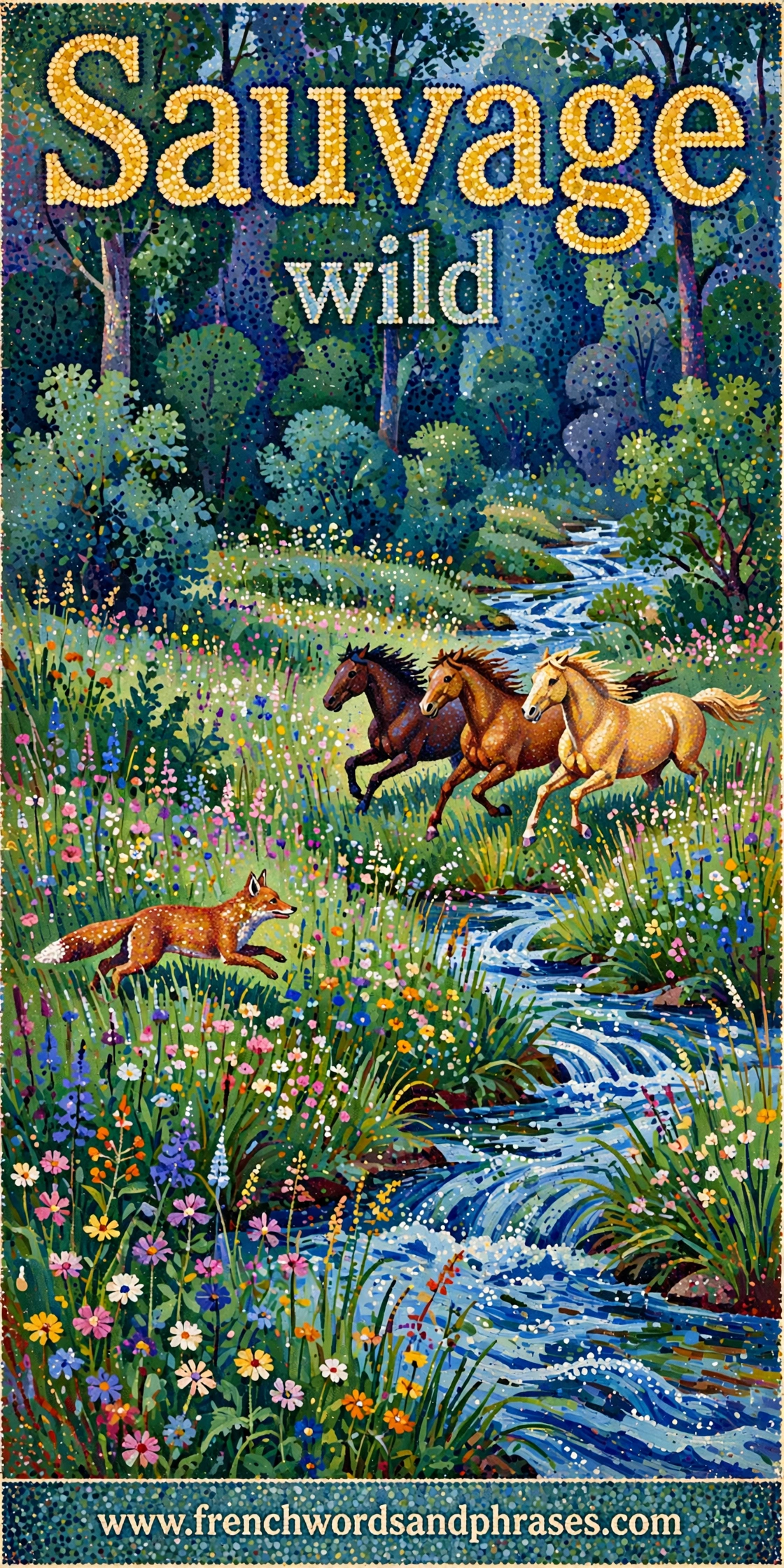
Sauvage means wild.
A horse no one has ever ridden, a beach with no footprints, berries growing where no gardener has ever been: sauvage, wild — everything that lives outside fences, gardens and rules.
In this guide, you’ll learn what sauvage means in English, why its feminine is exactly the same word, where it stands in the sentence, and how it stretches from wild animals to wild parties. Explore French examples, English translations, and practice quizzes.
Understanding the French Adjective Sauvage
Sauvage is a French adjective of nature and character. It descends from the Latin silvaticus — of the forest, silva — and it still smells of the woods: what is sauvage has not been tamed, planted, built or taught manners.
It means wild: un animal sauvage, a wild animal; des fraises sauvages, wild strawberries; une plage sauvage, an unspoilt beach. Of people it means unsociable, shy of company — il est un peu sauvage, he keeps himself to himself — and of behaviour, fierce and uncontrolled: une joie sauvage, wild joy.
Type: Adjective of nature and character — the untamed
Answers the question: What is it like? — wild, untamed, unspoilt
Changes form: Invariable in gender — sauvage for him and for her; plural sauvages
English equivalents: Wild; untamed; unspoilt; unsociable (of people).
One important usage detail: sauvage almost always follows its noun — un chat sauvage, never un sauvage chat in everyday French. And of a person, sauvage is not an insult about manners at table: it means someone who avoids company, a recluse by temperament.
Experience the Word
Sauvage is the world’s remainder: the part of the map that gardens, roads and timetables never reached.
Imagine the cove at the end of the path — no café, no umbrellas, only rocks, thyme and the sea: une plage sauvage, and the whole day smells of salt and freedom.
You have not just named roughness. You have named the untamed itself — sauvage, wild, living by its own law.
How to Use Sauvage in French: Complete Guide
Let’s explore how sauvage works in French, beginning with its forms — sauvage for both genders, sauvages in the plural.
Sauvage at a Glance
Before the details, here is the whole word on one card.
The Whole Word on One Card
Sauvage in four lines — meaning, type, position, form.
| Point | Sauvage |
|---|---|
| Meaning | wild — untamed, unspoilt, living outside rules |
| Type | adjective of nature and character |
| Usual position | after the noun — un animal sauvage |
| Form | sauvage for both genders — sauvages in the plural |
Example
Un renard sauvage traverse le jardin.
A wild fox crosses the garden.
The Four Forms of Sauvage
Sauvage ends in -e, so the feminine is the same word; only the plural adds an s.
| Form | Sauvage | Example |
|---|---|---|
| Masculine singular | sauvage | un cheval sauvage — a wild horse |
| Feminine singular | sauvage | une bête sauvage — a wild beast |
| Masculine plural | sauvages | des animaux sauvages — wild animals |
| Feminine plural | sauvages | des plages sauvages — unspoilt beaches |
Example
Des fraises sauvages poussent près du chemin.
Wild strawberries grow near the path.
Quick Quiz 1
Complete the sentence:
C’est une région encore ______ . (wild)
Reveal the answer
sauvage
C’est une région encore sauvage.
It is a still-wild region — sauvage does not change for the feminine.
The Feminine of Sauvage: The Same Word
Adjectives ending in -e keep one form for both genders.
| Situation | Example |
|---|---|
| Masculine | un jardin sauvage — a wild garden |
| Feminine | une nature sauvage — identical: the -e is already there |
| Why | adjectives ending in -e do not change for the feminine |
| The plural | add s — des fleurs sauvages, wild flowers |
Example
Une nature sauvage entoure le village.
Wild nature surrounds the village.
Where Sauvage Goes: After the Noun
Sauvage follows the noun it describes, like most descriptive adjectives.
| Pattern | Example |
|---|---|
| After the noun | un animal sauvage — a wild animal |
| After être | ce chat est sauvage — this cat is wild (untamed) |
| Of a person | il est sauvage — he is unsociable, he keeps to himself |
| Before the noun | un sauvage animal — not in everyday French |
Example
Ne t’approche pas, ce chien est sauvage.
Don’t go near, that dog is wild.
Quick Quiz 2
Choose the correct sentence:
(a) un sauvage cheval (b) un cheval sauvage
Reveal the answer
(b) un cheval sauvage
Sauvage follows its noun: un cheval sauvage, a wild horse.
More Sauvage: Comparing with Sauvage
Comparisons work as usual — plus, moins, aussi before the adjective.
| Degree | Example |
|---|---|
| As wild as | aussi sauvage que — as wild as |
| More wild | plus sauvage — wilder |
| Less wild | moins sauvage — less wild |
| The wildest (masc.) | le plus sauvage — le plus sauvage des animaux |
| The wildest (fem.) | la plus sauvage — la plus sauvage des plages |
Example
Ce sentier est plus sauvage que l’autre.
This path is wilder than the other.
Everyday Expressions with Sauvage
Animals, berries and beaches — where sauvage lives in daily French.
| Expression | In English |
|---|---|
| un animal sauvage | a wild animal |
| des fraises sauvages | wild strawberries |
| une plage sauvage | an unspoilt beach |
| un enfant sauvage | a feral child; a very shy child |
| la vie sauvage | wildlife; the wild life |
| une joie sauvage | wild, unrestrained joy |
Example
La vie sauvage reprend ses droits ici.
Wildlife is reclaiming its rights here.
Quick Quiz 3
What does une plage sauvage mean?
Reveal the answer
An unspoilt beach — wild, with no buildings or facilities.
Nous avons trouvé une plage sauvage magnifique.
We found a magnificent unspoilt beach.
Sauvage and Its Neighbours
Near words, from the garden to the jungle.
| French | In English |
|---|---|
| domestique | domestic, tame — the opposite |
| apprivoisé | tamed — an animal made tame |
| naturel | natural |
| farouche | fierce, shy and wild |
| primitif | primitive |
| civilisé | civilised — the far opposite |
Example
Un chat apprivoisé n’est plus sauvage.
A tamed cat is no longer wild.
Watch Out: The Traps Around Sauvage
Four things learners get wrong with sauvage.
| Trap | The truth |
|---|---|
| The feminine | une bête sauvage — no new form: sauvage is invariable in gender |
| The position | after the noun: un animal sauvage, not before |
| Of people | il est sauvage = he is unsociable, not he is a savage |
| The noun | un sauvage exists as a dated, offensive noun for a ‘savage’ — avoid it; the adjective is the living word |
Example
Il est un peu sauvage, il n’aime pas les fêtes.
He is a bit unsociable, he does not like parties.
Quick Quiz 4
Complete the sentence:
Des fleurs ______ poussent au bord de la route. (wild)
Reveal the answer
sauvages
Des fleurs sauvages poussent au bord de la route.
Wild flowers grow at the side of the road — plural sauvages.
Sauvage in Everyday French: Real-Life Examples
Now that you know the word, let’s see how sauvage appears in everyday French.
Example 1 — Animals
Un animal sauvage vit dans cette forêt.
A wild animal lives in this forest.
Example 2 — Berries
Des fraises sauvages poussent ici.
Wild strawberries grow here.
Example 3 — Beach
Nous cherchons une plage sauvage.
We are looking for an unspoilt beach.
Example 4 — Character
Il est un peu sauvage avec les inconnus.
He is a bit unsociable with strangers.
Example 5 — Joy
Une joie sauvage a rempli la salle.
Wild joy filled the room.
Example 6 — Nature
La nature sauvage doit être protégée.
Wild nature must be protected.
Beyond Translation: The Meaning of Sauvage
Sauvage was born in the forest — Latin silva, the woods, gave silvaticus, the one who belongs to the trees. Every use still carries the treeline: the sauvage animal owes nothing to man, the sauvage beach has no owner, and the sauvage person simply declines the party. Civilisation defined itself against this word, and secretly envies it.
Sauvage is the world’s way of saying: not everything is yours.
The wild strawberries are smaller than the garden ones — and everyone agrees they taste better.
How to Remember the French Adjective Sauvage
Remember it this way: Sauvage is the wild adjective — one form for him and for her, an s in the plural, and its home after the noun.
- One form for both genders — un animal sauvage, une plage sauvage; plural sauvages.
- After the noun — un cheval sauvage, a wild horse.
- Of a person — il est sauvage means he keeps to himself, unsociable.
The key idea is sauvage means wild; invariable in gender, plural sauvages.
Test Your Knowledge of Sauvage
Let’s see how much you’ve learned. Try answering these questions before revealing the answers.
Question 1
What is the feminine of sauvage?
Reveal the answer
Sauvage — identical; adjectives ending in -e do not change.
Question 2
How do you say a wild animal in French?
Reveal the answer
Un animal sauvage — the adjective follows the noun.
Question 3
Translate: We found an unspoilt beach.
Reveal the answer
Nous avons trouvé une plage sauvage.
Question 4
What does il est sauvage mean of a person?
Reveal the answer
He is unsociable — he avoids company; not that he is a savage.
Question 5
Complete the sentence:
Des animaux ______ vivent dans la montagne. (wild)
Reveal the answer
sauvages
Des animaux sauvages vivent dans la montagne.
Wild animals live in the mountains.
Your Final Challenge
Can You Use It?
How would you say this in French?
“Wild strawberries grow near the path.”
Reveal the answer
Des fraises sauvages poussent près du chemin.
Wild strawberries grow near the path.
A little French. A little curiosity. A richer everyday life.
LEARN FRENCH ONE WORD AT A TIME