A French Word to Live By
Translate Guerre to English
/ɡɛʁ/
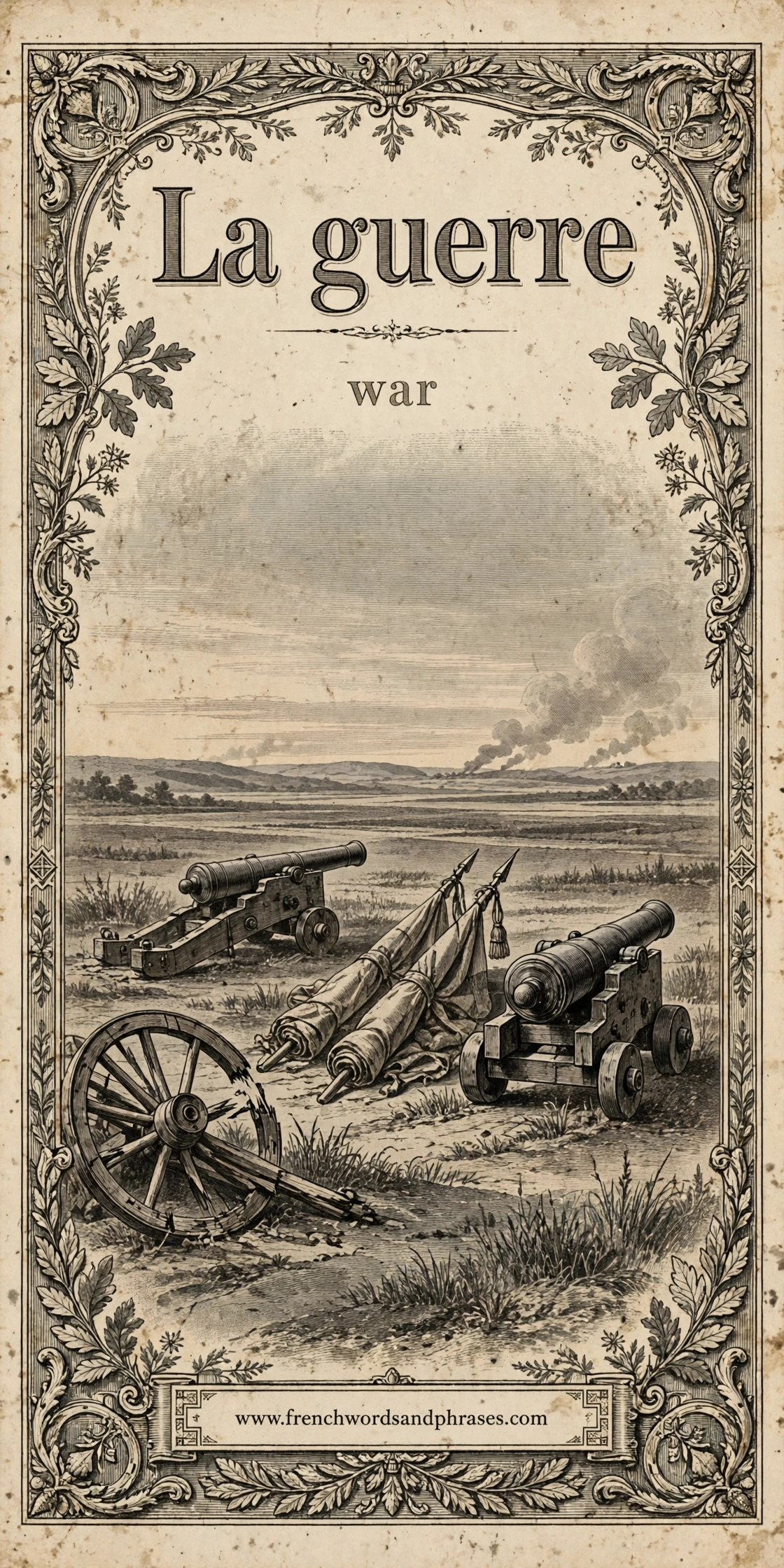
La guerre means war.
Names carved in stone in every village square in France, a generation’s photographs in black and white: la guerre, war — the heaviest noun in the language, and one no French village has been allowed to forget.
In this guide, you’ll learn what guerre means in English, how to use it with its articles, how to form its plural, and how it appears in everyday French. Explore French examples, English translations, and practice quizzes.
Understanding the French Noun Guerre
Guerre is a feminine French noun, learned with its article: la guerre, une guerre. It is not from Latin — bellum was replaced by a Germanic word, werra, strife, which also gave English its war. French history hangs its dates on it: la Première Guerre mondiale, the First World War, la Seconde Guerre mondiale, the Second, la guerre de Cent Ans, the Hundred Years’ War, la guerre froide, the Cold War.
It means war — armed conflict between states or peoples: déclarer la guerre, to declare war, être en guerre, to be at war, faire la guerre, to wage war, to fight in a war. Its frames are fixed: la guerre contre, the war against, pendant la guerre, during the war, après la guerre, after the war — in thousands of French family stories, simply la guerre means the one that marked their grandparents. Softened, it serves for any long struggle: la guerre des prix, the price war.
Gender: Feminine — la guerre
Definite article: la — la guerre (the war, war)
Indefinite article: une — une guerre (a war)
Plural: les guerres — regular, with a simple -s
Spelling note: from Germanic werra, strife — a cousin of English war, not of Latin bellum
Key verbs: déclarer la guerre (declare war), faire la guerre (wage war)
English equivalents: War; warfare.
The states of war are fixed phrases: en guerre, at war; en temps de guerre, in wartime; un pays en guerre, a country at war. Faire la guerre à quelqu’un is to wage war on someone — and in familiar French, to be hard on them. History capitalises its wars: la Grande Guerre is the First World War, and la guerre d’Algérie, la guerre du Vietnam keep the pattern guerre de / guerre du + place or date.
Experience the Word
Guerre is the noun French villages read aloud once a year — the names on the monument, in order, into the November silence.
Imagine the eleventh of November in a small town: the mayor, the flag, the schoolchildren laying flowers at the monument aux morts, where every family name appears twice — la guerre is not an abstraction here, it is a list.
You have not just named a conflict. You have named the event that divides French family time into avant and après — la guerre, the war.
How to Use Guerre in French: Complete Guide
Let’s explore how guerre works in French, beginning with its articles — la guerre, une guerre, être en guerre.
Guerre with the Definite Article (La, Les)
Used for a specific war — above all, the one a family or a century means by la guerre.
| Form | French |
|---|---|
| Feminine singular | la guerre |
| Plural | les guerres |
Example
La guerre a changé le visage du village.
The war changed the face of the village.
Guerre with the Indefinite Article (Une, Des)
Used for a war in general — one war among the wars of history.
| Form | French |
|---|---|
| Feminine singular | une guerre |
| Plural | des guerres |
Example
Une guerre terrible a éclaté à l’est.
A terrible war broke out in the east.
The Great Named Wars (Les grandes guerres)
History’s set list — each name built with guerre and learned whole.
| War | French |
|---|---|
| the First World War | la Première Guerre mondiale |
| the Second World War | la Seconde Guerre mondiale |
| the Hundred Years’ War | la guerre de Cent Ans |
| the Cold War | la guerre froide |
| the Great War | la Grande Guerre |
Example
La guerre de Cent Ans a opposé la France et l’Angleterre.
The Hundred Years’ War set France and England against each other.
Quick Quiz 1
Complete the sentence:
______ guerre froide a duré plus de quarante ans. (the)
Reveal the answer
La
La guerre froide a duré plus de quarante ans.
The Cold War lasted more than forty years — guerre is feminine, so la.
The Plural of Guerre
Guerre takes a regular plural in -s — the wars of a century, counted with sorrow.
| Number | French |
|---|---|
| Singular | la guerre |
| Plural | les guerres |
Example
Les guerres du siècle passé ont marqué chaque famille.
The wars of the last century marked every family.
Guerre with Possessive Adjectives (Ma, Ta, Sa…)
Possessives agree with the noun: guerre is feminine, so ma, ta, sa in the singular.
| Owner | French |
|---|---|
| my | ma guerre |
| your (tu) | ta guerre |
| his / her | sa guerre |
| our | notre guerre |
| your (vous) | votre guerre |
| their | leur guerre |
Example
Chaque génération espère ne pas connaître sa guerre.
Each generation hopes not to know its own war.
Quick Quiz 2
Complete the sentence:
Le pays a déclaré ______ guerre à son voisin. (the)
Reveal the answer
la
Le pays a déclaré la guerre à son voisin.
The country declared war on its neighbour — déclarer la guerre, the fixed phrase.
Guerre with Demonstrative Adjectives (Cette, Ces)
Used to point: cette guerre, this war — the one being lived or remembered.
| Form | French |
|---|---|
| Feminine singular | cette guerre |
| Plural | ces guerres |
Example
Cette guerre a séparé les deux frères pour toujours.
This war separated the two brothers forever.
Guerre with Adjectives
Adjectives agree with guerre — feminine singular: une guerre terrible, la guerre mondiale.
| Adjective | With Guerre |
|---|---|
| mondiale (world) | la guerre mondiale |
| froide (cold) | la guerre froide |
| terrible (terrible) | une guerre terrible |
| longue (long) | une longue guerre |
| civile (civil) | une guerre civile |
Example
Une guerre civile déchire le pays depuis des années.
A civil war has torn the country apart for years.
Quick Quiz 3
Complete the sentence:
La Seconde Guerre ______ s’est terminée en 1945. (world)
Reveal the answer
mondiale
La Seconde Guerre mondiale s’est terminée en 1945.
The Second World War ended in 1945 — mondiale, feminine, to agree with guerre.
Everyday Expressions with Guerre
Declarations, wartime and price wars — the guerre phrases of daily life.
| Expression | In English |
|---|---|
| déclarer la guerre | to declare war |
| être en guerre | to be at war |
| faire la guerre | to wage war, to fight in a war |
| en temps de guerre | in wartime |
| la guerre des prix | the price war |
Example
En temps de guerre, le pain était rationné.
In wartime, bread was rationed.
Words from the Same Family as Guerre
Conflict and its opposite — the words that travel with guerre.
| French | In English |
|---|---|
| la paix | peace — the opposite |
| un soldat | a soldier |
| une bataille | a battle |
| un conflit | a conflict |
| guerrier | warlike; a warrior |
Example
Après la guerre, la paix a été signée dans cette salle.
After the war, peace was signed in this room.
Quick Quiz 4
What does être en guerre mean?
Reveal the answer
To be at war — en guerre is the state, without an article.
Les deux pays sont en guerre depuis un an.
The two countries have been at war for a year.
Guerre in Everyday French: Real-Life Examples
Now that you know the word, let’s see how guerre appears in everyday French.
Example 1 — History
La Première Guerre mondiale a commencé en 1914.
The First World War began in 1914.
Example 2 — The news
Le pays est en guerre avec son voisin.
The country is at war with its neighbour.
Example 3 — Family memory
Mon grand-père a fait la guerre comme soldat.
My grandfather fought in the war as a soldier.
Example 4 — Wartime
En temps de guerre, tout manquait.
In wartime, everything was lacking.
Example 5 — Declaration
Le gouvernement a déclaré la guerre.
The government declared war.
Example 6 — Business
La guerre des prix fait baisser les tarifs.
The price war is bringing prices down.
Beyond Translation: The Meaning of Guerre
Guerre is a word France imported from its northern neighbours and then wrote across its own history: every village monument, every school textbook, every family’s avant la guerre and après la guerre. Its Germanic root, werra — strife, confusion — is honest about what it names. But French also tamed the word for smaller battlefields: la guerre des prix between supermarkets, la guerre des boutons in the famous children’s novel, and the everyday faire la guerre à la poussière, to wage war on dust. The noun scales from the Somme to the supermarket without changing its uniform.
To say guerre is to measure a struggle by the largest one there is.
It evokes the monument in the square, the ration card in the drawer, and — softened — every stubborn little campaign of daily life.
How to Remember the French Noun Guerre
Remember it this way: Guerre is war — feminine: la guerre, with fixed phrases déclarer la guerre, être en guerre, faire la guerre.
- Always feminine — la guerre, une guerre, ma guerre.
- The states — être en guerre, at war; en temps de guerre, in wartime.
- The named wars — la Première Guerre mondiale, la guerre froide, la guerre de Cent Ans.
The key idea is la guerre — war, feminine; être en guerre = to be at war.
Test Your Knowledge of Guerre
Let’s see how much you’ve learned. Try answering these questions before revealing the answers.
Question 1
Is guerre masculine or feminine?
Reveal the answer
Feminine — la guerre, une guerre.
Question 2
How do you say to declare war?
Reveal the answer
Déclarer la guerre.
Question 3
Translate: The country is at war.
Reveal the answer
Le pays est en guerre.
Question 4
How do you say the Cold War?
Reveal the answer
La guerre froide.
Question 5
Complete the sentence:
______ guerres ont marqué ce siècle. (the)
Reveal the answer
Les
Les guerres ont marqué ce siècle.
Wars have marked this century.
Your Final Challenge
Can You Use It?
How would you say this in French?
“In wartime, bread was rationed.”
Reveal the answer
En temps de guerre, le pain était rationné.
In wartime, bread was rationed.
A little French. A little curiosity. A richer everyday life.
LEARN FRENCH ONE WORD AT A TIME