A French Word to Live By
Translate Matin to English
/ma.tɛ̃/
Le matin means the morning.
First light at the shutters, coffee steaming, the street still blue and quiet: le matin, the morning — the half of the day French greets with bonjour and spends, more than any other, in ritual.
In this guide, you’ll learn what matin means in English, how to use it with its articles, how to form its plural, and how it appears in everyday French. Explore French examples, English translations, and practice quizzes.
Understanding the French Noun Matin
Matin is a masculine French noun, learned with its article: le matin, un matin. It comes from the Latin matutinum, the early hours, built on Matuta, goddess of dawn. French uses it two ways: for the morning as a stretch of time — le matin, je travaille, in the morning I work — and for one single morning as an event: un matin d’hiver, a winter morning. Its longer sister la matinée is the morning as a duration, spent doing something: passer la matinée à lire.
It means the morning: ce matin, this morning, demain matin, tomorrow morning, hier matin, yesterday morning — note that matin needs no preposition after ce, demain and hier. The fixed phrases run the French day: de bon matin, early in the morning, le petit matin, the small hours before dawn, du matin au soir, from morning to night, à sept heures du matin, at seven in the morning. A person is du matin — a morning person — or not.
Gender: Masculine — le matin
Definite article: le — le matin (the morning)
Indefinite article: un — un matin (one morning)
Plural: les matins — regular, with a simple -s
Spelling note: ce matin, demain matin, hier matin — no preposition needed
Matin or matinée?: le matin is the time of day; la matinée is the morning as a spent duration
English equivalents: The morning.
Time expressions with matin are a small system: le matin for habit (le matin, elle court — in the mornings, she runs), ce matin for today, un matin for one particular morning in a story. Clock times take du matin: huit heures du matin, 8 a.m. And la matinée is not a mistake: it is the feminine duration form — toute la matinée, the whole morning — exactly as la soirée answers le soir.
Experience the Word
Matin is the noun of beginnings — the day’s first, freshest territory, before anything has had time to go wrong.
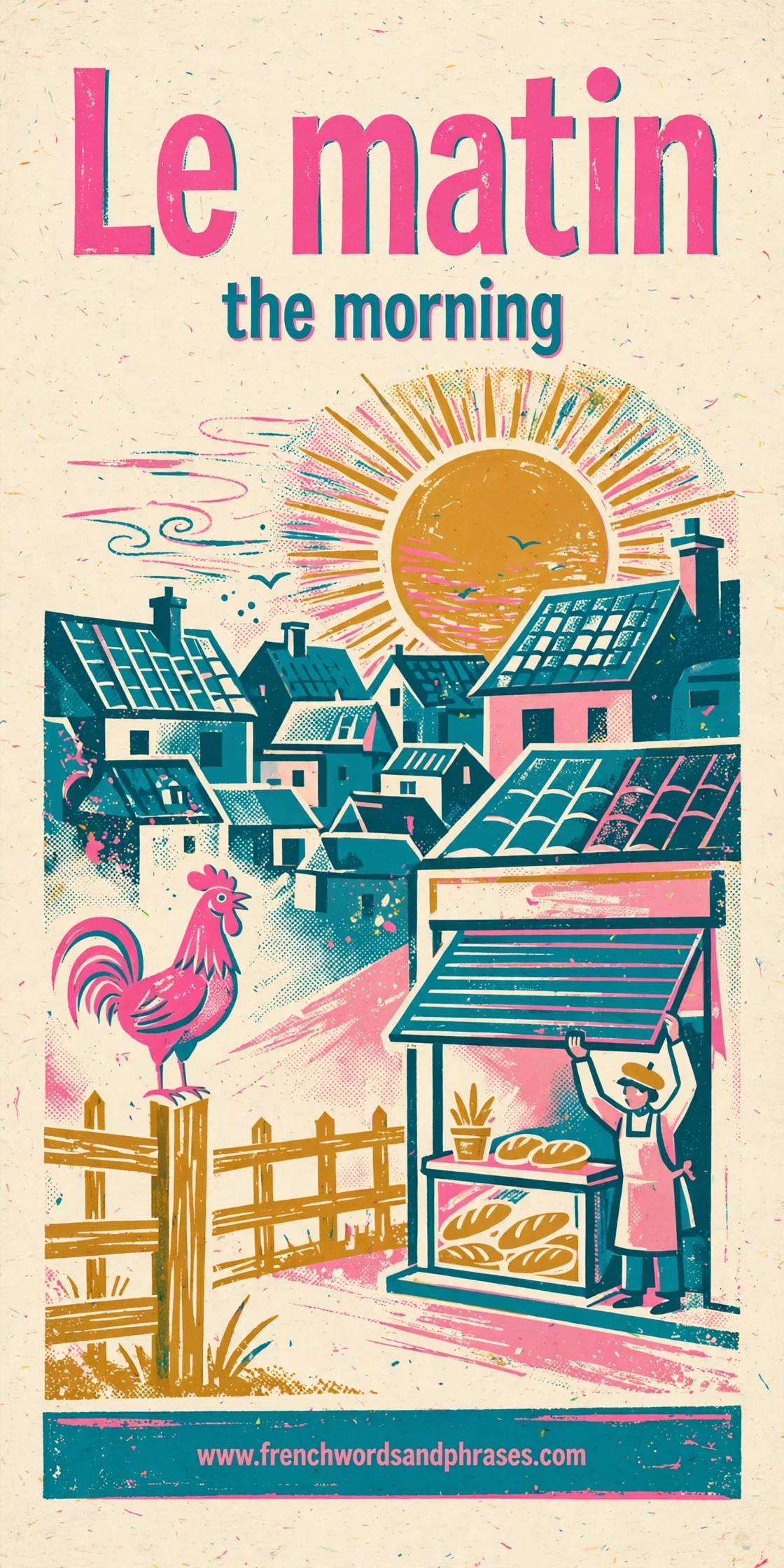
Imagine the baker’s morning: up at four, flour to the elbows by five, and the first baguettes crackling as the village wakes — son matin est fini quand le nôtre commence, his morning is over when ours begins.
You have not just named a time. You have named the day’s promise — le matin, the morning, when everything is still possible.
How to Use Matin in French: Complete Guide
Let’s explore how matin works in French, beginning with its articles — le matin, ce matin, de bon matin.
Matin with the Definite Article (Le, Les)
Used for the morning as a time of day, above all for habits.
| Form | French |
|---|---|
| Masculine singular | le matin |
| Plural | les matins |
Example
Le matin, la lumière entre par la cuisine.
In the morning, the light comes through the kitchen.
Matin with the Indefinite Article (Un, Des)
Used for one particular morning — the storyteller’s opening.
| Form | French |
|---|---|
| Masculine singular | un matin |
| Plural | des matins |
Example
Un matin de printemps, elle a décidé de partir.
One spring morning, she decided to leave.
Matin in Time Expressions (Ce matin, Demain matin…)
Matin’s home ground — the phrases that place events in the day, no preposition needed.
| Expression | French |
|---|---|
| this morning | ce matin |
| tomorrow morning | demain matin |
| yesterday morning | hier matin |
| every morning | chaque matin |
| at seven in the morning | à sept heures du matin |
Example
Nous partons demain matin à l’aube.
We leave tomorrow morning at dawn.
Quick Quiz 1
Complete the sentence:
______ matin, il pleuvait quand je me suis levé. (this)
Reveal the answer
Ce
Ce matin, il pleuvait quand je me suis levé.
This morning, it was raining when I got up — ce matin, the fixed phrase.
The Plural of Matin
Matin takes a regular plural in -s — mornings counted like beads, in routines and memories.
| Number | French |
|---|---|
| Singular | le matin |
| Plural | les matins |
Example
Les matins d’été commencent tôt à la campagne.
Summer mornings begin early in the countryside.
Matin with Possessive Adjectives (Mon, Ton, Son…)
Possessives agree with the noun: matin is masculine, so mon, ton, son in the singular.
| Owner | French |
|---|---|
| my | mon matin |
| your (tu) | ton matin |
| his / her | son matin |
| our | notre matin |
| your (vous) | votre matin |
| their | leur matin |
Example
Mon matin commence toujours par un café.
My morning always begins with a coffee.
Quick Quiz 2
Complete the sentence:
Le train part à six heures ______ matin. (in the — clock time)
Reveal the answer
du
Le train part à six heures du matin.
The train leaves at six in the morning — clock times take du matin.
Matin with Demonstrative Adjectives (Ce, Ces)
Used to point: ce matin, this morning — the one happening now.
| Form | French |
|---|---|
| Masculine singular | ce matin |
| Plural | ces matins |
Example
Ces matins de brume rendent la route dangereuse.
These misty mornings make the road dangerous.
Matin with Adjectives
Adjectives agree with matin — masculine singular: un beau matin, le petit matin.
| Adjective | With Matin |
|---|---|
| beau (fine, lovely) | un beau matin |
| petit (small, early — set phrase) | le petit matin |
| froid (cold) | un matin froid |
| calme (calm) | un matin calme |
| suivant (following, next) | le matin suivant |
Example
Un beau matin de mai, les hirondelles sont revenues.
One fine May morning, the swallows came back.
Quick Quiz 3
Complete the sentence:
Elle s’est levée de ______ matin, avant tout le monde. (early — set phrase)
Reveal the answer
bon
Elle s’est levée de bon matin, avant tout le monde.
She got up early in the morning, before everyone — de bon matin is the set phrase.
Everyday Expressions with Matin
Alarms, dawns and routines — the matin phrases of daily life.
| Expression | In English |
|---|---|
| de bon matin | early in the morning |
| le petit matin | the small hours, early dawn |
| du matin au soir | from morning to night |
| être du matin | to be a morning person |
| le matin même | that very morning |
Example
Du matin au soir, il ne pense qu’à son jardin.
From morning to night, he thinks only of his garden.
Words from the Same Family as Matin
The day’s other hours — the words that travel with matin.
| French | In English |
|---|---|
| la matinée | the morning as a duration (in the morning, theatre matinée) |
| le midi | midday, noon |
| l’après-midi | the afternoon |
| le soir | the evening |
| matinal | early, morning (adjective) — un oiseau matinal |
Example
Elle a passé la matinée à écrire des lettres.
She spent the morning writing letters.
Quick Quiz 4
What does de bon matin mean?
Reveal the answer
Early in the morning — before the day has properly begun.
De bon matin, le marché est déjà plein.
Early in the morning, the market is already full.
Matin in Everyday French: Real-Life Examples
Now that you know the word, let’s see how matin appears in everyday French.
Example 1 — Today
Ce matin, le ciel est complètement bleu.
This morning, the sky is completely blue.
Example 2 — Tomorrow
Nous prenons le train demain matin.
We are taking the train tomorrow morning.
Example 3 — Routine
Le matin, il court avant le petit déjeuner.
In the morning, he runs before breakfast.
Example 4 — Clock time
La réunion commence à neuf heures du matin.
The meeting starts at nine in the morning.
Example 5 — Early
De bon matin, les pêcheurs sont déjà en mer.
Early in the morning, the fishermen are already at sea.
Example 6 — Character
Je suis du matin : je me lève avec le soleil.
I am a morning person: I get up with the sun.
Beyond Translation: The Meaning of Matin
Matin descends from Matuta, the Roman goddess of dawn, and the word still carries her freshness: in French, le matin is not merely a segment of the clock but the day’s youth — the hours of coffee, markets and departures. The language guards a subtle pair here: le matin names the time, la matinée names the time as you spend it, and French speakers switch between them without thinking, the way English switches between morning and the whole morning long. Learn matin with its phrases — ce matin, demain matin, de bon matin — and you hold the keys to the French day’s front door.
To say matin is to stand at the day’s beginning, coffee in hand.
It evokes first light, fresh bread, and the road taken early — the morning, France’s favourite hour.
How to Remember the French Noun Matin
Remember it this way: Matin is the morning — masculine: le matin, and it follows ce, demain and hier with no preposition at all.
- Always masculine — le matin, un matin, mon matin.
- No preposition — ce matin, demain matin, hier matin.
- The pair — le matin is the time; la matinée is the morning you spend.
The key idea is le matin — the morning, masculine; de bon matin = early in the morning.
Test Your Knowledge of Matin
Let’s see how much you’ve learned. Try answering these questions before revealing the answers.
Question 1
Is matin masculine or feminine?
Reveal the answer
Masculine — le matin, un matin.
Question 2
How do you say tomorrow morning?
Reveal the answer
Demain matin — no preposition.
Question 3
Translate: The meeting starts at nine in the morning.
Reveal the answer
La réunion commence à neuf heures du matin.
Question 4
What is the difference between le matin and la matinée?
Reveal the answer
Le matin is the time of day; la matinée is the morning as a duration you spend — passer la matinée à lire.
Question 5
Complete the sentence:
______ matins d’hiver sont froids et sombres. (the)
Reveal the answer
Les
Les matins d’hiver sont froids et sombres.
Winter mornings are cold and dark.
Your Final Challenge
Can You Use It?
How would you say this in French?
“We are taking the train tomorrow morning.”
Reveal the answer
Nous prenons le train demain matin.
We are taking the train tomorrow morning.
A little French. A little curiosity. A richer everyday life.
LEARN FRENCH ONE WORD AT A TIME