
A French Word to Live By
How to Conjugate Voler in French
/vɔ.le/
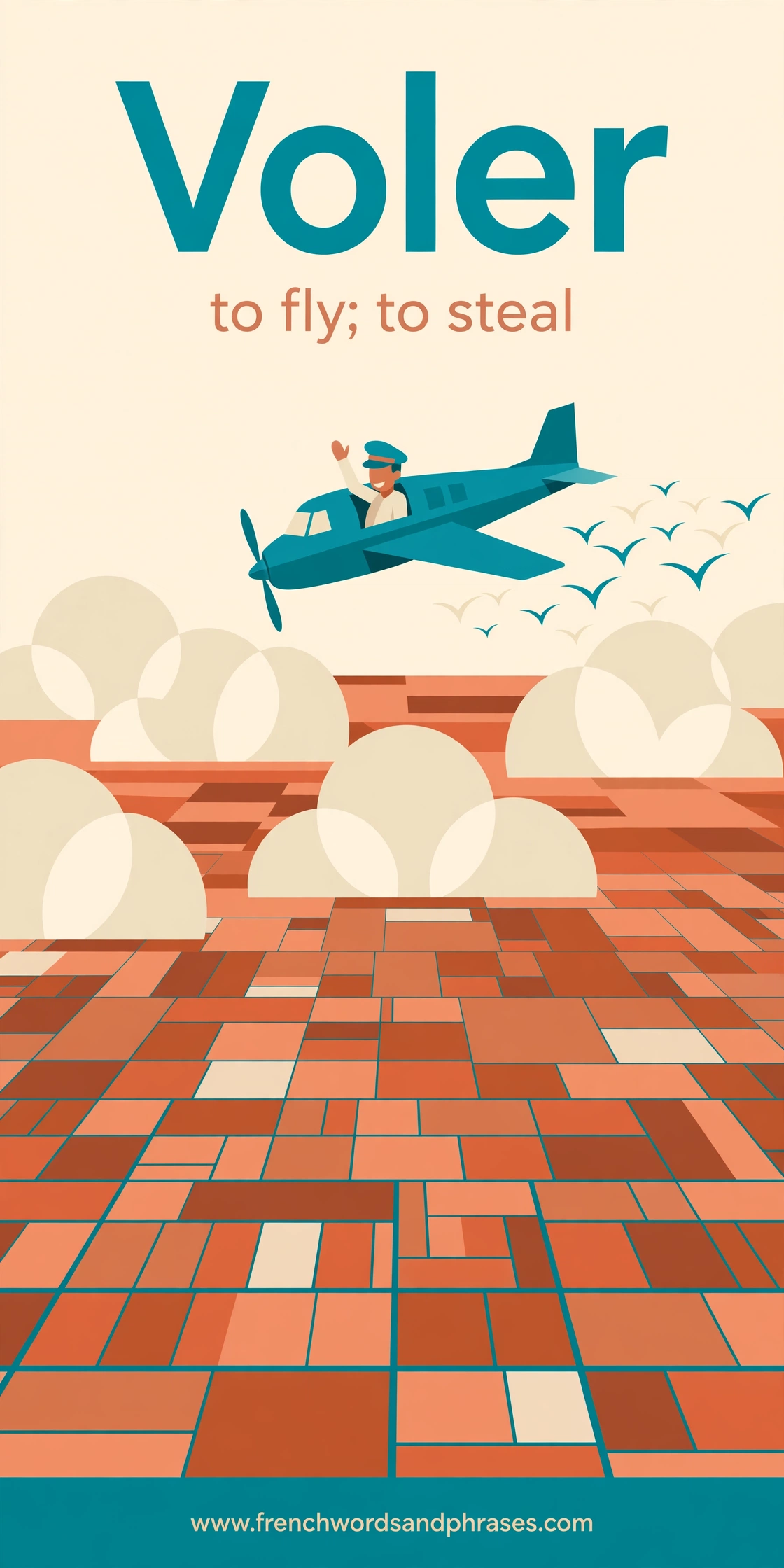
Voler means to fly — through the air, like a bird, a plane or a leaf on the wind; and it means to steal — the hawk’s old gesture, swooping down and carrying off what was not given.
A swallow stitching the evening sky, a kite climbing over the beach, a hand slipping a wallet from a pocket in the crowd — voler holds flight and theft in a single verb, the swoop and the snatch, and French has never wanted to separate them.
In this guide, you’ll learn how to conjugate voler in all the major French tenses and moods. Explore complete conjugation tables, French examples, English translations, and practice quizzes.
Understanding the French Verb Voler
Voler is a regular French verb belonging to the first group of verbs, those ending in-er.
It means to fly; to steal. Listen for the company: with birds, planes, kites, leaves and time itself (le temps vole, time flies), voler is flight. With bags, cars, money and ideas (voler une idée), it is theft — and the victim’s construction is se faire voler: je me suis fait voler mon vélo, I had my bike stolen. A third flash of the verb: voler en éclats, to fly into pieces, to shatter.
Verb classification: First group (-er)
Auxiliary verb: Avoir
Past participle: volé
Present participle: volant
English equivalents: To fly; to steal; voler vers Paris — to fly to Paris; voler un sac — to steal a bag; se faire voler quelque chose — to have something stolen; voler en éclats — to shatter, to fly into pieces; voler au secours de quelqu’un — to fly to someone’s rescue.
One important detail: voler is perfectly regular in both its lives — je vole, nous volons, ils volent, past participle volé — so only the context tells you whether the subject has wings or light fingers. The theft sense was born in falconry: the trained hawk volait — flew at — the prey and seized it; the seizing kept the flying verb, and the thief inherited the hawk’s name for his gesture.
Experience the Word
Voler is the verb of the swift taking — of everything that leaves the ground, or leaves its owner, faster than the eye approves.
Imagine the market square at noon: above the stalls, les hirondelles volent, the swallows fly, stitching the blue; below, in the press of shoppers, une main vole un portefeuille — a hand steals a wallet — with the same quick, silent swoop. The square holds both volers at once, and only the sentences know which is which.
Wings or fingers, the gesture is one. That is voler — to fly, to steal, to be gone before the cry.
How to Conjugate Voler: Complete French Conjugation Guide
Let’s explore every major conjugation of voler, beginning with the indicative mood.
How to Conjugate Voler in the Indicative Mood
The indicative mood is used to express facts, observations, actions, and events.
How to Conjugate Voler in the Present Tense (Présent)
Used for actions happening now, habitual actions, and general truths.
| Subject | Conjugation |
|---|---|
| je | vole |
| tu | voles |
| il / elle | vole |
| nous | volons |
| vous | volez |
| ils / elles | volent |
Example
Les hirondelles volent bas avant l’orage.
The swallows fly low before the storm.
Quick Quiz 1
Complete the sentence:
Nous ______ vers le Canada demain.
Reveal the answer
volerons
Nous volerons vers le Canada demain.
We will fly to Canada tomorrow.
How to Conjugate Voler in the Passé Composé
Used for completed actions in the past. Voler takes the auxiliary verb avoir.
| Subject | Conjugation |
|---|---|
| j’ | ai volé |
| tu | as volé |
| il / elle | a volé |
| nous | avons volé |
| vous | avez volé |
| ils / elles | ont volé |
Example
On nous a volé les vélos pendant la nuit.
Our bikes were stolen during the night.
How to Conjugate Voler in the Imparfait (Imperfect Tense)
Used for habitual past actions, descriptions, and ongoing situations in the past.
| Subject | Conjugation |
|---|---|
| je | volais |
| tu | volais |
| il / elle | volait |
| nous | volions |
| vous | voliez |
| ils / elles | volaient |
Example
Autrefois, cet avion volait entre Paris et New York.
In the old days, this plane flew between Paris and New York.
Quick Quiz 2
Choose the correct form:
Our bikes were stolen.
On nous ______ les vélos. (a volé / est volé)
Reveal the answer
a volé
On nous a volé les vélos.
Voler takes avoir.
How to Conjugate Voler in the Plus-que-parfait
Used to describe an action that had already been completed before another past event.
| Subject | Conjugation |
|---|---|
| j’ | avais volé |
| tu | avais volé |
| il / elle | avait volé |
| nous | avions volé |
| vous | aviez volé |
| ils / elles | avaient volé |
Example
Le cambrioleur avait volé les bijoux avant l’aube.
The burglar had stolen the jewels before dawn.
How to Conjugate Voler in the Passé Simple
Primarily used in formal writing, literature, and historical narratives. It is rarely used in everyday conversation.
| Subject | Conjugation |
|---|---|
| je | volai |
| tu | volas |
| il / elle | vola |
| nous | volâmes |
| vous | volâtes |
| ils / elles | volèrent |
Example
L’oiseau vola par-dessus les toits et disparut.
The bird flew over the rooftops and disappeared.
How to Conjugate Voler in the Passé Antérieur
A literary tense used to express an action completed immediately before another past action, generally in the passé simple.
| Subject | Conjugation |
|---|---|
| j’ | eus volé |
| tu | eus volé |
| il / elle | eut volé |
| nous | eûmes volé |
| vous | eûtes volé |
| ils / elles | eurent volé |
Example
Dès que le pilote eut volé cent heures, il obtint sa licence.
As soon as the pilot had flown a hundred hours, he obtained his licence.
How to Conjugate Voler in the Future Tense (Futur Simple)
Used to describe actions that will take place in the future.
| Subject | Conjugation |
|---|---|
| je | volerai |
| tu | voleras |
| il / elle | volera |
| nous | volerons |
| vous | volerez |
| ils / elles | voleront |
Example
Demain, nous volerons vers le Canada.
Tomorrow, we will fly to Canada.
How to Conjugate Voler in the Futur Antérieur (Future Perfect)
Used for an action that will have been completed before a particular point in the future.
| Subject | Conjugation |
|---|---|
| j’ | aurai volé |
| tu | auras volé |
| il / elle | aura volé |
| nous | aurons volé |
| vous | aurez volé |
| ils / elles | auront volé |
Example
À Noël, ils auront volé sur toutes les compagnies.
By Christmas, they will have flown with every airline.
How to Conjugate Voler in the Near Future (Futur Proche)
Used to describe something that is going to happen soon. Formed with aller + infinitive.
| Subject | Conjugation |
|---|---|
| je | vais voler |
| tu | vas voler |
| il / elle | va voler |
| nous | allons voler |
| vous | allez voler |
| ils / elles | vont voler |
Example
Le cerf-volant va voler dès que le vent se lèvera.
The kite will fly as soon as the wind rises.
How to Conjugate Voler in the Conditional Mood
The conditional mood expresses what would happen under certain circumstances. It is also frequently used to make polite requests or express wishes.
How to Conjugate Voler in the Present Conditional
| Subject | Conjugation |
|---|---|
| je | volerais |
| tu | volerais |
| il / elle | volerait |
| nous | volerions |
| vous | voleriez |
| ils / elles | voleraient |
Example
Avec des ailes, je volerais au-dessus des nuages.
With wings, I would fly above the clouds.
How to Conjugate Voler in the Past Conditional
| Subject | Conjugation |
|---|---|
| j’ | aurais volé |
| tu | aurais volé |
| il / elle | aurait volé |
| nous | aurions volé |
| vous | auriez volé |
| ils / elles | auraient volé |
Example
Sans la tempête, l’avion aurait volé à l’heure.
Without the storm, the plane would have flown on time.
Voler in the Literary Past Conditional Form
This less common literary form uses the imperfect subjunctive of avoir.
| Subject | Conjugation |
|---|---|
| j’ | eusse volé |
| tu | eusses volé |
| il / elle | eût volé |
| nous | eussions volé |
| vous | eussiez volé |
| ils / elles | eussent volé |
Example
Le dragon eût volé sur le village sans le chevalier.
The dragon would have flown over the village, had it not been for the knight.
How to Conjugate Voler in the Subjunctive Mood
The subjunctive is used to express wishes, emotions, doubts, necessity, and uncertainty. It frequently follows expressions such as il faut que (it is necessary that) or bien que (although).
How to Conjugate Voler in the Present Subjunctive
| Subject | Conjugation |
|---|---|
| que je | vole |
| que tu | voles |
| qu’il / qu’elle | vole |
| que nous | volions |
| que vous | voliez |
| qu’ils / qu’elles | volent |
Example
Il faut que cet avion vole avant la fin du mois.
This plane must fly before the end of the month.
Quick Quiz 3
Complete the sentence using the subjunctive:
Je suis surpris qu’on ______ ta voiture ici.
Reveal the answer
ait volé
Je suis surpris qu’on ait volé ta voiture ici.
I am surprised your car was stolen here.
How to Conjugate Voler in the Imperfect Subjunctive
A literary tense, rarely encountered in modern spoken French.
| Subject | Conjugation |
|---|---|
| que je | volasse |
| que tu | volasses |
| qu’il / qu’elle | volât |
| que nous | volassions |
| que vous | volassiez |
| qu’ils / qu’elles | volassent |
Example
Elle craignait que l’oiseau volât trop loin du nid.
She feared the bird might fly too far from the nest.
How to Conjugate Voler in the Pluperfect Subjunctive
A literary construction used to express an action completed before another past action.
| Subject | Conjugation |
|---|---|
| que j’ | eusse volé |
| que tu | eusses volé |
| qu’il / qu’elle | eût volé |
| que nous | eussions volé |
| que vous | eussiez volé |
| qu’ils / qu’elles | eussent volé |
Example
On racontait que le miroir eût volé en éclats d’un seul coup.
People said the mirror had flown into pieces with a single blow.
How to Conjugate Voler in the Past Subjunctive
| Subject | Conjugation |
|---|---|
| que j’ | aie volé |
| que tu | aies volé |
| qu’il / qu’elle | ait volé |
| que nous | ayons volé |
| que vous | ayez volé |
| qu’ils / qu’elles | aient volé |
Example
Je suis surpris qu’on ait volé ta voiture ici.
I am surprised your car was stolen here.
How to Conjugate Voler in the Imperative
The imperative is used to give commands, instructions, invitations, or suggestions. Subject pronouns are omitted.
How to Conjugate Voler in the Present Imperative
| Person | Conjugation |
|---|---|
| (tu) | vole |
| (nous) | volons |
| (vous) | volez |
Example
Vole, petit oiseau, vole vers le sud !
Fly, little bird, fly south!
Quick Quiz 4
How would you say Fly south (tu form, to a bird)?
Reveal the answer
Vole vers le sud !
French Participles of Voler
Participles are verb forms that can be used in compound tenses and other grammatical constructions.
Present Participle of Voler
volant
En volant de nuit, les chauves-souris évitent la chaleur.
By flying at night, bats avoid the heat.
Past Participle of Voler
volé
Volée en plein jour, la statue a été retrouvée en Italie.
Stolen in broad daylight, the statue was found again in Italy.
Voler in Everyday French: Real-Life Examples
Now that you know the conjugations, let’s see how voler appears in everyday French.
Example 1 — Present
Les hirondelles volent bas avant l’orage.
The swallows fly low before the storm.
Example 2 — Passé composé
On nous a volé les vélos pendant la nuit.
Our bikes were stolen during the night.
Example 3 — Imparfait
Cet avion volait entre Paris et New York.
This plane flew between Paris and New York.
Example 4 — Future
Demain, nous volerons vers le Canada.
Tomorrow, we will fly to Canada.
Example 5 — Conditional
Avec des ailes, je volerais au-dessus des nuages.
With wings, I would fly above the clouds.
Example 6 — Imperative
Vole, petit oiseau, vole vers le sud !
Fly, little bird, fly south!
Beyond Translation: The Meaning of Voler
Voler is French’s most elegant ambiguity: Latin volare, to fly, met the falconer’s art, where the hawk’s flight WAS the theft — the swoop that takes — and the verb kept both fortunes. Poets took the wings (le temps vole, time flies), courts took the fingers (un vol, a theft; un voleur, a thief), and the language never apologised for housing them together.
Every flight is a small theft of distance; every theft, a flight from the law.
Learn voler with its two lives clearly labelled by context, and you hold a verb that covers the swallow and the pickpocket in a single regular conjugation.
How to Remember the French Verb Voler
Remember it this way: Voler is about the swallows stitching the sky above the market while a hand steals a wallet below.
- Two lives, one conjugation: voler = to fly (birds, planes, time) and to steal (bags, cars, ideas).
- The victim’s frame: se faire voler quelque chose — je me suis fait voler mon vélo.
- Regular -er with avoir: je vole, nous volons, past participle volé; voler en éclats means to shatter.
The key idea is the swallows stitching the sky above the market while a hand steals a wallet below.
Test Your Knowledge of Voler
Let’s see how much you’ve learned. Try answering these questions before revealing the answers.
Question 1
What are the two great meanings of voler?
Reveal the answer
To fly — and to steal; context and company decide.
Question 2
How do you say our bikes were stolen in French?
Reveal the answer
On nous a volé les vélos.
Question 3
Translate: Tomorrow, we will fly to Canada.
Reveal the answer
Demain, nous volerons vers le Canada.
Question 4
What is the past participle of voler?
Reveal the answer
Volé — for both the flying and the stealing.
Question 5
Complete the sentence:
Les hirondelles ______ bas avant l’orage.
Reveal the answer
volent
Les hirondelles volent bas avant l’orage.
The swallows fly low before the storm.
Your Final Challenge
Can You Use It?
How would you say this in French?
The swallows fly above the market, and time flies with them.
Reveal the answer
Les hirondelles volent au-dessus du marché, et le temps vole avec elles.
The swallows fly above the market, and time flies with them.
A little French. A little curiosity. A richer everyday life.
LEARN FRENCH ONE WORD AT A TIME




