A French Word to Live By
Translate Neige to English
/nɛʒ/
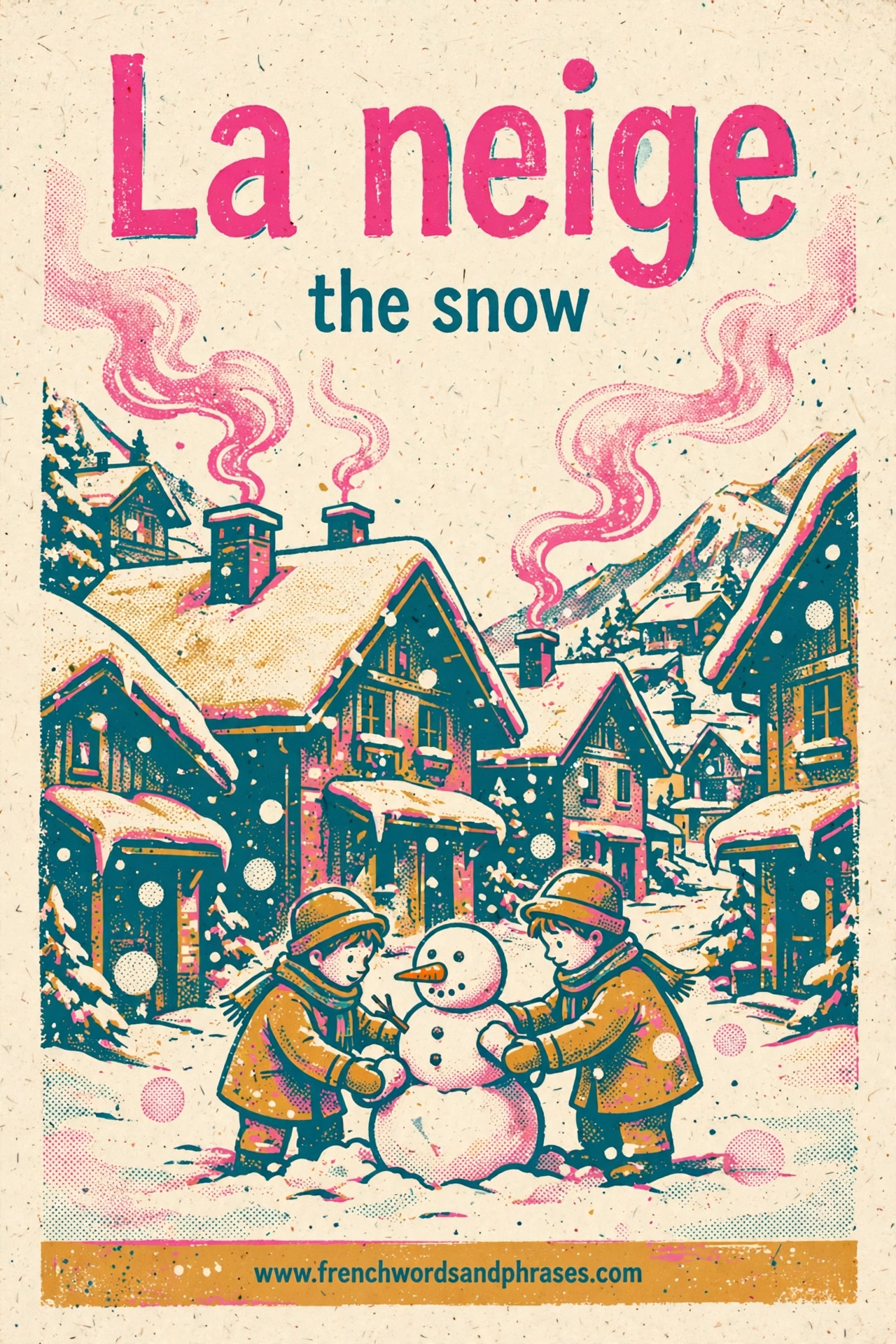
La neige means the snow.
The first flakes turning in the streetlight, the garden silent and white by morning, the mountain keeping its cap all year: la neige, the snow — winter’s own handwriting, falling softly and rewriting the whole landscape in a night.
In this guide, you’ll learn what neige means in English, how to use it with its articles, how to form its plural, and how it appears in everyday French. Explore French examples, English translations, and practice quizzes.
Understanding the French Noun Neige
Neige is a feminine French noun, learned with its article: la neige, une neige. It comes from the Latin nix, nivis, snow — the same root that gives niveau’s distant cousins and the English word’s learned twin in niveous. Its verb is neiger: il neige, it snows — one of the impersonal weather verbs, with no real subject but the sky.
It means snow — the white fall and the white cover: la neige tombe, the snow is falling, la neige fond, the snow melts, sous la neige, under the snow. French measures it in centimetres and in kinds: une neige fraîche, fresh snow, la neige poudreuse, powder snow beloved of skiers, les neiges éternelles, the eternal snows of the high peaks. In the kitchen it whips: des œufs en neige, egg whites beaten stiff — snow you can eat.
Gender: Feminine — la neige
Definite article: la — la neige (the snow)
Indefinite article: une — une neige (a snow, a snowfall)
Plural: les neiges — the snows, in set phrases: les neiges éternelles
Spelling note: its verb is impersonal: il neige, it snows, il a neigé, it snowed
Kitchen life: des œufs en neige — egg whites beaten to stiff peaks
English equivalents: The snow.
Snow is spoken of with the partitive when it lies or falls in quantity — de la neige: il y a de la neige sur le toit, there is snow on the roof. The verb neiger only exists in the il form: il neige, il neigeait, il a neigé. And a snowman is un bonhomme de neige — literally a snow fellow, never an homme de neige.
Experience the Word
Neige is the sky’s way of editing the world — every roof, road and field corrected to white, every sound politely hushed.
Imagine waking before dawn in a mountain village: the silence itself has changed, grown thicker. You open the shutter — la neige est tombée toute la nuit, the snow has fallen all night, and the garden you knew has been replaced by its white portrait.
You have not just named weather. You have named the world’s softest revolution — la neige, snow that silences and whitens everything.
How to Use Neige in French: Complete Guide
Let’s explore how neige works in French, beginning with its articles — la neige, de la neige, il neige.
Neige with the Definite Article (La, Les)
Used for the snow in question — the snow on the roof, the snows of the peaks.
| Form | French |
|---|---|
| Feminine singular | la neige |
| Plural | les neiges |
Example
La neige couvre les toits du village.
The snow covers the roofs of the village.
Neige with the Indefinite and Partitive (Une, De la…)
Snow is usually measured out with the partitive: some snow, a lot of snow, no snow at all.
| Quantity | French |
|---|---|
| some snow | de la neige |
| a snowfall | une neige (une chute de neige) |
| a lot of snow | beaucoup de neige |
| thirty centimetres of snow | trente centimètres de neige |
| no snow (after negation) | pas de neige |
Example
Il y a de la neige sur les sommets depuis hier.
There has been snow on the summits since yesterday.
Neige in the Weather (Tombe, Fond, Tient…)
Snow arrives, settles and leaves by its own verbs — learn the whole short story.
| Moment | French |
|---|---|
| the snow is falling | la neige tombe |
| it is snowing | il neige |
| the snow settles, holds | la neige tient |
| the snow melts | la neige fond |
| the eternal snows | les neiges éternelles |
Example
La neige tient sur les routes, conduisez prudemment.
The snow is settling on the roads, drive carefully.
Quick Quiz 1
Complete the sentence:
______ neige tombe depuis ce matin. (the)
Reveal the answer
La
La neige tombe depuis ce matin.
The snow has been falling since this morning — neige is feminine, so la.
The Plural of Neige
Neige lives mostly in the singular; the plural belongs to poetry and high mountains — les neiges éternelles.
| Number | French |
|---|---|
| Singular | la neige |
| Plural | les neiges |
Example
Les neiges éternelles du Mont-Blanc brillent au soleil.
The eternal snows of Mont Blanc shine in the sun.
Neige with Possessive Adjectives (Ma, Ta, Sa…)
Possessives agree with the noun: neige is feminine, so ma, ta, sa in the singular.
| Owner | French |
|---|---|
| my | ma neige |
| your (tu) | ta neige |
| his / her | sa neige |
| our | notre neige |
| your (vous) | votre neige |
| their | leur neige |
Example
Le jardin a perdu sa neige dès le premier soleil.
The garden lost its snow at the first sun.
Quick Quiz 2
How do you say it is snowing?
Reveal the answer
Il neige
Il neige depuis une heure.
It has been snowing for an hour — neiger is an impersonal verb, used only with il.
Neige with Demonstrative Adjectives (Cette, Ces)
Used to point: cette neige, this snow — this year’s, this morning’s, the one blocking the door.
| Form | French |
|---|---|
| Feminine singular | cette neige |
| Plural | ces neiges |
Example
Cette neige lourde casse les branches des arbres.
This heavy snow breaks the branches of the trees.
Neige with Adjectives
Adjectives agree with neige — feminine singular: une neige blanche, une neige fraîche.
| Adjective | With Neige |
|---|---|
| blanche (white) | une neige blanche |
| fraîche (fresh) | une neige fraîche |
| épaisse (thick) | une neige épaisse |
| poudreuse (powdery) | la neige poudreuse |
| fondue (melted) | la neige fondue |
Example
Les skieurs adorent la neige poudreuse de janvier.
Skiers love January’s powder snow.
Quick Quiz 3
Complete the sentence:
Une neige ______ couvre les champs ce matin. (fresh)
Reveal the answer
fraîche
Une neige fraîche couvre les champs ce matin.
Fresh snow covers the fields this morning — fraîche, feminine, to agree with neige.
Everyday Expressions with Neige
Snowmen, meringues and winter sports — the neige phrases of daily life.
| Expression | In English |
|---|---|
| un bonhomme de neige | a snowman |
| des œufs en neige | beaten egg whites |
| blanc comme neige | white as snow, snow-white |
| une boule de neige | a snowball |
| les sports d’hiver | winter sports (in the snow) |
Example
Les enfants font un bonhomme de neige devant la maison.
The children are making a snowman in front of the house.
Words from the Same Family as Neige
Winter’s household — the words that travel with neige.
| French | In English |
|---|---|
| neiger | to snow (the verb, il neige) |
| un flocon de neige | a snowflake |
| la glace | the ice; an ice cream |
| enneigé | snow-covered (adjective) |
| un chasse-neige | a snowplough |
Example
Un seul flocon de neige fond sur sa langue.
A single snowflake melts on her tongue.
Quick Quiz 4
What are des œufs en neige?
Reveal the answer
Beaten egg whites — whipped to stiff white peaks, like snow, for mousses and meringues.
Battez les œufs en neige avant de les ajouter.
Beat the egg whites until stiff before adding them.
Neige in Everyday French: Real-Life Examples
Now that you know the word, let’s see how neige appears in everyday French.
Example 1 — Weather
Il neige depuis ce matin, les routes sont blanches.
It has been snowing since this morning, the roads are white.
Example 2 — Children
Les enfants font un bonhomme de neige dans le jardin.
The children are making a snowman in the garden.
Example 3 — Skiing
La neige poudreuse rend la descente magnifique.
The powder snow makes the descent magnificent.
Example 4 — In the kitchen
Ajoutez les œufs en neige délicatement à la pâte.
Fold the beaten egg whites gently into the batter.
Example 5 — The peaks
Les neiges éternelles brillent au-dessus de la vallée.
The eternal snows shine above the valley.
La neige fond dès que le soleil se montre.
The snow melts as soon as the sun comes out.
Beyond Translation: The Meaning of Neige
Neige is winter’s gentlest weapon: it defeats armies and silences cities without raising its voice. French keeps the word close to purity — blanc comme neige, white as snow, is the language’s certificate of innocence — and close to pleasure, from the skier’s poudreuse to the cook’s œufs en neige, where the mountain is invited into the mixing bowl.
To say neige is to hear the world go quiet under a white hand.
It evokes the shutter opened on a transformed garden, the child’s snowman with his carrot nose, and the peaks that never surrender their cap.
How to Remember the French Noun Neige
Remember it this way: Neige is the snow — feminine: la neige, and its verb is impersonal, il neige, it snows.
- Always feminine — la neige, de la neige, cette neige.
- The weather verb — il neige, it snows; il a neigé, it snowed.
- The snowman — un bonhomme de neige, and the cook’s œufs en neige, beaten egg whites.
The key idea is la neige — the snow, feminine; il neige = it is snowing.
Test Your Knowledge of Neige
Let’s see how much you’ve learned. Try answering these questions before revealing the answers.
Question 1
Is neige masculine or feminine?
Reveal the answer
Feminine — la neige, une neige.
Question 2
How do you say it snowed yesterday?
Reveal the answer
Il a neigé hier.
Question 3
Translate: The children are making a snowman.
Reveal the answer
Les enfants font un bonhomme de neige.
Question 4
What is a snowflake in French?
Reveal the answer
Un flocon de neige.
Question 5
Complete the sentence:
______ neiges éternelles brillent au soleil. (the)
Reveal the answer
Les
Les neiges éternelles brillent au soleil.
The eternal snows shine in the sun.
Can You Use It?
How would you say this in French?
“It has been snowing since this morning, the roads are white.”
Reveal the answer
Il neige depuis ce matin, les routes sont blanches.
It has been snowing since this morning, the roads are white.
A little French. A little curiosity. A richer everyday life.
LEARN FRENCH ONE WORD AT A TIME