A French Word to Live By
Translate Direct to English
/di.ʁɛkt/
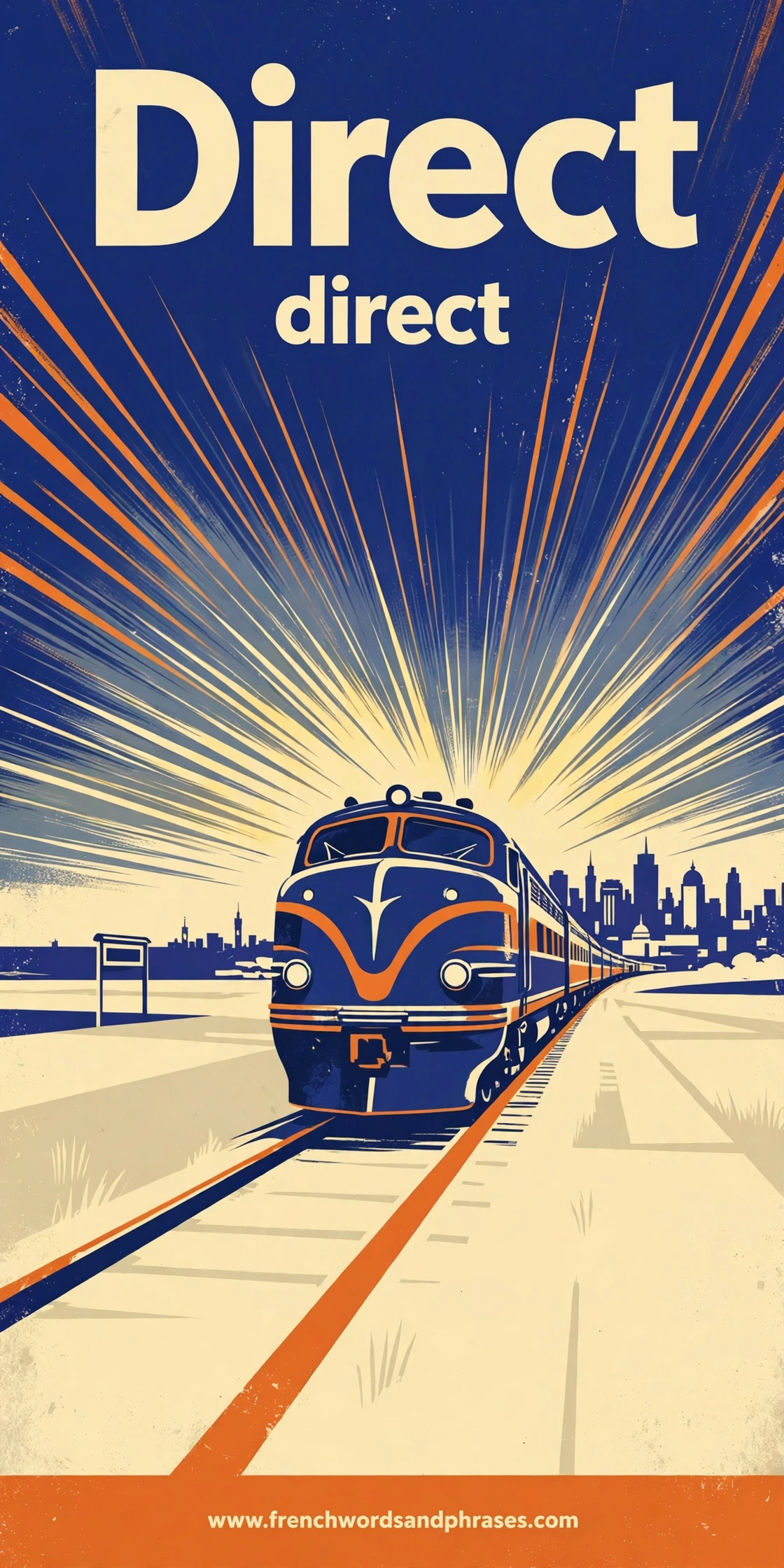
Direct means direct.
No changes, no detours, no waiting in corridors: the train goes straight there, the answer comes straight out, the look meets yours without blinking. Direct is the adjective of the straight line — in travel, in speech and in character, it cuts out everything between the start and the goal.
In this guide, you’ll learn what direct means in English, how its feminine directe is formed, where it stands in the sentence, and why French television loves its noun form, le direct. Explore French examples, English translations, and practice quizzes.
Understanding the French Adjective Direct
Direct is a French adjective of manner and route. It comes from the Latin directus, straightened, set in a line. Its feminine is directe: un train direct, une réponse directe, des vols directs. It describes whatever goes straight — routes without changes, speech without detours, people without evasion.
It means direct — first of journeys: un vol direct, a direct flight; un train direct, a through train, with no change. Then of communication: une question directe, a direct question; en direct, live on air. Then of people: un homme direct, a direct, frank man — in French, a compliment more often than a reproach. The noun twin is famous: le direct, the live broadcast.
Type: Adjective of route and manner — straight, without detour
Answers the question: How does it go? — straight there, without stopping or evading
Changes form: Feminine directe — direct / directe; plurals directs / directes
English equivalents: Direct; through (train); live (broadcast, in en direct).
One important usage detail: for journeys, direct promises no change of vehicle — un train direct pour Lyon takes you there in the same seat. For broadcasts the phrase is fixed: en direct, live — le match est en direct à la télévision. And of a person, être direct means speaking plainly: elle est très directe, she is very direct, very frank.
Experience the Word
Direct is the adjective of the unbroken line — the route, the sentence and the gaze that never look away.
Imagine the night train leaving the city: no changes, no platforms at midnight, just one long straight run through the dark while the passengers sleep. Au matin, Lyon. Voilà un train direct — travel with the middle taken out.
You have not just called something straight. You have praised the absence of detour — the shortest line between two points, honestly drawn.
How to Use Direct in French: Complete Guide
Let’s explore how direct works in French, beginning with the whole word on one card.
Direct at a Glance
Before the details, here is the whole word on one card.
The Whole Word on One Card
Meaning, type, position and forms — direct in four lines.
| Point | Direct |
|---|---|
| Meaning | direct — straight, without change or detour |
| Type | adjective of route and manner — from Latin directus, straightened |
| Usual position | after the noun — un train direct |
| Form | direct / directe — directs / directes in the plural |
Example
Un train direct relie Paris à Bordeaux.
A direct train links Paris to Bordeaux.
The Four Forms of Direct
Direct forms its feminine in -e with the c sounded as ct: directe. The plurals add s.
| Form | Direct | Example |
|---|---|---|
| Masculine singular | direct | un vol direct — a direct flight |
| Feminine singular | directe | une réponse directe — a direct answer |
| Masculine plural | directs | des trains directs — direct trains |
| Feminine plural | directes | des réponses directes — direct answers |
Example
Les vols directs pour Montréal partent le matin.
The direct flights to Montreal leave in the morning.
Quick Quiz 1
What is the feminine of direct?
Reveal the answer
directe
Une question directe — the feminine adds -e to direct.
A direct question.
The Feminine of Direct: Directe
Directe is not a separate word to learn later — it is half of this word’s life, formed by the regular addition of -e.
| Situation | Example |
|---|---|
| Masculine | un regard direct — a direct look |
| Feminine | une manière directe — a direct manner |
| Why | the feminine adds -e to the masculine form |
| The plural | add s to the feminine — des manières directes, direct manners |
Example
Elle a une manière directe de poser les questions.
She has a direct way of asking questions.
Where Direct Goes: After the Noun
Direct follows the noun it describes, like most French adjectives, and it sits naturally after être.
| Pattern | Example |
|---|---|
| After the noun | un train direct — a direct train |
| After être | elle est directe — she is direct, frank |
| In the fixed phrase | en direct — live (on air) |
| Before the noun | un direct train — not French; never before the noun |
Example
Ce chemin est plus direct que la route principale.
This path is more direct than the main road.
Quick Quiz 2
How do you say ‘a direct flight’ — un direct vol or un vol direct?
Reveal the answer
un vol direct
Direct stands after the noun in French.
A direct flight.
More Direct: Comparing with Direct
Direct compares the regular way, with plus, moins and aussi — straighter and less straight lines.
| Degree | Example |
|---|---|
| As direct as | aussi direct que — as direct as |
| More direct | plus direct — more direct |
| Less direct | moins direct — less direct |
| The most direct (masc.) | le plus direct — le plus direct des chemins |
| The most direct (fem.) | la plus directe — la plus directe des réponses |
Example
Prenons le chemin le plus direct pour rentrer.
Let’s take the most direct way home.
Everyday Expressions with Direct
Direct appears wherever French travels, broadcasts or speaks plainly.
| Expression | In English |
|---|---|
| un train direct | a direct, through train |
| un vol direct | a direct flight |
| en direct | live (on television, radio, online) |
| une question directe | a direct question |
| le direct | the live broadcast (as a noun) |
| être direct | to be direct, to speak plainly |
Example
Le concert est retransmis en direct ce soir.
The concert is broadcast live tonight.
Quick Quiz 3
What does en direct mean on television?
Reveal the answer
Live
En direct — broadcast as it happens, not recorded.
Live.
Direct and Its Neighbours
Direct keeps company with the other words of straightness — and faces the detour.
| French | In English |
|---|---|
| franc / franche | frank — direct in character |
| immédiat | immediate — without anything in between |
| droit | straight — tout droit, straight ahead |
| indirect | indirect — the opposite route |
| détourné | roundabout, diverted — the far opposite |
Example
Franche et directe, elle dit ce qu’elle pense.
Frank and direct, she says what she thinks.
Watch Out: The Traps Around Direct
The traps here are the broadcast phrase and the promise inside a direct train: no change, or the word is lying.
| Trap | The truth |
|---|---|
| A direct train | un train direct promises no change of train — if you change, it was not direct |
| Live television | en direct — never « en live » in careful French |
| Of a person | être direct is usually praise: plain-spoken, not rude |
| The feminine | une réponse directe — the -e is added and the t is heard |
Example
Il est direct, parfois brusque, mais jamais malhonnête.
He is direct, sometimes blunt, but never dishonest.
Quick Quiz 4
How do you say ‘direct answers’?
Reveal the answer
des réponses directes
Direct agrees with the feminine plural noun: directes.
Direct answers.
Direct in Everyday French: Real-Life Examples
Now that you know the word, let’s see how direct appears in everyday French.
Example 1 — Travel
Y a-t-il un train direct pour Nantes ?
Is there a direct train to Nantes?
Example 2 — Television
Le match est en direct à partir de vingt heures.
The match is live from eight o’clock.
Example 3 — Speech
Elle pose toujours des questions directes.
She always asks direct questions.
Example 4 — Character
Il est direct, il dit ce qu’il pense.
He is direct, he says what he thinks.
Example 5 — Directions
Ce chemin est le plus direct vers la plage.
This path is the most direct way to the beach.
Example 6 — Flights
Nous avons réservé un vol direct, sans escale.
We booked a direct flight, with no stopover.
Beyond Translation: The Meaning of Direct
Direct is Latin geometry in a French word: directus, drawn straight. The word kept the ruler’s honesty in every field it entered — the railway promises no change, the broadcast promises no delay, the speaker promises no evasion. French television built a noun from it, le direct, the live moment itself, as if straightness in time deserved a name of its own.
Direct is the adjective of the honest line — the word French trusts when nothing must come between.
Learn it with its mirror indirect and its cousin franc, and you can describe every route, answer and character on the straightness scale.
How to Remember the French Adjective Direct
Remember it this way: Direct is the straight one — direct for him, directe for her, and en direct for everything live.
- You place it behind — un train direct, une réponse directe.
- You keep the promise — a direct train means no change, ever.
- You broadcast with it — en direct, live on air.
The key idea is direct / directe means direct; en direct = live.
Test Your Knowledge of Direct
Let’s see how much you’ve learned. Try answering these questions before revealing the answers.
Question 1
What does direct mean?
Reveal the answer
Direct — straight, without change or detour.
Question 2
What is the feminine of direct?
Reveal the answer
directe — une réponse directe.
Question 3
Translate: a direct flight.
Reveal the answer
Un vol direct.
Question 4
Complete the sentence:
Elle pose des questions ______.
Reveal the answer
directes
Elle pose des questions directes.
She asks direct questions.
Question 5
How do you say a match is live on television?
Reveal the answer
Le match est en direct — en direct is the fixed phrase for live.
Your Final Challenge
Can You Use It?
How would you say this in French?
“The concert is broadcast live tonight.”
Reveal the answer
Le concert est retransmis en direct ce soir.
The concert is broadcast live tonight.
A little French. A little curiosity. A richer everyday life.
LEARN FRENCH ONE WORD AT A TIME