A French Word to Live By
Translate Proche to English
/pʁɔʃ/
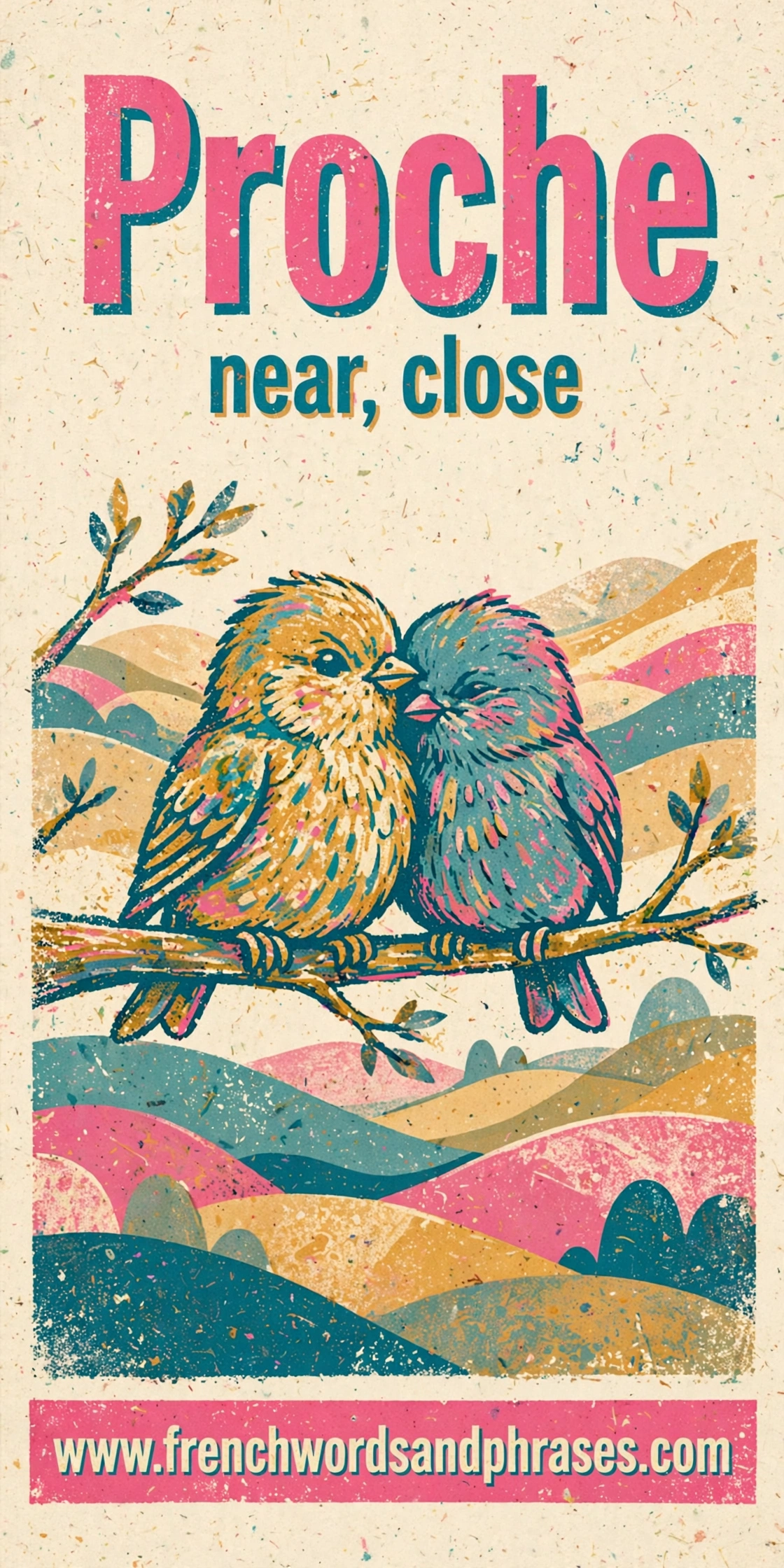
Proche means near, close.
The tired walkers crest the hill and the youngest points down at the valley lights: « Le village est proche ! » — The village is near! Proche is the adjective of small distances: the town almost reached, the friend almost family, the date almost here.
In this guide, you’ll learn what proche means in English, why its form never changes for the feminine, where it stands in the sentence, and how proche de builds the everyday phrase for ‘near to’. Explore French examples, English translations, and practice quizzes.
Understanding the French Adjective Proche
Proche is a French adjective of distance — in space, in time and in the heart. It already ends in -e, so it is invariable in gender: un village proche, une ville proche — one form for both. It stands after the noun, and it builds its most useful frame with de: proche de la gare, near the station.
It means near, close: une maison proche de l’école, a house near the school; l’avenir proche, the near future; des amis proches, close friends. As a noun, un proche is a close relative or loved one: ses proches, his loved ones. One word measures metres, days and affections with the same ruler.
Type: Adjective of distance — space, time and affection
Answers the question: À quelle distance ? — At what distance? (Answer: near, close)
Changes form: Invariable in gender — proche for him and for her; plural proches
English equivalents: Near, close; (as a noun) a loved one, a close relative.
One important usage detail: proche almost always travels with de when a place follows — proche de la gare, proche du centre (de + le = du). Standing alone after être, it needs no de: le village est proche, the village is near. And the noun twin is precious in careful French: les proches means the loved ones, the people close to someone — the word of hospitals and news bulletins.
Experience the Word
Proche is the adjective of the last kilometre — the distance you can feel shrinking.
Imagine the emigrant grandmother on the telephone, an ocean away, saying of her grandson in the same street: « Au moins, toi, tu es proche. » Nearness, in her mouth, is not measured in metres at all — proche is the word where geography and love share a ruler.
You have not just measured a distance. You have said what can be reached — a place, a date, a heart.
How to Use Proche in French: Complete Guide
Let’s explore how proche works in French, beginning with the whole word on one card.
Proche at a Glance
Before the details, here is the whole word on one card.
The Whole Word on One Card
Meaning, type, position and forms — proche in four lines.
| Point | Proche |
|---|---|
| Meaning | near, close — in space, time or affection |
| Type | adjective of distance |
| Usual position | after the noun — un village proche |
| Form | proche for both genders — proches in the plural |
Example
La gare est proche de l’hôtel.
The station is near the hotel.
The Four Forms of Proche
Proche already ends in -e, so masculine and feminine are identical; only the plural adds an s.
| Form | Proche | Example |
|---|---|---|
| Masculine singular | proche | un ami proche — a close friend |
| Feminine singular | proche | une amie proche — a close friend (female) |
| Masculine plural | proches | des villages proches — nearby villages |
| Feminine plural | proches | des villes proches — nearby towns |
Example
Des amis proches valent mieux que des trésors.
Close friends are worth more than treasures.
Quick Quiz 1
What is the feminine of proche?
Reveal the answer
proche
Une ville proche — the word already ends in -e, so the feminine changes nothing.
A nearby town.
The Feminine of Proche: The Same Word
Proche is not a word with a separate feminine to learn later — it keeps one single form for him and for her, like all adjectives ending in -e.
| Situation | Example |
|---|---|
| Masculine | un magasin proche — a nearby shop |
| Feminine | une boutique proche — identical: the -e is already there |
| Why | adjectives ending in -e do not change for the feminine |
| The plural | add s — des maisons proches, nearby houses |
Example
Une école proche attire les jeunes familles.
A nearby school attracts young families.
Where Proche Goes: After the Noun, With De
Proche follows the noun it describes, and when the other landmark is named, de builds the bridge: proche de, proche du, proche des.
| Pattern | Example |
|---|---|
| After the noun | un hôtel proche — a nearby hotel |
| With de + place | proche de la gare — near the station |
| With du (de + le) | proche du centre — near the centre |
| After être, alone | le village est proche — the village is near |
Example
Ils habitent proche de la mer.
They live near the sea.
Quick Quiz 2
How do you say ‘near the station’ — proche la gare or proche de la gare?
Reveal the answer
proche de la gare
Proche builds its bridge with de.
Near the station.
More Proche: Comparing with Proche
Proche compares the regular way, with plus, moins and aussi — a scale of distances.
| Degree | Example |
|---|---|
| As near as | aussi proche que — as close as |
| Nearer | plus proche — closer, nearer |
| Less near | moins proche — less close |
| The nearest (masc.) | le plus proche — le plus proche village |
| The nearest (fem.) | la plus proche — la plus proche ville |
Example
La boulangerie la plus proche est à deux rues d’ici.
The nearest bakery is two streets from here.
Everyday Expressions with Proche
Proche measures the map, the calendar and the family tree.
| Expression | In English |
|---|---|
| proche de | near to, close to |
| un ami proche | a close friend |
| les proches | the loved ones, the close family |
| dans un avenir proche | in the near future |
| le Proche-Orient | the Near East (the Middle East region) |
Example
Dans un avenir proche, la ligne de train ouvrira.
In the near future, the railway line will open.
Quick Quiz 3
What does les proches mean, as a noun?
Reveal the answer
The loved ones — the people close to someone: family and dearest friends.
Il passe Noël avec ses proches.
He spends Christmas with his loved ones.
Close Cousins: Proche, Près de, Loin
Distance has a small family: proche the adjective, près de the phrase, and loin standing at the far end.
| Word | The difference |
|---|---|
| proche | near, close — an adjective: un village proche; also of friends and dates |
| près de | near, close to — the adverb phrase of pure position: près de la gare |
| voisin | neighbouring — the adjective of next door: le village voisin |
| loin | far — the opposite bank of the river: loin d’ici |
Example
Le village voisin est proche, le suivant est loin.
The neighbouring village is near, the next one is far.
Watch Out: The Traps Around Proche
The traps: dropping the de, and confusing proche with the noun’s everyday twin près.
| Trap | The truth |
|---|---|
| proche la gare | the landmark needs de: proche de la gare, proche du centre |
| inventing a feminine | proche never changes for the feminine: une amie proche |
| proche for ‘ready’ | ready is prêt, a different word with a similar face: je suis prêt, I am ready |
| proche in time, forgotten | proche also measures days: les fêtes proches, the coming holidays |
Example
Noël est proche, et je ne suis pas encore prêt.
Christmas is near, and I am not ready yet.
Quick Quiz 4
Complete: Nous habitons ______ du parc. (near the park — de + le)
Reveal the answer
proche — with du carrying de + le: proche du parc.
Nous habitons proche du parc.
We live near the park.
Proche in Everyday French: Real-Life Examples
Now that you know the word, let’s see how proche appears in everyday French.
Example 1 — Directions
La gare est proche, cinq minutes à pied.
The station is near, five minutes on foot.
Example 2 — Housing
Ils cherchent une maison proche de l’école.
They are looking for a house near the school.
Example 3 — Friends
C’est un ami proche, presque un frère.
He is a close friend, almost a brother.
Example 4 — Family
Elle passe les fêtes avec ses proches.
She spends the holidays with her loved ones.
Example 5 — Time
Les vacances sont proches, courage !
The holidays are near, hang on!
Example 6 — The nearest
La pharmacie la plus proche est ouverte.
The nearest pharmacy is open.
Beyond Translation: The Meaning of Proche
Proche comes from a Latin word for what is at hand, within reach — and French kept the warmth of the hand in it. A place is proche when you can walk to it; a date is proche when you can almost touch it; a person is proche when the heart counts them as near, whatever the map says. Few adjectives measure three worlds with one ruler.
To say proche is to shrink the world to the size of a walk, a wait, or an embrace.
It is the word of homecomings: le village est proche — the village is near — is the sentence every long road is travelled to hear.
How to Remember the French Adjective Proche
Remember it this way: Proche means near and close — one form for both genders, after the noun, and proche de for every landmark.
- One form only — un village proche, une ville proche, the -e is already there.
- The bridge is de — proche de la gare, proche du centre.
- The noun twin is tender — les proches, the loved ones.
The key idea is proche = near, close (invariable); proche de = near to; les proches = loved ones.
Test Your Knowledge of Proche
Let’s see how much you’ve learned. Try answering these questions before revealing the answers.
Question 1
What does proche mean?
Reveal the answer
Near, close — in space, in time and in affection.
Question 2
What is the feminine of proche?
Reveal the answer
Proche — it already ends in -e and never changes: une amie proche.
Question 3
Translate: The station is near the hotel.
Reveal the answer
La gare est proche de l’hôtel.
Question 4
What does les proches mean?
Reveal the answer
The loved ones — the family and dearest friends of a person.
Question 5
Complete the sentence:
Ils habitent ______ de la mer. (near)
Reveal the answer
proche
Ils habitent proche de la mer.
They live near the sea.
Your Final Challenge
Can You Use It?
How would you say this in French?
“The station is near, five minutes on foot.”
Reveal the answer
La gare est proche, cinq minutes à pied.
The station is near, five minutes on foot.
A little French. A little curiosity. A richer everyday life.
LEARN FRENCH ONE WORD AT A TIME