
A French Word to Live By
How to Conjugate Entraîner in French
/ɑ̃.tʁɛ.ne/
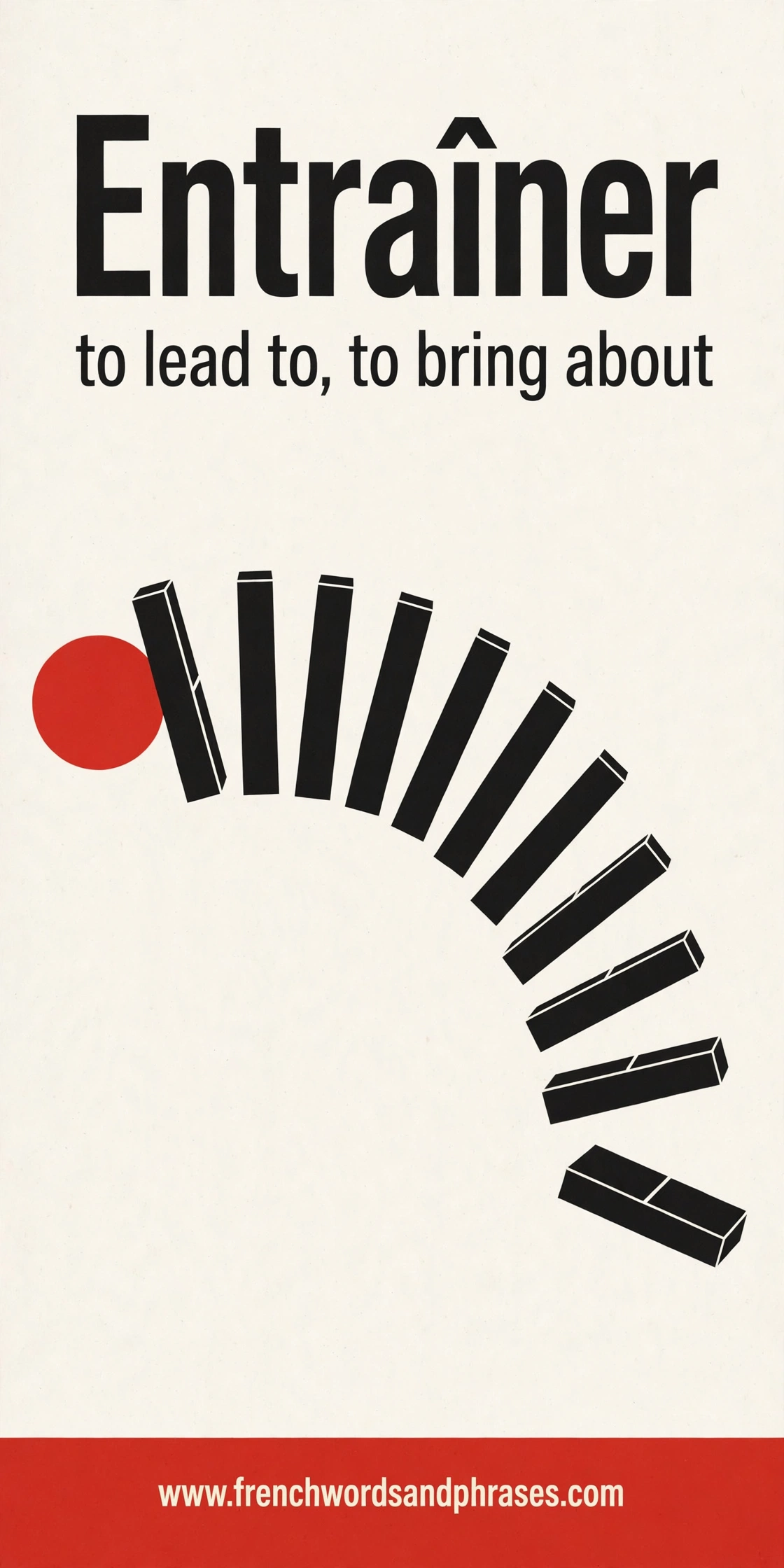
Entraîner means to lead to, to bring about — one thing dragging another in its wake, as a delay brings about a missed train, or a small lie leads to a disaster; it also means to train or coach sportsmen.
A stone that starts an avalanche, a cancelled train that ruins a whole journey, a coach drilling his runners at dawn — entraîner is the verb of consequences in motion: things, and people, pulled along by something stronger.
In this guide, you’ll learn how to conjugate entraîner in all the major French tenses and moods. Explore complete conjugation tables, French examples, English translations, and practice quizzes.
Understanding the French Verb Entraîner
Entraîner is a regular French verb belonging to the first group of verbs, those ending in-er.
It means to lead to, to bring about. In formal and news French, entraîner is the elegant verb of consequences: la mesure entraînera une hausse des prix — the measure will lead to a price rise. In everyday life you will meet its reflexive s’entraîner everywhere in sport: je m’entraîne trois fois par semaine — I train three times a week.
Verb classification: First group (-er)
Auxiliary verb: Avoir
Past participle: entraîné
Present participle: entraînant
English equivalents: To lead to, to bring about, to entail; entraîner des retards — to lead to delays; entraîner la chute de — to bring about the fall of; entraîner une équipe — to coach a team; s’entraîner — to train, to practise; entraîner quelqu’un dans une affaire — to drag someone into a business.
One important detail: entraîner keeps its circumflex on the î in every form — j’entraîne, nous entraînons, ils entraînent, past participle entraîné — inherited from the old spelling of traîner, to drag. The verb has two great families of meaning: causation (cela entraînera des frais — that will entail costs) and sport (entraîner une équipe, to coach a team; s’entraîner, to train). The link is the drag: the coach drags his runners forward, and one event drags the next behind it.
Experience the Word
Entraîner is the verb of the chain reaction — pull one link, and everything behind it moves.
Imagine a mountain path in spring. A walker dislodges one small stone; the stone entraîne quelques cailloux, the pebbles entraîne une coulée de terre, and within seconds half the hillside is sliding — one small cause, dragging a whole slope behind it.
That is the picture inside the word. Entraîner — to drag along, and to bring everything else with it.
How to Conjugate Entraîner: Complete French Conjugation Guide
Let’s explore every major conjugation of entraîner, beginning with the indicative mood.
How to Conjugate Entraîner in the Indicative Mood
The indicative mood is used to express facts, observations, actions, and events.
How to Conjugate Entraîner in the Present Tense (Présent)
Used for actions happening now, habitual actions, and general truths.
| Subject | Conjugation |
|---|---|
| je | entraîne |
| tu | entraînes |
| il / elle | entraîne |
| nous | entraînons |
| vous | entraînez |
| ils / elles | entraînent |
Example
Ce retard entraîne des problèmes pour tout le monde.
This delay leads to problems for everyone.
Quick Quiz 1
Complete the sentence:
Ces travaux ______ de longs retards sur toute la ligne.
Reveal the answer
entraînent
Ces travaux entraînent de longs retards sur toute la ligne.
These works are causing long delays on the whole line.
How to Conjugate Entraîner in the Passé Composé
Used for completed actions in the past. Entraîner takes the auxiliary verb avoir.
| Subject | Conjugation |
|---|---|
| j’ | ai entraîné |
| tu | as entraîné |
| il / elle | a entraîné |
| nous | avons entraîné |
| vous | avez entraîné |
| ils / elles | ont entraîné |
Example
La grève a entraîné l’annulation de cent vols.
The strike led to the cancellation of a hundred flights.
How to Conjugate Entraîner in the Imparfait (Imperfect Tense)
Used for habitual past actions, descriptions, and ongoing situations in the past.
| Subject | Conjugation |
|---|---|
| je | entraînais |
| tu | entraînais |
| il / elle | entraînait |
| nous | entraînions |
| vous | entraîniez |
| ils / elles | entraînaient |
Example
Chaque hiver, la neige entraînait la fermeture des cols.
Every winter, the snow used to bring about the closing of the passes.
Quick Quiz 2
Choose the correct form:
The strike led to cancellations.
La grève ______ des annulations. (a entraîné / est entraînée)
Reveal the answer
a entraîné
La grève a entraîné des annulations.
Entraîner takes avoir.
How to Conjugate Entraîner in the Plus-que-parfait
Used to describe an action that had already been completed before another past event.
| Subject | Conjugation |
|---|---|
| j’ | avais entraîné |
| tu | avais entraîné |
| il / elle | avait entraîné |
| nous | avions entraîné |
| vous | aviez entraîné |
| ils / elles | avaient entraîné |
Example
Sa décision avait entraîné la ruine de l’entreprise.
His decision had brought about the ruin of the company.
How to Conjugate Entraîner in the Passé Simple
Primarily used in formal writing, literature, and historical narratives. It is rarely used in everyday conversation.
| Subject | Conjugation |
|---|---|
| je | entraînai |
| tu | entraînas |
| il / elle | entraîna |
| nous | entraînâmes |
| vous | entraînâtes |
| ils / elles | entraînèrent |
Example
La sécheresse entraîna une mauvaise récolte dans tout le Sud.
The drought led to a poor harvest across the South.
How to Conjugate Entraîner in the Passé Antérieur
A literary tense used to express an action completed immediately before another past action, generally in the passé simple.
| Subject | Conjugation |
|---|---|
| j’ | eus entraîné |
| tu | eus entraîné |
| il / elle | eut entraîné |
| nous | eûmes entraîné |
| vous | eûtes entraîné |
| ils / elles | eurent entraîné |
Example
Quand la panne eut entraîné l’arrêt de l’usine, les ouvriers rentrèrent chez eux.
When the breakdown had brought the factory to a halt, the workers went home.
How to Conjugate Entraîner in the Future Tense (Futur Simple)
Used to describe actions that will take place in the future.
| Subject | Conjugation |
|---|---|
| je | entraînerai |
| tu | entraîneras |
| il / elle | entraînera |
| nous | entraînerons |
| vous | entraînerez |
| ils / elles | entraîneront |
Example
Cette réforme entraînera une hausse des prix.
This reform will lead to a rise in prices.
How to Conjugate Entraîner in the Futur Antérieur (Future Perfect)
Used for an action that will have been completed before a particular point in the future.
| Subject | Conjugation |
|---|---|
| j’ | aurai entraîné |
| tu | auras entraîné |
| il / elle | aura entraîné |
| nous | aurons entraîné |
| vous | aurez entraîné |
| ils / elles | auront entraîné |
Example
À la fin de l’année, ces travaux auront entraîné de longs retards.
By the end of the year, these works will have led to long delays.
How to Conjugate Entraîner in the Near Future (Futur Proche)
Used to describe something that is going to happen soon. Formed with aller + infinitive.
| Subject | Conjugation |
|---|---|
| je | vais entraîner |
| tu | vas entraîner |
| il / elle | va entraîner |
| nous | allons entraîner |
| vous | allez entraîner |
| ils / elles | vont entraîner |
Example
Ce changement va entraîner beaucoup de questions.
This change is going to lead to many questions.
How to Conjugate Entraîner in the Conditional Mood
The conditional mood expresses what would happen under certain circumstances. It is also frequently used to make polite requests or express wishes.
How to Conjugate Entraîner in the Present Conditional
| Subject | Conjugation |
|---|---|
| je | entraînerais |
| tu | entraînerais |
| il / elle | entraînerait |
| nous | entraînerions |
| vous | entraîneriez |
| ils / elles | entraîneraient |
Example
Un tel retard entraînerait la perte du contrat.
Such a delay would lead to the loss of the contract.
How to Conjugate Entraîner in the Past Conditional
| Subject | Conjugation |
|---|---|
| j’ | aurais entraîné |
| tu | aurais entraîné |
| il / elle | aurait entraîné |
| nous | aurions entraîné |
| vous | auriez entraîné |
| ils / elles | auraient entraîné |
Example
Son imprudence aurait entraîné un accident sans l’intervention du guide.
His carelessness would have led to an accident without the guide’s intervention.
Entraîner in the Literary Past Conditional Form
This less common literary form uses the imperfect subjunctive of avoir.
| Subject | Conjugation |
|---|---|
| j’ | eusse entraîné |
| tu | eusses entraîné |
| il / elle | eût entraîné |
| nous | eussions entraîné |
| vous | eussiez entraîné |
| ils / elles | eussent entraîné |
Example
La décision eût entraîné la chute du ministère avant l’hiver.
The decision would have brought about the fall of the ministry before winter.
How to Conjugate Entraîner in the Subjunctive Mood
The subjunctive is used to express wishes, emotions, doubts, necessity, and uncertainty. It frequently follows expressions such as il faut que (it is necessary that) or bien que (although).
How to Conjugate Entraîner in the Present Subjunctive
| Subject | Conjugation |
|---|---|
| que je | entraîne |
| que tu | entraînes |
| qu’il / qu’elle | entraîne |
| que nous | entraînions |
| que vous | entraîniez |
| qu’ils / qu’elles | entraînent |
Example
Je crains que ce retard entraîne l’annulation du voyage.
I fear this delay will lead to the cancellation of the trip.
Quick Quiz 3
Complete the sentence using the subjunctive:
Je suis désolé que mon erreur ______ tant de travail supplémentaire.
Reveal the answer
ait entraîné
Je suis désolé que mon erreur ait entraîné tant de travail supplémentaire.
I am sorry my mistake led to so much extra work.
How to Conjugate Entraîner in the Imperfect Subjunctive
A literary tense, rarely encountered in modern spoken French.
| Subject | Conjugation |
|---|---|
| que je | entraînasse |
| que tu | entraînasses |
| qu’il / qu’elle | entraînât |
| que nous | entraînassions |
| que vous | entraînassiez |
| qu’ils / qu’elles | entraînassent |
Example
On redoutait que la grève entraînât la fermeture des écoles.
People feared the strike might lead to the schools closing.
How to Conjugate Entraîner in the Pluperfect Subjunctive
A literary construction used to express an action completed before another past action.
| Subject | Conjugation |
|---|---|
| que j’ | eusse entraîné |
| que tu | eusses entraîné |
| qu’il / qu’elle | eût entraîné |
| que nous | eussions entraîné |
| que vous | eussiez entraîné |
| qu’ils / qu’elles | eussent entraîné |
Example
On savait que la panne eût entraîné l’arrêt de toute la ligne.
It was known the breakdown had brought the whole line to a standstill.
How to Conjugate Entraîner in the Past Subjunctive
| Subject | Conjugation |
|---|---|
| que j’ | aie entraîné |
| que tu | aies entraîné |
| qu’il / qu’elle | ait entraîné |
| que nous | ayons entraîné |
| que vous | ayez entraîné |
| qu’ils / qu’elles | aient entraîné |
Example
Je suis désolé que mon erreur ait entraîné tant de travail supplémentaire.
I am sorry my mistake led to so much extra work.
How to Conjugate Entraîner in the Imperative
The imperative is used to give commands, instructions, invitations, or suggestions. Subject pronouns are omitted.
How to Conjugate Entraîner in the Present Imperative
| Person | Conjugation |
|---|---|
| (tu) | entraîne |
| (nous) | entraînons |
| (vous) | entraînez |
Example
N’entraîne pas tes amis dans cette affaire douteuse !
Do not drag your friends into this dubious business!
Quick Quiz 4
How would you say Do not drag your friends into it (tu form)?
Reveal the answer
N’entraîne pas tes amis là-dedans !
French Participles of Entraîner
Participles are verb forms that can be used in compound tenses and other grammatical constructions.
Present Participle of Entraîner
entraînant
En entraînant son équipe chaque matin, le coach a forgé des champions.
By training his team every morning, the coach forged champions.
Past Participle of Entraîner
entraîné
Entraînée par le courant, la barque a dérivé vers la mer.
Carried along by the current, the boat drifted towards the sea.
Entraîner in Everyday French: Real-Life Examples
Now that you know the conjugations, let’s see how entraîner appears in everyday French.
Example 1 — Present
Ce retard entraîne des problèmes.
This delay leads to problems.
Example 2 — Passé composé
La grève a entraîné des annulations.
The strike led to cancellations.
Example 3 — Imparfait
La neige entraînait la fermeture des cols.
The snow used to cause the passes to close.
Example 4 — Future
Cette réforme entraînera une hausse des prix.
This reform will lead to a price rise.
Example 5 — Conditional
Un tel retard entraînerait la perte du contrat.
Such a delay would lead to the loss of the contract.
Example 6 — Imperative
N’entraîne pas tes amis là-dedans !
Do not drag your friends into it!
Beyond Translation: The Meaning of Entraîner
English speakers meet entraîner twice without noticing: in the word entourage‘s cousin train — a train is a thing that drags — and in sports pages, where l’entraîneur is the coach.
Dragging is the heart of every sense.
The coach drags his athletes towards fitness; the delay drags the whole timetable down with it; the current drags the boat to sea. Cause, coach and current — one picture.
How to Remember the French Verb Entraîner
Remember it this way: Entraîner is about one small stone on the mountain path, dragging the whole hillside down.
- Lead sense first: entraîner des retards, entraîner une hausse — one thing dragging another behind it.
- Sport sense: entraîner une équipe (to coach), s’entraîner (to train), l’entraîneur (the coach).
- The î never moves: j’entraîne, nous entraînons, entraîné.
The key idea is one small stone on the mountain path, dragging the whole hillside down.
Test Your Knowledge of Entraîner
Let’s see how much you’ve learned. Try answering these questions before revealing the answers.
Question 1
What single picture links the senses of entraîner?
Reveal the answer
Dragging along — a cause drags its consequences, a coach drags his team forward, a current drags a boat.
Question 2
How do you say The strike led to the cancellation of a hundred flights in French?
Reveal the answer
La grève a entraîné l’annulation de cent vols.
Question 3
Translate: This reform will lead to a rise in prices.
Reveal the answer
Cette réforme entraînera une hausse des prix.
Question 4
What is the past participle of entraîner?
Reveal the answer
Entraîné.
Question 5
Complete the sentence:
Je crains que ce retard ______ l’annulation du voyage.
Reveal the answer
entraîne
Je crains que ce retard entraîne l’annulation du voyage.
I fear this delay will lead to the cancellation of the trip.
Your Final Challenge
Can You Use It?
How would you say this in French?
A small decision, taken one March morning, led to changes that nobody had foreseen.
Reveal the answer
Une petite décision, prise un matin de mars, a entraîné des changements que personne n’avait prévus.
A small decision, taken one March morning, led to changes that nobody had foreseen.
A little French. A little curiosity. A richer everyday life.
LEARN FRENCH ONE WORD AT A TIME




