
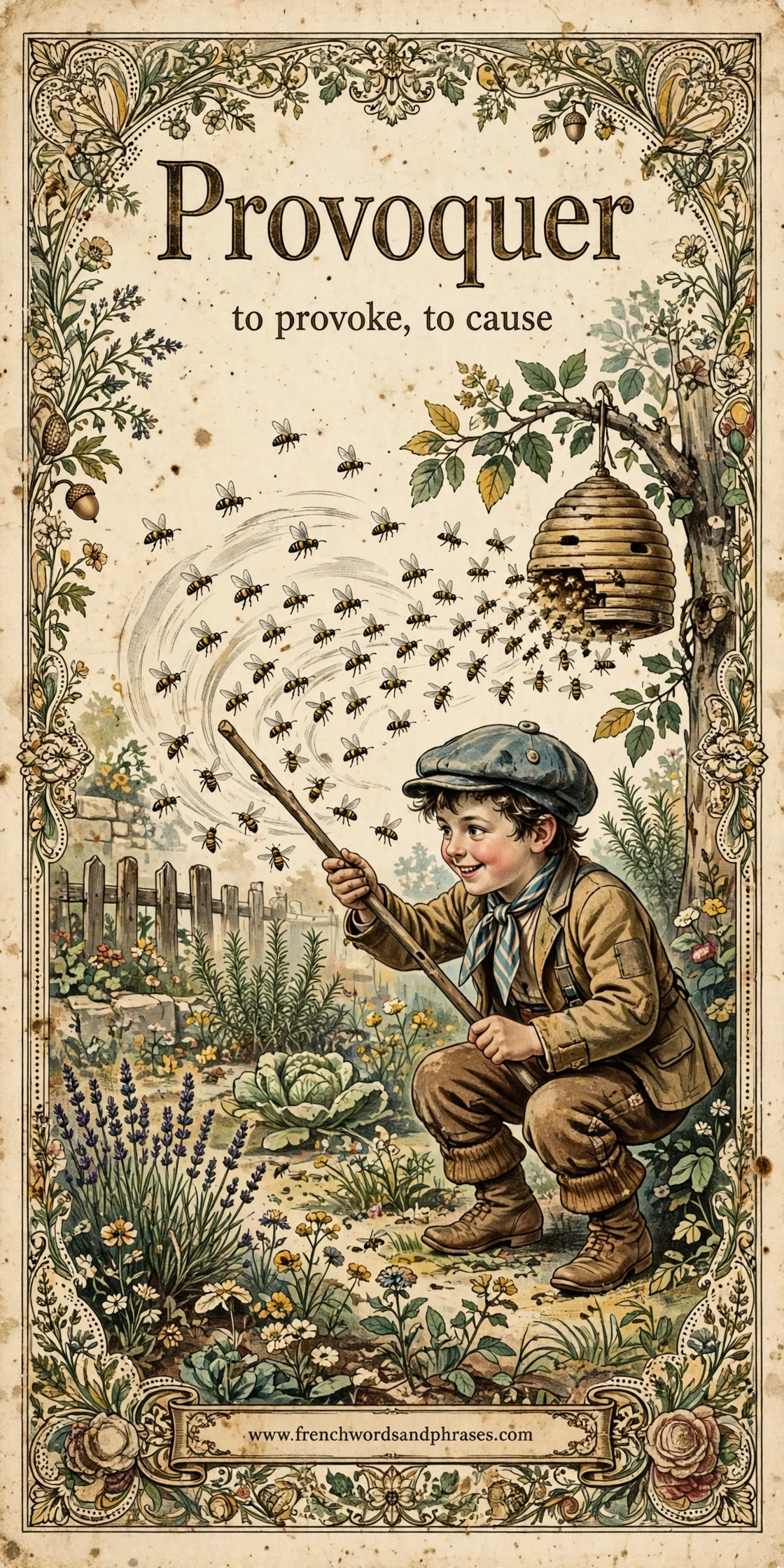
A French Word to Live By
How to Conjugate Provoquer in French
/pʁɔ.vɔ.ke/
Provoquer means to provoke and to cause — to trigger a reaction, a scandal, laughter or tears, whether by deliberate teasing or by simple cause and effect.
A remark that starts a riot, a joke that sets the whole table laughing, a virus that causes a fever — provoquer is the verb of triggers: something is said or done, and something else erupts in answer.
In this guide, you’ll learn how to conjugate provoquer in all the major French tenses and moods. Explore complete conjugation tables, French examples, English translations, and practice quizzes.
Understanding the French Verb Provoquer
Provoquer is a regular French verb belonging to the first group of verbs, those ending in-er.
It means to provoke, to cause. With people it means to goad or defy: il cherche à te provoquer — he is trying to provoke you. With events it is the standard verb of causation in news French: l’orage a provoqué des inondations — the storm caused flooding. Its noun, la provocation, is a deliberate taunt.
Verb classification: First group (-er)
Auxiliary verb: Avoir
Past participle: provoqué
Present participle: provoquant
English equivalents: To provoke, to cause, to bring about; provoquer un scandale — to cause a scandal; provoquer des rires — to provoke laughter; provoquer quelqu’un — to provoke/taunt someone; provoquer une réaction — to trigger a reaction; cesser de provoquer — to stop provoking.
One important detail: provoquer keeps its qu in every form — je provoque, nous provoquons, ils provoquent, past participle provoqué — the u is silent and simply guards the hard k sound of the c. The verb has two faces: deliberate (provoquer un adversaire, to taunt an opponent, close to English provoke) and neutral causation (provoquer un accident, provoquer des dégâts — to cause an accident, to cause damage), where no intention is implied.
Experience the Word
Provoquer is the verb of the spark — a word, a gesture, a spark of lightning, and the reaction follows at once.
Imagine a village meeting about a new road. The mayor speaks calmly for ten minutes; then one farmer stands up and asks a single sharp question — elle provoque un tollé: chairs scrape, voices rise, the whole evening catches fire from one sentence.
Nothing else changed in the room. One question provoked it all — provoqué, like a match to dry grass.
How to Conjugate Provoquer: Complete French Conjugation Guide
Let’s explore every major conjugation of provoquer, beginning with the indicative mood.
How to Conjugate Provoquer in the Indicative Mood
The indicative mood is used to express facts, observations, actions, and events.
How to Conjugate Provoquer in the Present Tense (Présent)
Used for actions happening now, habitual actions, and general truths.
| Subject | Conjugation |
|---|---|
| je | provoque |
| tu | provoques |
| il / elle | provoque |
| nous | provoquons |
| vous | provoquez |
| ils / elles | provoquent |
Example
Ses remarques provoquent toujours des réactions vives.
His remarks always provoke strong reactions.
Quick Quiz 1
Complete the sentence:
Ces annonces ______ toujours beaucoup de commentaires.
Reveal the answer
provoquent
Ces annonces provoquent toujours beaucoup de commentaires.
These announcements always provoke lots of comments.
How to Conjugate Provoquer in the Passé Composé
Used for completed actions in the past. Provoquer takes the auxiliary verb avoir.
| Subject | Conjugation |
|---|---|
| j’ | ai provoqué |
| tu | as provoqué |
| il / elle | a provoqué |
| nous | avons provoqué |
| vous | avez provoqué |
| ils / elles | ont provoqué |
Example
La décision a provoqué un scandale dans tout le pays.
The decision caused a scandal throughout the country.
How to Conjugate Provoquer in the Imparfait (Imperfect Tense)
Used for habitual past actions, descriptions, and ongoing situations in the past.
| Subject | Conjugation |
|---|---|
| je | provoquais |
| tu | provoquais |
| il / elle | provoquait |
| nous | provoquions |
| vous | provoquiez |
| ils / elles | provoquaient |
Example
Enfant, il provoquait ses camarades pour rire.
As a child, he used to provoke his classmates for fun.
Quick Quiz 2
Choose the correct form:
The storm caused flooding.
L’orage ______ des inondations. (a provoqué / est provoqué)
Reveal the answer
a provoqué
L’orage a provoqué des inondations.
Provoquer takes avoir.
How to Conjugate Provoquer in the Plus-que-parfait
Used to describe an action that had already been completed before another past event.
| Subject | Conjugation |
|---|---|
| j’ | avais provoqué |
| tu | avais provoqué |
| il / elle | avait provoqué |
| nous | avions provoqué |
| vous | aviez provoqué |
| ils / elles | avaient provoqué |
Example
L’orage avait provoqué des inondations dans trois villages.
The storm had caused flooding in three villages.
How to Conjugate Provoquer in the Passé Simple
Primarily used in formal writing, literature, and historical narratives. It is rarely used in everyday conversation.
| Subject | Conjugation |
|---|---|
| je | provoquai |
| tu | provoquas |
| il / elle | provoqua |
| nous | provoquâmes |
| vous | provoquâtes |
| ils / elles | provoquèrent |
Example
Une seule phrase provoqua le tumulte dans l’assemblée.
A single sentence provoked uproar in the assembly.
How to Conjugate Provoquer in the Passé Antérieur
A literary tense used to express an action completed immediately before another past action, generally in the passé simple.
| Subject | Conjugation |
|---|---|
| j’ | eus provoqué |
| tu | eus provoqué |
| il / elle | eut provoqué |
| nous | eûmes provoqué |
| vous | eûtes provoqué |
| ils / elles | eurent provoqué |
Example
Quand il eut provoqué son adversaire assez longtemps, le duel commença.
When he had provoked his opponent long enough, the duel began.
How to Conjugate Provoquer in the Future Tense (Futur Simple)
Used to describe actions that will take place in the future.
| Subject | Conjugation |
|---|---|
| je | provoquerai |
| tu | provoqueras |
| il / elle | provoquera |
| nous | provoquerons |
| vous | provoquerez |
| ils / elles | provoqueront |
Example
Ce projet provoquera sans doute de longs débats.
This project will no doubt provoke long debates.
How to Conjugate Provoquer in the Futur Antérieur (Future Perfect)
Used for an action that will have been completed before a particular point in the future.
| Subject | Conjugation |
|---|---|
| j’ | aurai provoqué |
| tu | auras provoqué |
| il / elle | aura provoqué |
| nous | aurons provoqué |
| vous | aurez provoqué |
| ils / elles | auront provoqué |
Example
À la fin de la semaine, l’annonce aura provoqué mille commentaires.
By the end of the week, the announcement will have provoked a thousand comments.
How to Conjugate Provoquer in the Near Future (Futur Proche)
Used to describe something that is going to happen soon. Formed with aller + infinitive.
| Subject | Conjugation |
|---|---|
| je | vais provoquer |
| tu | vas provoquer |
| il / elle | va provoquer |
| nous | allons provoquer |
| vous | allez provoquer |
| ils / elles | vont provoquer |
Example
Attention, tu vas provoquer un accident avec cette manœuvre.
Careful, you are going to cause an accident with that manoeuvre.
How to Conjugate Provoquer in the Conditional Mood
The conditional mood expresses what would happen under certain circumstances. It is also frequently used to make polite requests or express wishes.
How to Conjugate Provoquer in the Present Conditional
| Subject | Conjugation |
|---|---|
| je | provoquerais |
| tu | provoquerais |
| il / elle | provoquerait |
| nous | provoquerions |
| vous | provoqueriez |
| ils / elles | provoqueraient |
Example
Un mot de plus provoquerait une dispute.
One more word would provoke an argument.
How to Conjugate Provoquer in the Past Conditional
| Subject | Conjugation |
|---|---|
| j’ | aurais provoqué |
| tu | aurais provoqué |
| il / elle | aurait provoqué |
| nous | aurions provoqué |
| vous | auriez provoqué |
| ils / elles | auraient provoqué |
Example
Son silence aurait provoqué moins de remous que son discours.
His silence would have caused less stir than his speech.
Provoquer in the Literary Past Conditional Form
This less common literary form uses the imperfect subjunctive of avoir.
| Subject | Conjugation |
|---|---|
| j’ | eusse provoqué |
| tu | eusses provoqué |
| il / elle | eût provoqué |
| nous | eussions provoqué |
| vous | eussiez provoqué |
| ils / elles | eussent provoqué |
Example
Le roi eût provoqué la révolte par un seul impôt nouveau.
The king would have provoked revolt with a single new tax.
How to Conjugate Provoquer in the Subjunctive Mood
The subjunctive is used to express wishes, emotions, doubts, necessity, and uncertainty. It frequently follows expressions such as il faut que (it is necessary that) or bien que (although).
How to Conjugate Provoquer in the Present Subjunctive
| Subject | Conjugation |
|---|---|
| que je | provoque |
| que tu | provoques |
| qu’il / qu’elle | provoque |
| que nous | provoquions |
| que vous | provoquiez |
| qu’ils / qu’elles | provoquent |
Example
Je ne veux pas que tu provoques tes camarades.
I do not want you to provoke your classmates.
Quick Quiz 3
Complete the sentence using the subjunctive:
Je suis étonné que ce film ______ tant de polémiques.
Reveal the answer
ait provoqué
Je suis étonné que ce film ait provoqué tant de polémiques.
I am amazed this film caused so much controversy.
How to Conjugate Provoquer in the Imperfect Subjunctive
A literary tense, rarely encountered in modern spoken French.
| Subject | Conjugation |
|---|---|
| que je | provoquasse |
| que tu | provoquasses |
| qu’il / qu’elle | provoquât |
| que nous | provoquassions |
| que vous | provoquassiez |
| qu’ils / qu’elles | provoquassent |
Example
On craignait que la mesure provoquât des manifestations.
People feared the measure might provoke demonstrations.
How to Conjugate Provoquer in the Pluperfect Subjunctive
A literary construction used to express an action completed before another past action.
| Subject | Conjugation |
|---|---|
| que j’ | eusse provoqué |
| que tu | eusses provoqué |
| qu’il / qu’elle | eût provoqué |
| que nous | eussions provoqué |
| que vous | eussiez provoqué |
| qu’ils / qu’elles | eussent provoqué |
Example
On savait que l’incident eût provoqué une crise diplomatique.
It was known the incident had caused a diplomatic crisis.
How to Conjugate Provoquer in the Past Subjunctive
| Subject | Conjugation |
|---|---|
| que j’ | aie provoqué |
| que tu | aies provoqué |
| qu’il / qu’elle | ait provoqué |
| que nous | ayons provoqué |
| que vous | ayez provoqué |
| qu’ils / qu’elles | aient provoqué |
Example
Je suis étonné que ce film ait provoqué tant de polémiques.
I am amazed this film caused so much controversy.
How to Conjugate Provoquer in the Imperative
The imperative is used to give commands, instructions, invitations, or suggestions. Subject pronouns are omitted.
How to Conjugate Provoquer in the Present Imperative
| Person | Conjugation |
|---|---|
| (tu) | provoque |
| (nous) | provoquons |
| (vous) | provoquez |
Example
Ne provoque pas ton frère, laisse-le tranquille !
Do not provoke your brother, leave him alone!
Quick Quiz 4
How would you say Do not provoke your brother (tu form)?
Reveal the answer
Ne provoque pas ton frère !
French Participles of Provoquer
Participles are verb forms that can be used in compound tenses and other grammatical constructions.
Present Participle of Provoquer
provoquant
En provoquant l’orage politique, le ministre a perdu son poste.
By provoking the political storm, the minister lost his post.
Past Participle of Provoquer
provoqué
Provoquée par la sécheresse, la famine menaçait la région.
Caused by the drought, famine threatened the region.
Provoquer in Everyday French: Real-Life Examples
Now that you know the conjugations, let’s see how provoquer appears in everyday French.
Example 1 — Present
Ses remarques provoquent des réactions.
His remarks provoke reactions.
Example 2 — Passé composé
La décision a provoqué un scandale.
The decision caused a scandal.
Example 3 — Imparfait
Il provoquait ses camarades pour rire.
He used to provoke his classmates for fun.
Example 4 — Future
Ce projet provoquera de longs débats.
This project will provoke long debates.
Example 5 — Conditional
Un mot de plus provoquerait une dispute.
One more word would provoke an argument.
Example 6 — Imperative
Ne provoque pas ton frère !
Do not provoke your brother!
Beyond Translation: The Meaning of Provoquer
English provoke leans personal — you provoke a person; French provoquer does that too, but it is also the workhorse verb of cause and effect in the news: storms, laws and viruses provoquent floods, debates and fevers.
One verb for the taunt and for the trigger.
From Latin provocare, to call forth: provoquer calls the reaction out of hiding, whether it is a laugh, a riot or a rash.
How to Remember the French Verb Provoquer
Remember it this way: Provoquer is about one sharp question at the village meeting, and the whole room catches fire.
- Two faces: provoquer quelqu’un (to goad them) and provoquer un accident (to cause it).
- The qu never changes: je provoque, nous provoquons, provoqué.
- Regular -er with avoir; its noun is la provocation, a deliberate taunt.
The key idea is one sharp question at the village meeting, and the whole room catches fire.
Test Your Knowledge of Provoquer
Let’s see how much you’ve learned. Try answering these questions before revealing the answers.
Question 1
What are the two main senses of provoquer?
Reveal the answer
To provoke a person (goad, taunt) and to cause an event (a scandal, flooding, laughter).
Question 2
How do you say The decision caused a scandal in French?
Reveal the answer
La décision a provoqué un scandale.
Question 3
Translate: The storm caused flooding in three villages.
Reveal the answer
L’orage a provoqué des inondations dans trois villages.
Question 4
What is the past participle of provoquer?
Reveal the answer
Provoqué.
Question 5
Complete the sentence:
Je ne veux pas que tu ______ tes camarades.
Reveal the answer
provoques
Je ne veux pas que tu provoques tes camarades.
I do not want you to provoke your classmates.
Your Final Challenge
Can You Use It?
How would you say this in French?
A single question, asked at the right moment, provoked the debate the whole village had been waiting years for.
Reveal the answer
Une seule question, posée au bon moment, a provoqué le débat que tout le village attendait depuis des années.
A single question, asked at the right moment, provoked the debate the whole village had been waiting years for.
A little French. A little curiosity. A richer everyday life.
LEARN FRENCH ONE WORD AT A TIME




