A French Word to Live By
How to Conjugate Caresser in French
/ka.ʁɛ.se/
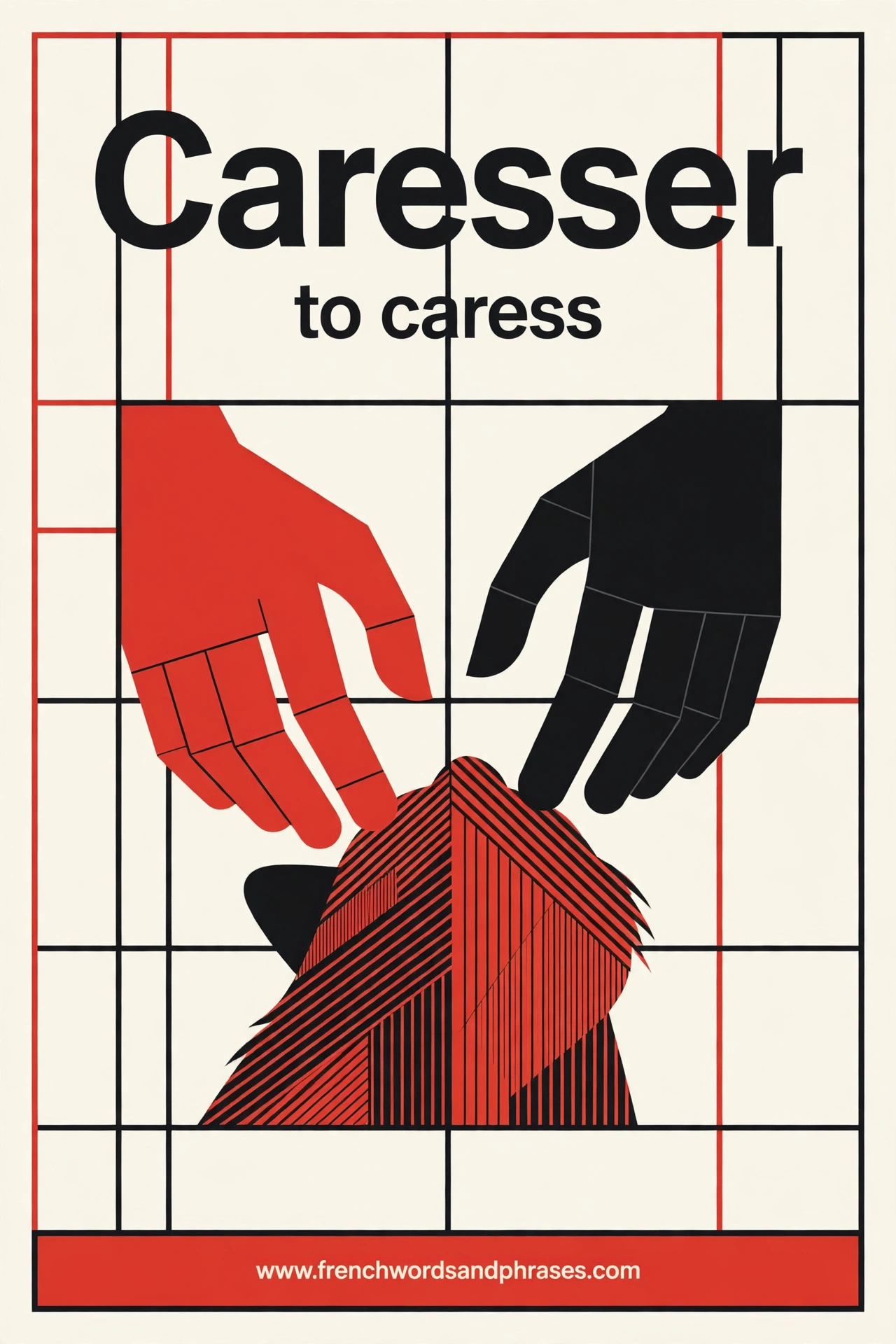
Caresser means to fondle, to caress — to stroke gently with the hand, and, in its tender figurative life, to cherish a hope or a plan the way you would stroke a cat.
A hand passing slowly over a sleeping cat’s fur, a grandmother’s palm on a child’s cheek — caresser is the verb of the gentle stroke, of touch that asks for nothing and simply says: I am here, and I am fond of you.
In this guide, you’ll learn how to conjugate caresser in all the major French tenses and moods. Explore complete conjugation tables, French examples, English translations, and practice quizzes.
Understanding the French Verb Caresser
Caresser is a regular French verb belonging to the first group of verbs, those ending in-er.
It means to fondle, to caress. It ranges from the physical — a hand on fur, hair or skin, the wind or the sun caressing a face — to the intimate figurative sense of cherishing: caresser un rêve, caresser l’idée de démissionner. The tone is always tender or fond, never rough.
Verb classification: First group (-er)
Auxiliary verb: Avoir
Past participle: caressé
Present participle: caressant
English equivalents: To caress, to stroke, to fondle; caresser un chat — to stroke a cat; caresser la joue de quelqu’un — to caress someone’s cheek; caresser un espoir — to cherish a hope; caresser un projet — to nurse a plan, to toy with an idea.
One important detail: caresser is perfectly regular, with a double s that never changes: je caresse, nous caressons, ils caressent, past participle caressé. The gentle trap is the figurative use — French caresses not only cats and cheeks but also hopes and projects: elle caresse l’espoir de partir, she cherishes the hope of leaving. And where English says to stroke a cat, French caresser is the everyday word; passer la main sur is the flat description.
Experience the Word
Caresser is the verb of the slow hand — touch reduced to its kindest form.
Imagine a fireside in winter. The old cat climbs onto the settee, turns twice, and settles; without looking up from her book, the grandmother caresse le chat, hand moving in time with the purring, page after page, stroke after stroke.
Nothing is being done or fixed. The cat has simply been caressed — caressé, slowly, for the pleasure of it.
How to Conjugate Caresser: Complete French Conjugation Guide
Let’s explore every major conjugation of caresser, beginning with the indicative mood.
How to Conjugate Caresser in the Indicative Mood
The indicative mood is used to express facts, observations, actions, and events.
How to Conjugate Caresser in the Present Tense (Présent)
Used for actions happening now, habitual actions, and general truths.
| Subject | Conjugation |
|---|---|
| je | caresse |
| tu | caresses |
| il / elle | caresse |
| nous | caressons |
| vous | caressez |
| ils / elles | caressent |
Example
Elle caresse le chat pendant qu’elle lit.
She strokes the cat while she reads.
Quick Quiz 1
Complete the sentence:
Nous ______ le chat pendant le dîner.
Reveal the answer
caressons
Nous caressons le chat pendant le dîner.
We stroke the cat during dinner.
How to Conjugate Caresser in the Passé Composé
Used for completed actions in the past. Caresser takes the auxiliary verb avoir.
| Subject | Conjugation |
|---|---|
| j’ | ai caressé |
| tu | as caressé |
| il / elle | a caressé |
| nous | avons caressé |
| vous | avez caressé |
| ils / elles | ont caressé |
Example
Il a caressé la joue de l’enfant endormi.
He caressed the sleeping child’s cheek.
How to Conjugate Caresser in the Imparfait (Imperfect Tense)
Used for habitual past actions, descriptions, and ongoing situations in the past.
| Subject | Conjugation |
|---|---|
| je | caressais |
| tu | caressais |
| il / elle | caressait |
| nous | caressions |
| vous | caressiez |
| ils / elles | caressaient |
Example
Le vent caressait doucement son visage.
The wind gently caressed her face.
Quick Quiz 2
Choose the correct form:
He caressed the child’s cheek.
Il ______ la joue de l’enfant. (a caressé / est caressé)
Reveal the answer
a caressé
Il a caressé la joue de l’enfant.
Caresser takes avoir.
How to Conjugate Caresser in the Plus-que-parfait
Used to describe an action that had already been completed before another past event.
| Subject | Conjugation |
|---|---|
| j’ | avais caressé |
| tu | avais caressé |
| il / elle | avait caressé |
| nous | avions caressé |
| vous | aviez caressé |
| ils / elles | avaient caressé |
Example
Elle avait longtemps caressé l’espoir de revoir la mer.
She had long cherished the hope of seeing the sea again.
How to Conjugate Caresser in the Passé Simple
Primarily used in formal writing, literature, and historical narratives. It is rarely used in everyday conversation.
| Subject | Conjugation |
|---|---|
| je | caressai |
| tu | caressas |
| il / elle | caressa |
| nous | caressâmes |
| vous | caressâtes |
| ils / elles | caressèrent |
Example
La mère caressa les cheveux de sa fille.
The mother stroked her daughter’s hair.
How to Conjugate Caresser in the Passé Antérieur
A literary tense used to express an action completed immediately before another past action, generally in the passé simple.
| Subject | Conjugation |
|---|---|
| j’ | eus caressé |
| tu | eus caressé |
| il / elle | eut caressé |
| nous | eûmes caressé |
| vous | eûtes caressé |
| ils / elles | eurent caressé |
Example
Quand il eut caressé le vieux chien, celui-ci s’endormit.
When he had stroked the old dog, it fell asleep.
How to Conjugate Caresser in the Future Tense (Futur Simple)
Used to describe actions that will take place in the future.
| Subject | Conjugation |
|---|---|
| je | caresserai |
| tu | caresseras |
| il / elle | caressera |
| nous | caresserons |
| vous | caresserez |
| ils / elles | caresseront |
Example
Un jour, tu caresseras un chat sur cette même terrasse.
One day, you will stroke a cat on this very terrace.
How to Conjugate Caresser in the Futur Antérieur (Future Perfect)
Used for an action that will have been completed before a particular point in the future.
| Subject | Conjugation |
|---|---|
| j’ | aurai caressé |
| tu | auras caressé |
| il / elle | aura caressé |
| nous | aurons caressé |
| vous | aurez caressé |
| ils / elles | auront caressé |
Example
Avant midi, elle aura caressé tous les chats du refuge.
Before noon, she will have stroked all the cats at the shelter.
How to Conjugate Caresser in the Near Future (Futur Proche)
Used to describe something that is going to happen soon. Formed with aller + infinitive.
| Subject | Conjugation |
|---|---|
| je | vais caresser |
| tu | vas caresser |
| il / elle | va caresser |
| nous | allons caresser |
| vous | allez caresser |
| ils / elles | vont caresser |
Example
Regarde, il va caresser le cheval pour la première fois.
Look, he is going to stroke the horse for the first time.
How to Conjugate Caresser in the Conditional Mood
The conditional mood expresses what would happen under certain circumstances. It is also frequently used to make polite requests or express wishes.
How to Conjugate Caresser in the Present Conditional
| Subject | Conjugation |
|---|---|
| je | caresserais |
| tu | caresserais |
| il / elle | caresserait |
| nous | caresserions |
| vous | caresseriez |
| ils / elles | caresseraient |
Example
Sans bruit, la brise caresserait les rideaux.
Silently, the breeze would caress the curtains.
How to Conjugate Caresser in the Past Conditional
| Subject | Conjugation |
|---|---|
| j’ | aurais caressé |
| tu | aurais caressé |
| il / elle | aurait caressé |
| nous | aurions caressé |
| vous | auriez caressé |
| ils / elles | auraient caressé |
Example
Il aurait caressé le chat si celui-ci ne s’était pas enfui.
He would have stroked the cat if it had not run away.
Caresser in the Literary Past Conditional Form
This less common literary form uses the imperfect subjunctive of avoir.
| Subject | Conjugation |
|---|---|
| j’ | eusse caressé |
| tu | eusses caressé |
| il / elle | eût caressé |
| nous | eussions caressé |
| vous | eussiez caressé |
| ils / elles | eussent caressé |
Example
Elle eût caressé le front du malade toute la nuit.
She would have stroked the patient’s forehead all night long.
How to Conjugate Caresser in the Subjunctive Mood
The subjunctive is used to express wishes, emotions, doubts, necessity, and uncertainty. It frequently follows expressions such as il faut que (it is necessary that) or bien que (although).
How to Conjugate Caresser in the Present Subjunctive
| Subject | Conjugation |
|---|---|
| que je | caresse |
| que tu | caresses |
| qu’il / qu’elle | caresse |
| que nous | caressions |
| que vous | caressiez |
| qu’ils / qu’elles | caressent |
Example
Il faut que tu caresses le chien doucement.
You must stroke the dog gently.
Quick Quiz 3
Complete the sentence using the subjunctive:
Il faut que vous ______ le cheval avant de le monter.
Reveal the answer
caressiez
Il faut que vous caressiez le cheval avant de le monter.
You must stroke the horse before riding it.
How to Conjugate Caresser in the Imperfect Subjunctive
A literary tense, rarely encountered in modern spoken French.
| Subject | Conjugation |
|---|---|
| que je | caressasse |
| que tu | caressasses |
| qu’il / qu’elle | caressât |
| que nous | caressassions |
| que vous | caressassiez |
| qu’ils / qu’elles | caressassent |
Example
Je souhaitais qu’elle caressât les cheveux de l’enfant.
I wished she would stroke the child’s hair.
How to Conjugate Caresser in the Pluperfect Subjunctive
A literary construction used to express an action completed before another past action.
| Subject | Conjugation |
|---|---|
| que j’ | eusse caressé |
| que tu | eusses caressé |
| qu’il / qu’elle | eût caressé |
| que nous | eussions caressé |
| que vous | eussiez caressé |
| qu’ils / qu’elles | eussent caressé |
Example
On racontait qu’il eût caressé l’espoir de devenir peintre.
People said he had cherished the hope of becoming a painter.
How to Conjugate Caresser in the Past Subjunctive
| Subject | Conjugation |
|---|---|
| que j’ | aie caressé |
| que tu | aies caressé |
| qu’il / qu’elle | ait caressé |
| que nous | ayons caressé |
| que vous | ayez caressé |
| qu’ils / qu’elles | aient caressé |
Example
Je suis heureux qu’elle ait caressé le vieux chat.
I am glad she stroked the old cat.
How to Conjugate Caresser in the Imperative
The imperative is used to give commands, instructions, invitations, or suggestions. Subject pronouns are omitted.
How to Conjugate Caresser in the Present Imperative
| Person | Conjugation |
|---|---|
| (tu) | caresse |
| (nous) | caressons |
| (vous) | caressez |
Example
Caresse le chat, mais doucement !
Stroke the cat, but gently!
Quick Quiz 4
How would you say Stroke the cat gently (tu form)?
Reveal the answer
Caresse le chat doucement !
French Participles of Caresser
Participles are verb forms that can be used in compound tenses and other grammatical constructions.
Present Participle of Caresser
caressant
En caressant le chien, l’enfant s’est calmé.
By stroking the dog, the child calmed down.
Past Participle of Caresser
caressé
Caressé par le soleil, le village semblait endormi.
Caressed by the sun, the village seemed asleep.
Caresser in Everyday French: Real-Life Examples
Now that you know the conjugations, let’s see how caresser appears in everyday French.
Example 1 — Present
Elle caresse le chat en lisant.
She strokes the cat while reading.
Example 2 — Passé composé
Il a caressé la joue de l’enfant.
He caressed the child’s cheek.
Example 3 — Imparfait
Le vent caressait son visage.
The wind caressed her face.
Example 4 — Future
Tu caresseras le cheval tout à l’heure.
You will stroke the horse in a little while.
Example 5 — Conditional
La brise caresserait les rideaux.
The breeze would caress the curtains.
Example 6 — Imperative
Caresse le chien doucement !
Stroke the dog gently!
Beyond Translation: The Meaning of Caresser
English caress is the same word borrowed whole — Italian carezza, a dear, costly thing, lies behind both.
In French, hopes get caressed too.
That is the charm of caresser: the hand’s gesture extends to the mind — caresser un espoir, caresser un projet — so that an ambition is something you keep stroking, gently, until one day it purrs and comes true.
How to Remember the French Verb Caresser
Remember it this way: Caresser is about the slow hand on the cat’s fur — and on a cherished hope.
- A hand stroking a cat: caresser is gentle touch — and cherishing a hope.
- Figurative frames to keep: caresser un espoir, caresser un projet.
- Regular -er with a double s: je caresse, nous caressons, past participle caressé.
The key idea is the slow hand on the cat’s fur — and on a cherished hope.
Test Your Knowledge of Caresser
Let’s see how much you’ve learned. Try answering these questions before revealing the answers.
Question 1
What does caresser un espoir mean?
Reveal the answer
To cherish a hope — the figurative use: caresser un projet, to nurse a plan.
Question 2
How do you say She strokes the cat in French?
Reveal the answer
Elle caresse le chat.
Question 3
Translate: The wind caressed her face.
Reveal the answer
Le vent caressait son visage.
Question 4
What is the past participle of caresser?
Reveal the answer
Caressé.
Question 5
Complete the sentence:
Il faut que tu ______ le chien doucement.
Reveal the answer
caresses
Il faut que tu caresses le chien doucement.
You must stroke the dog gently.
Your Final Challenge
Can You Use It?
How would you say this in French?
In the evening, she strokes the old cat by the fire, and the whole world seems to breathe more softly.
Reveal the answer
Le soir, elle caresse le vieux chat près du feu, et le monde entier semble respirer plus doucement.
In the evening, she strokes the old cat by the fire, and the whole world seems to breathe more softly.
A little French. A little curiosity. A richer everyday life.
LEARN FRENCH ONE WORD AT A TIME