
A French Word to Live By
How to Conjugate Caréner in French
/ka.ʁe.ne/
Caréner means to careen — to lay a ship over on her side so her hull can be cleaned and repaired, and, by extension, to give any vehicle a smooth, streamlined shape.
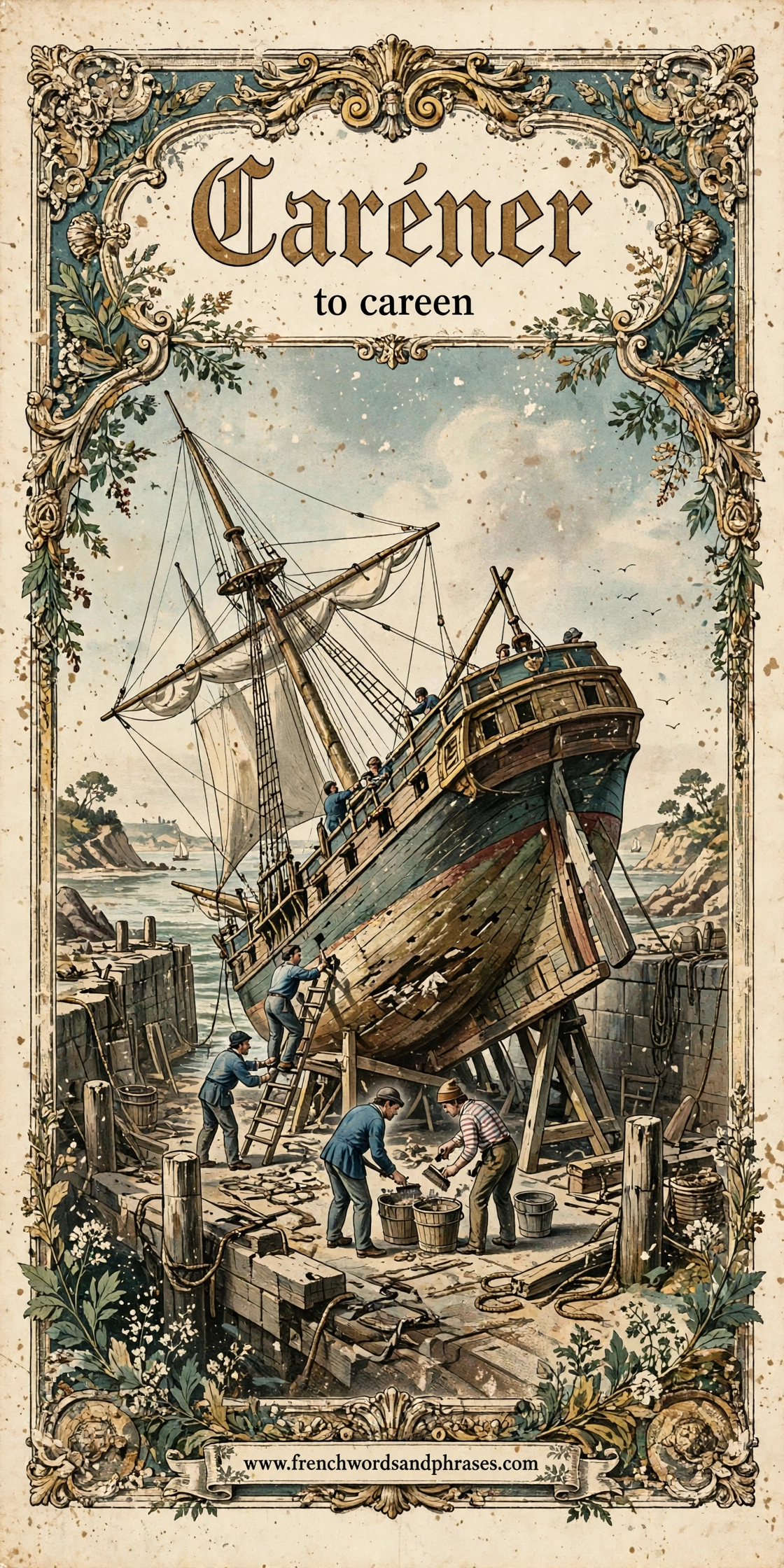
A fishing boat hauled onto the mud at low tide, tilted on wooden props while men scrape her hull — caréner is the old sailor’s verb for that careful laying-over, and the modern engineer’s verb for streamlining whatever moves through wind or water.
In this guide, you’ll learn how to conjugate caréner in all the major French tenses and moods. Explore complete conjugation tables, French examples, English translations, and practice quizzes.
Understanding the French Verb Caréner
Caréner is a regular French verb belonging to the first group of verbs, those ending in-er.
It means to careen. In the boatyard it means the whole operation: heeling the vessel over, scraping, caulking and repainting the hull — le carénage is still the word for a boat’s annual refit. In modern technical French it has widened to streamlining: caréner une voiture, un train, une moto is to fair them in so they cut through the air.
Verb classification: First group (-er)
Auxiliary verb: Avoir
Past participle: caréné
Present participle: carénant
English equivalents: To careen, to lay a ship over for repairs; caréner un bateau — to careen a boat; caréner la coque — to clean and repair the hull; caréner une moto — to streamline a motorbike; un carénage complet — a full careening and refit.
One important detail: caréner is an espérer-type verb — the é of the stem opens to è in the present singular and third plural, in the subjunctive singular and third plural, and in the tu imperative: je carène, tu carènes, il carène, ils carènent. But watch the future and conditional: there the é stays — je carénerai, je carénerais, never with è. The é also survives wherever the ending is sounded: nous carénons, vous carénez, je carénais, and in the infinitive and participle, caréner, caréné.
Experience the Word
Caréner is the verb of the tilted ship — a whole vessel leaning on her side, trusting the tide to leave her dry and the men to make her clean.
Imagine a Breton harbour at low water. The fishing boat rests on the mud, propped at an angle, and the crew, brushes and scrapers in hand, carènent la coque while the sea is away — every shell and weed must go before the tide returns.
By evening she floats upright again. She has been careened — carénée, scraped, painted and made swift.
How to Conjugate Caréner: Complete French Conjugation Guide
Let’s explore every major conjugation of caréner, beginning with the indicative mood.
How to Conjugate Caréner in the Indicative Mood
The indicative mood is used to express facts, observations, actions, and events.
How to Conjugate Caréner in the Present Tense (Présent)
Used for actions happening now, habitual actions, and general truths.
| Subject | Conjugation |
|---|---|
| je | carène |
| tu | carènes |
| il / elle | carène |
| nous | carénons |
| vous | carénez |
| ils / elles | carènent |
Example
Chaque printemps, le pêcheur carène son bateau dans le port.
Every spring, the fisherman careens his boat in the harbour.
Quick Quiz 1
Complete the sentence:
Nous ______ le voilier chaque printemps.
Reveal the answer
carénons
Nous carénons le voilier chaque printemps.
We careen the sailing boat every spring.
How to Conjugate Caréner in the Passé Composé
Used for completed actions in the past. Caréner takes the auxiliary verb avoir.
| Subject | Conjugation |
|---|---|
| j’ | ai caréné |
| tu | as caréné |
| il / elle | a caréné |
| nous | avons caréné |
| vous | avez caréné |
| ils / elles | ont caréné |
Example
Nous avons caréné la coque avant la grande traversée.
We careened the hull before the long crossing.
How to Conjugate Caréner in the Imparfait (Imperfect Tense)
Used for habitual past actions, descriptions, and ongoing situations in the past.
| Subject | Conjugation |
|---|---|
| je | carénais |
| tu | carénais |
| il / elle | carénait |
| nous | carénions |
| vous | caréniez |
| ils / elles | carénaient |
Example
Autrefois, les marins carénaient leurs navires sur les plages.
In the old days, sailors used to careen their ships on the beaches.
Quick Quiz 2
Choose the correct form:
Tomorrow, we will careen the boat.
Demain, nous ______ le bateau. (carénerons / carènerons)
Reveal the answer
carénerons
Demain, nous carénerons le bateau.
The future keeps the é of the stem: carénerai, carénerons.
How to Conjugate Caréner in the Plus-que-parfait
Used to describe an action that had already been completed before another past event.
| Subject | Conjugation |
|---|---|
| j’ | avais caréné |
| tu | avais caréné |
| il / elle | avait caréné |
| nous | avions caréné |
| vous | aviez caréné |
| ils / elles | avaient caréné |
Example
L’équipage avait caréné le voilier avant la tempête.
The crew had careened the sailing boat before the storm.
How to Conjugate Caréner in the Passé Simple
Primarily used in formal writing, literature, and historical narratives. It is rarely used in everyday conversation.
| Subject | Conjugation |
|---|---|
| je | carénai |
| tu | carénas |
| il / elle | caréna |
| nous | carénâmes |
| vous | carénâtes |
| ils / elles | carénèrent |
Example
Le capitaine caréna son navire dans une baie abritée.
The captain careened his ship in a sheltered bay.
How to Conjugate Caréner in the Passé Antérieur
A literary tense used to express an action completed immediately before another past action, generally in the passé simple.
| Subject | Conjugation |
|---|---|
| j’ | eus caréné |
| tu | eus caréné |
| il / elle | eut caréné |
| nous | eûmes caréné |
| vous | eûtes caréné |
| ils / elles | eurent caréné |
Example
Quand ils eurent caréné la coque, ils remirent le bateau à flot.
When they had careened the hull, they refloated the boat.
How to Conjugate Caréner in the Future Tense (Futur Simple)
Used to describe actions that will take place in the future.
| Subject | Conjugation |
|---|---|
| je | carénerai |
| tu | caréneras |
| il / elle | carénera |
| nous | carénerons |
| vous | carénerez |
| ils / elles | caréneront |
Example
Demain, nous carénerons le bateau à marée basse.
Tomorrow, we will careen the boat at low tide.
How to Conjugate Caréner in the Futur Antérieur (Future Perfect)
Used for an action that will have been completed before a particular point in the future.
| Subject | Conjugation |
|---|---|
| j’ | aurai caréné |
| tu | auras caréné |
| il / elle | aura caréné |
| nous | aurons caréné |
| vous | aurez caréné |
| ils / elles | auront caréné |
Example
À midi, les ouvriers auront caréné les deux coques.
By noon, the workers will have careened both hulls.
How to Conjugate Caréner in the Near Future (Futur Proche)
Used to describe something that is going to happen soon. Formed with aller + infinitive.
| Subject | Conjugation |
|---|---|
| je | vais caréner |
| tu | vas caréner |
| il / elle | va caréner |
| nous | allons caréner |
| vous | allez caréner |
| ils / elles | vont caréner |
Example
Le chantier va caréner ce voilier la semaine prochaine.
The boatyard is going to careen this sailing boat next week.
How to Conjugate Caréner in the Conditional Mood
The conditional mood expresses what would happen under certain circumstances. It is also frequently used to make polite requests or express wishes.
How to Conjugate Caréner in the Present Conditional
| Subject | Conjugation |
|---|---|
| je | carénerais |
| tu | carénerais |
| il / elle | carénerait |
| nous | carénerions |
| vous | caréneriez |
| ils / elles | caréneraient |
Example
Avec de meilleurs outils, je carénerais la coque en un jour.
With better tools, I would careen the hull in a day.
How to Conjugate Caréner in the Past Conditional
| Subject | Conjugation |
|---|---|
| j’ | aurais caréné |
| tu | aurais caréné |
| il / elle | aurait caréné |
| nous | aurions caréné |
| vous | auriez caréné |
| ils / elles | auraient caréné |
Example
Ils auraient caréné le navire si la marée l’avait permis.
They would have careened the ship if the tide had allowed it.
Caréner in the Literary Past Conditional Form
This less common literary form uses the imperfect subjunctive of avoir.
| Subject | Conjugation |
|---|---|
| j’ | eusse caréné |
| tu | eusses caréné |
| il / elle | eût caréné |
| nous | eussions caréné |
| vous | eussiez caréné |
| ils / elles | eussent caréné |
Example
Le capitaine eût caréné son brick avant l’hiver.
The captain would have careened his brig before the winter.
How to Conjugate Caréner in the Subjunctive Mood
The subjunctive is used to express wishes, emotions, doubts, necessity, and uncertainty. It frequently follows expressions such as il faut que (it is necessary that) or bien que (although).
How to Conjugate Caréner in the Present Subjunctive
| Subject | Conjugation |
|---|---|
| que je | carène |
| que tu | carènes |
| qu’il / qu’elle | carène |
| que nous | carénions |
| que vous | caréniez |
| qu’ils / qu’elles | carènent |
Example
Il faut que tu carènes ton bateau avant l’été.
You must careen your boat before the summer.
Quick Quiz 3
Complete the sentence using the subjunctive:
Il faut que vous ______ la coque à temps.
Reveal the answer
caréniez
Il faut que vous caréniez la coque à temps.
You must careen the hull in time.
How to Conjugate Caréner in the Imperfect Subjunctive
A literary tense, rarely encountered in modern spoken French.
| Subject | Conjugation |
|---|---|
| que je | carénasse |
| que tu | carénasses |
| qu’il / qu’elle | carénât |
| que nous | carénassions |
| que vous | carénassiez |
| qu’ils / qu’elles | carénassent |
Example
Le commandant exigeait que l’on carénât la frégate.
The commander demanded that the frigate be careened.
How to Conjugate Caréner in the Pluperfect Subjunctive
A literary construction used to express an action completed before another past action.
| Subject | Conjugation |
|---|---|
| que j’ | eusse caréné |
| que tu | eusses caréné |
| qu’il / qu’elle | eût caréné |
| que nous | eussions caréné |
| que vous | eussiez caréné |
| qu’ils / qu’elles | eussent caréné |
Example
On racontait que les pirates eussent caréné leur navire sur une île déserte.
People said the pirates had careened their ship on a desert island.
How to Conjugate Caréner in the Past Subjunctive
| Subject | Conjugation |
|---|---|
| que j’ | aie caréné |
| que tu | aies caréné |
| qu’il / qu’elle | ait caréné |
| que nous | ayons caréné |
| que vous | ayez caréné |
| qu’ils / qu’elles | aient caréné |
Example
Je suis content que vous ayez caréné la coque à temps.
I am glad you careened the hull in time.
How to Conjugate Caréner in the Imperative
The imperative is used to give commands, instructions, invitations, or suggestions. Subject pronouns are omitted.
How to Conjugate Caréner in the Present Imperative
| Person | Conjugation |
|---|---|
| (tu) | carène |
| (nous) | carénons |
| (vous) | carénez |
Example
Carène le bateau dès que la marée descend !
Careen the boat as soon as the tide goes out!
Quick Quiz 4
How would you say Careen the boat (tu form)?
Reveal the answer
Carène le bateau !
French Participles of Caréner
Participles are verb forms that can be used in compound tenses and other grammatical constructions.
Present Participle of Caréner
carénant
En carénant la coque, ils ont découvert une fissure.
While careening the hull, they discovered a crack.
Past Participle of Caréner
caréné
Carénée et repeinte, la barque semblait neuve.
Careened and repainted, the boat looked new.
Caréner in Everyday French: Real-Life Examples
Now that you know the conjugations, let’s see how caréner appears in everyday French.
Example 1 — Present
Le pêcheur carène son bateau au printemps.
The fisherman careens his boat in spring.
Example 2 — Passé composé
Nous avons caréné la coque hier.
We careened the hull yesterday.
Example 3 — Imparfait
Les marins carénaient leurs navires sur la plage.
Sailors used to careen their ships on the beach.
Example 4 — Future
Nous carénerons le voilier à marée basse.
We will careen the sailing boat at low tide.
Example 5 — Conditional
Je carénerais la coque avec de bons outils.
I would careen the hull with good tools.
Example 6 — Imperative
Carène le bateau dès demain !
Careen the boat first thing tomorrow!
Beyond Translation: The Meaning of Caréner
English careen is the very same word — from Latin carina, a keel, the backbone of the ship that careening exposes to the sky.
To careen is to show the keel.
English speakers beware: in American English careen has drifted into meaning to swerve at speed, but French caréner never lost the boatyard — it is about hulls, tides and, nowadays, smooth fairings on fast machines.
How to Remember the French Verb Caréner
Remember it this way: Caréner is about the ship on her side at low tide — keel to the sky.
- Espérer-type spelling: je carène with è in the present, but je carénerai with é in the future.
- Picture the ship laid over on the mud: caréner is to expose and clean the hull — and to streamline.
- Regular -er underneath: nous carénons, vous carénez, past participle caréné.
The key idea is the ship on her side at low tide — keel to the sky.
Test Your Knowledge of Caréner
Let’s see how much you’ve learned. Try answering these questions before revealing the answers.
Question 1
Why does je carène have a grave accent but je carénerai an acute one?
Reveal the answer
The espérer-type rule — é becomes è in the present and subjunctive stems, but the future and conditional keep é: je carénerai.
Question 2
How do you say The fisherman careens his boat in French?
Reveal the answer
Le pêcheur carène son bateau.
Question 3
Translate: We careened the hull before the crossing.
Reveal the answer
Nous avons caréné la coque avant la traversée.
Question 4
What is the past participle of caréner?
Reveal the answer
Caréné.
Question 5
Complete the sentence:
Il faut que tu ______ ton bateau avant l’été.
Reveal the answer
carènes
Il faut que tu carènes ton bateau avant l’été.
You must careen your boat before the summer.
Your Final Challenge
Can You Use It?
How would you say this in French?
At low tide, the sailors careen the hull, and the old boat finds its youth again before the sea returns.
Reveal the answer
À marée basse, les marins carènent la coque, et le vieux bateau retrouve sa jeunesse avant le retour de la mer.
At low tide, the sailors careen the hull, and the old boat finds its youth again before the sea returns.
A little French. A little curiosity. A richer everyday life.
LEARN FRENCH ONE WORD AT A TIME




