
A French Word to Live By
How to Conjugate Carencer in French
/ka.ʁɑ̃.se/
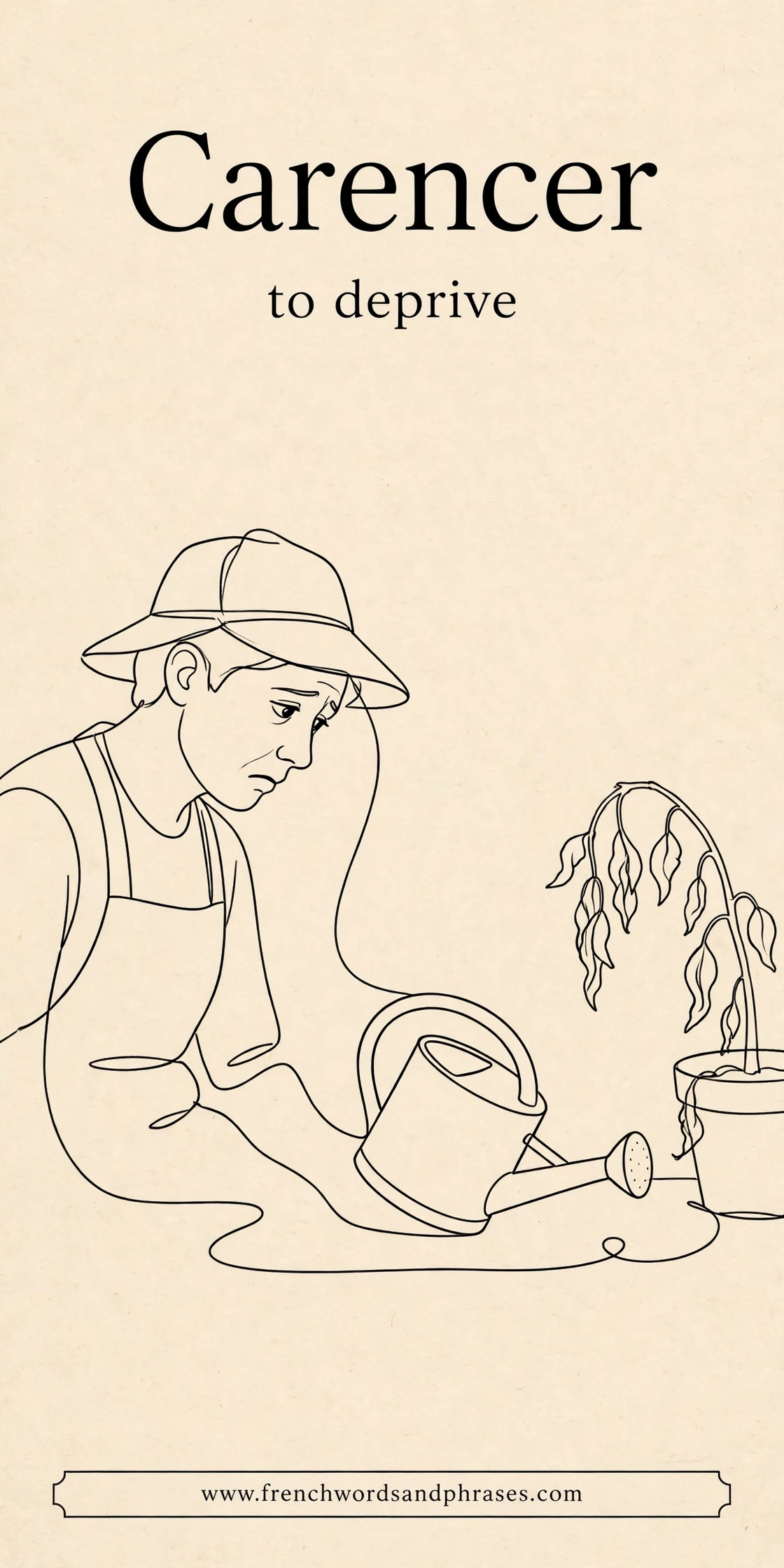
Carencer means to deprive — to leave a body or a person short of something essential, so that a deficiency, une carence, sets in.
A diet with no green vegetables, a winter with no sunlight, a child missing the iron his blood needs — carencer is the medical verb of the quiet shortage: to deprive an organism of something vital until the lack itself becomes an illness.
In this guide, you’ll learn how to conjugate carencer in all the major French tenses and moods. Explore complete conjugation tables, French examples, English translations, and practice quizzes.
Understanding the French Verb Carencer
Carencer is a regular French verb belonging to the first group of verbs, those ending in-er.
It means to deprive. Its family is the giveaway: la carence is a deficiency (carence en fer, carence affective), and carencer is the verb built on it. Doctors, dietitians and agronomists use it — of children, patients, soils and diets — almost always in the frame carencer en, or in the passive-flavoured participle carencé.
Verb classification: First group (-er)
Auxiliary verb: Avoir
Past participle: carencé
Present participle: carençant
English equivalents: To deprive, to leave deficient; carencer un organisme en fer — to deprive a body of iron; un enfant carencé — a deficient child (lacking nutrients); carencé en vitamine D — deficient in vitamin D; une alimentation qui carence — a diet that leaves deficiencies.
One important detail: carencer is a -cer verb, so the c becomes ç before a and o: nous carençons, je carençais, but je carence, nous carencions keep the plain c. Be honest about its usage: in modern French you will meet the past participle carencé far more often than the active verb — un enfant carencé, un sol carencé en azote. The construction is carencer quelqu’un/quelque chose en quelque chose: to leave someone deficient in something.
Experience the Word
Carencer is the verb of the missing ingredient — nothing is attacked, something essential is simply not there.
Imagine a doctor reading a child’s blood test in a quiet surgery. The boy is pale and always tired; the figures explain why. « Son alimentation le carence en fer depuis des mois », she says — his diet has been quietly depriving him of iron, and the shortage has become the illness.
No blow, no germ — just an absence. That silent deprivation is carencer.
How to Conjugate Carencer: Complete French Conjugation Guide
Let’s explore every major conjugation of carencer, beginning with the indicative mood.
How to Conjugate Carencer in the Indicative Mood
The indicative mood is used to express facts, observations, actions, and events.
How to Conjugate Carencer in the Present Tense (Présent)
Used for actions happening now, habitual actions, and general truths.
| Subject | Conjugation |
|---|---|
| je | carence |
| tu | carences |
| il / elle | carence |
| nous | carençons |
| vous | carencez |
| ils / elles | carencent |
Example
Une alimentation monotone carence l’organisme en vitamines.
A monotonous diet deprives the body of vitamins.
Quick Quiz 1
Complete the sentence:
Nous savons que ce régime ______ les enfants en calcium. (présent)
Reveal the answer
carence
Nous savons que ce régime carence les enfants en calcium.
We know this diet deprives the children of calcium.
How to Conjugate Carencer in the Passé Composé
Used for completed actions in the past. Carencer takes the auxiliary verb avoir.
| Subject | Conjugation |
|---|---|
| j’ | ai carencé |
| tu | as carencé |
| il / elle | a carencé |
| nous | avons carencé |
| vous | avez carencé |
| ils / elles | ont carencé |
Example
Ce régime a carencé les enfants en calcium.
This diet deprived the children of calcium.
How to Conjugate Carencer in the Imparfait (Imperfect Tense)
Used for habitual past actions, descriptions, and ongoing situations in the past.
| Subject | Conjugation |
|---|---|
| je | carençais |
| tu | carençais |
| il / elle | carençait |
| nous | carencions |
| vous | carenciez |
| ils / elles | carençaient |
Example
La pauvreté carençait autrefois beaucoup d’enfants en protéines.
Poverty used to deprive many children of protein.
Quick Quiz 2
Choose the correct form:
We are depriving nobody of anything.
Nous ne ______ personne en rien. (carencons / carençons)
Reveal the answer
carençons
Nous ne carençons personne en rien.
Before o, the c of a -cer verb is written ç to keep the soft s sound.
How to Conjugate Carencer in the Plus-que-parfait
Used to describe an action that had already been completed before another past event.
| Subject | Conjugation |
|---|---|
| j’ | avais carencé |
| tu | avais carencé |
| il / elle | avait carencé |
| nous | avions carencé |
| vous | aviez carencé |
| ils / elles | avaient carencé |
Example
Le sol sableux avait carencé les plantes en azote.
The sandy soil had deprived the plants of nitrogen.
How to Conjugate Carencer in the Passé Simple
Primarily used in formal writing, literature, and historical narratives. It is rarely used in everyday conversation.
| Subject | Conjugation |
|---|---|
| je | carençai |
| tu | carenças |
| il / elle | carença |
| nous | carençâmes |
| vous | carençâtes |
| ils / elles | carençèrent |
Example
La sécheresse carença les cultures en eau tout l’été.
The drought deprived the crops of water all summer.
How to Conjugate Carencer in the Passé Antérieur
A literary tense used to express an action completed immediately before another past action, generally in the passé simple.
| Subject | Conjugation |
|---|---|
| j’ | eus carencé |
| tu | eus carencé |
| il / elle | eut carencé |
| nous | eûmes carencé |
| vous | eûtes carencé |
| ils / elles | eurent carencé |
Example
Quand la maladie eut carencé son corps en fer, il consulta enfin.
When the illness had deprived his body of iron, he finally saw a doctor.
How to Conjugate Carencer in the Future Tense (Futur Simple)
Used to describe actions that will take place in the future.
| Subject | Conjugation |
|---|---|
| je | carencerai |
| tu | carenceras |
| il / elle | carencera |
| nous | carencerons |
| vous | carencerez |
| ils / elles | carenceront |
Example
Un tel régime carencera les enfants en quelques mois.
Such a diet will leave the children deficient within a few months.
How to Conjugate Carencer in the Futur Antérieur (Future Perfect)
Used for an action that will have been completed before a particular point in the future.
| Subject | Conjugation |
|---|---|
| j’ | aurai carencé |
| tu | auras carencé |
| il / elle | aura carencé |
| nous | aurons carencé |
| vous | aurez carencé |
| ils / elles | auront carencé |
Example
À la fin de l’hiver, le manque de soleil aura carencé beaucoup de gens en vitamine D.
By the end of winter, the lack of sun will have left many people deficient in vitamin D.
How to Conjugate Carencer in the Near Future (Futur Proche)
Used to describe something that is going to happen soon. Formed with aller + infinitive.
| Subject | Conjugation |
|---|---|
| je | vais carencer |
| tu | vas carencer |
| il / elle | va carencer |
| nous | allons carencer |
| vous | allez carencer |
| ils / elles | vont carencer |
Example
Ce menu déséquilibré va carencer les élèves en protéines.
This unbalanced menu is going to deprive the pupils of protein.
How to Conjugate Carencer in the Conditional Mood
The conditional mood expresses what would happen under certain circumstances. It is also frequently used to make polite requests or express wishes.
How to Conjugate Carencer in the Present Conditional
| Subject | Conjugation |
|---|---|
| je | carencerais |
| tu | carencerais |
| il / elle | carencerait |
| nous | carencerions |
| vous | carenceriez |
| ils / elles | carenceraient |
Example
Sans produits laitiers, tu carencerais les enfants en calcium.
Without dairy products, you would deprive the children of calcium.
How to Conjugate Carencer in the Past Conditional
| Subject | Conjugation |
|---|---|
| j’ | aurais carencé |
| tu | aurais carencé |
| il / elle | aurait carencé |
| nous | aurions carencé |
| vous | auriez carencé |
| ils / elles | auraient carencé |
Example
Un meilleur repas aurait carencé personne en rien.
A better meal would have deprived nobody of anything.
Carencer in the Literary Past Conditional Form
This less common literary form uses the imperfect subjunctive of avoir.
| Subject | Conjugation |
|---|---|
| j’ | eusse carencé |
| tu | eusses carencé |
| il / elle | eût carencé |
| nous | eussions carencé |
| vous | eussiez carencé |
| ils / elles | eussent carencé |
Example
La disette eût carencé le village entier en un hiver.
The famine would have left the whole village deficient in one winter.
How to Conjugate Carencer in the Subjunctive Mood
The subjunctive is used to express wishes, emotions, doubts, necessity, and uncertainty. It frequently follows expressions such as il faut que (it is necessary that) or bien que (although).
How to Conjugate Carencer in the Present Subjunctive
| Subject | Conjugation |
|---|---|
| que je | carence |
| que tu | carences |
| qu’il / qu’elle | carence |
| que nous | carencions |
| que vous | carenciez |
| qu’ils / qu’elles | carencent |
Example
Il ne faut pas que ce régime carence les enfants en fer.
This diet must not deprive the children of iron.
Quick Quiz 3
Complete the sentence using the subjunctive:
Il ne faut pas que ce menu ______ les élèves en protéines.
Reveal the answer
carence
Il ne faut pas que ce menu carence les élèves en protéines.
This menu must not deprive the pupils of protein.
How to Conjugate Carencer in the Imperfect Subjunctive
A literary tense, rarely encountered in modern spoken French.
| Subject | Conjugation |
|---|---|
| que je | carencasse |
| que tu | carencasses |
| qu’il / qu’elle | carencât |
| que nous | carencassions |
| que vous | carencassiez |
| qu’ils / qu’elles | carencassent |
Example
Le médecin craignait que le sol carençât les vignes en azote.
The doctor feared the soil might deprive the vines of nitrogen.
How to Conjugate Carencer in the Pluperfect Subjunctive
A literary construction used to express an action completed before another past action.
| Subject | Conjugation |
|---|---|
| que j’ | eusse carencé |
| que tu | eusses carencé |
| qu’il / qu’elle | eût carencé |
| que nous | eussions carencé |
| que vous | eussiez carencé |
| qu’ils / qu’elles | eussent carencé |
Example
On disait que la maladie eût carencé son corps en vitamines.
People said the illness had deprived his body of vitamins.
How to Conjugate Carencer in the Past Subjunctive
| Subject | Conjugation |
|---|---|
| que j’ | aie carencé |
| que tu | aies carencé |
| qu’il / qu’elle | ait carencé |
| que nous | ayons carencé |
| que vous | ayez carencé |
| qu’ils / qu’elles | aient carencé |
Example
Je regrette que ce régime ait carencé tant d’enfants.
I regret that this diet deprived so many children.
How to Conjugate Carencer in the Imperative
The imperative is used to give commands, instructions, invitations, or suggestions. Subject pronouns are omitted.
How to Conjugate Carencer in the Present Imperative
| Person | Conjugation |
|---|---|
| (tu) | carence |
| (nous) | carençons |
| (vous) | carencez |
Example
Ne carencez pas vos enfants en légumes verts !
Do not deprive your children of green vegetables!
Quick Quiz 4
How would you say Do not deprive your body of sleep (tu form)?
Reveal the answer
Ne carence pas ton corps en sommeil !
French Participles of Carencer
Participles are verb forms that can be used in compound tenses and other grammatical constructions.
Present Participle of Carencer
carençant
En carençant le sol en azote, on appauvrit la récolte.
By depriving the soil of nitrogen, you impoverish the harvest.
Past Participle of Carencer
carencé
Carencé en fer, l’enfant était pâle et fatigué.
Deprived of iron, the child was pale and tired.
Carencer in Everyday French: Real-Life Examples
Now that you know the conjugations, let’s see how carencer appears in everyday French.
Example 1 — Present
Ce régime carence les enfants en calcium.
This diet deprives the children of calcium.
Example 2 — Passé composé
La pauvreté a carencé des générations en protéines.
Poverty deprived generations of protein.
Example 3 — Imparfait
La sécheresse carençait les cultures en eau.
The drought used to deprive the crops of water.
Example 4 — Future
Un tel menu carencera les élèves en vitamines.
Such a menu will leave the pupils deficient in vitamins.
Example 5 — Conditional
Sans lait, tu carencerais les enfants en calcium.
Without milk, you would deprive the children of calcium.
Example 6 — Imperative
Ne carence pas ton corps en sommeil !
Do not deprive your body of sleep!
Beyond Translation: The Meaning of Carencer
The whole family hangs on one Latin word: carere, to lack, to be without — la carence is the lack itself, and carencer is to cause that lack.
The image is an empty shelf where something vital should be.
French even extends the idea beyond food: une carence affective is an emotional deficiency, a childhood short of affection — the same silent shortage, measured in love instead of iron.
How to Remember the French Verb Carencer
Remember it this way: Carencer is about an empty shelf where the iron should be.
- Meet the participle first: carencé en fer = deficient in iron — that is the form modern French actually uses.
- The construction is carencer quelqu’un en quelque chose — the missing thing follows en.
- -cer verb: c becomes ç before a and o — nous carençons, je carençais, but nous carencions.
The key idea is an empty shelf where the iron should be.
Test Your Knowledge of Carencer
Let’s see how much you’ve learned. Try answering these questions before revealing the answers.
Question 1
Which form of carencer do you meet most often in modern French?
Reveal the answer
The past participle carencé — un enfant carencé, carencé en vitamine D.
Question 2
How do you say This diet deprives the children of calcium in French?
Reveal the answer
Ce régime carence les enfants en calcium.
Question 3
Translate: Deprived of iron, the child was pale.
Reveal the answer
Carencé en fer, l’enfant était pâle.
Question 4
What is the nous form of carencer in the present, and why?
Reveal the answer
Nous carençons — the c becomes ç before o to keep the soft s sound.
Question 5
Complete the sentence:
Il ne faut pas que ce régime ______ les enfants en fer.
Reveal the answer
carence
Il ne faut pas que ce régime carence les enfants en fer.
This diet must not deprive the children of iron.
Your Final Challenge
Can You Use It?
How would you say this in French?
All winter, the lack of light deprived the village of vitamin D, and spring was welcomed like a doctor.
Reveal the answer
Tout l’hiver, le manque de lumière carença le village en vitamine D, et le printemps fut accueilli comme un médecin.
All winter, the lack of light deprived the village of vitamin D, and spring was welcomed like a doctor.
A little French. A little curiosity. A richer everyday life.
LEARN FRENCH ONE WORD AT A TIME




