A French Word to Live By
How to Conjugate Carder in French
/kaʁ.de/
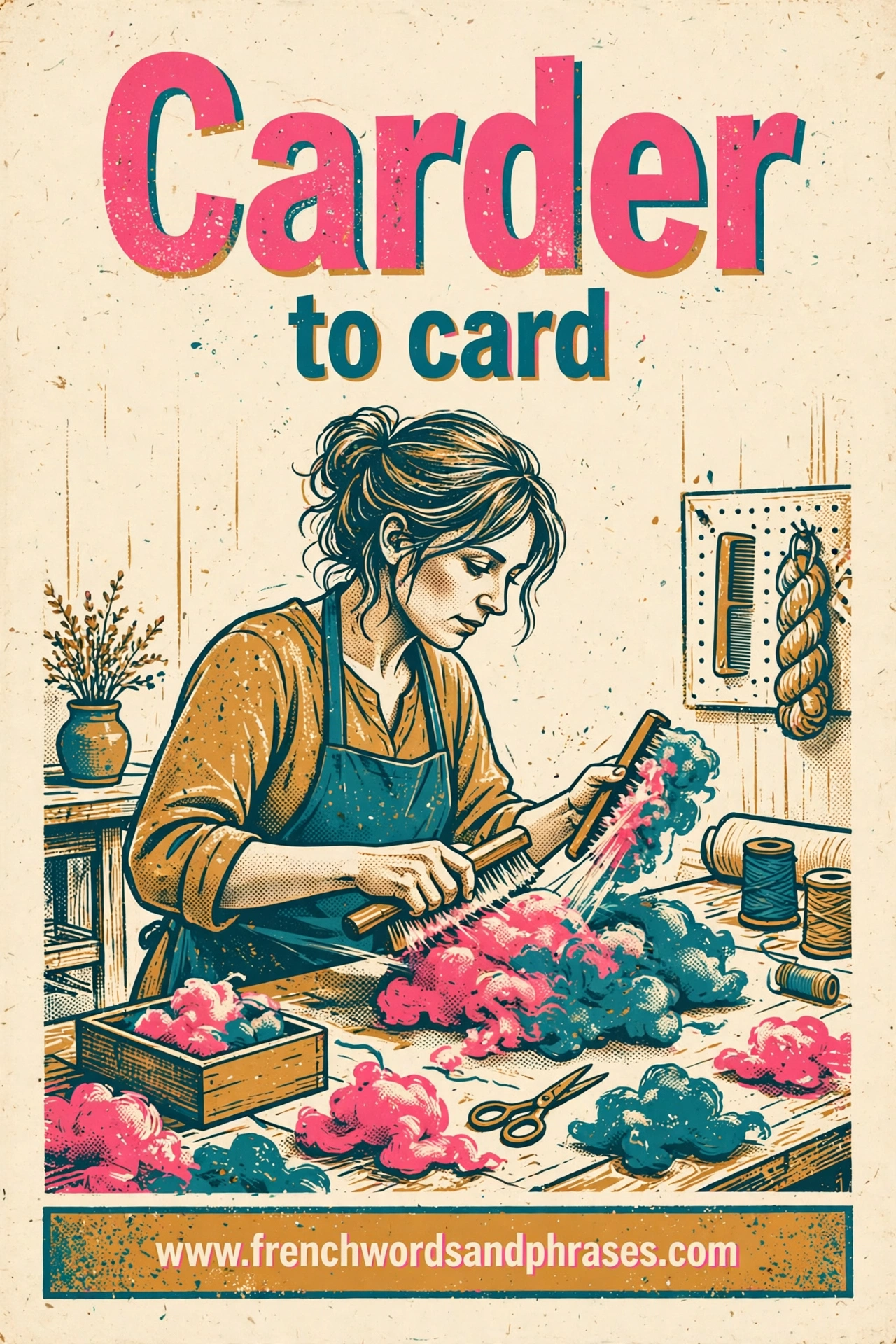
Carder means to card — to comb raw wool or cotton between wire brushes until its tangled fibres lie straight, clean and ready for spinning.
A fleece straight off the sheep, full of tangles, straw and knots, passes again and again between two boards studded with fine wire teeth — carder is the textile worker’s verb for that patient combing that turns a fleece into a cloud of aligned fibres.
In this guide, you’ll learn how to conjugate carder in all the major French tenses and moods. Explore complete conjugation tables, French examples, English translations, and practice quizzes.
Understanding the French Verb Carder
Carder is a regular French verb belonging to the first group of verbs, those ending in-er.
It means to card. It belongs to the wool and cotton trades: fibres are carded after washing and before spinning, by hand with two cardes or by machine in a mill. You will meet it in textile history, craft workshops and any account of how a fleece becomes yarn.
Verb classification: First group (-er)
Auxiliary verb: Avoir
Past participle: cardé
Present participle: cardant
English equivalents: To card (wool, cotton); carder la laine — to card wool; carder le coton — to card cotton; une laine bien cardée — well-carded wool; carder à la main — to card by hand.
One important detail: carder is as regular as a verb can be — je carde, nous cardons, ils cardent, past participle cardé. Its name is its tool: les cardes are the wire-toothed boards (from the teasel plant, le chardon, once used for the job), and the worker is le cardeur. Do not confuse it with peigner, to comb — carding comes first, rough and thorough, before any combing or spinning.
Experience the Word
Carder is the verb of the first transformation — chaos in, order out, one stroke of the wire brush at a time.
Imagine a spinner’s workshop in the mountains. On the table, a grey fleece still smelling of the sheep; in her hands, two wooden cardes bristling with teeth. Elle carde la laine, stroke after stroke, until the tangle opens into a soft white roll, ready for the wheel.
Nothing is spun yet, nothing is woven. But the wool has been carded — cardée — and everything else is now possible.
How to Conjugate Carder: Complete French Conjugation Guide
Let’s explore every major conjugation of carder, beginning with the indicative mood.
How to Conjugate Carder in the Indicative Mood
The indicative mood is used to express facts, observations, actions, and events.
How to Conjugate Carder in the Present Tense (Présent)
Used for actions happening now, habitual actions, and general truths.
| Subject | Conjugation |
|---|---|
| je | carde |
| tu | cardes |
| il / elle | carde |
| nous | cardons |
| vous | cardez |
| ils / elles | cardent |
Example
Elle carde la laine avant de la filer.
She cards the wool before spinning it.
Quick Quiz 1
Complete the sentence:
Nous ______ le coton avant de l’envoyer à la filature.
Reveal the answer
cardons
Nous cardons le coton avant de l’envoyer à la filature.
We card the cotton before sending it to the mill.
How to Conjugate Carder in the Passé Composé
Used for completed actions in the past. Carder takes the auxiliary verb avoir.
| Subject | Conjugation |
|---|---|
| j’ | ai cardé |
| tu | as cardé |
| il / elle | a cardé |
| nous | avons cardé |
| vous | avez cardé |
| ils / elles | ont cardé |
Example
Les ouvriers ont cardé tout le coton de la récolte.
The workers carded all the cotton from the harvest.
How to Conjugate Carder in the Imparfait (Imperfect Tense)
Used for habitual past actions, descriptions, and ongoing situations in the past.
| Subject | Conjugation |
|---|---|
| je | cardais |
| tu | cardais |
| il / elle | cardait |
| nous | cardions |
| vous | cardiez |
| ils / elles | cardaient |
Example
Autrefois, on cardait la laine à la main dans chaque ferme.
In the old days, wool was carded by hand on every farm.
Quick Quiz 2
Choose the correct form:
The workers have carded the wool.
Les ouvriers ______ la laine. (ont cardé / ont carder)
Reveal the answer
ont cardé
Les ouvriers ont cardé la laine.
The past participle of an -er verb ends in -é.
How to Conjugate Carder in the Plus-que-parfait
Used to describe an action that had already been completed before another past event.
| Subject | Conjugation |
|---|---|
| j’ | avais cardé |
| tu | avais cardé |
| il / elle | avait cardé |
| nous | avions cardé |
| vous | aviez cardé |
| ils / elles | avaient cardé |
Example
La fileuse avait cardé la laine avant l’arrivée des tisserands.
The spinner had carded the wool before the weavers arrived.
How to Conjugate Carder in the Passé Simple
Primarily used in formal writing, literature, and historical narratives. It is rarely used in everyday conversation.
| Subject | Conjugation |
|---|---|
| je | cardai |
| tu | cardas |
| il / elle | carda |
| nous | cardâmes |
| vous | cardâtes |
| ils / elles | cardèrent |
Example
Elle carda la laine de trois moutons en une matinée.
She carded the wool of three sheep in one morning.
How to Conjugate Carder in the Passé Antérieur
A literary tense used to express an action completed immediately before another past action, generally in the passé simple.
| Subject | Conjugation |
|---|---|
| j’ | eus cardé |
| tu | eus cardé |
| il / elle | eut cardé |
| nous | eûmes cardé |
| vous | eûtes cardé |
| ils / elles | eurent cardé |
Example
Quand il eut cardé tout le coton, il le porta à la filature.
When he had carded all the cotton, he took it to the mill.
How to Conjugate Carder in the Future Tense (Futur Simple)
Used to describe actions that will take place in the future.
| Subject | Conjugation |
|---|---|
| je | carderai |
| tu | carderas |
| il / elle | cardera |
| nous | carderons |
| vous | carderez |
| ils / elles | carderont |
Example
Demain, nous carderons la laine des agneaux.
Tomorrow, we will card the lambs’ wool.
How to Conjugate Carder in the Futur Antérieur (Future Perfect)
Used for an action that will have been completed before a particular point in the future.
| Subject | Conjugation |
|---|---|
| j’ | aurai cardé |
| tu | auras cardé |
| il / elle | aura cardé |
| nous | aurons cardé |
| vous | aurez cardé |
| ils / elles | auront cardé |
Example
À la fin de la journée, elle aura cardé dix toisons.
By the end of the day, she will have carded ten fleeces.
How to Conjugate Carder in the Near Future (Futur Proche)
Used to describe something that is going to happen soon. Formed with aller + infinitive.
| Subject | Conjugation |
|---|---|
| je | vais carder |
| tu | vas carder |
| il / elle | va carder |
| nous | allons carder |
| vous | allez carder |
| ils / elles | vont carder |
Example
Je vais carder cette laine pour un pull.
I am going to card this wool for a sweater.
How to Conjugate Carder in the Conditional Mood
The conditional mood expresses what would happen under certain circumstances. It is also frequently used to make polite requests or express wishes.
How to Conjugate Carder in the Present Conditional
| Subject | Conjugation |
|---|---|
| je | carderais |
| tu | carderais |
| il / elle | carderait |
| nous | carderions |
| vous | carderiez |
| ils / elles | carderaient |
Example
Avec de meilleures cardes, on carderait plus vite.
With better cards, we would card faster.
How to Conjugate Carder in the Past Conditional
| Subject | Conjugation |
|---|---|
| j’ | aurais cardé |
| tu | aurais cardé |
| il / elle | aurait cardé |
| nous | aurions cardé |
| vous | auriez cardé |
| ils / elles | auraient cardé |
Example
Sans la machine, ils auraient cardé à la main.
Without the machine, they would have carded by hand.
Carder in the Literary Past Conditional Form
This less common literary form uses the imperfect subjunctive of avoir.
| Subject | Conjugation |
|---|---|
| j’ | eusse cardé |
| tu | eusses cardé |
| il / elle | eût cardé |
| nous | eussions cardé |
| vous | eussiez cardé |
| ils / elles | eussent cardé |
Example
La fileuse eût cardé la laine dès l’aube.
The spinner would have carded the wool from dawn.
How to Conjugate Carder in the Subjunctive Mood
The subjunctive is used to express wishes, emotions, doubts, necessity, and uncertainty. It frequently follows expressions such as il faut que (it is necessary that) or bien que (although).
How to Conjugate Carder in the Present Subjunctive
| Subject | Conjugation |
|---|---|
| que je | carde |
| que tu | cardes |
| qu’il / qu’elle | carde |
| que nous | cardions |
| que vous | cardiez |
| qu’ils / qu’elles | cardent |
Example
Il faut que tu cardes la laine avant de la filer.
You must card the wool before spinning it.
Quick Quiz 3
Complete the sentence using the subjunctive:
Il faut que vous ______ la laine avec soin.
Reveal the answer
cardiez
Il faut que vous cardiez la laine avec soin.
You must card the wool with care.
How to Conjugate Carder in the Imperfect Subjunctive
A literary tense, rarely encountered in modern spoken French.
| Subject | Conjugation |
|---|---|
| que je | cardasse |
| que tu | cardasses |
| qu’il / qu’elle | cardât |
| que nous | cardassions |
| que vous | cardassiez |
| qu’ils / qu’elles | cardassent |
Example
La maîtresse exigeait que les apprenties cardassent sans se presser.
The mistress required the apprentices to card without hurrying.
How to Conjugate Carder in the Pluperfect Subjunctive
A literary construction used to express an action completed before another past action.
| Subject | Conjugation |
|---|---|
| que j’ | eusse cardé |
| que tu | eusses cardé |
| qu’il / qu’elle | eût cardé |
| que nous | eussions cardé |
| que vous | eussiez cardé |
| qu’ils / qu’elles | eussent cardé |
Example
On racontait que la fileuse eût cardé cent toisons en un hiver.
People said the spinner had carded a hundred fleeces in one winter.
How to Conjugate Carder in the Past Subjunctive
| Subject | Conjugation |
|---|---|
| que j’ | aie cardé |
| que tu | aies cardé |
| qu’il / qu’elle | ait cardé |
| que nous | ayons cardé |
| que vous | ayez cardé |
| qu’ils / qu’elles | aient cardé |
Example
Je suis content que vous ayez cardé le coton si finement.
I am glad you carded the cotton so finely.
How to Conjugate Carder in the Imperative
The imperative is used to give commands, instructions, invitations, or suggestions. Subject pronouns are omitted.
How to Conjugate Carder in the Present Imperative
| Person | Conjugation |
|---|---|
| (tu) | carde |
| (nous) | cardons |
| (vous) | cardez |
Example
Carde la laine doucement, sans casser les fibres !
Card the wool gently, without breaking the fibres!
Quick Quiz 4
How would you say Card the wool gently (tu form)?
Reveal the answer
Carde la laine doucement !
French Participles of Carder
Participles are verb forms that can be used in compound tenses and other grammatical constructions.
Present Participle of Carder
cardant
En cardant la laine, elle en retire les impuretés.
By carding the wool, she removes its impurities.
Past Participle of Carder
cardé
La laine, cardée avec soin, forme de beaux rouleaux.
The wool, carefully carded, forms beautiful rolls.
Carder in Everyday French: Real-Life Examples
Now that you know the conjugations, let’s see how carder appears in everyday French.
Example 1 — Present
Elle carde la laine avant de la filer.
She cards the wool before spinning it.
Example 2 — Passé composé
Ils ont cardé tout le coton de la récolte.
They carded all the cotton from the harvest.
Example 3 — Imparfait
On cardait la laine à la main autrefois.
Wool used to be carded by hand.
Example 4 — Future
Nous carderons la laine des agneaux demain.
We will card the lambs’ wool tomorrow.
Example 5 — Conditional
Avec de bonnes cardes, on carderait plus vite.
With good cards, we would card faster.
Example 6 — Imperative
Cardez la laine doucement, sans la casser !
Card the wool gently, without breaking it!
Beyond Translation: The Meaning of Carder
English to card and French carder are the same craft word — both from the Latin carduus, the thistle, because dried teasel heads, all hooks and spikes, were the original carding tools.
The image is two wire brushes opening a fleece.
Before spinning, before weaving, before the sweater, there is carder: the humble, repetitive stroke that turns a sheep’s messy coat into order.
How to Remember the French Verb Carder
Remember it this way: Carder is about two wire brushes turning a fleece into a cloud.
- Think of the tool: les cardes, wire brushes — carder is combing wool straight with them.
- Carding comes before spinning: carder la laine, puis la filer.
- Perfectly regular -er: je carde, nous cardons, past participle cardé.
The key idea is two wire brushes turning a fleece into a cloud.
Test Your Knowledge of Carder
Let’s see how much you’ve learned. Try answering these questions before revealing the answers.
Question 1
What exactly does carder do to wool?
Reveal the answer
It combs the fibres straight and clean between wire-toothed cards, ready for spinning.
Question 2
How do you say She cards the wool in French?
Reveal the answer
Elle carde la laine.
Question 3
Translate: Wool used to be carded by hand.
Reveal the answer
On cardait la laine à la main.
Question 4
What is the past participle of carder?
Reveal the answer
Cardé — a regular -er participle.
Question 5
Complete the sentence:
Il faut que tu ______ la laine avant de la filer.
Reveal the answer
cardes
Il faut que tu cardes la laine avant de la filer.
You must card the wool before spinning it.
Your Final Challenge
Can You Use It?
How would you say this in French?
All morning, the spinner carded the white wool, and by evening the soft rolls awaited the spinning wheel like a promise.
Reveal the answer
Toute la matinée, la fileuse carda la laine blanche, et le soir, les rouleaux doux attendaient le rouet comme une promesse.
All morning, the spinner carded the white wool, and by evening the soft rolls awaited the spinning wheel like a promise.
A little French. A little curiosity. A richer everyday life.
LEARN FRENCH ONE WORD AT A TIME