A French Word to Live By
How to Conjugate Caparaçonner in French
/ka.pa.ʁa.sɔ.ne/
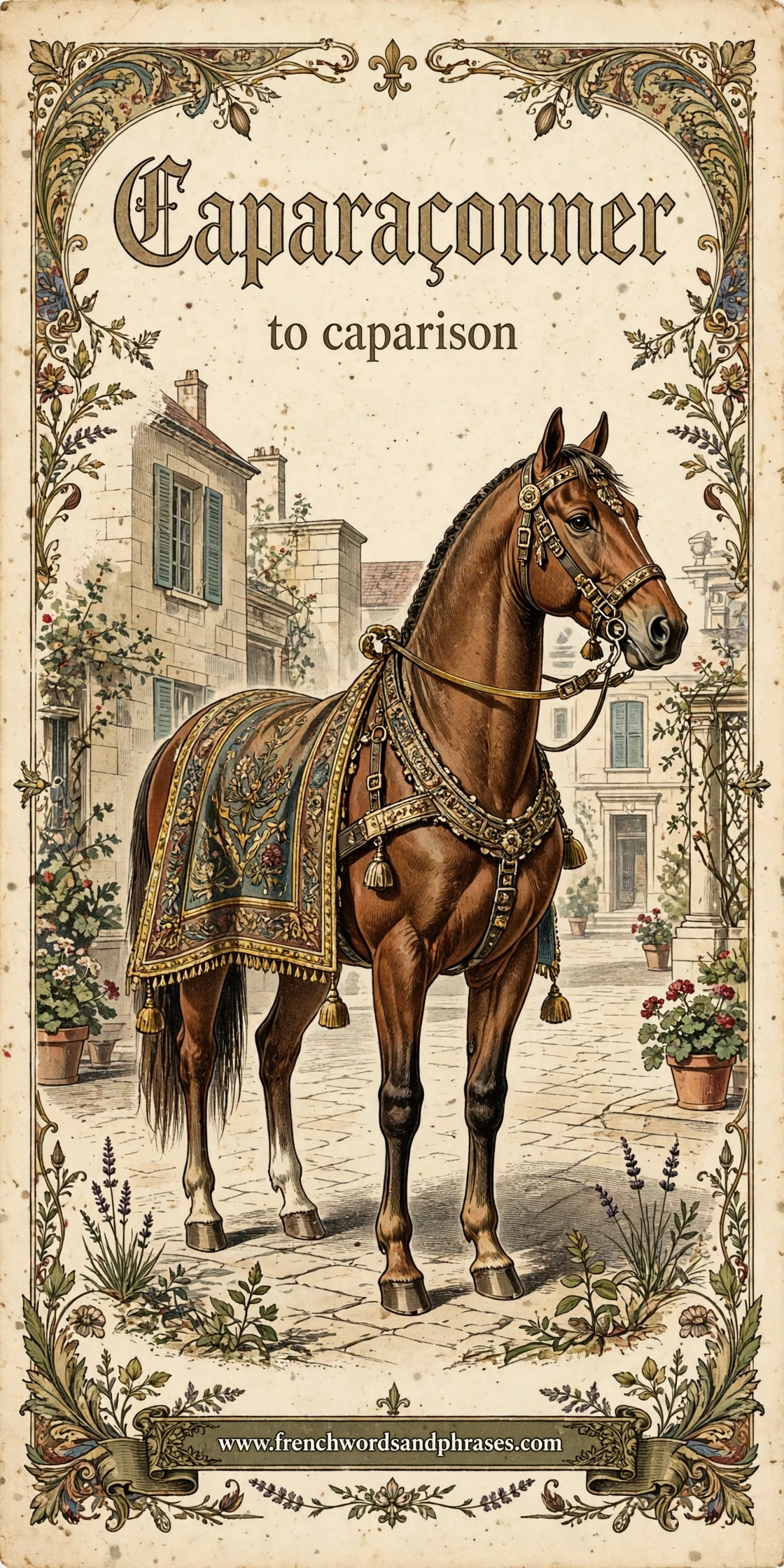
Caparaçonner means to caparison — to deck a horse out in a rich ornamental cloth, the way knights dressed their chargers for tournaments and parades.
A great horse standing patiently in the stable yard while servants throw a cloth of gold and velvet over its back — caparaçonner is the verb of dressing a horse for ceremony, all embroidery, heraldry and pride.
In this guide, you’ll learn how to conjugate caparaçonner in all the major French tenses and moods. Explore complete conjugation tables, French examples, English translations, and practice quizzes.
Understanding the French Verb Caparaçonner
Caparaçonner is a regular French verb belonging to the first group of verbs, those ending in-er.
It means to caparison. It is used almost exclusively of horses in ceremonial contexts — tournaments, processions, royal entries, circus parades — and by extension, humorously, of anything or anyone ridiculously overdressed. Expect it in historical writing rather than at the riding school.
Verb classification: First group (-er)
Auxiliary verb: Avoir
Past participle: caparaçonné
Present participle: caparaçonnant
English equivalents: To caparison, to deck out (a horse); caparaçonner un cheval — to caparison a horse; un cheval caparaçonné d’or — a horse caparisoned in gold; caparaçonner pour le tournoi — to deck out for the tournament; caparaçonner aux armes du seigneur — to caparison with the lord’s arms.
One important detail: caparaçonner keeps its cedilla in every single form — the stem is caparaçonn- throughout: je caparaçonne, nous caparaçonnons, ils caparaçonnent, past participle caparaçonné. The noun behind it is le caparaçon, the ornamental horse-cloth itself. The verb is rare and belongs to history, pageantry and historical novels; for ordinary dressing-up of people, French uses habiller or parer.
Experience the Word
Caparaçonner is the verb of the horse dressed as a banner — cloth, embroidery and heraldry from ears to tail.
Imagine the morning of a medieval tournament. In the stable yard, two servants lift a heavy cloth of crimson velvet worked with golden lions and settle it over the knight’s great grey charger — ils caparaçonnent le cheval — while the animal stamps and snorts under all that splendour.
The horse has not changed at all. He has simply been caparisoned — caparaçonné, turned into a moving coat of arms.
How to Conjugate Caparaçonner: Complete French Conjugation Guide
Let’s explore every major conjugation of caparaçonner, beginning with the indicative mood.
How to Conjugate Caparaçonner in the Indicative Mood
The indicative mood is used to express facts, observations, actions, and events.
How to Conjugate Caparaçonner in the Present Tense (Présent)
Used for actions happening now, habitual actions, and general truths.
| Subject | Conjugation |
|---|---|
| je | caparaçonne |
| tu | caparaçonnes |
| il / elle | caparaçonne |
| nous | caparaçonnons |
| vous | caparaçonnez |
| ils / elles | caparaçonnent |
Example
Les écuyers caparaçonnent le cheval du roi avant la parade.
The squires caparison the king’s horse before the parade.
Quick Quiz 1
Complete the sentence:
Nous ______ les chevaux pour la reconstitution.
Reveal the answer
caparaçonnons
Nous caparaçonnons les chevaux pour la reconstitution.
We are caparisoning the horses for the re-enactment.
How to Conjugate Caparaçonner in the Passé Composé
Used for completed actions in the past. Caparaçonner takes the auxiliary verb avoir.
| Subject | Conjugation |
|---|---|
| j’ | ai caparaçonné |
| tu | as caparaçonné |
| il / elle | a caparaçonné |
| nous | avons caparaçonné |
| vous | avez caparaçonné |
| ils / elles | ont caparaçonné |
Example
On a caparaçonné les chevaux de velours rouge pour la fête.
They caparisoned the horses in red velvet for the festival.
How to Conjugate Caparaçonner in the Imparfait (Imperfect Tense)
Used for habitual past actions, descriptions, and ongoing situations in the past.
| Subject | Conjugation |
|---|---|
| je | caparaçonnais |
| tu | caparaçonnais |
| il / elle | caparaçonnait |
| nous | caparaçonnions |
| vous | caparaçonniez |
| ils / elles | caparaçonnaient |
Example
Autrefois, on caparaçonnait les chevaux avant chaque tournoi.
In the old days, they used to caparison the horses before every tournament.
Quick Quiz 2
Choose the correct form:
They caparisoned the horses in velvet.
On ______ les chevaux de velours. (a caparaçonné / est caparaçonné)
Reveal the answer
a caparaçonné
On a caparaçonné les chevaux de velours.
Caparaçonner takes avoir.
How to Conjugate Caparaçonner in the Plus-que-parfait
Used to describe an action that had already been completed before another past event.
| Subject | Conjugation |
|---|---|
| j’ | avais caparaçonné |
| tu | avais caparaçonné |
| il / elle | avait caparaçonné |
| nous | avions caparaçonné |
| vous | aviez caparaçonné |
| ils / elles | avaient caparaçonné |
Example
Les servants avaient caparaçonné la monture du prince dès l’aube.
The servants had caparisoned the prince’s mount at dawn.
How to Conjugate Caparaçonner in the Passé Simple
Primarily used in formal writing, literature, and historical narratives. It is rarely used in everyday conversation.
| Subject | Conjugation |
|---|---|
| je | caparaçonnai |
| tu | caparaçonnas |
| il / elle | caparaçonna |
| nous | caparaçonnâmes |
| vous | caparaçonnâtes |
| ils / elles | caparaçonnèrent |
Example
Le héraut caparaçonna son cheval aux armes de son seigneur.
The herald caparisoned his horse with his lord’s arms.
How to Conjugate Caparaçonner in the Passé Antérieur
A literary tense used to express an action completed immediately before another past action, generally in the passé simple.
| Subject | Conjugation |
|---|---|
| j’ | eus caparaçonné |
| tu | eus caparaçonné |
| il / elle | eut caparaçonné |
| nous | eûmes caparaçonné |
| vous | eûtes caparaçonné |
| ils / elles | eurent caparaçonné |
Example
Quand les valets eurent caparaçonné les chevaux, le cortège se forma.
When the grooms had caparisoned the horses, the procession formed.
How to Conjugate Caparaçonner in the Future Tense (Futur Simple)
Used to describe actions that will take place in the future.
| Subject | Conjugation |
|---|---|
| je | caparaçonnerai |
| tu | caparaçonneras |
| il / elle | caparaçonnera |
| nous | caparaçonnerons |
| vous | caparaçonnerez |
| ils / elles | caparaçonneront |
Example
Demain, nous caparaçonnerons les chevaux pour la reconstitution historique.
Tomorrow, we will caparison the horses for the historical re-enactment.
How to Conjugate Caparaçonner in the Futur Antérieur (Future Perfect)
Used for an action that will have been completed before a particular point in the future.
| Subject | Conjugation |
|---|---|
| j’ | aurai caparaçonné |
| tu | auras caparaçonné |
| il / elle | aura caparaçonné |
| nous | aurons caparaçonné |
| vous | aurez caparaçonné |
| ils / elles | auront caparaçonné |
Example
À midi, ils auront caparaçonné tous les chevaux du défilé.
By noon, they will have caparisoned all the horses in the parade.
How to Conjugate Caparaçonner in the Near Future (Futur Proche)
Used to describe something that is going to happen soon. Formed with aller + infinitive.
| Subject | Conjugation |
|---|---|
| je | vais caparaçonner |
| tu | vas caparaçonner |
| il / elle | va caparaçonner |
| nous | allons caparaçonner |
| vous | allez caparaçonner |
| ils / elles | vont caparaçonner |
Example
Le cirque va caparaçonner ses chevaux blancs pour le spectacle du soir.
The circus is going to caparison its white horses for the evening show.
How to Conjugate Caparaçonner in the Conditional Mood
The conditional mood expresses what would happen under certain circumstances. It is also frequently used to make polite requests or express wishes.
How to Conjugate Caparaçonner in the Present Conditional
| Subject | Conjugation |
|---|---|
| je | caparaçonnerais |
| tu | caparaçonnerais |
| il / elle | caparaçonnerait |
| nous | caparaçonnerions |
| vous | caparaçonneriez |
| ils / elles | caparaçonneraient |
Example
Avec plus de temps, on caparaçonnerait les chevaux d’or et d’argent.
With more time, they would caparison the horses in gold and silver.
How to Conjugate Caparaçonner in the Past Conditional
| Subject | Conjugation |
|---|---|
| j’ | aurais caparaçonné |
| il / elle | aurait caparaçonné |
| nous | aurions caparaçonné |
| vous | auriez caparaçonné |
| ils / elles | auraient caparaçonné |
Example
Ils auraient caparaçonné la jument si la pluie n’avait pas tout gâché.
They would have caparisoned the mare if the rain had not spoiled everything.
Caparaçonner in the Literary Past Conditional Form
This less common literary form uses the imperfect subjunctive of avoir.
| Subject | Conjugation |
|---|---|
| j’ | eusse caparaçonné |
| tu | eusses caparaçonné |
| il / elle | eût caparaçonné |
| nous | eussions caparaçonné |
| vous | eussiez caparaçonné |
| ils / elles | eussent caparaçonné |
Example
Le roi eût caparaçonné son coursier de soie écarlate.
The king would have caparisoned his charger in scarlet silk.
How to Conjugate Caparaçonner in the Subjunctive Mood
The subjunctive is used to express wishes, emotions, doubts, necessity, and uncertainty. It frequently follows expressions such as il faut que (it is necessary that) or bien que (although).
How to Conjugate Caparaçonner in the Present Subjunctive
| Subject | Conjugation |
|---|---|
| que je | caparaçonne |
| que tu | caparaçonnes |
| qu’il / qu’elle | caparaçonne |
| que nous | caparaçonnions |
| que vous | caparaçonniez |
| qu’ils / qu’elles | caparaçonnent |
Example
Il faut que l’on caparaçonne les chevaux avant l’arrivée des invités.
The horses must be caparisoned before the guests arrive.
Quick Quiz 3
Complete the sentence using the subjunctive:
Il faut que vous ______ la jument avant les invités.
Reveal the answer
caparaçonniez
Il faut que vous caparaçonniez la jument avant les invités.
You must caparison the mare before the guests.
How to Conjugate Caparaçonner in the Imperfect Subjunctive
A literary tense, rarely encountered in modern spoken French.
| Subject | Conjugation |
|---|---|
| que je | caparaçonnasse |
| que tu | caparaçonnasses |
| qu’il / qu’elle | caparaçonnât |
| que nous | caparaçonnassions |
| que vous | caparaçonnassiez |
| qu’ils / qu’elles | caparaçonnassent |
Example
Le protocole exigeait qu’on caparaçonnât les montures des ambassadeurs.
Protocol required that the ambassadors’ mounts be caparisoned.
How to Conjugate Caparaçonner in the Pluperfect Subjunctive
A literary construction used to express an action completed before another past action.
| Subject | Conjugation |
|---|---|
| que j’ | eusse caparaçonné |
| que tu | eusses caparaçonné |
| qu’il / qu’elle | eût caparaçonné |
| que nous | eussions caparaçonné |
| que vous | eussiez caparaçonné |
| qu’ils / qu’elles | eussent caparaçonné |
Example
On admirait qu’ils eussent caparaçonné les chevaux avec tant de soin.
People admired that they had caparisoned the horses with such care.
How to Conjugate Caparaçonner in the Past Subjunctive
| Subject | Conjugation |
|---|---|
| que j’ | aie caparaçonné |
| que tu | aies caparaçonné |
| qu’il / qu’elle | ait caparaçonné |
| que nous | ayons caparaçonné |
| que vous | ayez caparaçonné |
| qu’ils / qu’elles | aient caparaçonné |
Example
Je suis ravi que vous ayez caparaçonné le vieux cheval pour la photo.
I am delighted that you caparisoned the old horse for the photograph.
How to Conjugate Caparaçonner in the Imperative
The imperative is used to give commands, instructions, invitations, or suggestions. Subject pronouns are omitted.
How to Conjugate Caparaçonner in the Present Imperative
| Person | Conjugation |
|---|---|
| (tu) | caparaçonne |
| (nous) | caparaçonnons |
| (vous) | caparaçonnez |
Example
Caparaçonne ce cheval comme pour un tournoi !
Caparison this horse as if for a tournament!
Quick Quiz 4
How would you say Caparison this horse (tu form)?
Reveal the answer
Caparaçonne ce cheval !
French Participles of Caparaçonner
Participles are verb forms that can be used in compound tenses and other grammatical constructions.
Present Participle of Caparaçonner
caparaçonnant
En caparaçonnant le cheval, le valet fredonnait un air ancien.
While caparisoning the horse, the groom hummed an old tune.
Past Participle of Caparaçonner
caparaçonné
Caparaçonné d’or, le cheval ouvrait la procession.
Caparisoned in gold, the horse led the procession.
Caparaçonner in Everyday French: Real-Life Examples
Now that you know the conjugations, let’s see how caparaçonner appears in everyday French.
Example 1 — Present
Les écuyers caparaçonnent le cheval du roi.
The squires caparison the king’s horse.
Example 2 — Passé composé
On a caparaçonné les chevaux de velours rouge.
They caparisoned the horses in red velvet.
Example 3 — Imparfait
On caparaçonnait les chevaux avant les tournois.
They used to caparison the horses before tournaments.
Example 4 — Future
Nous caparaçonnerons les chevaux pour la parade.
We will caparison the horses for the parade.
Example 5 — Conditional
On caparaçonnerait les chevaux d’or avec plus de temps.
They would caparison the horses in gold with more time.
Example 6 — Imperative
Caparaçonne ce cheval pour la fête !
Caparison this horse for the festival!
Beyond Translation: The Meaning of Caparaçonner
English caparison is the same rare, splendid word — both languages borrowed it for the same object, the embroidered cloth over a warhorse.
Shakespeare’s audiences knew it well.
Today the French verb survives in historical novels, re-enactments and jokes about overdressed guests — but the picture it paints, a horse turned into a walking banner, has lost none of its colour.
How to Remember the French Verb Caparaçonner
Remember it this way: Caparaçonner is about the charger in crimson velvet and golden lions.
- Le caparaçon is the ornamental cloth itself — caparaçonner is to put it on the horse.
- The cedilla never leaves: caparaçonn- in every form, je caparaçonne, nous caparaçonnons.
- A word for horses and history: tournaments, parades and pageants, not the everyday stable.
The key idea is the charger in crimson velvet and golden lions.
Test Your Knowledge of Caparaçonner
Let’s see how much you’ve learned. Try answering these questions before revealing the answers.
Question 1
What does a caparaçonner do to a horse?
Reveal the answer
Decks it out in an ornamental cloth — a caparaçon of velvet and embroidery, for a parade or tournament.
Question 2
How do you say They caparison the king’s horse in French?
Reveal the answer
Ils caparaçonnent le cheval du roi.
Question 3
Translate: They caparisoned the horses in red velvet for the festival.
Reveal the answer
On a caparaçonné les chevaux de velours rouge pour la fête.
Question 4
What is the past participle of caparaçonner?
Reveal the answer
Caparaçonné.
Question 5
Complete the sentence:
Il faut que l’on ______ les chevaux avant la parade.
Reveal the answer
caparaçonne
Il faut que l’on caparaçonne les chevaux avant la parade.
The horses must be caparisoned before the parade.
Your Final Challenge
Can You Use It?
How would you say this in French?
Caparisoned in gold and crimson, the old warhorse raises his head as if at the first tournament of his youth.
Reveal the answer
Caparaçonné d’or et de cramoisi, le vieux cheval de guerre relève la tête comme au premier tournoi de sa jeunesse.
Caparisoned in gold and crimson, the old warhorse raises his head as if at the first tournament of his youth.
A little French. A little curiosity. A richer everyday life.
LEARN FRENCH ONE WORD AT A TIME