A French Word to Live By
How to Conjugate Camionner in French
/ka.mjɔ.ne/
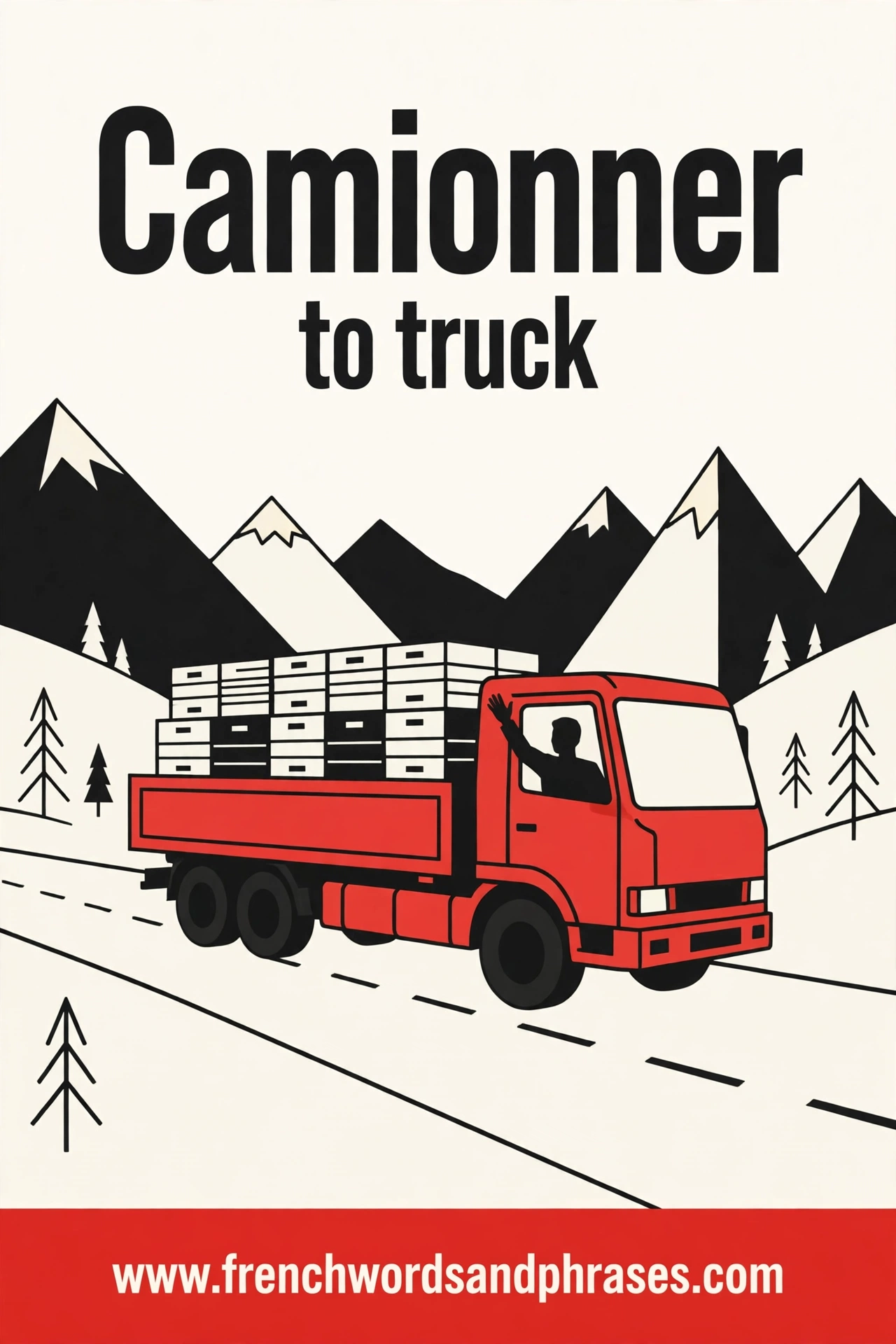
Camionner means to truck, to convey — to transport goods by lorry, loading them up and hauling them from one place to another by road.
Crates of oranges at dawn in a warehouse yard, a lorry reversing to the loading dock with its lights blinking — camionner is the plain working verb of moving goods by road.
In this guide, you’ll learn how to conjugate camionner in all the major French tenses and moods. Explore complete conjugation tables, French examples, English translations, and practice quizzes.
Understanding the French Verb Camionner
Camionner is a regular French verb belonging to the first group of verbs, those ending in-er.
It means to truck, to convey. Camionner is the logistics verb: it is used by hauliers, builders and warehouse staff for moving loads by road — sand, crates, furniture, harvests. For carrying in general French prefers transporter; camionner specifies the lorry and the road.
Verb classification: First group (-er)
Auxiliary verb: Avoir
Past participle: camionné
Present participle: camionnant
English equivalents: To truck, to haul by lorry, to convey by road; camionner des marchandises — to truck goods; camionner du sable — to haul sand by lorry; camionner entre deux dépôts — to shuttle goods between two depots; un camion — a lorry, a truck; un camionneur — a lorry driver.
One important detail: camionner is built on un camion, a lorry — and the double n belongs to the stem in every form: je camionne, nous camionnons, ils camionnent, past participle camionné. It is a plain regular -er verb with nothing to trap you except that double n, which simply copies the noun.
Experience the Word
Camionner is the verb of the loaded lorry — goods on wheels, from the depot to the door.
Imagine a building site at six in the morning. Before the cranes wake, the lorries are already at work: ils camionnent le sable, le ciment et les parpaings from the depot across town, load after load, so that the masons never stand idle.
Nothing glamorous has happened. The goods have simply been trucked — camionnées, load by load, exactly where they were needed.
How to Conjugate Camionner: Complete French Conjugation Guide
Let’s explore every major conjugation of camionner, beginning with the indicative mood.
How to Conjugate Camionner in the Indicative Mood
The indicative mood is used to express facts, observations, actions, and events.
How to Conjugate Camionner in the Present Tense (Présent)
Used for actions happening now, habitual actions, and general truths.
| Subject | Conjugation |
|---|---|
| je | camionne |
| tu | camionnes |
| il / elle | camionne |
| nous | camionnons |
| vous | camionnez |
| ils / elles | camionnent |
Example
Cette entreprise camionne des fruits dans toute la France.
This firm trucks fruit all over France.
Quick Quiz 1
Complete the sentence:
Nous ______ le sable jusqu’au chantier.
Reveal the answer
camionnons
Nous camionnons le sable jusqu’au chantier.
We are hauling the sand by lorry to the building site.
How to Conjugate Camionner in the Passé Composé
Used for completed actions in the past. Camionner takes the auxiliary verb avoir.
| Subject | Conjugation |
|---|---|
| j’ | ai camionné |
| tu | as camionné |
| il / elle | a camionné |
| nous | avons camionné |
| vous | avez camionné |
| ils / elles | ont camionné |
Example
Nous avons camionné le sable jusqu’au chantier.
We hauled the sand by lorry to the building site.
How to Conjugate Camionner in the Imparfait (Imperfect Tense)
Used for habitual past actions, descriptions, and ongoing situations in the past.
| Subject | Conjugation |
|---|---|
| je | camionnais |
| tu | camionnais |
| il / elle | camionnait |
| nous | camionnions |
| vous | camionniez |
| ils / elles | camionnaient |
Example
Autrefois, on camionnait les vendanges jusqu’à la coopérative.
In the old days, the grape harvest was trucked to the cooperative.
Quick Quiz 2
Choose the correct form:
The crates arrived in time.
Les caisses, ______ dès l’aube, sont arrivées à temps. (camionnées / camionnons)
Reveal the answer
camionnées
Les caisses, camionnées dès l’aube, sont arrivées à temps.
Here camionnées is the past participle agreeing with caisses.
How to Conjugate Camionner in the Plus-que-parfait
Used to describe an action that had already been completed before another past event.
| Subject | Conjugation |
|---|---|
| j’ | avais camionné |
| tu | avais camionné |
| il / elle | avait camionné |
| nous | avions camionné |
| vous | aviez camionné |
| ils / elles | avaient camionné |
Example
Le transporteur avait camionné les meubles avant la vente.
The carrier had trucked the furniture before the sale.
How to Conjugate Camionner in the Passé Simple
Primarily used in formal writing, literature, and historical narratives. It is rarely used in everyday conversation.
| Subject | Conjugation |
|---|---|
| je | camionnai |
| tu | camionnas |
| il / elle | camionna |
| nous | camionnâmes |
| vous | camionnâtes |
| ils / elles | camionnèrent |
Example
En deux jours, l’équipe camionna tout le matériel.
In two days, the team trucked all the equipment.
How to Conjugate Camionner in the Passé Antérieur
A literary tense used to express an action completed immediately before another past action, generally in the passé simple.
| Subject | Conjugation |
|---|---|
| j’ | eus camionné |
| tu | eus camionné |
| il / elle | eut camionné |
| nous | eûmes camionné |
| vous | eûtes camionné |
| ils / elles | eurent camionné |
Example
Quand ils eurent camionné la dernière charge, ils fermèrent le dépôt.
When they had hauled the last load, they closed the depot.
How to Conjugate Camionner in the Future Tense (Futur Simple)
Used to describe actions that will take place in the future.
| Subject | Conjugation |
|---|---|
| je | camionnerai |
| tu | camionneras |
| il / elle | camionnera |
| nous | camionnerons |
| vous | camionnerez |
| ils / elles | camionneront |
Example
Demain, nous camionnerons les caisses à la gare.
Tomorrow, we shall truck the crates to the station.
How to Conjugate Camionner in the Futur Antérieur (Future Perfect)
Used for an action that will have been completed before a particular point in the future.
| Subject | Conjugation |
|---|---|
| j’ | aurai camionné |
| tu | auras camionné |
| il / elle | aura camionné |
| nous | aurons camionné |
| vous | aurez camionné |
| ils / elles | auront camionné |
Example
À midi, le chauffeur aura camionné trois chargements.
By noon, the driver will have hauled three loads.
How to Conjugate Camionner in the Near Future (Futur Proche)
Used to describe something that is going to happen soon. Formed with aller + infinitive.
| Subject | Conjugation |
|---|---|
| je | vais camionner |
| tu | vas camionner |
| il / elle | va camionner |
| nous | allons camionner |
| vous | allez camionner |
| ils / elles | vont camionner |
Example
Le camion va camionner le gravier cet après-midi.
The lorry is going to haul the gravel this afternoon.
How to Conjugate Camionner in the Conditional Mood
The conditional mood expresses what would happen under certain circumstances. It is also frequently used to make polite requests or express wishes.
How to Conjugate Camionner in the Present Conditional
| Subject | Conjugation |
|---|---|
| je | camionnerais |
| tu | camionnerais |
| il / elle | camionnerait |
| nous | camionnerions |
| vous | camionneriez |
| ils / elles | camionneraient |
Example
Avec un deuxième camion, on camionnerait tout en une journée.
With a second lorry, we would truck everything in one day.
How to Conjugate Camionner in the Past Conditional
| Subject | Conjugation |
|---|---|
| j’ | aurais camionné |
| tu | aurais camionné |
| il / elle | aurait camionné |
| nous | aurions camionné |
| vous | auriez camionné |
| ils / elles | auraient camionné |
Example
Tu aurais camionné les caisses si le camion avait démarré.
You would have trucked the crates if the lorry had started.
Camionner in the Literary Past Conditional Form
This less common literary form uses the imperfect subjunctive of avoir.
| Subject | Conjugation |
|---|---|
| j’ | eusse camionné |
| tu | eusses camionné |
| il / elle | eût camionné |
| nous | eussions camionné |
| vous | eussiez camionné |
| ils / elles | eussent camionné |
Example
Il eût camionné le sable avant la pluie.
He would have hauled the sand before the rain.
How to Conjugate Camionner in the Subjunctive Mood
The subjunctive is used to express wishes, emotions, doubts, necessity, and uncertainty. It frequently follows expressions such as il faut que (it is necessary that) or bien que (although).
How to Conjugate Camionner in the Present Subjunctive
| Subject | Conjugation |
|---|---|
| que je | camionne |
| que tu | camionnes |
| qu’il / qu’elle | camionne |
| que nous | camionnions |
| que vous | camionniez |
| qu’ils / qu’elles | camionnent |
Example
Il faut que vous camionniez les marchandises avant vendredi.
You must truck the goods before Friday.
Quick Quiz 3
Complete the sentence using the subjunctive:
Il faut que tu ______ les caisses à la gare.
Reveal the answer
camionnes
Il faut que tu camionnes les caisses à la gare.
You must truck the crates to the station.
How to Conjugate Camionner in the Imperfect Subjunctive
A literary tense, rarely encountered in modern spoken French.
| Subject | Conjugation |
|---|---|
| que je | camionnasse |
| que tu | camionnasses |
| qu’il / qu’elle | camionnât |
| que nous | camionnassions |
| que vous | camionnassiez |
| qu’ils / qu’elles | camionnassent |
Example
Le client demandait qu’on camionnât les meubles le matin même.
The customer asked for the furniture to be trucked that very morning.
How to Conjugate Camionner in the Pluperfect Subjunctive
A literary construction used to express an action completed before another past action.
| Subject | Conjugation |
|---|---|
| que j’ | eusse camionné |
| que tu | eusses camionné |
| qu’il / qu’elle | eût camionné |
| que nous | eussions camionné |
| que vous | eussiez camionné |
| qu’ils / qu’elles | eussent camionné |
Example
On vérifia qu’il eût camionné la charge entière.
They checked that he had hauled the whole load.
How to Conjugate Camionner in the Past Subjunctive
| Subject | Conjugation |
|---|---|
| que j’ | aie camionné |
| que tu | aies camionné |
| qu’il / qu’elle | ait camionné |
| que nous | ayons camionné |
| que vous | ayez camionné |
| qu’ils / qu’elles | aient camionné |
Example
Je suis content que vous ayez camionné tout le stock.
I am glad you trucked all the stock.
How to Conjugate Camionner in the Imperative
The imperative is used to give commands, instructions, invitations, or suggestions. Subject pronouns are omitted.
How to Conjugate Camionner in the Present Imperative
| Person | Conjugation |
|---|---|
| (tu) | camionne |
| (nous) | camionnons |
| (vous) | camionnez |
Example
Camionnez les caisses à la gare, vite !
Truck the crates to the station, quickly!
Quick Quiz 4
How would you say Truck the crates to the station (tu form)?
Reveal the answer
Camionne les caisses à la gare !
French Participles of Camionner
Participles are verb forms that can be used in compound tenses and other grammatical constructions.
Present Participle of Camionner
camionnant
En camionnant la nuit, les chauffeurs évitent les embouteillages.
By trucking at night, the drivers avoid traffic jams.
Past Participle of Camionner
camionné
Camionnées dès l’aube, les caisses sont arrivées à temps.
Trucked from dawn, the crates arrived in time.
Camionner in Everyday French: Real-Life Examples
Now that you know the conjugations, let’s see how camionner appears in everyday French.
Example 1 — Present
Cette entreprise camionne des fruits.
This firm trucks fruit.
Example 2 — Passé composé
Nous avons camionné le sable au chantier.
We hauled the sand to the site by lorry.
Example 3 — Imparfait
On camionnait les vendanges à la coopérative.
The harvest used to be trucked to the cooperative.
Example 4 — Future
Nous camionnerons les caisses à la gare.
We shall truck the crates to the station.
Example 5 — Conditional
On camionnerait tout en une journée.
We would truck everything in one day.
Example 6 — Imperative
Camionnez les caisses à la gare !
Truck the crates to the station!
Beyond Translation: The Meaning of Camionner
English to truck as a verb is the exact twin — and French camionner is simply un camion, a lorry, turned into an action.
It is a word of depots and loading docks.
You will not meet it in love poems, but on delivery notes, building sites and harvest mornings it does honest work: whatever is camionné travels by road, in a lorry, load by load.
How to Remember the French Verb Camionner
Remember it this way: Camionner is about a lorry reversing to the loading dock at dawn.
- Built on un camion: the double n never changes — nous camionnons.
- It specifies the lorry: transporter is general, camionner is by road in a truck.
- Plain regular -er: je camionne, past participle camionné.
The key idea is a lorry reversing to the loading dock at dawn.
Test Your Knowledge of Camionner
Let’s see how much you’ve learned. Try answering these questions before revealing the answers.
Question 1
Why does camionner have a double n?
Reveal the answer
It copies its noun — un camion gives the stem camionn-, so: je camionne, nous camionnons.
Question 2
How do you say This firm trucks fruit all over France in French?
Reveal the answer
Cette entreprise camionne des fruits dans toute la France.
Question 3
Translate: We hauled the sand by lorry to the building site.
Reveal the answer
Nous avons camionné le sable jusqu’au chantier.
Question 4
What is the past participle of camionner?
Reveal the answer
Camionné.
Question 5
Complete the sentence:
Il faut que vous ______ les marchandises avant vendredi.
Reveal the answer
camionniez
Il faut que vous camionniez les marchandises avant vendredi.
You must truck the goods before Friday.
Your Final Challenge
Can You Use It?
How would you say this in French?
They trucked the grape harvest under the moon, and the cooperative woke to the scent of crushed grapes.
Reveal the answer
Ils camionnèrent les vendanges sous la lune, et la coopérative s’éveilla dans un parfum de raisin écrasé.
They trucked the grape harvest under the moon, and the cooperative woke to the scent of crushed grapes.
A little French. A little curiosity. A richer everyday life.
LEARN FRENCH ONE WORD AT A TIME