A French Word to Live By
How to Conjugate Cameloter in French
/kam.lɔ.te/
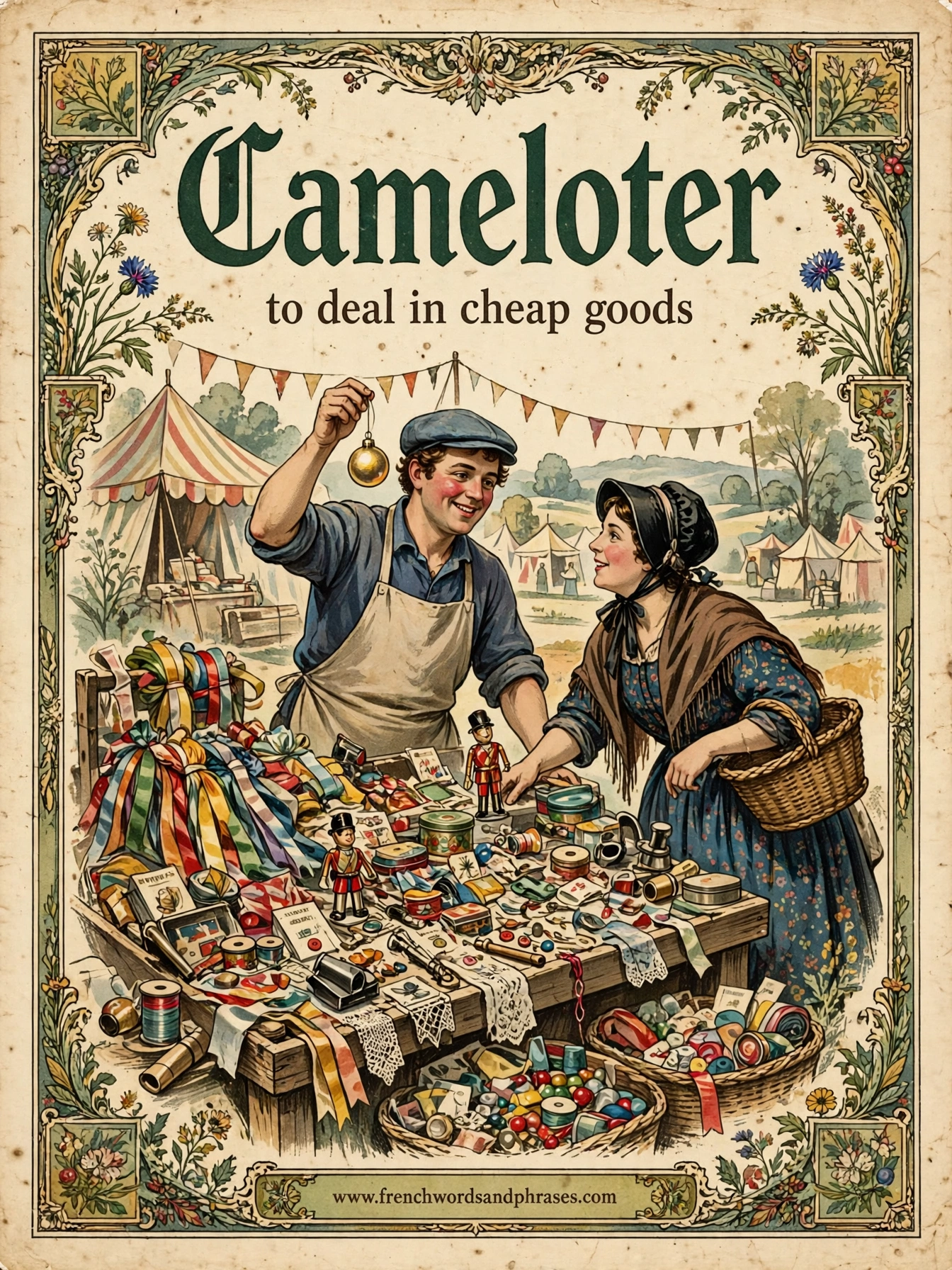
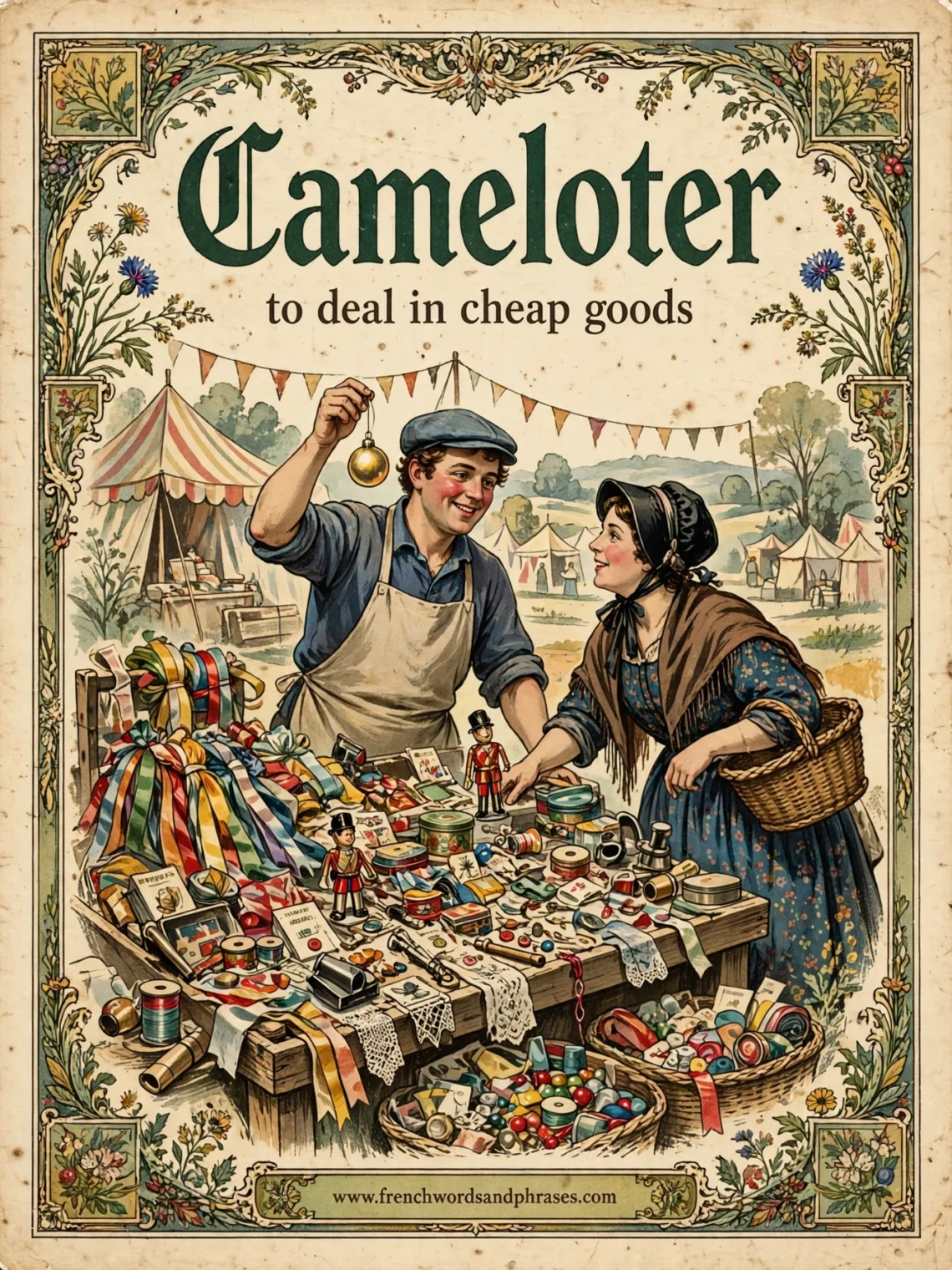
Cameloter means to deal in cheap goods — to make and sell camelote, the cheap, shoddy merchandise that falls apart almost before it is bought.
A market stall of watches that stop by Friday, umbrellas that fold at the first wind — cameloter is the rare verb of the shoddy-goods trade, built on la camelote, cheap rubbishy merchandise.
In this guide, you’ll learn how to conjugate cameloter in all the major French tenses and moods. Explore complete conjugation tables, French examples, English translations, and practice quizzes.
Understanding the French Verb Cameloter
Cameloter is a regular French verb belonging to the first group of verbs, those ending in-er.
It means to deal in cheap goods. Cameloter names the whole trade in rubbish: manufacturing or peddling goods made to be cheap rather than to last. Modern French usually just says vendre de la camelote; the verb survives as a colourful, slightly old-fashioned way to mock a trader’s stock.
Verb classification: First group (-er)
Auxiliary verb: Avoir
Past participle: cameloté
Present participle: camelotant
English equivalents: To deal in cheap goods, to sell shoddy merchandise; cameloter sur les marchés — to peddle cheap goods at markets; la camelote — cheap, shoddy goods; de la pure camelote — utter rubbish (of merchandise); un camelot — a street hawker, a pedlar of cheap goods.
One important detail: cameloter keeps a single t everywhere — je camelote, nous camelotons, ils camelotent, past participle cameloté; unlike cacheter, the t does not double. It is a rare verb, far less common than its noun la camelote, cheap shoddy goods, and its cousin un camelot, the street pedlar who sells them. You will meet the noun in shops and markets; the verb mostly in older or humorous writing.
Experience the Word
Cameloter is the verb of the stallholder’s shame — goods made to be sold, not to be used.
Imagine a travelling salesman at a country fair, unrolling watches by the dozen from a suitcase. They gleam, they chime, they cost almost nothing — and by Sunday half of them have stopped. Il camelote, et tout le village le sait: ses montres sont de la camelote.
Nobody has been robbed exactly. They have simply bought cheap goods — camelotés, sold by a man whose trade is shoddiness itself.
How to Conjugate Cameloter: Complete French Conjugation Guide
Let’s explore every major conjugation of cameloter, beginning with the indicative mood.
How to Conjugate Cameloter in the Indicative Mood
The indicative mood is used to express facts, observations, actions, and events.
How to Conjugate Cameloter in the Present Tense (Présent)
Used for actions happening now, habitual actions, and general truths.
| Subject | Conjugation |
|---|---|
| je | camelote |
| tu | camelotes |
| il / elle | camelote |
| nous | camelotons |
| vous | camelotez |
| ils / elles | camelotent |
Example
Ce marchand camelote sur tous les marchés de la région.
This trader deals in cheap goods at every market in the region.
Quick Quiz 1
Complete the sentence:
Nous ______ sur les marchés de la région.
Reveal the answer
camelotons
Nous camelotons sur les marchés de la région.
We deal in cheap goods at the region’s markets.
How to Conjugate Cameloter in the Passé Composé
Used for completed actions in the past. Cameloter takes the auxiliary verb avoir.
| Subject | Conjugation |
|---|---|
| j’ | ai cameloté |
| tu | as cameloté |
| il / elle | a cameloté |
| nous | avons cameloté |
| vous | avez cameloté |
| ils / elles | ont cameloté |
Example
Il a cameloté pendant des années avant d’ouvrir un vrai magasin.
He dealt in cheap goods for years before opening a proper shop.
How to Conjugate Cameloter in the Imparfait (Imperfect Tense)
Used for habitual past actions, descriptions, and ongoing situations in the past.
| Subject | Conjugation |
|---|---|
| je | camelotais |
| tu | camelotais |
| il / elle | camelotait |
| nous | camelotions |
| vous | camelotiez |
| ils / elles | camelotaient |
Example
Autrefois, les colporteurs camelotaient de village en village.
In the old days, pedlars dealt in cheap goods from village to village.
Quick Quiz 2
Choose the correct form:
He dealt in cheap goods for years.
Il ______ pendant des années. (a cameloté / est cameloté)
Reveal the answer
a cameloté
Il a cameloté pendant des années.
Cameloter takes avoir.
How to Conjugate Cameloter in the Plus-que-parfait
Used to describe an action that had already been completed before another past event.
| Subject | Conjugation |
|---|---|
| j’ | avais cameloté |
| tu | avais cameloté |
| il / elle | avait cameloté |
| nous | avions cameloté |
| vous | aviez cameloté |
| ils / elles | avaient cameloté |
Example
Le forain avait cameloté tout l’été sans grand profit.
The fairground trader had peddled cheap goods all summer without much profit.
How to Conjugate Cameloter in the Passé Simple
Primarily used in formal writing, literature, and historical narratives. It is rarely used in everyday conversation.
| Subject | Conjugation |
|---|---|
| je | camelotai |
| tu | camelotas |
| il / elle | camelota |
| nous | camelotâmes |
| vous | camelotâtes |
| ils / elles | camelotèrent |
Example
Le marchand camelota sur les foires pendant vingt ans.
The trader dealt in cheap goods at fairs for twenty years.
How to Conjugate Cameloter in the Passé Antérieur
A literary tense used to express an action completed immediately before another past action, generally in the passé simple.
| Subject | Conjugation |
|---|---|
| j’ | eus cameloté |
| tu | eus cameloté |
| il / elle | eut cameloté |
| nous | eûmes cameloté |
| vous | eûtes cameloté |
| ils / elles | eurent cameloté |
Example
Quand il eut cameloté toute la journée, il plia son étal.
When he had peddled his cheap goods all day, he packed up his stall.
How to Conjugate Cameloter in the Future Tense (Futur Simple)
Used to describe actions that will take place in the future.
| Subject | Conjugation |
|---|---|
| je | cameloterai |
| tu | cameloteras |
| il / elle | camelotera |
| nous | cameloterons |
| vous | cameloterez |
| ils / elles | cameloteront |
Example
Sans argent, il camelotera encore l’été prochain.
Without money, he will deal in cheap goods again next summer.
How to Conjugate Cameloter in the Futur Antérieur (Future Perfect)
Used for an action that will have been completed before a particular point in the future.
| Subject | Conjugation |
|---|---|
| j’ | aurai cameloté |
| tu | auras cameloté |
| il / elle | aura cameloté |
| nous | aurons cameloté |
| vous | aurez cameloté |
| ils / elles | auront cameloté |
Example
À la fin de la foire, ils auront cameloté tout leur stock.
By the end of the fair, they will have sold off all their cheap stock.
How to Conjugate Cameloter in the Near Future (Futur Proche)
Used to describe something that is going to happen soon. Formed with aller + infinitive.
| Subject | Conjugation |
|---|---|
| je | vais cameloter |
| tu | vas cameloter |
| il / elle | va cameloter |
| nous | allons cameloter |
| vous | allez cameloter |
| ils / elles | vont cameloter |
Example
Ce vendeur va cameloter devant la gare.
This seller is going to peddle cheap goods outside the station.
How to Conjugate Cameloter in the Conditional Mood
The conditional mood expresses what would happen under certain circumstances. It is also frequently used to make polite requests or express wishes.
How to Conjugate Cameloter in the Present Conditional
| Subject | Conjugation |
|---|---|
| je | cameloterais |
| tu | cameloterais |
| il / elle | cameloterait |
| nous | cameloterions |
| vous | cameloteriez |
| ils / elles | cameloteraient |
Example
Avec un tel stock, n’importe qui cameloterait à sa place.
With stock like that, anyone would be dealing in cheap goods in his place.
How to Conjugate Cameloter in the Past Conditional
| Subject | Conjugation |
|---|---|
| j’ | aurais cameloté |
| tu | aurais cameloté |
| il / elle | aurait cameloté |
| nous | aurions cameloté |
| vous | auriez cameloté |
| ils / elles | auraient cameloté |
Example
Tu aurais cameloté si tu avais hérité de son étal.
You would have dealt in cheap goods if you had inherited his stall.
Cameloter in the Literary Past Conditional Form
This less common literary form uses the imperfect subjunctive of avoir.
| Subject | Conjugation |
|---|---|
| j’ | eusse cameloté |
| tu | eusses cameloté |
| il / elle | eût cameloté |
| nous | eussions cameloté |
| vous | eussiez cameloté |
| ils / elles | eussent cameloté |
Example
Il eût cameloté toute sa vie sans la guerre.
He would have peddled cheap goods all his life without the war.
How to Conjugate Cameloter in the Subjunctive Mood
The subjunctive is used to express wishes, emotions, doubts, necessity, and uncertainty. It frequently follows expressions such as il faut que (it is necessary that) or bien que (although).
How to Conjugate Cameloter in the Present Subjunctive
| Subject | Conjugation |
|---|---|
| que je | camelote |
| que tu | camelotes |
| qu’il / qu’elle | camelote |
| que nous | camelotions |
| que vous | camelotiez |
| qu’ils / qu’elles | camelotent |
Example
Je ne veux pas que tu camelotes comme ton oncle.
I do not want you dealing in cheap goods like your uncle.
Quick Quiz 3
Complete the sentence using the subjunctive:
Je ne veux pas que vous ______ ce stock.
Reveal the answer
camelotiez
Je ne veux pas que vous camelotiez ce stock.
I do not want you peddling that cheap stock.
How to Conjugate Cameloter in the Imperfect Subjunctive
A literary tense, rarely encountered in modern spoken French.
| Subject | Conjugation |
|---|---|
| que je | camelotasse |
| que tu | camelotasses |
| qu’il / qu’elle | camelotât |
| que nous | camelotassions |
| que vous | camelotassiez |
| qu’ils / qu’elles | camelotassent |
Example
Il était triste que le vieux marchand camelotât encore à son âge.
It was sad that the old trader was still peddling cheap goods at his age.
How to Conjugate Cameloter in the Pluperfect Subjunctive
A literary construction used to express an action completed before another past action.
| Subject | Conjugation |
|---|---|
| que j’ | eusse cameloté |
| que tu | eusses cameloté |
| qu’il / qu’elle | eût cameloté |
| que nous | eussions cameloté |
| que vous | eussiez cameloté |
| qu’ils / qu’elles | eussent cameloté |
Example
On racontait qu’il eût cameloté sur toutes les foires du pays.
People said he had dealt in cheap goods at every fair in the country.
How to Conjugate Cameloter in the Past Subjunctive
| Subject | Conjugation |
|---|---|
| que j’ | aie cameloté |
| que tu | aies cameloté |
| qu’il / qu’elle | ait cameloté |
| que nous | ayons cameloté |
| que vous | ayez cameloté |
| qu’ils / qu’elles | aient cameloté |
Example
Je suis étonné qu’il ait cameloté si longtemps.
I am amazed he dealt in cheap goods for so long.
How to Conjugate Cameloter in the Imperative
The imperative is used to give commands, instructions, invitations, or suggestions. Subject pronouns are omitted.
How to Conjugate Cameloter in the Present Imperative
| Person | Conjugation |
|---|---|
| (tu) | camelote |
| (nous) | camelotons |
| (vous) | camelotez |
Example
Ne camelote pas, vends de la qualité !
Do not deal in cheap goods, sell quality!
Quick Quiz 4
How would you say Do not deal in cheap goods (tu form)?
Reveal the answer
Ne camelote pas !
French Participles of Cameloter
Participles are verb forms that can be used in compound tenses and other grammatical constructions.
Present Participle of Cameloter
camelotant
En camelotant ainsi, il a perdu tous ses clients sérieux.
By dealing in cheap goods like that, he lost all his serious customers.
Past Participle of Cameloter
cameloté
Camelotées à la foire, ces montres sont tombées en panne en une semaine.
Peddled cheap at the fair, these watches broke down within a week.
Cameloter in Everyday French: Real-Life Examples
Now that you know the conjugations, let’s see how cameloter appears in everyday French.
Example 1 — Present
Ce marchand camelote sur les marchés.
This trader deals in cheap goods at the markets.
Example 2 — Passé composé
Il a cameloté pendant des années.
He dealt in cheap goods for years.
Example 3 — Imparfait
Les colporteurs camelotaient de village en village.
Pedlars used to deal in cheap goods from village to village.
Example 4 — Future
Il camelotera encore l’été prochain.
He will deal in cheap goods again next summer.
Example 5 — Conditional
N’importe qui cameloterait avec un tel stock.
Anyone would deal in cheap goods with stock like that.
Example 6 — Imperative
Ne camelote pas, vends de la qualité !
Do not deal in cheap goods, sell quality!
Beyond Translation: The Meaning of Cameloter
The star of this family is the noun: la camelote is the French word for cheap, shoddy merchandise — the umbrella that inverts in the first gust, the toy that breaks by bedtime.
The verb cameloter is its rare shadow.
Dictionaries keep it, traders rarely say it, but it completes the picture: un camelot peddles, la camelote disappoints, and cameloter is the trade that joins the two.
How to Remember the French Verb Cameloter
Remember it this way: Cameloter is about a suitcase of watches that stop by Friday.
- Single t everywhere: je camelote, nous camelotons — no doubling.
- The noun la camelote (cheap shoddy goods) is far commoner than the verb.
- A rare, colourful verb — everyday French says vendre de la camelote.
The key idea is a suitcase of watches that stop by Friday.
Test Your Knowledge of Cameloter
Let’s see how much you’ve learned. Try answering these questions before revealing the answers.
Question 1
What is la camelote?
Reveal the answer
Cheap, shoddy goods — merchandise made to be sold cheaply, not to last.
Question 2
How do you say This trader deals in cheap goods in French?
Reveal the answer
Ce marchand camelote.
Question 3
Translate: He dealt in cheap goods for years.
Reveal the answer
Il a cameloté pendant des années.
Question 4
What is the past participle of cameloter?
Reveal the answer
Cameloté — with a single t, like the present stem.
Question 5
Complete the sentence:
Je ne veux pas que tu ______ comme ton oncle.
Reveal the answer
camelotes
Je ne veux pas que tu camelotes comme ton oncle.
I do not want you dealing in cheap goods like your uncle.
Your Final Challenge
Can You Use It?
How would you say this in French?
He dealt in cheap goods all his life, and his watches, true to their reputation, never told the time two days running.
Reveal the answer
Il camelota toute sa vie, et ses montres, fidèles à leur réputation, ne donnèrent jamais l’heure deux jours de suite.
He dealt in cheap goods all his life, and his watches, true to their reputation, never told the time two days running.
A little French. A little curiosity. A richer everyday life.
LEARN FRENCH ONE WORD AT A TIME