A French Word to Live By
How to Conjugate Calmir in French
/kal.miʁ/
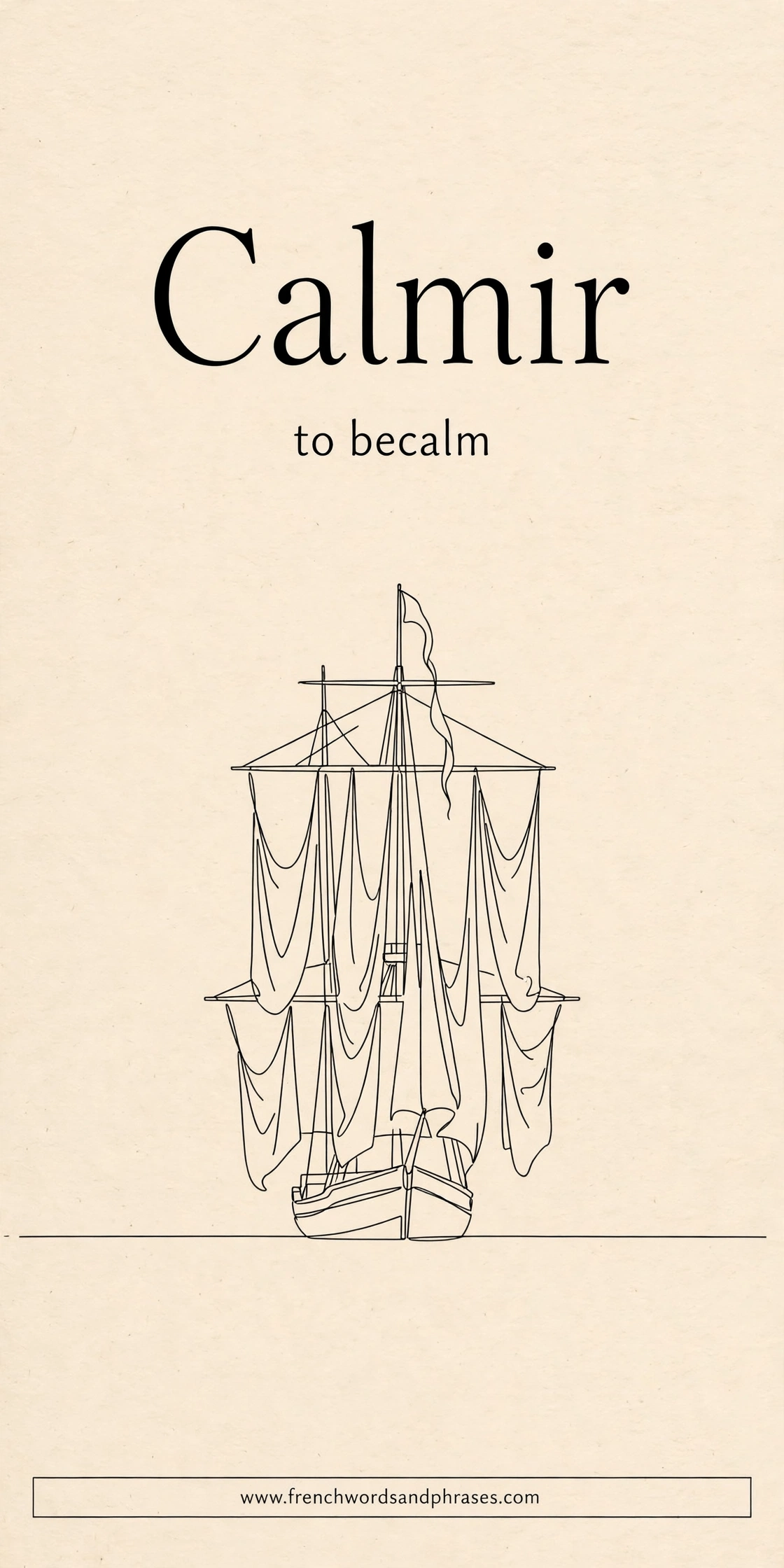
Calmir means to becalm — said of the wind and the sea when they drop away and leave a sailing ship motionless, waiting for a breath of air.
A sailing ship in mid-ocean, sails hanging limp, not a ripple on the water — calmir is the old sailors’ verb for the sea and wind settling into stillness, and for the ship left becalmed by that calm.
In this guide, you’ll learn how to conjugate calmir in all the major French tenses and moods. Explore complete conjugation tables, French examples, English translations, and practice quizzes.
Understanding the French Verb Calmir
Calmir is a regular French verb belonging to the second group of verbs, those ending in -ir.
It means to becalm. Its subjects are almost never people: it is the wind, the sea or the storm that calmit, and the ship that ends up calmi. For everyday calming French uses calmer or s’apaiser; calmir belongs to the world of sails, weather logs and maritime literature.
Verb classification: Second group (-ir)
Auxiliary verb: Avoir
Past participle: calmi
Present participle: calmissant
English equivalents: To becalm, to grow calm at sea; la mer calmit — the sea is settling; le vent a calmi — the wind has dropped; un navire calmi — a becalmed ship; être calmi en pleine mer — to be becalmed in the open sea; la tempête calmit — the storm is dying down.
One important detail: calmir is a second-group -ir verb, conjugated exactly like finir — look for the tell-tale -iss- in the plural: nous calmissons, vous calmissez, ils calmissent, past participle calmi. It is a rare, nautical verb: in modern French you will mostly meet the infinitive and the past participle calmi in sea stories and older novels, where a ship calmi is a ship stuck without wind.
Experience the Word
Calmir is the verb of the wind dying at sea — the moment the ocean smooths itself out and the ship simply stops.
Imagine a small sailing boat two days from land. All morning the wind has been failing; by noon the sail hangs like a curtain and the sea is glass. La mer a calmi — beautiful, silent, and maddening for a crew with a port to reach.
Nothing is broken and nobody is in danger. The ship is simply becalmed — calmi, waiting on an empty sea for the wind to remember it.
How to Conjugate Calmir: Complete French Conjugation Guide
Let’s explore every major conjugation of calmir, beginning with the indicative mood.
How to Conjugate Calmir in the Indicative Mood
The indicative mood is used to express facts, observations, actions, and events.
How to Conjugate Calmir in the Present Tense (Présent)
Used for actions happening now, habitual actions, and general truths.
| Subject | Conjugation |
|---|---|
| je | calmis |
| tu | calmis |
| il / elle | calmit |
| nous | calmissons |
| vous | calmissez |
| ils / elles | calmissent |
Example
Quand le vent tombe, la mer calmit peu à peu.
When the wind drops, the sea settles little by little.
Quick Quiz 1
Complete the sentence:
Les vagues ______ peu à peu.
Reveal the answer
calmissent
Les vagues calmissent peu à peu.
The waves are settling little by little.
How to Conjugate Calmir in the Passé Composé
Used for completed actions in the past. Calmir takes the auxiliary verb avoir.
| Subject | Conjugation |
|---|---|
| j’ | ai calmi |
| tu | as calmi |
| il / elle | a calmi |
| nous | avons calmi |
| vous | avez calmi |
| ils / elles | ont calmi |
Example
Vers le soir, la mer a calmi et le silence est devenu total.
Towards evening, the sea settled and the silence became total.
How to Conjugate Calmir in the Imparfait (Imperfect Tense)
Used for habitual past actions, descriptions, and ongoing situations in the past.
| Subject | Conjugation |
|---|---|
| je | calmissais |
| tu | calmissais |
| il / elle | calmissait |
| nous | calmissions |
| vous | calmissiez |
| ils / elles | calmissaient |
Example
La tempête calmissait lentement au large des côtes.
The storm was slowly dying down off the coast.
Quick Quiz 2
Choose the correct form:
The sea has settled.
La mer ______ . (a calmi / est calmi)
Reveal the answer
a calmi
La mer a calmi.
Calmir takes avoir in compound tenses.
How to Conjugate Calmir in the Plus-que-parfait
Used to describe an action that had already been completed before another past event.
| Subject | Conjugation |
|---|---|
| j’ | avais calmi |
| tu | avais calmi |
| il / elle | avait calmi |
| nous | avions calmi |
| vous | aviez calmi |
| ils / elles | avaient calmi |
Example
La mer avait calmi quand les secours sont arrivés.
The sea had settled when help arrived.
How to Conjugate Calmir in the Passé Simple
Primarily used in formal writing, literature, and historical narratives. It is rarely used in everyday conversation.
| Subject | Conjugation |
|---|---|
| je | calmis |
| tu | calmis |
| il / elle | calmit |
| nous | calmîmes |
| vous | calmîtes |
| ils / elles | calmirent |
Example
Au matin, le vent calmit et la grande voile retomba.
In the morning, the wind dropped and the mainsail fell limp.
How to Conjugate Calmir in the Passé Antérieur
A literary tense used to express an action completed immediately before another past action, generally in the passé simple.
| Subject | Conjugation |
|---|---|
| j’ | eus calmi |
| tu | eus calmi |
| il / elle | eut calmi |
| nous | eûmes calmi |
| vous | eûtes calmi |
| ils / elles | eurent calmi |
Example
Dès que la mer eut calmi, le capitaine remit à la voile.
As soon as the sea had settled, the captain set sail again.
How to Conjugate Calmir in the Future Tense (Futur Simple)
Used to describe actions that will take place in the future.
| Subject | Conjugation |
|---|---|
| je | calmirai |
| tu | calmiras |
| il / elle | calmira |
| nous | calmirons |
| vous | calmirez |
| ils / elles | calmiront |
Example
La mer calmira avant la nuit, j’espère.
The sea will settle before nightfall, I hope.
How to Conjugate Calmir in the Futur Antérieur (Future Perfect)
Used for an action that will have been completed before a particular point in the future.
| Subject | Conjugation |
|---|---|
| j’ | aurai calmi |
| tu | auras calmi |
| il / elle | aura calmi |
| nous | aurons calmi |
| vous | aurez calmi |
| ils / elles | auront calmi |
Example
Demain, la tempête aura calmi et nous pourrons repartir.
Tomorrow, the storm will have died down and we shall be able to leave.
How to Conjugate Calmir in the Near Future (Futur Proche)
Used to describe something that is going to happen soon. Formed with aller + infinitive.
| Subject | Conjugation |
|---|---|
| je | vais calmir |
| tu | vas calmir |
| il / elle | va calmir |
| nous | allons calmir |
| vous | allez calmir |
| ils / elles | vont calmir |
Example
Le vent va calmir, rentrons au port.
The wind is going to drop, let us head back to port.
How to Conjugate Calmir in the Conditional Mood
The conditional mood expresses what would happen under certain circumstances. It is also frequently used to make polite requests or express wishes.
How to Conjugate Calmir in the Present Conditional
| Subject | Conjugation |
|---|---|
| je | calmirais |
| tu | calmirais |
| il / elle | calmirait |
| nous | calmirions |
| vous | calmiriez |
| ils / elles | calmiraient |
Example
Sans ce courant, la mer calmirait encore plus vite.
Without this current, the sea would settle even faster.
How to Conjugate Calmir in the Past Conditional
| Subject | Conjugation |
|---|---|
| j’ | aurais calmi |
| tu | aurais calmi |
| il / elle | aurait calmi |
| nous | aurions calmi |
| vous | auriez calmi |
| ils / elles | auraient calmi |
Example
La mer aurait calmi plus tôt sans le vent du nord.
The sea would have settled sooner without the north wind.
Calmir in the Literary Past Conditional Form
This less common literary form uses the imperfect subjunctive of avoir.
| Subject | Conjugation |
|---|---|
| j’ | eusse calmi |
| tu | eusses calmi |
| il / elle | eût calmi |
| nous | eussions calmi |
| vous | eussiez calmi |
| ils / elles | eussent calmi |
Example
La mer eût calmi si le vent fût tombé plus tôt.
The sea would have settled if the wind had dropped sooner.
How to Conjugate Calmir in the Subjunctive Mood
The subjunctive is used to express wishes, emotions, doubts, necessity, and uncertainty. It frequently follows expressions such as il faut que (it is necessary that) or bien que (although).
How to Conjugate Calmir in the Present Subjunctive
| Subject | Conjugation |
|---|---|
| que je | calmisse |
| que tu | calmisses |
| qu’il / qu’elle | calmisse |
| que nous | calmissions |
| que vous | calmissiez |
| qu’ils / qu’elles | calmissent |
Example
Il faut que la mer calmisse avant le départ.
The sea must settle before the departure.
Quick Quiz 3
Complete the sentence using the subjunctive:
Il faut que la tempête ______ avant demain.
Reveal the answer
calmisse
Il faut que la tempête calmisse avant demain.
The storm must die down before tomorrow.
How to Conjugate Calmir in the Imperfect Subjunctive
A literary tense, rarely encountered in modern spoken French.
| Subject | Conjugation |
|---|---|
| que je | calmisse |
| que tu | calmisses |
| qu’il / qu’elle | calmît |
| que nous | calmissions |
| que vous | calmissiez |
| qu’ils / qu’elles | calmissent |
Example
Le capitaine attendait que le vent calmît enfin.
The captain was waiting for the wind to drop at last.
How to Conjugate Calmir in the Pluperfect Subjunctive
A literary construction used to express an action completed before another past action.
| Subject | Conjugation |
|---|---|
| que j’ | eusse calmi |
| que tu | eusses calmi |
| qu’il / qu’elle | eût calmi |
| que nous | eussions calmi |
| que vous | eussiez calmi |
| qu’ils / qu’elles | eussent calmi |
Example
On racontait que la tempête eût calmi avant l’aube.
People said the storm had died down before dawn.
How to Conjugate Calmir in the Past Subjunctive
| Subject | Conjugation |
|---|---|
| que j’ | aie calmi |
| que tu | aies calmi |
| qu’il / qu’elle | ait calmi |
| que nous | ayons calmi |
| que vous | ayez calmi |
| qu’ils / qu’elles | aient calmi |
Example
Je suis content que la mer ait calmi.
I am glad the sea has settled.
How to Conjugate Calmir in the Imperative
The imperative is used to give commands, instructions, invitations, or suggestions. Subject pronouns are omitted.
How to Conjugate Calmir in the Present Imperative
| Person | Conjugation |
|---|---|
| (tu) | calmis |
| (nous) | calmissons |
| (vous) | calmissez |
Example
Calmis, ô mer, et laisse-nous passer !
Settle, O sea, and let us pass!
Quick Quiz 4
How would you say Settle, O sea (tu form)?
Reveal the answer
Calmis, ô mer !
French Participles of Calmir
Participles are verb forms that can be used in compound tenses and other grammatical constructions.
Present Participle of Calmir
calmissant
La mer, calmissant peu à peu, laissait enfin le navire avancer.
The sea, settling little by little, at last let the ship move forward.
Past Participle of Calmir
calmi
Calmi au milieu de l’océan, le voilier attendait le retour du vent.
Becalmed in the middle of the ocean, the sailing boat waited for the wind to return.
Calmir in Everyday French: Real-Life Examples
Now that you know the conjugations, let’s see how calmir appears in everyday French.
Example 1 — Present
La mer calmit peu à peu.
The sea is settling little by little.
Example 2 — Passé composé
Le vent a calmi vers le soir.
The wind dropped towards evening.
Example 3 — Imparfait
La tempête calmissait au large.
The storm was dying down offshore.
Example 4 — Future
La mer calmira avant la nuit.
The sea will settle before nightfall.
Example 5 — Conditional
La mer calmirait sans ce courant.
The sea would settle without this current.
Example 6 — Imperative
Calmis, ô mer !
Settle, O sea!
Beyond Translation: The Meaning of Calmir
English becalmed is nearly always an adjective — a becalmed ship. French calmir makes it a verb, something the sea itself does.
It is a word from the age of sail.
In the doldrums a crew could stay calmi for days, rationing water under a burning sky — which is why the word still carries a hint of beautiful, frustrating stillness whenever it appears in a novel.
How to Remember the French Verb Calmir
Remember it this way: Calmir is about a ship on a glassy sea, waiting for wind.
- Finir-type -ir verb: nous calmissons — the -iss- in the plural is the giveaway.
- Subjects are the sea, the wind and the storm; the ship is what ends up calmi.
- Mostly met in the infinitive and the past participle calmi — a rare nautical word.
The key idea is a ship on a glassy sea, waiting for wind.
Test Your Knowledge of Calmir
Let’s see how much you’ve learned. Try answering these questions before revealing the answers.
Question 1
Which verb is calmir conjugated like?
Reveal the answer
Finir — it is a regular second-group -ir verb: nous calmissons.
Question 2
How do you say The sea is settling in French?
Reveal the answer
La mer calmit.
Question 3
Translate: The wind dropped towards evening.
Reveal the answer
Le vent a calmi vers le soir.
Question 4
What is the past participle of calmir?
Reveal the answer
Calmi — un navire calmi, a becalmed ship.
Question 5
Complete the sentence:
Il faut que la mer ______ avant le départ.
Reveal the answer
calmisse
Il faut que la mer calmisse avant le départ.
The sea must settle before the departure.
Your Final Challenge
Can You Use It?
How would you say this in French?
Becalmed for three days, the old sailing ship waited, sails hanging, for the sea to remember the wind.
Reveal the answer
Calmi depuis trois jours, le vieux voilier attendait, voiles pendantes, que la mer se souvienne du vent.
Becalmed for three days, the old sailing ship waited, sails hanging, for the sea to remember the wind.
A little French. A little curiosity. A richer everyday life.
LEARN FRENCH ONE WORD AT A TIME