
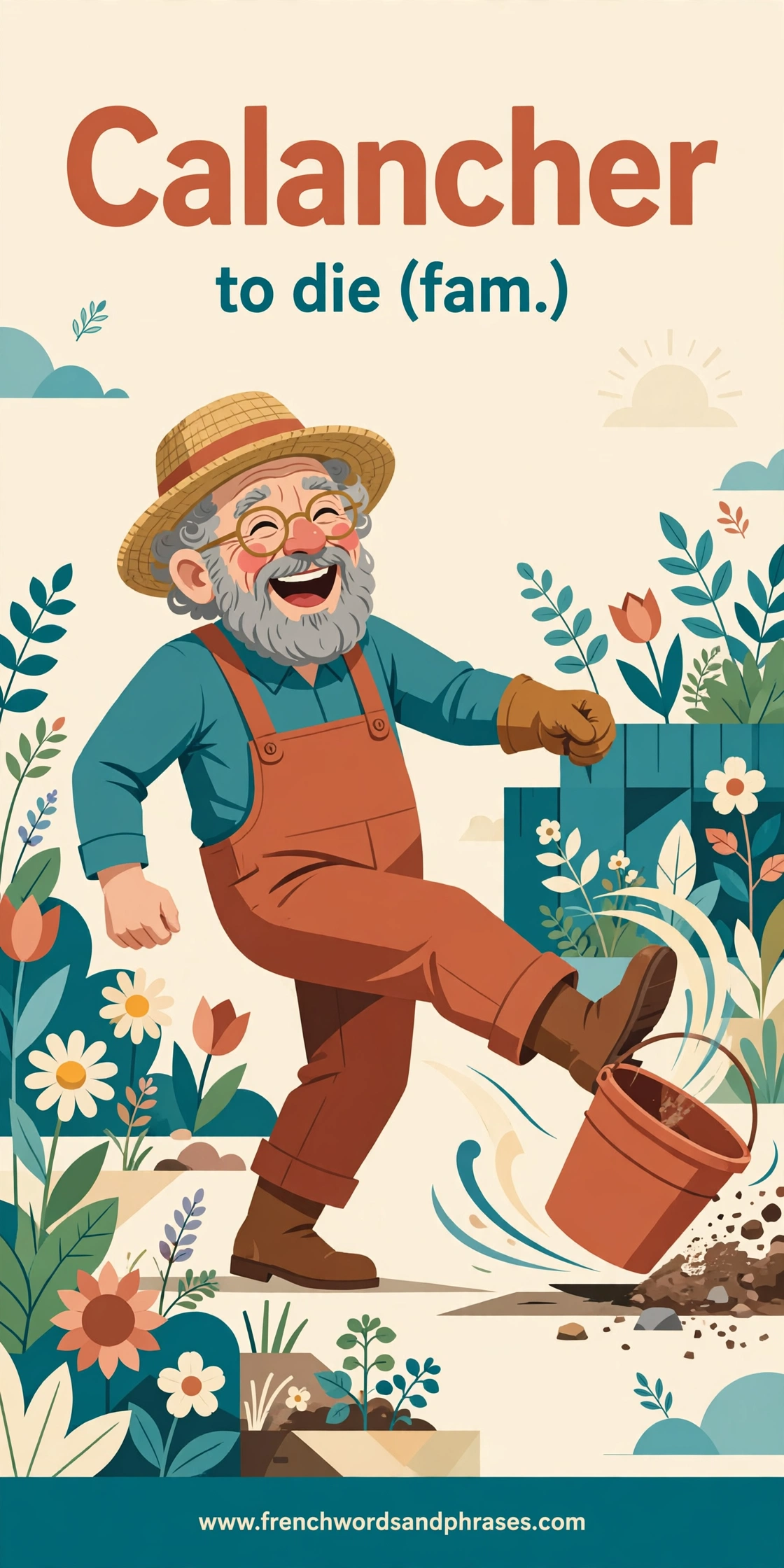
A French Word to Live By
How to Conjugate Calancher in French
/ka.lɑ̃.ʃe/
Calancher means to die — but in the familiar, slangy register of French, the way English says to kick the bucket or to pop one’s clogs.
An old soldier telling war stories with a wink, a mechanic shaking his head over a dead engine — calancher is the familier French word for dying: irreverent, vivid, and never used in a funeral speech.
In this guide, you’ll learn how to conjugate calancher in all the major French tenses and moods. Explore complete conjugation tables, French examples, English translations, and practice quizzes.
Understanding the French Verb Calancher
Calancher is a regular French verb belonging to the first group of verbs, those ending in-er.
It means to die (fam.). It is used of people only with deliberate comic irreverence — about a tough old character, a villain in a story, or oneself in a joke — and very freely of engines, batteries and old machines that die. Nobody calanche in an official document.
Verb classification: First group (-er)
Auxiliary verb: Avoir
Past participle: calanché
Present participle: calanchant
English equivalents: To die (familiar), to kick the bucket, to croak; il a calanché — he kicked the bucket; le moteur a calanché — the engine died (gave up the ghost); calancher de faim — to drop dead of hunger (exaggeration).
One important detail: calancher is familier — informal slang — so it belongs to jokes, banter and tall tales, never to a condolence letter, where you would use mourir or décéder. The verb itself is a perfectly regular -er: je calanche, nous calanchons, ils calanchent, past participle calanché. Like English to croak, it is also said of machines that give up for good: la vieille voiture a calanché sur l’autoroute.
Experience the Word
Calancher is death with its boots on — the word people reach for when they want the grim fact without the solemn face.
Imagine an old fisherman mending his nets on the quay. He points at the harbour’s oldest boat, a rusting trawler listing against the wall. « Elle a tenu quarante ans, la pauvre — et l’hiver dernier, elle a calanché. » Everyone nods and smiles: the boat has not died, she has kicked the bucket, like an old comrade.
No tears, no ceremony. The trawler has simply calanché — packed up, for good, in the language of the quay.
How to Conjugate Calancher: Complete French Conjugation Guide
Let’s explore every major conjugation of calancher, beginning with the indicative mood.
How to Conjugate Calancher in the Indicative Mood
The indicative mood is used to express facts, observations, actions, and events.
How to Conjugate Calancher in the Present Tense (Présent)
Used for actions happening now, habitual actions, and general truths.
| Subject | Conjugation |
|---|---|
| je | calanche |
| tu | calanches |
| il / elle | calanche |
| nous | calanchons |
| vous | calanchez |
| ils / elles | calanchent |
Example
Dans ce métier dangereux, on calanche jeune si on ne fait pas attention.
In this dangerous trade, you die young if you are not careful.
Quick Quiz 1
Complete the sentence:
Nous disons que ces vieilles machines ______ une à une.
Reveal the answer
calanchent
Nous disons que ces vieilles machines calanchent une à une.
We say these old machines are dying one by one.
How to Conjugate Calancher in the Passé Composé
Used for completed actions in the past. Calancher takes the auxiliary verb avoir.
| Subject | Conjugation |
|---|---|
| j’ | ai calanché |
| tu | as calanché |
| il / elle | a calanché |
| nous | avons calanché |
| vous | avez calanché |
| ils / elles | ont calanché |
Example
Le vieux moteur a calanché au milieu de la côte.
The old engine died in the middle of the hill.
How to Conjugate Calancher in the Imparfait (Imperfect Tense)
Used for habitual past actions, descriptions, and ongoing situations in the past.
| Subject | Conjugation |
|---|---|
| je | calanchais |
| tu | calanchais |
| il / elle | calanchait |
| nous | calanchions |
| vous | calanchiez |
| ils / elles | calanchaient |
Example
Autrefois, les mineurs calanchaient avant cinquante ans.
In the old days, miners used to die before fifty.
Quick Quiz 2
Choose the correct form:
The engine died on the motorway.
Le moteur ______ sur l’autoroute. (a calanché / est calanché)
Reveal the answer
a calanché
Le moteur a calanché sur l’autoroute.
Calancher takes avoir.
How to Conjugate Calancher in the Plus-que-parfait
Used to describe an action that had already been completed before another past event.
| Subject | Conjugation |
|---|---|
| j’ | avais calanché |
| tu | avais calanché |
| il / elle | avait calanché |
| nous | avions calanché |
| vous | aviez calanché |
| ils / elles | avaient calanché |
Example
Le chien avait calanché pendant l’hiver, après quinze ans de bons services.
The dog had died during the winter, after fifteen years of good service.
How to Conjugate Calancher in the Passé Simple
Primarily used in formal writing, literature, and historical narratives. It is rarely used in everyday conversation.
| Subject | Conjugation |
|---|---|
| je | calanchai |
| tu | calanchas |
| il / elle | calancha |
| nous | calanchâmes |
| vous | calanchâtes |
| ils / elles | calanchèrent |
Example
Le vieux capitaine calancha dans son sommeil, à quatre-vingt-dix ans.
The old captain died in his sleep, at ninety years old.
How to Conjugate Calancher in the Passé Antérieur
A literary tense used to express an action completed immediately before another past action, generally in the passé simple.
| Subject | Conjugation |
|---|---|
| j’ | eus calanché |
| tu | eus calanché |
| il / elle | eut calanché |
| nous | eûmes calanché |
| vous | eûtes calanché |
| ils / elles | eurent calanché |
Example
Quand le moteur eut calanché, le mécanicien ferma le capot en soupirant.
When the engine had given up the ghost, the mechanic closed the bonnet with a sigh.
How to Conjugate Calancher in the Future Tense (Futur Simple)
Used to describe actions that will take place in the future.
| Subject | Conjugation |
|---|---|
| je | calancherai |
| tu | calancheras |
| il / elle | calanchera |
| nous | calancherons |
| vous | calancherez |
| ils / elles | calancheront |
Example
À ce rythme-là, tu calancheras avant la retraite !
At this rate, you will kick the bucket before retirement!
How to Conjugate Calancher in the Futur Antérieur (Future Perfect)
Used for an action that will have been completed before a particular point in the future.
| Subject | Conjugation |
|---|---|
| j’ | aurai calanché |
| tu | auras calanché |
| il / elle | aura calanché |
| nous | aurons calanché |
| vous | aurez calanché |
| ils / elles | auront calanché |
Example
Dans dix ans, toutes ces vieilles machines auront calanché.
In ten years, all these old machines will have packed up.
How to Conjugate Calancher in the Near Future (Futur Proche)
Used to describe something that is going to happen soon. Formed with aller + infinitive.
| Subject | Conjugation |
|---|---|
| je | vais calancher |
| tu | vas calancher |
| il / elle | va calancher |
| nous | allons calancher |
| vous | allez calancher |
| ils / elles | vont calancher |
Example
Attention, la batterie va calancher si tu laisses les phares allumés.
Careful, the battery is going to die if you leave the headlights on.
How to Conjugate Calancher in the Conditional Mood
The conditional mood expresses what would happen under certain circumstances. It is also frequently used to make polite requests or express wishes.
How to Conjugate Calancher in the Present Conditional
| Subject | Conjugation |
|---|---|
| je | calancherais |
| tu | calancherais |
| il / elle | calancherait |
| nous | calancherions |
| vous | calancheriez |
| ils / elles | calancheraient |
Example
Sans son casque, le motard calancherait au premier accident.
Without his helmet, the biker would croak at the first accident.
How to Conjugate Calancher in the Past Conditional
| Subject | Conjugation |
|---|---|
| j’ | aurais calanché |
| tu | aurais calanché |
| il / elle | aurait calanché |
| nous | aurions calanché |
| vous | auriez calanché |
| ils / elles | auraient calanché |
Example
Le moteur aurait calanché sans l’huile que tu as ajoutée.
The engine would have died without the oil you added.
Calancher in the Literary Past Conditional Form
This less common literary form uses the imperfect subjunctive of avoir.
| Subject | Conjugation |
|---|---|
| j’ | eusse calanché |
| tu | eusses calanché |
| il / elle | eût calanché |
| nous | eussions calanché |
| vous | eussiez calanché |
| ils / elles | eussent calanché |
Example
Le vieux loup eût calanché dans la neige sans la meute.
The old wolf would have died in the snow without the pack.
How to Conjugate Calancher in the Subjunctive Mood
The subjunctive is used to express wishes, emotions, doubts, necessity, and uncertainty. It frequently follows expressions such as il faut que (it is necessary that) or bien que (although).
How to Conjugate Calancher in the Present Subjunctive
| Subject | Conjugation |
|---|---|
| que je | calanche |
| que tu | calanches |
| qu’il / qu’elle | calanche |
| que nous | calanchions |
| que vous | calanchiez |
| qu’ils / qu’elles | calanchent |
Example
Je ne veux pas que le moteur calanche sur l’autoroute.
I do not want the engine to die on the motorway.
Quick Quiz 3
Complete the sentence using the subjunctive:
Je ne veux pas que les plantes ______ pendant les vacances.
Reveal the answer
calanchent
Je ne veux pas que les plantes calanchent pendant les vacances.
I do not want the plants to die during the holidays.
How to Conjugate Calancher in the Imperfect Subjunctive
A literary tense, rarely encountered in modern spoken French.
| Subject | Conjugation |
|---|---|
| que je | calanchasse |
| que tu | calanchasses |
| qu’il / qu’elle | calanchât |
| que nous | calanchassions |
| que vous | calanchassiez |
| qu’ils / qu’elles | calanchassent |
Example
Il fallait éviter que les plantes calanchassent pendant les vacances.
We had to stop the plants dying during the holidays.
How to Conjugate Calancher in the Pluperfect Subjunctive
A literary construction used to express an action completed before another past action.
| Subject | Conjugation |
|---|---|
| que j’ | eusse calanché |
| que tu | eusses calanché |
| qu’il / qu’elle | eût calanché |
| que nous | eussions calanché |
| que vous | eussiez calanché |
| qu’ils / qu’elles | eussent calanché |
Example
On racontait que le vieux roi eût calanché dans la nuit.
People said the old king had popped his clogs in the night.
How to Conjugate Calancher in the Past Subjunctive
| Subject | Conjugation |
|---|---|
| que j’ | aie calanché |
| que tu | aies calanché |
| qu’il / qu’elle | ait calanché |
| que nous | ayons calanché |
| que vous | ayez calanché |
| qu’ils / qu’elles | aient calanché |
Example
Je suis désolé que ton poisson rouge ait calanché.
I am sorry your goldfish died.
How to Conjugate Calancher in the Imperative
The imperative is used to give commands, instructions, invitations, or suggestions. Subject pronouns are omitted.
How to Conjugate Calancher in the Present Imperative
| Person | Conjugation |
|---|---|
| (tu) | calanche |
| (nous) | calanchons |
| (vous) | calanchez |
Example
Ne calanche pas avant d’avoir vu la mer, grand-père !
Do not kick the bucket before you have seen the sea, Grandad!
Quick Quiz 4
How would you say Do not kick the bucket yet (tu form)?
Reveal the answer
Ne calanche pas encore !
French Participles of Calancher
Participles are verb forms that can be used in compound tenses and other grammatical constructions.
Present Participle of Calancher
calanchant
En calanchant ainsi, les vieilles ampoules nous coûtaient une fortune.
By dying like that, the old light bulbs were costing us a fortune.
Past Participle of Calancher
calanché
Calanché en pleine route, le vieux camion bloquait toute la circulation.
Having died in the middle of the road, the old lorry was blocking all the traffic.
Calancher in Everyday French: Real-Life Examples
Now that you know the conjugations, let’s see how calancher appears in everyday French.
Example 1 — Present
Dans ce métier, on calanche jeune.
In this trade, you die young.
Example 2 — Passé composé
Le moteur a calanché sur la côte.
The engine died on the hill.
Example 3 — Imparfait
Les mineurs calanchaient avant cinquante ans.
Miners used to die before fifty.
Example 4 — Future
Tu calancheras avant la retraite à ce rythme !
You will kick the bucket before retirement at this rate!
Example 5 — Conditional
Sans casque, il calancherait au premier accident.
Without a helmet, he would croak at the first accident.
Example 6 — Imperative
Ne calanche pas avant la fin du film !
Do not kick the bucket before the end of the film!
Beyond Translation: The Meaning of Calancher
English to kick the bucket is the exact twin — and French calancher plays the same role: a slang word that lets people talk about death with a shrug instead of a shudder.
It is the language of the quay, the garage and the barracks.
Engines, batteries, boats and tough old characters calanchent; poets and presidents meurent. Choose calancher only when the irreverence is the point — that choice is precisely what the word is for.
How to Remember the French Verb Calancher
Remember it this way: Calancher is about the old trawler on the quay — kicked the bucket after forty years.
- Familier register: calancher is slang for dying — fine for engines and jokes, never for condolences.
- Machines calanchent too: le moteur a calanché — the engine gave up the ghost.
- Regular -er: je calanche, nous calanchons, past participle calanché.
The key idea is the old trawler on the quay — kicked the bucket after forty years.
Test Your Knowledge of Calancher
Let’s see how much you’ve learned. Try answering these questions before revealing the answers.
Question 1
What register is calancher, and when should you avoid it?
Reveal the answer
Familier (informal slang) — never in formal or solemn contexts; use mourir or décéder there.
Question 2
How do you say The old engine died in the middle of the hill in French?
Reveal the answer
Le vieux moteur a calanché au milieu de la côte.
Question 3
Translate: I do not want the engine to die on the motorway.
Reveal the answer
Je ne veux pas que le moteur calanche sur l’autoroute.
Question 4
What is the past participle of calancher?
Reveal the answer
Calanché.
Question 5
Complete the sentence:
Attention, la batterie va ______ si tu laisses les phares allumés.
Reveal the answer
calancher
Attention, la batterie va calancher si tu laisses les phares allumés.
Careful, the battery is going to die if you leave the headlights on.
Your Final Challenge
Can You Use It?
How would you say this in French?
The old engine died on the hill, but the mechanic swears it will run again tomorrow.
Reveal the answer
Le vieux moteur a calanché sur la côte, mais le mécanicien jure qu’il roulera encore demain.
The old engine died on the hill, but the mechanic swears it will run again tomorrow.
A little French. A little curiosity. A richer everyday life.
LEARN FRENCH ONE WORD AT A TIME




