A French Word to Live By
How to Conjugate Cajoler in French
/ka.ʒɔ.le/
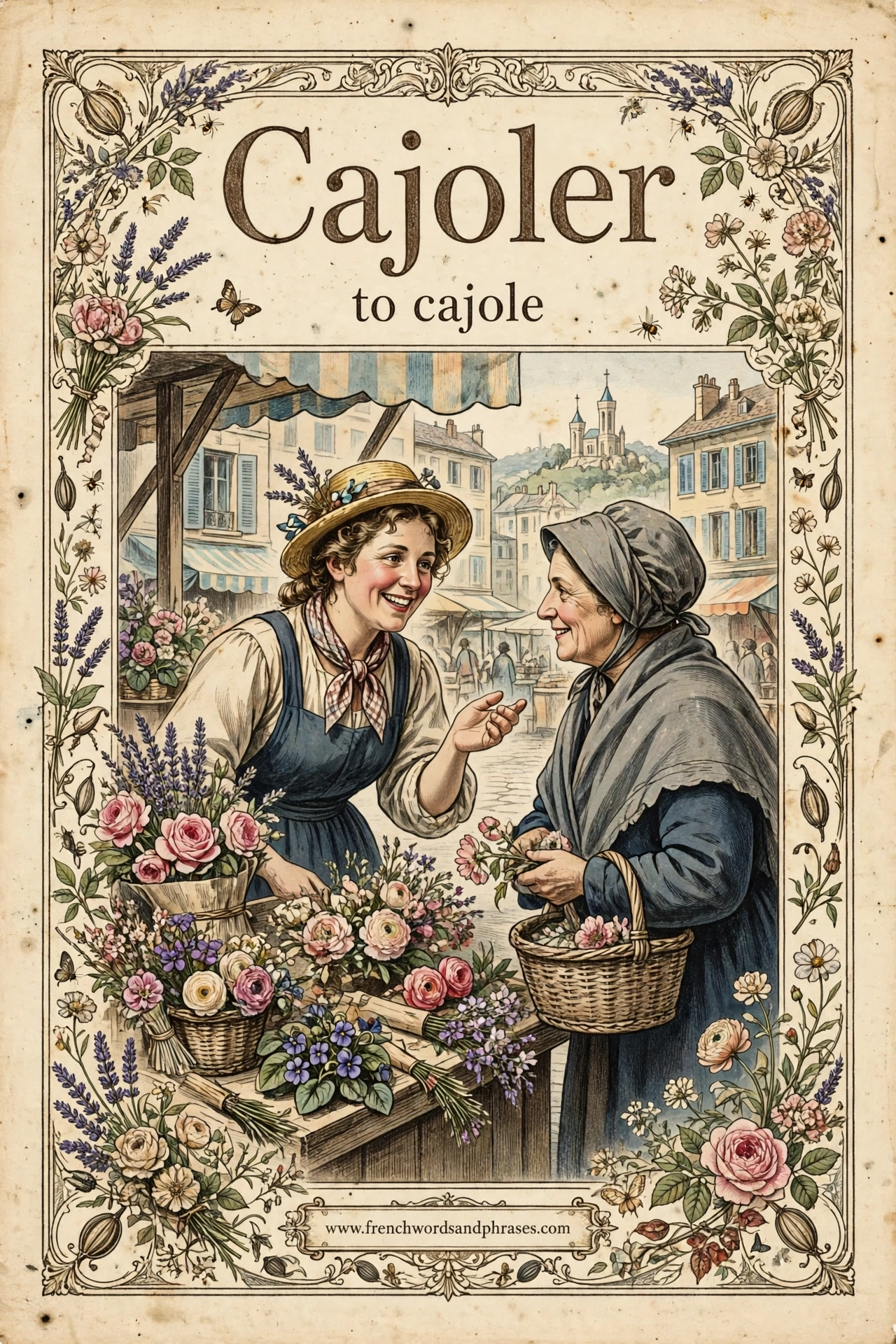
Cajoler means to coax, to cajole — to win someone over with soft words, caresses and patience rather than with orders.
A grandfather talking a sulky child out of her mood with a story, a cat talked down from the top of the wardrobe with a saucer of milk — cajoler is the verb of gentle persuasion: nothing forced, everything coaxed.
In this guide, you’ll learn how to conjugate cajoler in all the major French tenses and moods. Explore complete conjugation tables, French examples, English translations, and practice quizzes.
Understanding the French Verb Cajoler
Cajoler is a regular French verb belonging to the first group of verbs, those ending in-er.
It means to coax, to cajole. It sits between câliner (pure cuddling) and amadouer (coaxing with a hint of strategy): cajoler is warm, open persuasion — the treat is visible, the affection real. Grandparents, cat-owners and good salespeople all cajolent; nobody cajoles with a raised voice.
Verb classification: First group (-er)
Auxiliary verb: Avoir
Past participle: cajolé
Present participle: cajolant
English equivalents: To coax, to cajole, to cuddle, to pet; cajoler un enfant — to coax (and cuddle) a child; cajoler le chat — to pet the cat; se faire cajoler — to get oneself fussed over; à force de cajoler — by dint of coaxing.
One important detail: cajoler works on people and animals alike, and it always involves softness — words, strokes, caresses. With a child it slides naturally towards cuddling: cajoler un bébé is as much a cuddle as a coaxing; with an adult it is persuasion with honey on it, and the English twin to cajole — borrowed from this very verb — keeps exactly that sense. A plain regular -er verb: je cajole, nous cajolons, past participle cajolé, and the noun for the treatment is une cajolerie, a piece of coaxing flattery.
Experience the Word
Cajoler is the verb of the soft voice — the art of getting a yes without ever asking twice.
Imagine a kitchen in Brittany. Little Léa, arms crossed, has declared war on her fish soup. Her grandfather does not argue: he tells the soup’s story, the boat, the storm, the brave fisherman — et à force de cajoler, spoon by spoon, the bowl empties, and Léa demands the ending and seconds.
No order was given. She was simply coaxed — cajolée, with a story for a spoon.
How to Conjugate Cajoler: Complete French Conjugation Guide
Let’s explore every major conjugation of cajoler, beginning with the indicative mood.
How to Conjugate Cajoler in the Indicative Mood
The indicative mood is used to express facts, observations, actions, and events.
How to Conjugate Cajoler in the Present Tense (Présent)
Used for actions happening now, habitual actions, and general truths.
| Subject | Conjugation |
|---|---|
| je | cajole |
| tu | cajoles |
| il / elle | cajole |
| nous | cajolons |
| vous | cajolez |
| ils / elles | cajolent |
Example
Elle cajole son petit frère pour qu’il partage ses jouets.
She coaxes her little brother into sharing his toys.
Quick Quiz 1
Complete the sentence:
Nous ______ le chat pour le faire descendre.
Reveal the answer
cajolons
Nous cajolons le chat pour le faire descendre.
We are coaxing the cat to make it come down.
How to Conjugate Cajoler in the Passé Composé
Used for completed actions in the past. Cajoler takes the auxiliary verb avoir.
| Subject | Conjugation |
|---|---|
| j’ | ai cajolé |
| tu | as cajolé |
| il / elle | a cajolé |
| nous | avons cajolé |
| vous | avez cajolé |
| ils / elles | ont cajolé |
Example
Il a cajolé le chat jusqu’à ce qu’il descende de l’armoire.
He coaxed the cat until it came down from the wardrobe.
How to Conjugate Cajoler in the Imparfait (Imperfect Tense)
Used for habitual past actions, descriptions, and ongoing situations in the past.
| Subject | Conjugation |
|---|---|
| je | cajolais |
| tu | cajolais |
| il / elle | cajolait |
| nous | cajolions |
| vous | cajoliez |
| ils / elles | cajolaient |
Example
Ma grand-mère cajolait les enfants avec des histoires et des bonbons.
My grandmother used to cajole the children with stories and sweets.
Quick Quiz 2
Choose the correct form:
He coaxed the cat until it came down.
Il ______ le chat jusqu’à ce qu’il descende. (a cajolé / est cajolé)
Reveal the answer
a cajolé
Il a cajolé le chat jusqu’à ce qu’il descende.
Cajoler takes avoir.
How to Conjugate Cajoler in the Plus-que-parfait
Used to describe an action that had already been completed before another past event.
| Subject | Conjugation |
|---|---|
| j’ | avais cajolé |
| tu | avais cajolé |
| il / elle | avait cajolé |
| nous | avions cajolé |
| vous | aviez cajolé |
| ils / elles | avaient cajolé |
Example
Elle avait cajolé son père avant de lui demander la voiture.
She had buttered up her father before asking him for the car.
How to Conjugate Cajoler in the Passé Simple
Primarily used in formal writing, literature, and historical narratives. It is rarely used in everyday conversation.
| Subject | Conjugation |
|---|---|
| je | cajolai |
| tu | cajolas |
| il / elle | cajola |
| nous | cajolâmes |
| vous | cajolâtes |
| ils / elles | cajolèrent |
Example
Le vieux marin cajola l’enfant et la tempête de larmes s’apaisa.
The old sailor coaxed the child and the storm of tears died down.
How to Conjugate Cajoler in the Passé Antérieur
A literary tense used to express an action completed immediately before another past action, generally in the passé simple.
| Subject | Conjugation |
|---|---|
| j’ | eus cajolé |
| tu | eus cajolé |
| il / elle | eut cajolé |
| nous | eûmes cajolé |
| vous | eûtes cajolé |
| ils / elles | eurent cajolé |
Example
Quand il eut cajolé le chien, celui-ci le suivit docilement.
When he had coaxed the dog, it followed him meekly.
How to Conjugate Cajoler in the Future Tense (Futur Simple)
Used to describe actions that will take place in the future.
| Subject | Conjugation |
|---|---|
| je | cajolerai |
| tu | cajoleras |
| il / elle | cajolera |
| nous | cajolerons |
| vous | cajolerez |
| ils / elles | cajoleront |
Example
Tu cajoleras le bébé, et il s’endormira dans tes bras.
You will cuddle the baby, and he will fall asleep in your arms.
How to Conjugate Cajoler in the Futur Antérieur (Future Perfect)
Used for an action that will have been completed before a particular point in the future.
| Subject | Conjugation |
|---|---|
| j’ | aurai cajolé |
| tu | auras cajolé |
| il / elle | aura cajolé |
| nous | aurons cajolé |
| vous | aurez cajolé |
| ils / elles | auront cajolé |
Example
Quand elle aura cajolé son grand-père, il lui prêtera sa canne à pêche.
Once she has coaxed her grandfather, he will lend her his fishing rod.
How to Conjugate Cajoler in the Near Future (Futur Proche)
Used to describe something that is going to happen soon. Formed with aller + infinitive.
| Subject | Conjugation |
|---|---|
| je | vais cajoler |
| tu | vas cajoler |
| il / elle | va cajoler |
| nous | allons cajoler |
| vous | allez cajoler |
| ils / elles | vont cajoler |
Example
Je vais cajoler le chat avec un peu de lait.
I am going to coax the cat with a little milk.
How to Conjugate Cajoler in the Conditional Mood
The conditional mood expresses what would happen under certain circumstances. It is also frequently used to make polite requests or express wishes.
How to Conjugate Cajoler in the Present Conditional
| Subject | Conjugation |
|---|---|
| je | cajolerais |
| tu | cajolerais |
| il / elle | cajolerait |
| nous | cajolerions |
| vous | cajoleriez |
| ils / elles | cajoleraient |
Example
Avec des mots doux, tu cajolerais n’importe qui.
With sweet words, you could cajole anyone.
How to Conjugate Cajoler in the Past Conditional
| Subject | Conjugation |
|---|---|
| j’ | aurais cajolé |
| tu | aurais cajolé |
| il / elle | aurait cajolé |
| nous | aurions cajolé |
| vous | auriez cajolé |
| ils / elles | auraient cajolé |
Example
Elle aurait cajolé son frère si elle avait eu le temps.
She would have coaxed her brother if she had had the time.
Cajoler in the Literary Past Conditional Form
This less common literary form uses the imperfect subjunctive of avoir.
| Subject | Conjugation |
|---|---|
| j’ | eusse cajolé |
| tu | eusses cajolé |
| il / elle | eût cajolé |
| nous | eussions cajolé |
| vous | eussiez cajolé |
| ils / elles | eussent cajolé |
Example
Le renard eût cajolé le corbeau comme dans la fable.
The fox would have flattered the crow just as in the fable.
How to Conjugate Cajoler in the Subjunctive Mood
The subjunctive is used to express wishes, emotions, doubts, necessity, and uncertainty. It frequently follows expressions such as il faut que (it is necessary that) or bien que (although).
How to Conjugate Cajoler in the Present Subjunctive
| Subject | Conjugation |
|---|---|
| que je | cajole |
| que tu | cajoles |
| qu’il / qu’elle | cajole |
| que nous | cajolions |
| que vous | cajoliez |
| qu’ils / qu’elles | cajolent |
Example
Il faut que tu cajoles le bébé pour le calmer.
You must cuddle the baby to calm him.
Quick Quiz 3
Complete the sentence using the subjunctive:
Il faut que vous ______ le bébé pour le calmer.
Reveal the answer
cajoliez
Il faut que vous cajoliez le bébé pour le calmer.
You must cuddle the baby to calm him.
How to Conjugate Cajoler in the Imperfect Subjunctive
A literary tense, rarely encountered in modern spoken French.
| Subject | Conjugation |
|---|---|
| que je | cajolasse |
| que tu | cajolasses |
| qu’il / qu’elle | cajolât |
| que nous | cajolassions |
| que vous | cajolassiez |
| qu’ils / qu’elles | cajolassent |
Example
Je voulais qu’elle cajolât le chat au lieu de le poursuivre.
I wanted her to coax the cat instead of chasing it.
How to Conjugate Cajoler in the Pluperfect Subjunctive
A literary construction used to express an action completed before another past action.
| Subject | Conjugation |
|---|---|
| que j’ | eusse cajolé |
| que tu | eusses cajolé |
| qu’il / qu’elle | eût cajolé |
| que nous | eussions cajolé |
| que vous | eussiez cajolé |
| qu’ils / qu’elles | eussent cajolé |
Example
On disait que le vendeur eût cajolé tous ses clients.
People said the salesman had coaxed all his customers.
How to Conjugate Cajoler in the Past Subjunctive
| Subject | Conjugation |
|---|---|
| que j’ | aie cajolé |
| que tu | aies cajolé |
| qu’il / qu’elle | ait cajolé |
| que nous | ayons cajolé |
| que vous | ayez cajolé |
| qu’ils / qu’elles | aient cajolé |
Example
Je suis content qu’elle ait cajolé sa petite sœur.
I am glad she made a fuss of her little sister.
How to Conjugate Cajoler in the Imperative
The imperative is used to give commands, instructions, invitations, or suggestions. Subject pronouns are omitted.
How to Conjugate Cajoler in the Present Imperative
| Person | Conjugation |
|---|---|
| (tu) | cajole |
| (nous) | cajolons |
| (vous) | cajolez |
Example
Cajole le bébé doucement, il est fatigué.
Cuddle the baby gently, he is tired.
Quick Quiz 4
How would you say Cuddle the baby gently (tu form)?
Reveal the answer
Cajole le bébé doucement !
French Participles of Cajoler
Participles are verb forms that can be used in compound tenses and other grammatical constructions.
Present Participle of Cajoler
cajolant
En cajolant le chat, elle l’a convaincu de descendre.
By coaxing the cat, she persuaded it to come down.
Past Participle of Cajoler
cajolé
Cajolé par sa grand-mère, l’enfant a fini son assiette.
Coaxed by his grandmother, the child finished his plate.
Cajoler in Everyday French: Real-Life Examples
Now that you know the conjugations, let’s see how cajoler appears in everyday French.
Example 1 — Present
Elle cajole son petit frère.
She coaxes her little brother.
Example 2 — Passé composé
Il a cajolé le chat avec du lait.
He coaxed the cat with some milk.
Example 3 — Imparfait
Ma grand-mère cajolait les enfants.
My grandmother used to cajole the children.
Example 4 — Future
Tu cajoleras le bébé pour l’endormir.
You will cuddle the baby to sleep.
Example 5 — Conditional
Tu cajolerais n’importe qui avec des mots doux.
You could cajole anyone with sweet words.
Example 6 — Imperative
Cajole le bébé doucement !
Cuddle the baby gently!
Beyond Translation: The Meaning of Cajoler
English to cajole is this verb wearing an English coat — borrowed in the seventeenth century and never given back — but the French original is warmer: cajoler still allows the arms as well as the voice.
In French, cajoling can be a cuddle.
That double life explains its empire: babies, cats, grandfathers and customers are all cajolés in French, each with the mixture of softness and strategy that suits them.
How to Remember the French Verb Cajoler
Remember it this way: Cajoler is about the grandfather, the story and the spoon — a yes without an order.
- English cajole is the same word — French cajoler adds the cuddle to the coaxing.
- The tools are soft words and caresses: cajoler un enfant, cajoler le chat.
- Regular -er: je cajole, nous cajolons, past participle cajolé.
The key idea is the grandfather, the story and the spoon — a yes without an order.
Test Your Knowledge of Cajoler
Let’s see how much you’ve learned. Try answering these questions before revealing the answers.
Question 1
How does cajoler differ from câliner?
Reveal the answer
Cajoler also persuades — câliner is pure cuddling; cajoler coaxes with words and caresses together.
Question 2
How do you say She coaxes her little brother in French?
Reveal the answer
Elle cajole son petit frère.
Question 3
Translate: He coaxed the cat with a little milk.
Reveal the answer
Il a cajolé le chat avec un peu de lait.
Question 4
What is the past participle of cajoler?
Reveal the answer
Cajolé — and une cajolerie is a piece of coaxing flattery.
Question 5
Complete the sentence:
Il faut que tu ______ le bébé pour le calmer.
Reveal the answer
cajoles
Il faut que tu cajoles le bébé pour le calmer.
You must cuddle the baby to calm him.
Your Final Challenge
Can You Use It?
How would you say this in French?
By dint of coaxing, the grandmother obtains what no order would ever have obtained: a smile.
Reveal the answer
À force de cajoler, la grand-mère obtient ce qu’aucun ordre n’aurait jamais obtenu : un sourire.
By dint of coaxing, the grandmother obtains what no order would ever have obtained: a smile.
A little French. A little curiosity. A richer everyday life.
LEARN FRENCH ONE WORD AT A TIME