A French Word to Live By
How to Conjugate Se cabrer in French
/sə ka.bʁe/
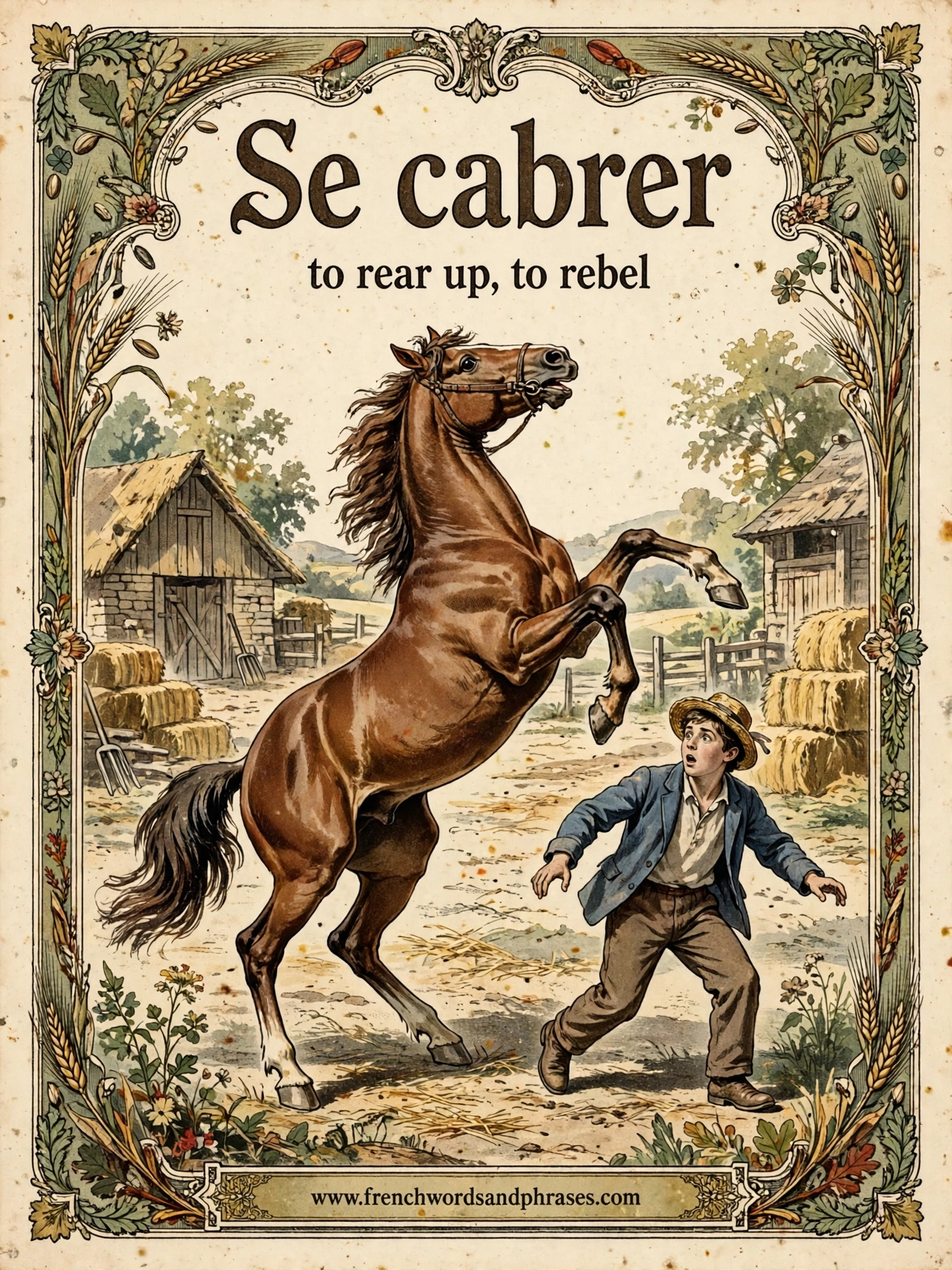
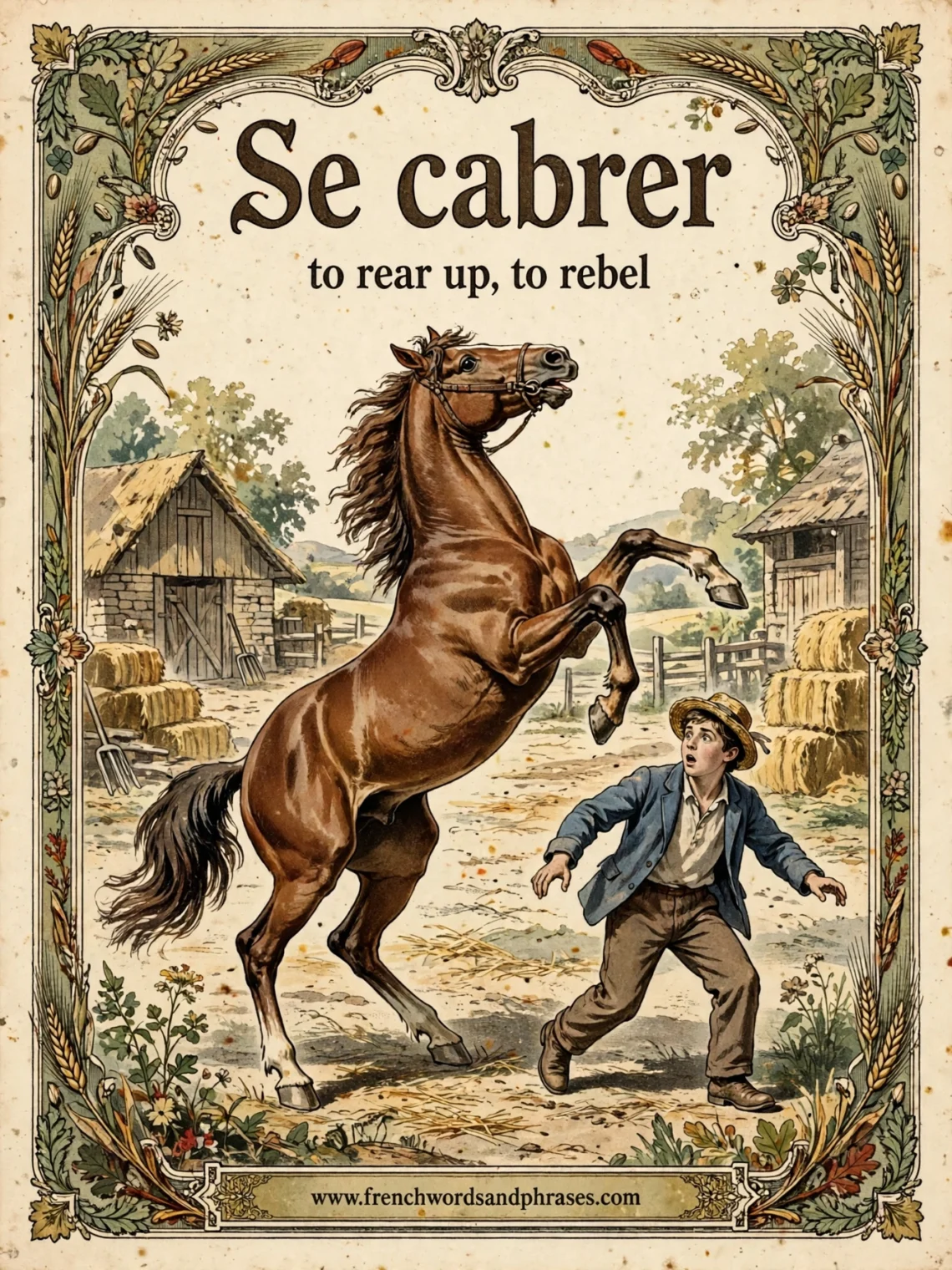
Se cabrer means to rear up, to rebel — a horse rising on its hind legs of its own accord, or a person bristling and refusing point-blank to obey.
A horse startled by a plastic bag, a teenager told to hand over his phone — se cabrer is the verb of the instant rebellion: the whole body rears up and says no before the mind has found the words.
In this guide, you’ll learn how to conjugate se cabrer in all the major French tenses and moods. Explore complete conjugation tables, French examples, English translations, and practice quizzes.
Understanding the French Verb Se cabrer
Se cabrer is a regular French verb belonging to the first group of verbs, those ending in-er.
It means to rear up, to rebel. It is used literally of horses rearing in fright or defiance, and figuratively of anyone who reacts to an order, a criticism or a suggestion with instant, visible resistance — the shoulders rise, the chin lifts, and cooperation is over. A very French picture of pride: the rebellion is in the posture before it is in the words.
Verb classification: First group (-er), reflexive
Auxiliary verb: Être
Past participle: cabré
Present participle: cabrant
English equivalents: To rear up, to bristle, to rebel; le cheval se cabre — the horse rears up; se cabrer devant un ordre — to bridle at an order; il se cabre dès qu’on le contredit — he bristles whenever he is contradicted; ne te cabre pas ! — do not get on your high horse!
One important detail: se cabrer is the reflexive twin of cabrer — the horse rears itself, nobody makes it — and French extends the picture to people: to se cabrer is to bristle, rear up and refuse, with the same sudden stiffening of the neck. Being reflexive, it takes être in every compound tense and the past participle agrees with the subject: elle s’est cabrée, ils se sont cabrés. The tu imperative tucks the pronoun behind the verb: cabre-toi ! — get on your high horse, literally.
Experience the Word
Se cabrer is the verb of the body saying no — neck stiff, head high, before a single word is spoken.
Imagine a riding lesson. A paper bag blows across the arena, and the gentle mare explodes upwards — elle se cabre, front hooves striking the air, while her young rider clings to the mane and the instructor calls out, calmly: assieds-toi, laisse-la redescendre.
Two seconds of pure refusal. The mare has reared — cabrée — and everyone has felt the power of a body that says no.
How to Conjugate Se cabrer: Complete French Conjugation Guide
Let’s explore every major conjugation of se cabrer, beginning with the indicative mood.
How to Conjugate Se cabrer in the Indicative Mood
The indicative mood is used to express facts, observations, actions, and events.
How to Conjugate Se cabrer in the Present Tense (Présent)
Used for actions happening now, habitual actions, and general truths.
| Subject | Conjugation |
|---|---|
| je | me cabre |
| tu | te cabres |
| il / elle | se cabre |
| nous | nous cabrons |
| vous | vous cabrez |
| ils / elles | se cabrent |
Example
Le cheval se cabre dès qu’il entend un bruit sec.
The horse rears up as soon as it hears a sharp noise.
Quick Quiz 1
Complete the sentence:
Nous nous ______ dès qu’on nous donne un ordre injuste.
Reveal the answer
cabrons
Nous nous cabrons dès qu’on nous donne un ordre injuste.
We bristle as soon as we are given an unfair order.
How to Conjugate Se cabrer in the Passé Composé
Used for completed actions in the past. Se cabrer takes the auxiliary verb être.
| Subject | Conjugation |
|---|---|
| je | me suis cabré / me suis cabrée |
| tu | t’es cabré / t’es cabrée |
| il / elle | s’est cabré / s’est cabrée |
| nous | nous sommes cabrés / nous sommes cabrées |
| vous | vous êtes cabrés / vous êtes cabrées / vous êtes cabré / vous êtes cabrée |
| ils / elles | se sont cabrés / se sont cabrées |
Example
Elle s’est cabrée quand on lui a donné cet ordre.
She bristled when she was given that order.
How to Conjugate Se cabrer in the Imparfait (Imperfect Tense)
Used for habitual past actions, descriptions, and ongoing situations in the past.
| Subject | Conjugation |
|---|---|
| je | me cabrais |
| tu | te cabrais |
| il / elle | se cabrait |
| nous | nous cabrions |
| vous | vous cabriez |
| ils / elles | se cabraient |
Example
Ce cheval se cabrait à la moindre frayeur.
That horse used to rear at the slightest fright.
Quick Quiz 2
Choose the correct form:
The mare reared up and the rider fell.
La jument ______ et le cavalier est tombé. (s’est cabrée / a cabré)
Reveal the answer
s’est cabrée
La jument s’est cabrée et le cavalier est tombé.
Se cabrer is reflexive, takes être, and the participle agrees: cabrée.
How to Conjugate Se cabrer in the Plus-que-parfait
Used to describe an action that had already been completed before another past event.
| Subject | Conjugation |
|---|---|
| je | m’étais cabré / m’étais cabrée |
| tu | t’étais cabré / t’étais cabrée |
| il / elle | s’était cabré / s’était cabrée |
| nous | nous étions cabrés / nous étions cabrées |
| vous | vous étiez cabrés / vous étiez cabrées / vous étiez cabré / vous étiez cabrée |
| ils / elles | s’étaient cabrés / s’étaient cabrées |
Example
Il s’était cabré bien avant qu’on lui explique la décision.
He had bristled well before the decision was explained to him.
How to Conjugate Se cabrer in the Passé Simple
Primarily used in formal writing, literature, and historical narratives. It is rarely used in everyday conversation.
| Subject | Conjugation |
|---|---|
| je | me cabrai |
| tu | te cabras |
| il / elle | se cabra |
| nous | nous cabrâmes |
| vous | vous cabrâtes |
| ils / elles | se cabrèrent |
Example
La jument se cabra et le cavalier tomba dans le sable.
The mare reared up and the rider fell into the sand.
How to Conjugate Se cabrer in the Passé Antérieur
A literary tense used to express an action completed immediately before another past action, generally in the passé simple.
| Subject | Conjugation |
|---|---|
| je | me fus cabré / me fus cabrée |
| tu | te fus cabré / te fus cabrée |
| il / elle | se fut cabré / se fut cabrée |
| nous | nous fûmes cabrés / nous fûmes cabrées |
| vous | vous fûtes cabrés / vous fûtes cabrées / vous fûtes cabré / vous fûtes cabrée |
| ils / elles | se furent cabrés / se furent cabrées |
Example
Dès que le cheval se fut cabré, l’écuyer le calma d’une voix douce.
As soon as the horse had reared, the riding master calmed it with a soft voice.
How to Conjugate Se cabrer in the Future Tense (Futur Simple)
Used to describe actions that will take place in the future.
| Subject | Conjugation |
|---|---|
| je | me cabrerai |
| tu | te cabreras |
| il / elle | se cabrera |
| nous | nous cabrerons |
| vous | vous cabrerez |
| ils / elles | se cabreront |
Example
Si tu cries, le cheval se cabrera encore plus.
If you shout, the horse will rear up even more.
How to Conjugate Se cabrer in the Futur Antérieur (Future Perfect)
Used for an action that will have been completed before a particular point in the future.
| Subject | Conjugation |
|---|---|
| je | me serai cabré / me serai cabrée |
| tu | te seras cabré / te seras cabrée |
| il / elle | se sera cabré / se sera cabrée |
| nous | nous serons cabrés / nous serons cabrées |
| vous | vous serez cabrés / vous serez cabrées / vous serez cabré / vous serez cabrée |
| ils / elles | se seront cabrés / se seront cabrées |
Example
À la fin de la leçon, la jument se sera cabrée trois fois.
By the end of the lesson, the mare will have reared three times.
How to Conjugate Se cabrer in the Near Future (Futur Proche)
Used to describe something that is going to happen soon. Formed with aller + infinitive.
| Subject | Conjugation |
|---|---|
| je | vais me cabrer |
| tu | vas te cabrer |
| il / elle | va se cabrer |
| nous | allons nous cabrer |
| vous | allez vous cabrer |
| ils / elles | vont se cabrer |
Example
Regarde son visage, il va se cabrer.
Look at his face, he is going to bristle.
How to Conjugate Se cabrer in the Conditional Mood
The conditional mood expresses what would happen under certain circumstances. It is also frequently used to make polite requests or express wishes.
How to Conjugate Se cabrer in the Present Conditional
| Subject | Conjugation |
|---|---|
| je | me cabrerais |
| tu | te cabrerais |
| il / elle | se cabrerait |
| nous | nous cabrerions |
| vous | vous cabreriez |
| ils / elles | se cabreraient |
Example
Sans ce bruit soudain, le cheval ne se cabrerait pas.
Without that sudden noise, the horse would not rear up.
How to Conjugate Se cabrer in the Past Conditional
| Subject | Conjugation |
|---|---|
| je | me serais cabré / me serais cabrée |
| tu | te serais cabré / te serais cabrée |
| il / elle | se serait cabré / se serait cabrée |
| nous | nous serions cabrés / nous serions cabrées |
| vous | vous seriez cabrés / vous seriez cabrées / vous seriez cabré / vous seriez cabrée |
| ils / elles | se seraient cabrés / se seraient cabrées |
Example
Elle se serait cabrée si on l’avait forcée à signer.
She would have rebelled if they had forced her to sign.
Se cabrer in the Literary Past Conditional Form
This less common literary form uses the imperfect subjunctive of être.
| Subject | Conjugation |
|---|---|
| je | me fusse cabré / me fusse cabrée |
| tu | te fusses cabré / te fusses cabrée |
| il / elle | se fût cabré / se fût cabrée |
| nous | nous fussions cabrés / nous fussions cabrées |
| vous | vous fussiez cabrés / vous fussiez cabrées / vous fussiez cabré / vous fussiez cabrée |
| ils / elles | se fussent cabrés / se fussent cabrées |
Example
Il se fût cabré devant un tel ordre.
He would have bristled at such an order.
How to Conjugate Se cabrer in the Subjunctive Mood
The subjunctive is used to express wishes, emotions, doubts, necessity, and uncertainty. It frequently follows expressions such as il faut que (it is necessary that) or bien que (although).
How to Conjugate Se cabrer in the Present Subjunctive
| Subject | Conjugation |
|---|---|
| que je | me cabre |
| que tu | te cabres |
| qu’il / qu’elle | se cabre |
| que nous | nous cabrions |
| que vous | vous cabriez |
| qu’ils / qu’elles | se cabrent |
Example
Je ne veux pas que le cheval se cabre devant les enfants.
I do not want the horse to rear up in front of the children.
Quick Quiz 3
Complete the sentence using the subjunctive:
On craignait que la jument se ______ encore une fois.
Reveal the answer
cabrât
On craignait que la jument se cabrât encore une fois.
People feared the mare might rear up once more.
How to Conjugate Se cabrer in the Imperfect Subjunctive
A literary tense, rarely encountered in modern spoken French.
| Subject | Conjugation |
|---|---|
| que je | me cabrasse |
| que tu | te cabrasses |
| qu’il / qu’elle | se cabrât |
| que nous | nous cabrassions |
| que vous | vous cabrassiez |
| qu’ils / qu’elles | se cabrassent |
Example
On craignait que la jument se cabrât encore une fois.
People feared the mare might rear up once more.
How to Conjugate Se cabrer in the Pluperfect Subjunctive
A literary construction used to express an action completed before another past action.
| Subject | Conjugation |
|---|---|
| que je | me fusse cabré / me fusse cabrée |
| que tu | te fusses cabré / te fusses cabrée |
| qu’il / qu’elle | se fût cabré / se fût cabrée |
| que nous | nous fussions cabrés / nous fussions cabrées |
| que vous | vous fussiez cabrés / vous fussiez cabrées / vous fussiez cabré / vous fussiez cabrée |
| qu’ils / qu’elles | se fussent cabrés / se fussent cabrées |
Example
On racontait qu’il se fût cabré devant le directeur lui-même.
People said he had bristled in front of the director himself.
How to Conjugate Se cabrer in the Past Subjunctive
| Subject | Conjugation |
|---|---|
| que je | me sois cabré / me sois cabrée |
| que tu | te sois cabré / te sois cabrée |
| qu’il / qu’elle | se soit cabré / se soit cabrée |
| que nous | nous soyons cabrés / nous soyons cabrées |
| que vous | vous soyez cabrés / vous soyez cabrées / vous soyez cabré / vous soyez cabrée |
| qu’ils / qu’elles | se soient cabrés / se soient cabrées |
Example
Je suis étonné qu’elle se soit cabrée pour si peu.
I am amazed she bristled over so little.
How to Conjugate Se cabrer in the Imperative
The imperative is used to give commands, instructions, invitations, or suggestions. Subject pronouns are omitted.
How to Conjugate Se cabrer in the Present Imperative
| Person | Conjugation |
|---|---|
| (tu) | cabre-toi |
| (nous) | cabrons-nous |
| (vous) | cabrez-vous |
Example
Ne te cabre pas, écoute d’abord mes raisons !
Do not get on your high horse, first listen to my reasons!
Quick Quiz 4
How would you say Do not get on your high horse (tu form)?
Reveal the answer
Ne te cabre pas !
French Participles of Se cabrer
Participles are verb forms that can be used in compound tenses and other grammatical constructions.
Present Participle of Se cabrer
cabrant
En se cabrant, le cheval a renversé la barrière.
In rearing up, the horse knocked over the fence.
Past Participle of Se cabrer
cabré
Cabré devant l’obstacle, le cheval refusait d’avancer.
Rearing in front of the obstacle, the horse refused to move forward.
Se cabrer in Everyday French: Real-Life Examples
Now that you know the conjugations, let’s see how se cabrer appears in everyday French.
Example 1 — Present
Le cheval se cabre au moindre bruit.
The horse rears up at the slightest noise.
Example 2 — Passé composé
Elle s’est cabrée devant cet ordre.
She bristled at that order.
Example 3 — Imparfait
Ce cheval se cabrait facilement.
That horse used to rear easily.
Example 4 — Future
Le cheval se cabrera si tu cries.
The horse will rear up if you shout.
Example 5 — Conditional
Elle se cabrerait si on la forçait.
She would rebel if they forced her.
Example 6 — Imperative
Ne te cabre pas !
Do not get on your high horse!
Beyond Translation: The Meaning of Se cabrer
English to bridle at something is the exact cousin — the horse again, tossing its head against the bit — and French se cabrer works the same way, the animal picture doing duty for human pride.
The rebellion is physical first.
That is why se cabrer suits arguments so well: the person has reared up before they have reasoned, and everyone in the room can see the hooves in the air.
How to Remember the French Verb Se cabrer
Remember it this way: Se cabrer is about the mare rearing at the paper bag — the whole body saying no.
- Always reflexive in this sense: je me cabre, elle s’est cabrée — être, and the participle agrees.
- Two pictures, one verb: the horse rearing, and the person bristling at an order.
- Regular -er underneath: nous nous cabrons, vous vous cabrez, past participle cabré.
The key idea is the mare rearing at the paper bag — the whole body saying no.
Test Your Knowledge of Se cabrer
Let’s see how much you’ve learned. Try answering these questions before revealing the answers.
Question 1
Which auxiliary does se cabrer use, and why?
Reveal the answer
Être — it is a reflexive verb: elle s’est cabrée devant l’obstacle.
Question 2
How do you say The horse rears up at the slightest noise in French?
Reveal the answer
Le cheval se cabre au moindre bruit.
Question 3
Translate: She bristled when she was given that order.
Reveal the answer
Elle s’est cabrée quand on lui a donné cet ordre.
Question 4
What is the past participle of se cabrer?
Reveal the answer
Cabré — agreeing: cabrée, cabrés, cabrées.
Question 5
Complete the sentence:
Je ne veux pas que le cheval se ______ devant les enfants.
Reveal the answer
cabre
Je ne veux pas que le cheval se cabre devant les enfants.
I do not want the horse to rear up in front of the children.
Your Final Challenge
Can You Use It?
How would you say this in French?
As soon as anyone contradicts him, he bristles like a frightened horse, and the discussion stops dead.
Reveal the answer
Dès qu’on le contredit, il se cabre comme un cheval effrayé, et la discussion s’arrête net.
As soon as anyone contradicts him, he bristles like a frightened horse, and the discussion stops dead.
A little French. A little curiosity. A richer everyday life.
LEARN FRENCH ONE WORD AT A TIME