A French Word to Live By
How to Conjugate Cabrer in French
/ka.bʁe/
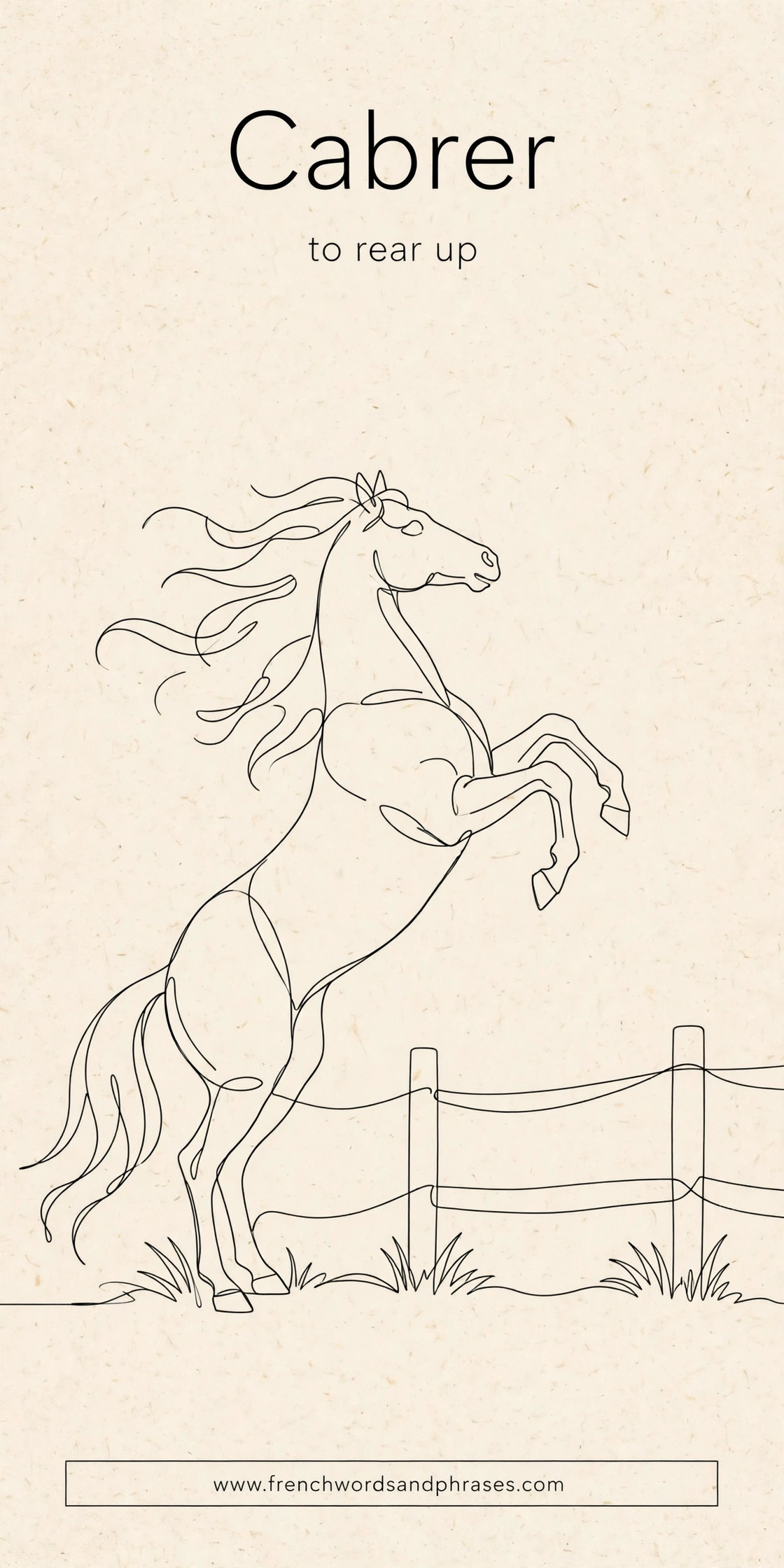
Cabrer means to rear up — said of a horse rising on its hind legs, or of making a horse rear; it is the verb of the prancing, front-hooves-in-the-air moment.
A startled horse rising on its hind legs, a motorbike lifting its front wheel — cabrer is the verb of the upward surge: front end in the air, back legs taking all the weight, for one dramatic second.
In this guide, you’ll learn how to conjugate cabrer in all the major French tenses and moods. Explore complete conjugation tables, French examples, English translations, and practice quizzes.
Understanding the French Verb Cabrer
Cabrer is a regular French verb belonging to the first group of verbs, those ending in-er.
It means to rear up. It belongs first to the riding school: a trained movement in dressage, a fright reaction in a young horse, a stunt on a motorbike (cabrer = to wheelie). Pilots use it too, when a plane’s nose rears up too steeply at take-off. In every case the picture is the same: the front rises, the back bears the weight.
Verb classification: First group (-er)
Auxiliary verb: Avoir
Past participle: cabré
Present participle: cabrant
English equivalents: To rear up, to make rear; cabrer un cheval — to make a horse rear; le cheval cabre — the horse is rearing; cabrer une moto — to lift a motorbike’s front wheel, to wheelie; un avion qui cabre — a plane rearing its nose up.
One important detail: cabrer is transitive here — the rider cabre the horse, makes it rear — while the horse itself, rearing of its own accord, is the reflexive se cabrer, which has its own page. The plain verb is perfectly regular: je cabre, nous cabrons, ils cabrent, past participle cabré. Watch the past participle describing the pose: un cheval cabré, hooves in the air, is the heraldic horse on a hundred coats of arms — and the prancing horse of a certain Italian car badge.
Experience the Word
Cabrer is the verb of the front end leaving the ground — hooves, wheel or nose pointing at the sky.
Imagine a riding school on a summer morning. The instructor raises one hand, the great chestnut horse gathers himself — et le cavalier cabre son cheval, rising tall on his hind legs, front hooves paddling the air, magnificent and perfectly calm.
It lasts two seconds. The horse has been reared — cabré — a statue come alive, then hooves back on the sand.
How to Conjugate Cabrer: Complete French Conjugation Guide
Let’s explore every major conjugation of cabrer, beginning with the indicative mood.
How to Conjugate Cabrer in the Indicative Mood
The indicative mood is used to express facts, observations, actions, and events.
How to Conjugate Cabrer in the Present Tense (Présent)
Used for actions happening now, habitual actions, and general truths.
| Subject | Conjugation |
|---|---|
| je | cabre |
| tu | cabres |
| il / elle | cabre |
| nous | cabrons |
| vous | cabrez |
| ils / elles | cabrent |
Example
Le cavalier cabre son cheval devant le public.
The rider makes his horse rear in front of the audience.
Quick Quiz 1
Complete the sentence:
Nous ______ les chevaux seulement dans le manège.
Reveal the answer
cabrons
Nous cabrons les chevaux seulement dans le manège.
We rear the horses only in the riding arena.
How to Conjugate Cabrer in the Passé Composé
Used for completed actions in the past. Cabrer takes the auxiliary verb avoir.
| Subject | Conjugation |
|---|---|
| j’ | ai cabré |
| tu | as cabré |
| il / elle | a cabré |
| nous | avons cabré |
| vous | avez cabré |
| ils / elles | ont cabré |
Example
Il a cabré sa moto devant ses amis.
He wheelied his motorbike in front of his friends.
How to Conjugate Cabrer in the Imparfait (Imperfect Tense)
Used for habitual past actions, descriptions, and ongoing situations in the past.
| Subject | Conjugation |
|---|---|
| je | cabrais |
| tu | cabrais |
| il / elle | cabrait |
| nous | cabrions |
| vous | cabriez |
| ils / elles | cabraient |
Example
Chaque matin, l’écuyer cabrait les jeunes chevaux.
Every morning, the riding master used to rear the young horses.
Quick Quiz 2
Choose the correct form:
She made her horse rear.
Elle ______ son cheval. (a cabré / s’est cabrée)
Reveal the answer
a cabré
Elle a cabré son cheval.
Cabrer is transitive and takes avoir; se cabrer is the reflexive.
How to Conjugate Cabrer in the Plus-que-parfait
Used to describe an action that had already been completed before another past event.
| Subject | Conjugation |
|---|---|
| j’ | avais cabré |
| tu | avais cabré |
| il / elle | avait cabré |
| nous | avions cabré |
| vous | aviez cabré |
| ils / elles | avaient cabré |
Example
Elle avait cabré son cheval avant l’arrivée des juges.
She had made her horse rear before the judges arrived.
How to Conjugate Cabrer in the Passé Simple
Primarily used in formal writing, literature, and historical narratives. It is rarely used in everyday conversation.
| Subject | Conjugation |
|---|---|
| je | cabrai |
| tu | cabras |
| il / elle | cabra |
| nous | cabrâmes |
| vous | cabrâtes |
| ils / elles | cabrèrent |
Example
Le cavalier cabra son cheval au milieu de l’arène.
The rider made his horse rear in the middle of the arena.
How to Conjugate Cabrer in the Passé Antérieur
A literary tense used to express an action completed immediately before another past action, generally in the passé simple.
| Subject | Conjugation |
|---|---|
| j’ | eus cabré |
| tu | eus cabré |
| il / elle | eut cabré |
| nous | eûmes cabré |
| vous | eûtes cabré |
| ils / elles | eurent cabré |
Example
Quand il eut cabré son cheval, la foule applaudit.
When he had made his horse rear, the crowd applauded.
How to Conjugate Cabrer in the Future Tense (Futur Simple)
Used to describe actions that will take place in the future.
| Subject | Conjugation |
|---|---|
| je | cabrerai |
| tu | cabreras |
| il / elle | cabrera |
| nous | cabrerons |
| vous | cabrerez |
| ils / elles | cabreront |
Example
Demain, tu cabreras ton cheval pour la première fois.
Tomorrow, you will make your horse rear for the first time.
How to Conjugate Cabrer in the Futur Antérieur (Future Perfect)
Used for an action that will have been completed before a particular point in the future.
| Subject | Conjugation |
|---|---|
| j’ | aurai cabré |
| tu | auras cabré |
| il / elle | aura cabré |
| nous | aurons cabré |
| vous | aurez cabré |
| ils / elles | auront cabré |
Example
À la fin du spectacle, il aura cabré tous ses chevaux.
By the end of the show, he will have reared all his horses.
How to Conjugate Cabrer in the Near Future (Futur Proche)
Used to describe something that is going to happen soon. Formed with aller + infinitive.
| Subject | Conjugation |
|---|---|
| je | vais cabrer |
| tu | vas cabrer |
| il / elle | va cabrer |
| nous | allons cabrer |
| vous | allez cabrer |
| ils / elles | vont cabrer |
Example
Attention, il va cabrer sa moto au feu rouge.
Careful, he is going to wheelie his motorbike at the traffic lights.
How to Conjugate Cabrer in the Conditional Mood
The conditional mood expresses what would happen under certain circumstances. It is also frequently used to make polite requests or express wishes.
How to Conjugate Cabrer in the Present Conditional
| Subject | Conjugation |
|---|---|
| je | cabrerais |
| tu | cabrerais |
| il / elle | cabrerait |
| nous | cabrerions |
| vous | cabreriez |
| ils / elles | cabreraient |
Example
Avec plus d’expérience, elle cabrerait son cheval sans effort.
With more experience, she would rear her horse effortlessly.
How to Conjugate Cabrer in the Past Conditional
| Subject | Conjugation |
|---|---|
| j’ | aurais cabré |
| tu | aurais cabré |
| il / elle | aurait cabré |
| nous | aurions cabré |
| vous | auriez cabré |
| ils / elles | auraient cabré |
Example
Il aurait cabré sa moto sans ce gravier sur la route.
He would have wheelied his motorbike without that gravel on the road.
Cabrer in the Literary Past Conditional Form
This less common literary form uses the imperfect subjunctive of avoir.
| Subject | Conjugation |
|---|---|
| j’ | eusse cabré |
| tu | eusses cabré |
| il / elle | eût cabré |
| nous | eussions cabré |
| vous | eussiez cabré |
| ils / elles | eussent cabré |
Example
Le cavalier eût cabré son cheval devant le roi.
The rider would have made his horse rear before the king.
How to Conjugate Cabrer in the Subjunctive Mood
The subjunctive is used to express wishes, emotions, doubts, necessity, and uncertainty. It frequently follows expressions such as il faut que (it is necessary that) or bien que (although).
How to Conjugate Cabrer in the Present Subjunctive
| Subject | Conjugation |
|---|---|
| que je | cabre |
| que tu | cabres |
| qu’il / qu’elle | cabre |
| que nous | cabrions |
| que vous | cabriez |
| qu’ils / qu’elles | cabrent |
Example
Il faut que tu cabres ton cheval en douceur.
You must make your horse rear gently.
Quick Quiz 3
Complete the sentence using the subjunctive:
Je suis étonné qu’elle ______ sa moto si facilement.
Reveal the answer
ait cabré
Je suis étonné qu’elle ait cabré sa moto si facilement.
I am amazed she wheelied her motorbike so easily.
How to Conjugate Cabrer in the Imperfect Subjunctive
A literary tense, rarely encountered in modern spoken French.
| Subject | Conjugation |
|---|---|
| que je | cabrasse |
| que tu | cabrasses |
| qu’il / qu’elle | cabrât |
| que nous | cabrassions |
| que vous | cabrassiez |
| qu’ils / qu’elles | cabrassent |
Example
Je doutais qu’il cabrât son cheval devant tant de monde.
I doubted he would rear his horse in front of so many people.
How to Conjugate Cabrer in the Pluperfect Subjunctive
A literary construction used to express an action completed before another past action.
| Subject | Conjugation |
|---|---|
| que j’ | eusse cabré |
| que tu | eusses cabré |
| qu’il / qu’elle | eût cabré |
| que nous | eussions cabré |
| que vous | eussiez cabré |
| qu’ils / qu’elles | eussent cabré |
Example
On racontait qu’il eût cabré son cheval sur la place du village.
People said he had made his horse rear in the village square.
How to Conjugate Cabrer in the Past Subjunctive
| Subject | Conjugation |
|---|---|
| que j’ | aie cabré |
| que tu | aies cabré |
| qu’il / qu’elle | ait cabré |
| que nous | ayons cabré |
| que vous | ayez cabré |
| qu’ils / qu’elles | aient cabré |
Example
Je suis étonné qu’elle ait cabré sa moto si facilement.
I am amazed she wheelied her motorbike so easily.
How to Conjugate Cabrer in the Imperative
The imperative is used to give commands, instructions, invitations, or suggestions. Subject pronouns are omitted.
How to Conjugate Cabrer in the Present Imperative
| Person | Conjugation |
|---|---|
| (tu) | cabre |
| (nous) | cabrons |
| (vous) | cabrez |
Example
Cabrez vos chevaux seulement dans le manège !
Rear your horses only in the riding arena!
Quick Quiz 4
How would you say Rear your horses in the arena (vous form)?
Reveal the answer
Cabrez vos chevaux dans le manège !
French Participles of Cabrer
Participles are verb forms that can be used in compound tenses and other grammatical constructions.
Present Participle of Cabrer
cabrant
En cabrant son cheval, le cavalier a salué le public.
In making his horse rear, the rider saluted the audience.
Past Participle of Cabrer
cabré
Cabré par son cavalier, le cheval salua la foule.
Made to rear by its rider, the horse saluted the crowd.
Cabrer in Everyday French: Real-Life Examples
Now that you know the conjugations, let’s see how cabrer appears in everyday French.
Example 1 — Present
Le cavalier cabre son cheval.
The rider makes his horse rear.
Example 2 — Passé composé
Il a cabré sa moto devant ses amis.
He wheelied his motorbike in front of his friends.
Example 3 — Imparfait
L’écuyer cabrait les jeunes chevaux.
The riding master used to rear the young horses.
Example 4 — Future
Tu cabreras ton cheval demain.
You will make your horse rear tomorrow.
Example 5 — Conditional
Elle cabrerait son cheval sans effort.
She would rear her horse effortlessly.
Example 6 — Imperative
Cabrez vos chevaux dans le manège !
Rear your horses in the arena!
Beyond Translation: The Meaning of Cabrer
English to rear needs its object explained; French cabrer draws the whole silhouette — the animal up on its hind legs, the most famous pose in heraldry.
The prancing horse is a cabré horse.
From coats of arms to car badges, the rearing horse means power barely contained — and in the riding school, cabrer remains a skill: anyone can frighten a horse up, a rider makes it rise like a statue and come down like a feather.
How to Remember the French Verb Cabrer
Remember it this way: Cabrer is about the chestnut horse rising like a statue on its hind legs in the arena.
- Transitive: the rider cabre the horse — he makes it rear. The horse rearing by itself is se cabrer.
- Also motorbikes: cabrer sa moto, to do a wheelie.
- Regular -er: je cabre, nous cabrons, past participle cabré.
The key idea is the chestnut horse rising like a statue on its hind legs in the arena.
Test Your Knowledge of Cabrer
Let’s see how much you’ve learned. Try answering these questions before revealing the answers.
Question 1
What is the difference between cabrer and se cabrer?
Reveal the answer
Cabrer is transitive — the rider makes the horse rear; se cabrer is the horse rearing of its own accord, or a person rebelling.
Question 2
How do you say The rider makes his horse rear in French?
Reveal the answer
Le cavalier cabre son cheval.
Question 3
Translate: He wheelied his motorbike in front of his friends.
Reveal the answer
Il a cabré sa moto devant ses amis.
Question 4
What is the past participle of cabrer?
Reveal the answer
Cabré.
Question 5
Complete the sentence:
Il faut que tu ______ ton cheval en douceur.
Reveal the answer
cabres
Il faut que tu cabres ton cheval en douceur.
You must make your horse rear gently.
Your Final Challenge
Can You Use It?
How would you say this in French?
The rider makes his horse rear in the middle of the arena, and for two seconds man and beast become a statue.
Reveal the answer
Le cavalier cabre son cheval au milieu de l’arène, et pendant deux secondes l’homme et la bête deviennent une statue.
The rider makes his horse rear in the middle of the arena, and for two seconds man and beast become a statue.
A little French. A little curiosity. A richer everyday life.
LEARN FRENCH ONE WORD AT A TIME