
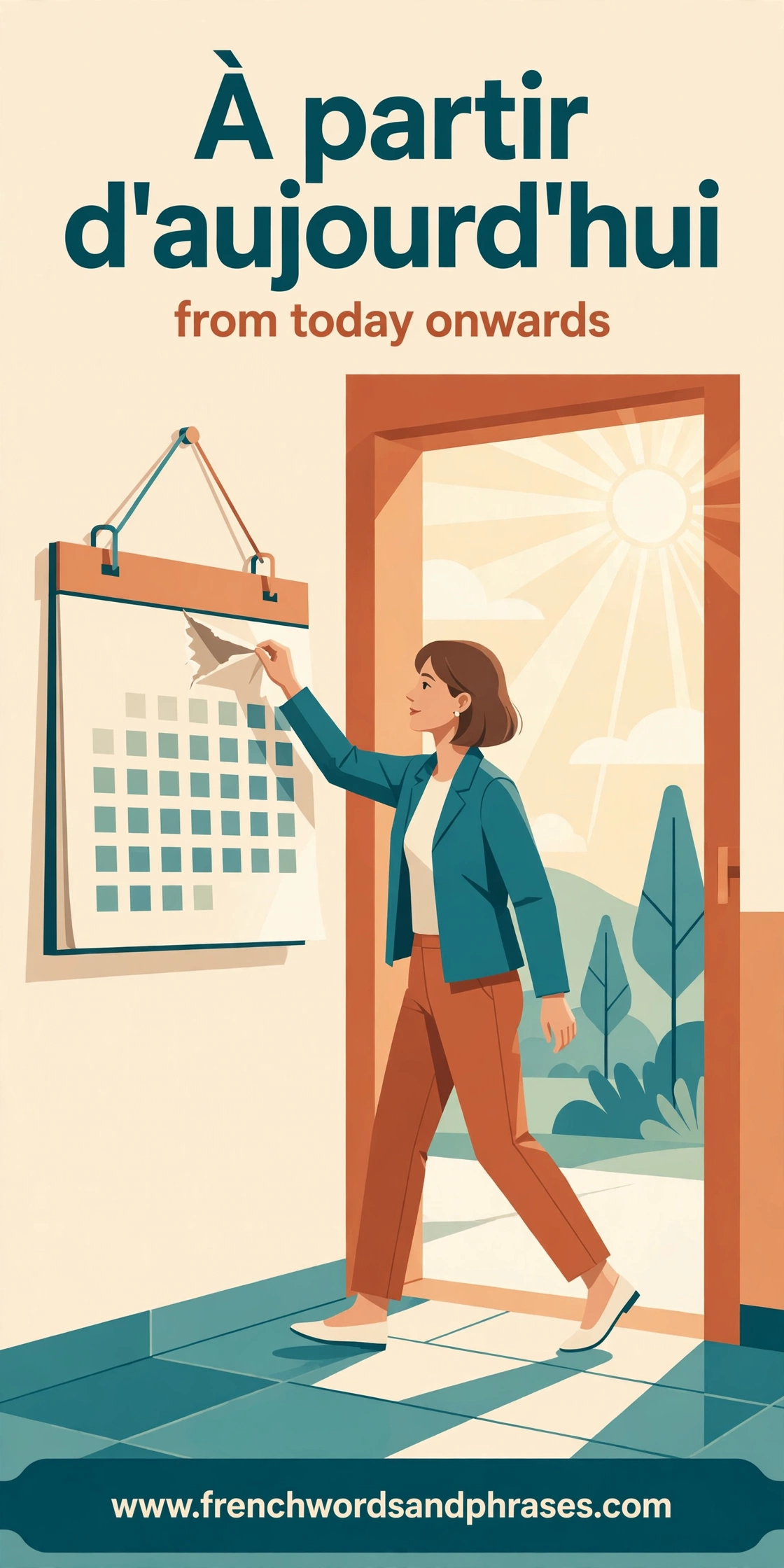
A French Word to Live By
Translate À partir d’aujourd’hui to English
/a paʁ.tiʁ do.ʒuʁ.dɥi/
À partir d’aujourd’hui means from today onwards — starting today, and from now on.
The mayor steps up to the microphone in the village hall, taps it twice, and waits for silence. « À partir d’aujourd’hui, la bibliothèque ouvrira aussi le dimanche. » A small cheer, a line of applause — a new rule has just been born, and everyone knows the exact day it starts.
Let’s explore how à partir d’aujourd’hui works in French, beginning with the whole phrase on one card.
Understanding the French Phrase À partir d’aujourd’hui
À partir d’aujourd’hui is a French everyday phrase built from à partir de (starting from — with the de elided to d’ before a vowel) and aujourd’hui (today — a word that has its own page on this site). It is the official starting pistol of French daily life: a line is drawn at today, and everything after the line follows the new rule.
It means from today onwards, starting today. À partir d’aujourd’hui, je ne fume plus — from today onwards, I no longer smoke. Le tarif change à partir d’aujourd’hui — the price changes from today. The phrase announces beginnings: resolutions, rules, prices, timetables — anything that takes effect now and runs forward.
Type: Everyday phrase — starting points (à partir de + aujourd’hui)
Answers the need: Announcing that something begins today and continues from now on
Register: Neutral — announcements, resolutions and everyday speech alike
Strength: Decisive — today is the line; everything after it is new
One important usage detail: à partir de changes its shape before a vowel — de becomes d’, giving à partir d’aujourd’hui, never « à partir de aujourd’hui ». The same elision runs through the whole family: à partir de demain (tomorrow, no elision), à partir d’avril (from April), à partir de lundi (from Monday).
Experience the Word
À partir d’aujourd’hui is the phrase of fresh pages — the first day of the diet, the new timetable, the rule that changes at midnight and the promise made at breakfast.
Imagine the café owner chalking the new menu on the board while the morning regulars watch. Under the date she writes, in her best handwriting: « À partir d’aujourd’hui : formule à dix euros. » The regulars nod gravely, as if a treaty had been signed.
English says from today onwards with the same ceremony. French draws its line with partir — to set out: à partir d’aujourd’hui, today is not a date, it is a departure.
How to Use À partir d’aujourd’hui in French: Complete Guide
Let’s explore how à partir d’aujourd’hui works in French, beginning with the whole phrase on one card.
À partir d’aujourd’hui at a Glance
The Whole Phrase on One Card
Real meaning, literal picture, English twin and register — à partir d’aujourd’hui in five lines.
| Point | À partir d’aujourd’hui |
|---|---|
| What it really means | from today onwards — beginning today and continuing forward |
| Word for word | starting from today — à partir de (starting from) + aujourd’hui (today) |
| English equivalent | from today onwards / starting today / as of today |
| Register | neutral — announcements, rules and resolutions |
| Use it for | new rules, new prices, new habits, new timetables |
Example
À partir d’aujourd’hui, le bureau ouvre à huit heures.
From today onwards, the office opens at eight o’clock.
Word by Word: Building the Starting Line
Two pieces — a starting marker and a day, and together they draw the line.
| Word | Literal meaning | Its job in the phrase |
|---|---|---|
| à partir de | starting from, as of | the starting marker — de elides to d’ before a vowel |
| aujourd’hui | today | the day the line is drawn on — the present day itself |
| (the new rule) | what changes | never inside the phrase, but always announced beside it |
Example
À partir d’aujourd’hui, je marche jusqu’au bureau.
From today onwards, I walk to the office.
Quick Quiz 1
Why does the phrase say d’aujourd’hui and not de aujourd’hui?
Reveal the answer
Because de elides before a vowel — aujourd’hui begins with a vowel sound, so de becomes d’: à partir d’aujourd’hui.
À partir d’avril, les jours rallongent.
From April onwards, the days grow longer.
When You Say It: The Starting-Pistol Moments
À partir d’aujourd’hui fires at moments like these — wherever something takes effect today.
| Situation | Example |
|---|---|
| A resolution | à partir d’aujourd’hui, j’arrête le sucre — from today, I give up sugar |
| A new rule | à partir d’aujourd’hui, les vélos sont interdits ici — from today, bikes are banned here |
| A price change | le tarif augmente à partir d’aujourd’hui — the price goes up from today |
| A timetable | à partir d’aujourd’hui, le train part à sept heures — from today, the train leaves at seven |
| A promise | à partir d’aujourd’hui, je t’écoute — from today onwards, I’ll listen to you |
Example
À partir d’aujourd’hui, nous fermons le lundi.
From today onwards, we close on Mondays.
Make It Yours: The Whole À partir Family
Swap the day and the phrase starts anything — learn the family once and every starting line is yours.
| Form | French | In English |
|---|---|---|
| Today | à partir d’aujourd’hui | from today onwards |
| Tomorrow | à partir de demain | from tomorrow |
| Monday | à partir de lundi | from Monday |
| Next month | à partir du mois prochain | from next month |
| Now (the moment) | à partir de maintenant | from now on |
Example
À partir de demain, je me lève plus tôt.
From tomorrow, I get up earlier.
Quick Quiz 2
Which member of the family means from now on — à partir d’aujourd’hui or à partir de maintenant?
Reveal the answer
À partir de maintenant — from this very moment. À partir d’aujourd’hui draws the line at the day; maintenant draws it at the instant.
À partir de maintenant, silence dans la salle.
From now on, silence in the room.
Everyday Expressions: Building on the Line
À partir d’aujourd’hui slots into these everyday frames — each one ready to use as it stands.
| Frame | In English |
|---|---|
| à partir de maintenant | from now on |
| à compter d’aujourd’hui | effective today — the administrative twin |
| dès aujourd’hui | as early as today, starting right today |
| à partir d’ici | from here — the same marker for places |
| à partir de quand ? | from when? — the question the phrase answers |
Example
Dès aujourd’hui, tu peux t’inscrire en ligne.
Starting today, you can register online.
Close Cousins: The Other Starting Lines
French starts things from many markers — à partir d’aujourd’hui is the calendar’s line; its cousins start from moments, places and people.
| Expression | The difference |
|---|---|
| à partir d’aujourd’hui | from today onwards — the day is the line |
| désormais | from now on, henceforth — one word, a shade more formal |
| dès maintenant | right from now — the instant, urgently |
| à compter de | effective from — contracts, salaries, official paper |
| depuis aujourd’hui | since today — looking back at a start already begun |
Example
Désormais, et à partir d’aujourd’hui, la porte reste ouverte.
Henceforth, and from today onwards, the door stays open.
Quick Quiz 3
A contract says: « Salaire à compter du 1er septembre. » When does the salary start?
Reveal the answer
On the first of September — à compter de is the official, written form of the starting marker, the cousin of à partir de.
À compter d’aujourd’hui, le nouveau tarif s’applique.
Effective today, the new price applies.
À partir d’aujourd’hui and Its Neighbours
The calendar shelf around the phrase — days, dates and deadlines.
| French | In English |
|---|---|
| aujourd’hui | today |
| demain | tomorrow |
| hier | yesterday — the day the line leaves behind |
| une règle | a rule |
| un horaire | a timetable, a schedule |
Example
Hier c’était l’ancien horaire ; à partir d’aujourd’hui, tout change.
Yesterday it was the old timetable; from today onwards, everything changes.
Watch Out: The Traps Around À partir d’aujourd’hui
The traps: the missing elision, and a starting line confused with a duration.
| Trap | The truth |
|---|---|
| « à partir de aujourd’hui » | de must elide before the vowel: à partir d’aujourd’hui |
| using it for the past | the phrase launches forward from today; for a start already behind you, depuis aujourd’hui or depuis ce matin |
| aujourd’hui without its apostrophe | the word itself carries one: aujourd’hui — dropping it is a spelling fault everywhere |
| à partir de for prices alone | it works for anything that takes effect: rules, habits, feelings — not just tariffs |
Example
À partir d’aujourd’hui — avec l’apostrophe, et avec le sourire.
From today onwards — with the apostrophe, and with a smile.
Quick Quiz 4
True or false: à partir d’aujourd’hui can describe something that started last year.
Reveal the answer
False — the line is drawn at today and runs forward. A start in the past takes depuis: depuis l’année dernière.
Il habite ici depuis l’année dernière.
He has lived here since last year.
À partir d’aujourd’hui in Everyday French: Real-Life Examples
Now that you know the word, let’s see how à partir d’aujourd’hui appears in everyday French.
Example 1 — A resolution
À partir d’aujourd’hui, je ne fume plus.
From today onwards, I no longer smoke.
Example 2 — A shop notice
À partir d’aujourd’hui, nous ouvrons le dimanche.
From today onwards, we open on Sundays.
Example 3 — A timetable
Le train part à sept heures à partir d’aujourd’hui.
The train leaves at seven from today onwards.
Example 4 — At school
À partir d’aujourd’hui, les devoirs se rendent le vendredi.
From today onwards, homework is handed in on Fridays.
Example 5 — A promise
À partir d’aujourd’hui, je range ma chambre.
From today onwards, I tidy my room.
Example 6 — A price
Le pain augmente à partir d’aujourd’hui.
Bread goes up (in price) from today.
Beyond Translation: The Meaning of À partir d’aujourd’hui
Every language needs a way to declare a before and an after, and French draws the line at the most human scale there is: today. Not the first of the month, not Monday — aujourd’hui, this day, the one already under your feet.
To say à partir d’aujourd’hui is to make today into a border — everything before it is the old country.
That is why the phrase belongs to resolutions as much as to regulations: a new rule and a new habit are both just a line drawn at today, with a whole future asked to queue up behind it.
How to Remember the French Phrase À partir d’aujourd’hui
Remember it this way: À partir d’aujourd’hui means from today onwards — the starting line drawn at today, with de elided to d’ before the vowel.
- You elide — à partir d’aujourd’hui, because aujourd’hui begins with a vowel.
- You draw the line at today — rules, prices and resolutions all take effect from the phrase.
- You learn the family — à partir de demain, à partir de lundi, à partir de maintenant.
The key idea is à partir d’aujourd’hui means from today onwards — de elides to d’ before a vowel.
Test Your Knowledge of À partir d’aujourd’hui
Let’s see how much you’ve learned. Try answering these questions before revealing the answers.
Question 1
What does à partir d’aujourd’hui mean?
Reveal the answer
From today onwards — beginning today and continuing forward.
Question 2
Why is it d’aujourd’hui and not de aujourd’hui?
Reveal the answer
Elision — de becomes d’ before a vowel, and aujourd’hui starts with one.
Question 3
Translate: From today onwards, I no longer smoke.
Reveal the answer
À partir d’aujourd’hui, je ne fume plus.
Question 4
How do you say from tomorrow, in the same family?
Reveal the answer
À partir de demain — no elision: demain begins with a consonant.
Question 5
Complete the sentence:
À partir d’______, le bureau ouvre à huit heures. (today)
Reveal the answer
aujourd’hui
À partir d’aujourd’hui, le bureau ouvre à huit heures.
From today onwards, the office opens at eight.
Your Final Challenge
Can You Use It?
How would you say this in French?
“From today onwards, I no longer smoke.”
Reveal the answer
À partir d’aujourd’hui, je ne fume plus.
From today onwards, I no longer smoke.
A little French. A little curiosity. A richer everyday life.
LEARN FRENCH ONE WORD AT A TIME




