
A French Word to Live By
How to Conjugate Insinuer in French
/ɛ̃.si.nɥe/
Insinuer means to insinuate, to imply — to slip an unpleasant suggestion into a conversation sideways, without ever saying it outright.
A raised eyebrow, a sentence left hanging, a compliment with a hook in it — insinuer is the verb of the sideways accusation: nothing is stated, everything is understood, and the speaker can always deny having said a word.
In this guide, you’ll learn how to conjugate insinuer in all the major French tenses and moods. Explore complete conjugation tables, French examples, English translations, and practice quizzes.
Understanding the French Verb Insinuer
Insinuer is a regular French verb belonging to the first group of verbs, those ending in-er.
It means to insinuate, to imply. It is almost always used of something unflattering — a suspicion, an accusation, a doubt — delivered indirectly: insinuer que quelqu’un a menti, insinuer des doutes sur sa loyauté. Faced with an insinuation, the classic reply is a challenge: « Qu’insinuez-vous ? » — what exactly are you insinuating?
Verb classification: First group (-er)
Auxiliary verb: Avoir
Past participle: insinué
Present participle: insinuant
English equivalents: To insinuate, to imply, to hint; insinuer que… — to insinuate that…; insinuer des doutes — to sow doubts by hinting; qu’insinuez-vous ? — what are you insinuating?; s’insinuer dans — to worm one’s way into.
One important detail: insinuer is a perfectly regular -uer verb — j’insinue, nous insinuons, ils insinuent, past participle insinué — but it has a second life in the reflexive: s’insinuer dans means to slip or worm your way into a place or a group: le chat s’insinue dans la maison, elle s’est insinuée dans leur cercle d’amis. The plain verb hints; the reflexive wriggles in. Both pictures come from the Latin sinus, a fold or a curve — the suggestion, like the cat, arrives by a winding path.
Experience the Word
Insinuer is the verb of the sentence that accuses without accusing — the knife slid in between two polite words.
Imagine a family dinner. The missing silver spoon is mentioned, and one uncle remarks, mildly, that some people have been visiting the house rather often lately. He names nobody, he accuses nobody — mais il insinue, and everyone at the table understands perfectly.
Nothing has actually been said. Yet the suggestion is in the room — insinuée, and impossible to unpick.
How to Conjugate Insinuer: Complete French Conjugation Guide
Let’s explore every major conjugation of insinuer, beginning with the indicative mood.
How to Conjugate Insinuer in the Indicative Mood
The indicative mood is used to express facts, observations, actions, and events.
How to Conjugate Insinuer in the Present Tense (Présent)
Used for actions happening now, habitual actions, and general truths.
| Subject | Conjugation |
|---|---|
| je | insinue |
| tu | insinues |
| il / elle | insinue |
| nous | insinuons |
| vous | insinuez |
| ils / elles | insinuent |
Example
Sans accuser personne, il insinue que l’argent a disparu tout seul.
Without accusing anyone, he insinuates that the money disappeared all by itself.
Quick Quiz 1
Complete the sentence:
Nous ______ des doutes sur sa loyauté, sans le vouloir.
Reveal the answer
insinuons
Nous insinuons des doutes sur sa loyauté, sans le vouloir.
We are insinuating doubts about his loyalty, without meaning to.
How to Conjugate Insinuer in the Passé Composé
Used for completed actions in the past. Insinuer takes the auxiliary verb avoir.
| Subject | Conjugation |
|---|---|
| j’ | ai insinué |
| tu | as insinué |
| il / elle | a insinué |
| nous | avons insinué |
| vous | avez insinué |
| ils / elles | ont insinué |
Example
Par ses questions, elle a insinué que le témoin mentait.
Through her questions, she insinuated that the witness was lying.
How to Conjugate Insinuer in the Imparfait (Imperfect Tense)
Used for habitual past actions, descriptions, and ongoing situations in the past.
| Subject | Conjugation |
|---|---|
| je | insinuais |
| tu | insinuais |
| il / elle | insinuait |
| nous | insinuions |
| vous | insinuiez |
| ils / elles | insinuaient |
Example
Chaque semaine, le journal insinuait des doutes sur le ministre.
Every week, the newspaper insinuated doubts about the minister.
Quick Quiz 2
Choose the correct form:
She insinuated that he was lying.
Elle ______ qu’il mentait. (a insinué / est insinuée)
Reveal the answer
a insinué
Elle a insinué qu’il mentait.
Insinuer takes avoir.
How to Conjugate Insinuer in the Plus-que-parfait
Used to describe an action that had already been completed before another past event.
| Subject | Conjugation |
|---|---|
| j’ | avais insinué |
| tu | avais insinué |
| il / elle | avait insinué |
| nous | avions insinué |
| vous | aviez insinué |
| ils / elles | avaient insinué |
Example
Il avait insinué tant de choses que plus personne ne le croyait innocent.
He had insinuated so many things that nobody believed him innocent any more.
How to Conjugate Insinuer in the Passé Simple
Primarily used in formal writing, literature, and historical narratives. It is rarely used in everyday conversation.
| Subject | Conjugation |
|---|---|
| je | insinuai |
| tu | insinuas |
| il / elle | insinua |
| nous | insinuâmes |
| vous | insinuâtes |
| ils / elles | insinuèrent |
Example
D’une voix douce, elle insinua que la porte avait été laissée ouverte.
In a gentle voice, she insinuated that the door had been left open.
How to Conjugate Insinuer in the Passé Antérieur
A literary tense used to express an action completed immediately before another past action, generally in the passé simple.
| Subject | Conjugation |
|---|---|
| j’ | eus insinué |
| tu | eus insinué |
| il / elle | eut insinué |
| nous | eûmes insinué |
| vous | eûtes insinué |
| ils / elles | eurent insinué |
Example
Quand il eut insinué que son frère était responsable, le silence se fit.
When he had insinuated that his brother was responsible, silence fell.
How to Conjugate Insinuer in the Future Tense (Futur Simple)
Used to describe actions that will take place in the future.
| Subject | Conjugation |
|---|---|
| je | insinuerai |
| tu | insinueras |
| il / elle | insinuera |
| nous | insinuerons |
| vous | insinuerez |
| ils / elles | insinueront |
Example
Je sais qu’il insinuera encore quelque chose contre moi.
I know he will insinuate something against me again.
How to Conjugate Insinuer in the Futur Antérieur (Future Perfect)
Used for an action that will have been completed before a particular point in the future.
| Subject | Conjugation |
|---|---|
| j’ | aurai insinué |
| tu | auras insinué |
| il / elle | aura insinué |
| nous | aurons insinué |
| vous | aurez insinué |
| ils / elles | auront insinué |
Example
À la fin de l’émission, ils auront insinué tout et son contraire.
By the end of the programme, they will have insinuated everything and its opposite.
How to Conjugate Insinuer in the Near Future (Futur Proche)
Used to describe something that is going to happen soon. Formed with aller + infinitive.
| Subject | Conjugation |
|---|---|
| je | vais insinuer |
| tu | vas insinuer |
| il / elle | va insinuer |
| nous | allons insinuer |
| vous | allez insinuer |
| ils / elles | vont insinuer |
Example
Attention, il va insinuer que c’est de ta faute.
Careful, he is going to insinuate that it is your fault.
How to Conjugate Insinuer in the Conditional Mood
The conditional mood expresses what would happen under certain circumstances. It is also frequently used to make polite requests or express wishes.
How to Conjugate Insinuer in the Present Conditional
| Subject | Conjugation |
|---|---|
| je | insinuerais |
| tu | insinuerais |
| il / elle | insinuerait |
| nous | insinuerions |
| vous | insinueriez |
| ils / elles | insinueraient |
Example
Sans preuves, je n’insinuerais jamais une chose pareille.
Without proof, I would never insinuate such a thing.
How to Conjugate Insinuer in the Past Conditional
| Subject | Conjugation |
|---|---|
| j’ | aurais insinué |
| tu | aurais insinué |
| il / elle | aurait insinué |
| nous | aurions insinué |
| vous | auriez insinué |
| ils / elles | auraient insinué |
Example
Il aurait insinué pire encore si on l’avait laissé parler.
He would have insinuated worse still if they had let him talk.
Insinuer in the Literary Past Conditional Form
This less common literary form uses the imperfect subjunctive of avoir.
| Subject | Conjugation |
|---|---|
| j’ | eusse insinué |
| tu | eusses insinué |
| il / elle | eût insinué |
| nous | eussions insinué |
| vous | eussiez insinué |
| ils / elles | eussent insinué |
Example
Il insinuât des doutes que personne n’osa relever.
He would insinuate doubts that nobody dared take up.
How to Conjugate Insinuer in the Subjunctive Mood
The subjunctive is used to express wishes, emotions, doubts, necessity, and uncertainty. It frequently follows expressions such as il faut que (it is necessary that) or bien que (although).
How to Conjugate Insinuer in the Present Subjunctive
| Subject | Conjugation |
|---|---|
| que je | insinue |
| que tu | insinues |
| qu’il / qu’elle | insinue |
| que nous | insinuions |
| que vous | insinuiez |
| qu’ils / qu’elles | insinuent |
Example
Je ne crois pas qu’il insinue quoi que ce soit contre toi.
I do not think he is insinuating anything against you.
Quick Quiz 3
Complete the sentence using the subjunctive:
Je ne crois pas que vous ______ quelque chose contre moi.
Reveal the answer
insinuiez
Je ne crois pas que vous insinuiez quelque chose contre moi.
I do not think you are insinuating anything against me.
How to Conjugate Insinuer in the Imperfect Subjunctive
A literary tense, rarely encountered in modern spoken French.
| Subject | Conjugation |
|---|---|
| que je | insinuasse |
| que tu | insinuasses |
| qu’il / qu’elle | insinuât |
| que nous | insinuassions |
| que vous | insinuassiez |
| qu’ils / qu’elles | insinuassent |
Example
On craignait qu’elle insinuât que l’argent avait été volé.
People feared she might insinuate that the money had been stolen.
How to Conjugate Insinuer in the Pluperfect Subjunctive
A literary construction used to express an action completed before another past action.
| Subject | Conjugation |
|---|---|
| que j’ | eusse insinué |
| que tu | eusses insinué |
| qu’il / qu’elle | eût insinué |
| que nous | eussions insinué |
| que vous | eussiez insinué |
| qu’ils / qu’elles | eussent insinué |
Example
On racontait qu’il eût insinué la trahison de son propre frère.
People said he had insinuated his own brother’s betrayal.
How to Conjugate Insinuer in the Past Subjunctive
| Subject | Conjugation |
|---|---|
| que j’ | aie insinué |
| que tu | aies insinué |
| qu’il / qu’elle | ait insinué |
| que nous | ayons insinué |
| que vous | ayez insinué |
| qu’ils / qu’elles | aient insinué |
Example
Je suis étonné qu’elle ait insinué une chose pareille.
I am amazed she insinuated such a thing.
How to Conjugate Insinuer in the Imperative
The imperative is used to give commands, instructions, invitations, or suggestions. Subject pronouns are omitted.
How to Conjugate Insinuer in the Present Imperative
| Person | Conjugation |
|---|---|
| (tu) | insinue |
| (nous) | insinuons |
| (vous) | insinuez |
Example
N’insinue rien sans preuves, dis les choses franchement !
Do not insinuate anything without proof, say things frankly!
Quick Quiz 4
How would you say What are you insinuating? (vous form)
Reveal the answer
Qu’insinuez-vous ?
French Participles of Insinuer
Participles are verb forms that can be used in compound tenses and other grammatical constructions.
Present Participle of Insinuer
insinuant
En insinuant des doutes partout, il a fini par se faire détester.
By insinuating doubts everywhere, he ended up making himself hated.
Past Participle of Insinuer
insinué
Insinué à demi-mot, le soupçon a fait son chemin.
Insinuated in half-words, the suspicion made its way.
Insinuer in Everyday French: Real-Life Examples
Now that you know the conjugations, let’s see how insinuer appears in everyday French.
Example 1 — Present
Il insinue que l’argent a disparu.
He insinuates that the money has disappeared.
Example 2 — Passé composé
Elle a insinué que le témoin mentait.
She insinuated that the witness was lying.
Example 3 — Imparfait
Le journal insinuait des doutes chaque semaine.
The newspaper insinuated doubts every week.
Example 4 — Future
Il insinuera encore quelque chose contre moi.
He will insinuate something against me again.
Example 5 — Conditional
Je n’insinuerais jamais une chose pareille.
I would never insinuate such a thing.
Example 6 — Imperative
N’insinue rien sans preuves !
Do not insinuate anything without proof!
Beyond Translation: The Meaning of Insinuer
English insinuate is the exact twin — same Latin root, same sideways movement — and French insinuer keeps both halves of the picture: the hint that slips in, and the person who slips in with it (s’insinuer dans un groupe).
An insinuation is a guest nobody invited.
It enters by a winding path, settles in every mind at the table, and cannot be shown the door — because, officially, it was never said at all.
How to Remember the French Verb Insinuer
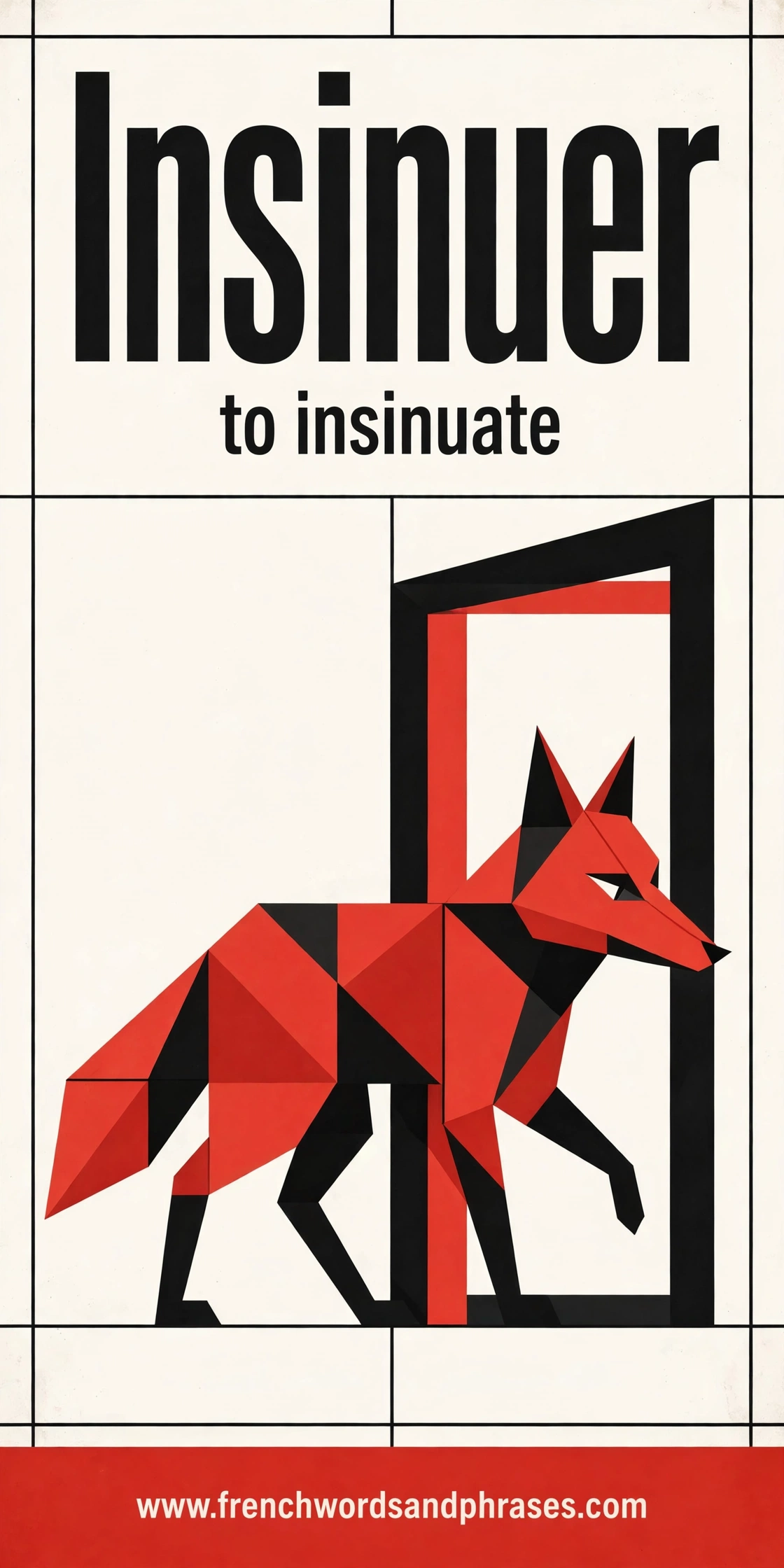
Remember it this way: Insinuer is about the suggestion that slips in sideways, like a cat through a door.
- Insinuer = to hint at something unpleasant without saying it: insinuer que…, insinuer des doutes.
- The reflexive s’insinuer dans means to worm your way into a place or a group.
- Regular -uer: j’insinue, nous insinuons, past participle insinué.
The key idea is the suggestion that slips in sideways, like a cat through a door.
Test Your Knowledge of Insinuer
Let’s see how much you’ve learned. Try answering these questions before revealing the answers.
Question 1
What does insinuer usually suggest, and how?
Reveal the answer
Something unflattering — indirectly: a suspicion or accusation hinted at, never stated outright.
Question 2
How do you say He insinuates that the witness was lying in French?
Reveal the answer
Il insinue que le témoin mentait.
Question 3
Translate: She insinuated that the money had been stolen.
Reveal the answer
Elle a insinué que l’argent avait été volé.
Question 4
What is the past participle of insinuer?
Reveal the answer
Insinué.
Question 5
Complete the sentence:
Je ne crois pas qu’il ______ quoi que ce soit contre toi.
Reveal the answer
insinue
Je ne crois pas qu’il insinue quoi que ce soit contre toi.
I do not think he is insinuating anything against you.
Your Final Challenge
Can You Use It?
How would you say this in French?
He accused nothing, he only insinuated — and the suspicion did the rest all by itself.
Reveal the answer
Il n’a rien accusé, il a seulement insinué — et le soupçon a fait le reste tout seul.
He accused nothing, he only insinuated — and the suspicion did the rest all by itself.
A little French. A little curiosity. A richer everyday life.
LEARN FRENCH ONE WORD AT A TIME




