
A French Word to Live By
How to Conjugate Injurier in French
/ɛ̃.ʒy.ʁje/
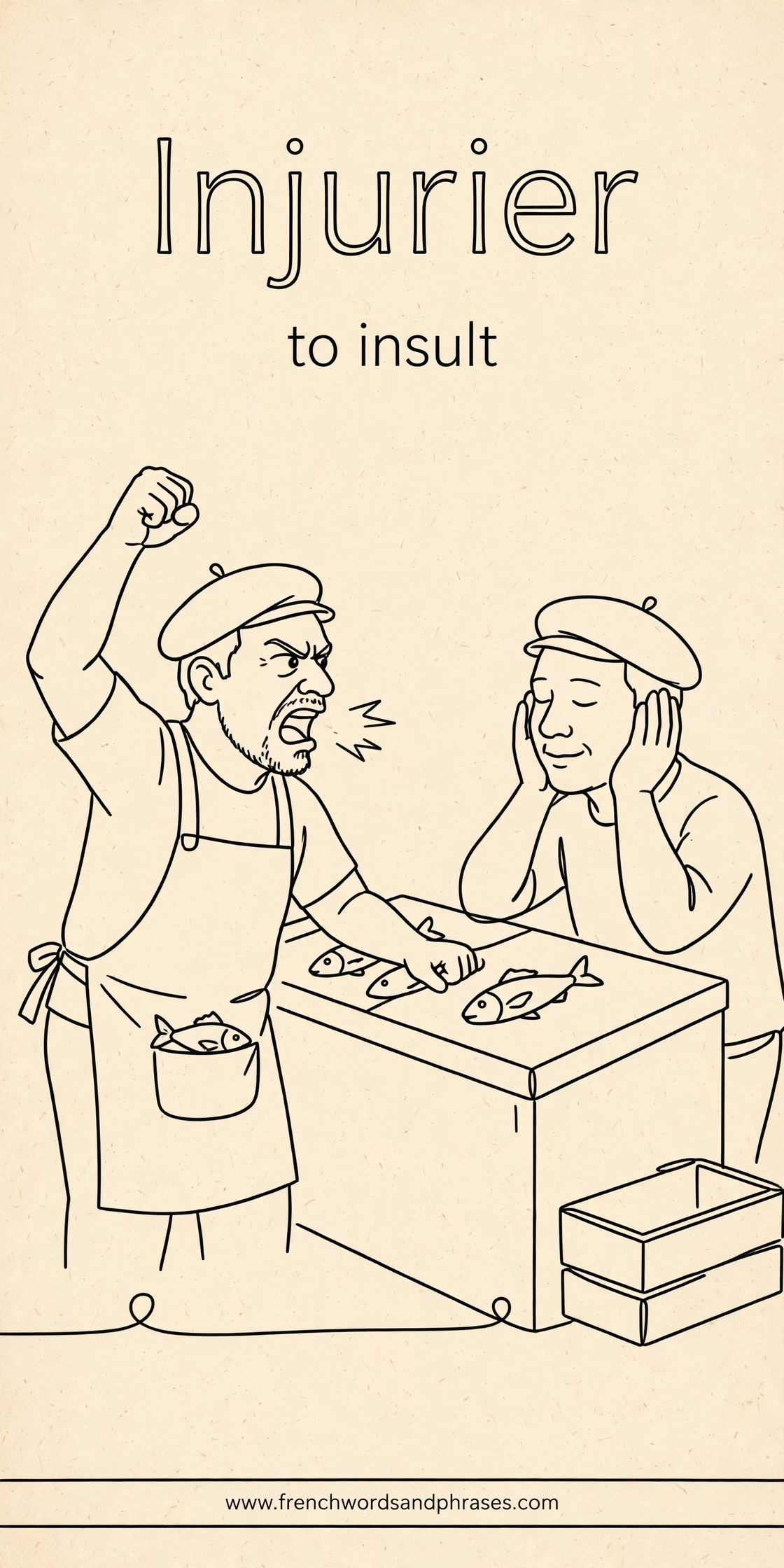
Injurier means to insult, to abuse — to shower someone with insults, out loud and to their face: the verb of the shouted insult, stronger and more deliberate than a mere rude word.
A driver leaning on his horn and shouting through the window, a crowd hurling abuse at a referee — injurier is the verb of verbal attack: not a slip of the tongue, but a volley of insults aimed at a person.
In this guide, you’ll learn how to conjugate injurier in all the major French tenses and moods. Explore complete conjugation tables, French examples, English translations, and practice quizzes.
Understanding the French Verb Injurier
Injurier is a regular French verb belonging to the first group of verbs, those ending in-er.
It means to insult, to abuse. It takes a direct object — the person abused: injurier un voisin, injurier l’arbitre, injurier un agent. The scene is almost always public and noisy: streets, stadiums, assemblies. In law, injure is a defined offence (public insult), which gives the verb a formal shadow behind its street life.
Verb classification: First group (-er)
Auxiliary verb: Avoir
Past participle: injurié
Present participle: injuriant
English equivalents: To insult, to abuse, to swear at; injurier quelqu’un — to hurl insults at someone; injurier l’arbitre — to abuse the referee; se faire injurier — to be insulted, to get sworn at; une injure — an insult, a term of abuse.
One important detail: injurier is an -ier verb, and -ier verbs double the i in the nous and vous forms of the imperfect and the subjunctive: nous injuriions, que vous injuriiez — while the present keeps a single i there: nous injurions. Do not confuse it with its near-twin insulter: insulter is the everyday word, while injurier stresses the shower of abuse itself — and its noun, une injure, is the legal word for an insult: poursuivre quelqu’un pour injures, to sue someone for abusive language.
Experience the Word
Injurier is the verb of the volley — insult after insult, aimed, audible, and meant to wound in public.
Imagine a football stadium at the final whistle. The referee walks toward the tunnel and fifty thousand voices rise as one — les supporters injurient l’arbitre, a storm of abuse following him down the steps, while the stewards simply watch: it is, somehow, part of the job.
No argument has been made. The referee has simply been abused — injurié, showered with insults from every stand.
How to Conjugate Injurier: Complete French Conjugation Guide
Let’s explore every major conjugation of injurier, beginning with the indicative mood.
How to Conjugate Injurier in the Indicative Mood
The indicative mood is used to express facts, observations, actions, and events.
How to Conjugate Injurier in the Present Tense (Présent)
Used for actions happening now, habitual actions, and general truths.
| Subject | Conjugation |
|---|---|
| je | injurie |
| tu | injuries |
| il / elle | injurie |
| nous | injurions |
| vous | injuriez |
| ils / elles | injurient |
Example
Les supporters injurient l’arbitre à chaque match.
The supporters abuse the referee at every match.
Quick Quiz 1
Complete the sentence:
Nous ______ l’arbitre à chaque match.
Reveal the answer
injurions
Nous injurions l’arbitre à chaque match.
We abuse the referee at every match.
How to Conjugate Injurier in the Passé Composé
Used for completed actions in the past. Injurier takes the auxiliary verb avoir.
| Subject | Conjugation |
|---|---|
| j’ | ai injurié |
| tu | as injurié |
| il / elle | a injurié |
| nous | avons injurié |
| vous | avez injurié |
| ils / elles | ont injurié |
Example
Le conducteur a injurié l’agent qui le verbalisait.
The driver swore at the officer who was fining him.
How to Conjugate Injurier in the Imparfait (Imperfect Tense)
Used for habitual past actions, descriptions, and ongoing situations in the past.
| Subject | Conjugation |
|---|---|
| je | injuriais |
| tu | injuriais |
| il / elle | injuriait |
| nous | injuriions |
| vous | injuriiez |
| ils / elles | injuriaient |
Example
Autrefois, les voisins injuriaient le facteur pour un rien.
In the past, the neighbours used to insult the postman over nothing.
Quick Quiz 2
Choose the correct form:
The driver swore at the officer.
Le conducteur ______ l’agent. (a injurié / est injurié)
Reveal the answer
a injurié
Le conducteur a injurié l’agent.
Injurier takes avoir.
How to Conjugate Injurier in the Plus-que-parfait
Used to describe an action that had already been completed before another past event.
| Subject | Conjugation |
|---|---|
| j’ | avais injurié |
| tu | avais injurié |
| il / elle | avait injurié |
| nous | avions injurié |
| vous | aviez injurié |
| ils / elles | avaient injurié |
Example
Elle avait injurié son frère avant de claquer la porte.
She had insulted her brother before slamming the door.
How to Conjugate Injurier in the Passé Simple
Primarily used in formal writing, literature, and historical narratives. It is rarely used in everyday conversation.
| Subject | Conjugation |
|---|---|
| je | injuriai |
| tu | injurias |
| il / elle | injuria |
| nous | injuriâmes |
| vous | injuriâtes |
| ils / elles | injurièrent |
Example
La foule injuria le ministre à sa sortie.
The crowd hurled abuse at the minister as he left.
How to Conjugate Injurier in the Passé Antérieur
A literary tense used to express an action completed immediately before another past action, generally in the passé simple.
| Subject | Conjugation |
|---|---|
| j’ | eus injurié |
| tu | eus injurié |
| il / elle | eut injurié |
| nous | eûmes injurié |
| vous | eûtes injurié |
| ils / elles | eurent injurié |
Example
Quand il eut injurié tout le monde, il partit seul.
When he had insulted everyone, he left alone.
How to Conjugate Injurier in the Future Tense (Futur Simple)
Used to describe actions that will take place in the future.
| Subject | Conjugation |
|---|---|
| je | injurierai |
| tu | injurieras |
| il / elle | injuriera |
| nous | injurierons |
| vous | injurierez |
| ils / elles | injurieront |
Example
Tu injurieras les gens si tu perds ton calme.
You will insult people if you lose your temper.
How to Conjugate Injurier in the Futur Antérieur (Future Perfect)
Used for an action that will have been completed before a particular point in the future.
| Subject | Conjugation |
|---|---|
| j’ | aurai injurié |
| tu | auras injurié |
| il / elle | aura injurié |
| nous | aurons injurié |
| vous | aurez injurié |
| ils / elles | auront injurié |
Example
À la fin du match, ils auront injurié l’arbitre dix fois.
By the end of the match, they will have abused the referee ten times.
How to Conjugate Injurier in the Near Future (Futur Proche)
Used to describe something that is going to happen soon. Formed with aller + infinitive.
| Subject | Conjugation |
|---|---|
| je | vais injurier |
| tu | vas injurier |
| il / elle | va injurier |
| nous | allons injurier |
| vous | allez injurier |
| ils / elles | vont injurier |
Example
Attention, ce chauffard va injurier tout le monde.
Careful, that reckless driver is going to swear at everyone.
How to Conjugate Injurier in the Conditional Mood
The conditional mood expresses what would happen under certain circumstances. It is also frequently used to make polite requests or express wishes.
How to Conjugate Injurier in the Present Conditional
| Subject | Conjugation |
|---|---|
| je | injurierais |
| tu | injurierais |
| il / elle | injurierait |
| nous | injurierions |
| vous | injurieriez |
| ils / elles | injurieraient |
Example
Sans témoins, il injurierait ses voisins chaque jour.
Without witnesses, he would insult his neighbours every day.
How to Conjugate Injurier in the Past Conditional
| Subject | Conjugation |
|---|---|
| j’ | aurais injurié |
| tu | aurais injurié |
| il / elle | aurait injurié |
| nous | aurions injurié |
| vous | auriez injurié |
| ils / elles | auraient injurié |
Example
Elle aurait injurié le vendeur si elle avait perdu patience.
She would have sworn at the salesman if she had lost patience.
Injurier in the Literary Past Conditional Form
This less common literary form uses the imperfect subjunctive of avoir.
| Subject | Conjugation |
|---|---|
| j’ | eusse injurié |
| tu | eusses injurié |
| il / elle | eût injurié |
| nous | eussions injurié |
| vous | eussiez injurié |
| ils / elles | eussent injurié |
Example
Le poète injuriât ses critiques dans ses vers.
The poet would abuse his critics in his verses.
How to Conjugate Injurier in the Subjunctive Mood
The subjunctive is used to express wishes, emotions, doubts, necessity, and uncertainty. It frequently follows expressions such as il faut que (it is necessary that) or bien que (although).
How to Conjugate Injurier in the Present Subjunctive
| Subject | Conjugation |
|---|---|
| que je | injurie |
| que tu | injuries |
| qu’il / qu’elle | injurie |
| que nous | injuriions |
| que vous | injuriiez |
| qu’ils / qu’elles | injurient |
Example
Je ne veux pas que tu injuries les gens dans la rue.
I do not want you to insult people in the street.
Quick Quiz 3
Complete the sentence using the subjunctive:
Je ne veux pas que vous ______ les gens.
Reveal the answer
injuriiez
Je ne veux pas que vous injuriiez les gens.
I do not want you to insult people — note the double i.
How to Conjugate Injurier in the Imperfect Subjunctive
A literary tense, rarely encountered in modern spoken French.
| Subject | Conjugation |
|---|---|
| que je | injuriasse |
| que tu | injuriasses |
| qu’il / qu’elle | injuriât |
| que nous | injuriassions |
| que vous | injuriassiez |
| qu’ils / qu’elles | injuriassent |
Example
Il fallait qu’il injuriât l’arbitre pour être expulsé.
He had to abuse the referee to be sent off.
How to Conjugate Injurier in the Pluperfect Subjunctive
A literary construction used to express an action completed before another past action.
| Subject | Conjugation |
|---|---|
| que j’ | eusse injurié |
| que tu | eusses injurié |
| qu’il / qu’elle | eût injurié |
| que nous | eussions injurié |
| que vous | eussiez injurié |
| qu’ils / qu’elles | eussent injurié |
Example
On racontait qu’il eût injurié le maire en pleine séance.
People said he had insulted the mayor in full session.
How to Conjugate Injurier in the Past Subjunctive
| Subject | Conjugation |
|---|---|
| que j’ | aie injurié |
| que tu | aies injurié |
| qu’il / qu’elle | ait injurié |
| que nous | ayons injurié |
| que vous | ayez injurié |
| qu’ils / qu’elles | aient injurié |
Example
Je regrette qu’elle ait injurié son frère.
I regret that she insulted her brother.
How to Conjugate Injurier in the Imperative
The imperative is used to give commands, instructions, invitations, or suggestions. Subject pronouns are omitted.
How to Conjugate Injurier in the Present Imperative
| Person | Conjugation |
|---|---|
| (tu) | injurie |
| (nous) | injurions |
| (vous) | injuriez |
Example
N’injurie pas les gens, parle calmement !
Do not insult people, speak calmly!
Quick Quiz 4
How would you say Do not insult people (tu form)?
Reveal the answer
N’injurie pas les gens !
French Participles of Injurier
Participles are verb forms that can be used in compound tenses and other grammatical constructions.
Present Participle of Injurier
injuriant
En injuriant l’agent, il a aggravé son cas.
By swearing at the officer, he made his case worse.
Past Participle of Injurier
injurié
Injurié par la foule, le ministre est parti sans répondre.
Abused by the crowd, the minister left without replying.
Injurier in Everyday French: Real-Life Examples
Now that you know the conjugations, let’s see how injurier appears in everyday French.
Example 1 — Present
Les supporters injurient l’arbitre.
The supporters abuse the referee.
Example 2 — Passé composé
Le conducteur a injurié l’agent.
The driver swore at the officer.
Example 3 — Imparfait
Les voisins injuriaient le facteur.
The neighbours used to insult the postman.
Example 4 — Future
Tu injurieras les gens si tu perds ton calme.
You will insult people if you lose your temper.
Example 5 — Conditional
Il injurierait ses voisins chaque jour.
He would insult his neighbours every day.
Example 6 — Imperative
N’injurie pas les gens !
Do not insult people!
Beyond Translation: The Meaning of Injurier
English injury is the false friend to watch: in English an injury wounds the body, but French une injure wounds with words — it is an insult, and injurier is to deliver it.
Same Latin root, two kinds of wound.
Latin injuria meant a wrong, an injustice — French kept the wrong in its verbal form, English in its physical one. Learn injurier and you will never again read « poursuivi pour injures » as a case about broken bones: it is a court case about insults.
How to Remember the French Verb Injurier
Remember it this way: Injurier is about the referee under a storm of abuse — insults, not injuries.
- False friend alert: une injure is an insult, not a physical injury — that is une blessure.
- -ier spelling: nous injuriions in the imperfect, que vous injuriiez in the subjunctive — double i.
- It takes a direct object: injurier l’arbitre, injurier un agent — the person abused.
The key idea is the referee under a storm of abuse — insults, not injuries.
Test Your Knowledge of Injurier
Let’s see how much you’ve learned. Try answering these questions before revealing the answers.
Question 1
What does une injure mean, and what is the trap for English speakers?
Reveal the answer
An insult — not a physical injury; a bodily injury is une blessure.
Question 2
How do you say The supporters abuse the referee in French?
Reveal the answer
Les supporters injurient l’arbitre.
Question 3
Translate: The driver swore at the officer.
Reveal the answer
Le conducteur a injurié l’agent.
Question 4
What is the past participle of injurier?
Reveal the answer
Injurié.
Question 5
Complete the sentence:
Autrefois, nous ______ le facteur pour un rien.
Reveal the answer
injuriions
Autrefois, nous injuriions le facteur pour un rien.
In the past, we used to insult the postman over nothing — note the double i.
Your Final Challenge
Can You Use It?
How would you say this in French?
Abused by the crowd as he left, the minister kept his calm and did not reply.
Reveal the answer
Injurié par la foule à sa sortie, le ministre a gardé son calme et n’a pas répondu.
Abused by the crowd as he left, the minister kept his calm and did not reply.
A little French. A little curiosity. A richer everyday life.
LEARN FRENCH ONE WORD AT A TIME




