
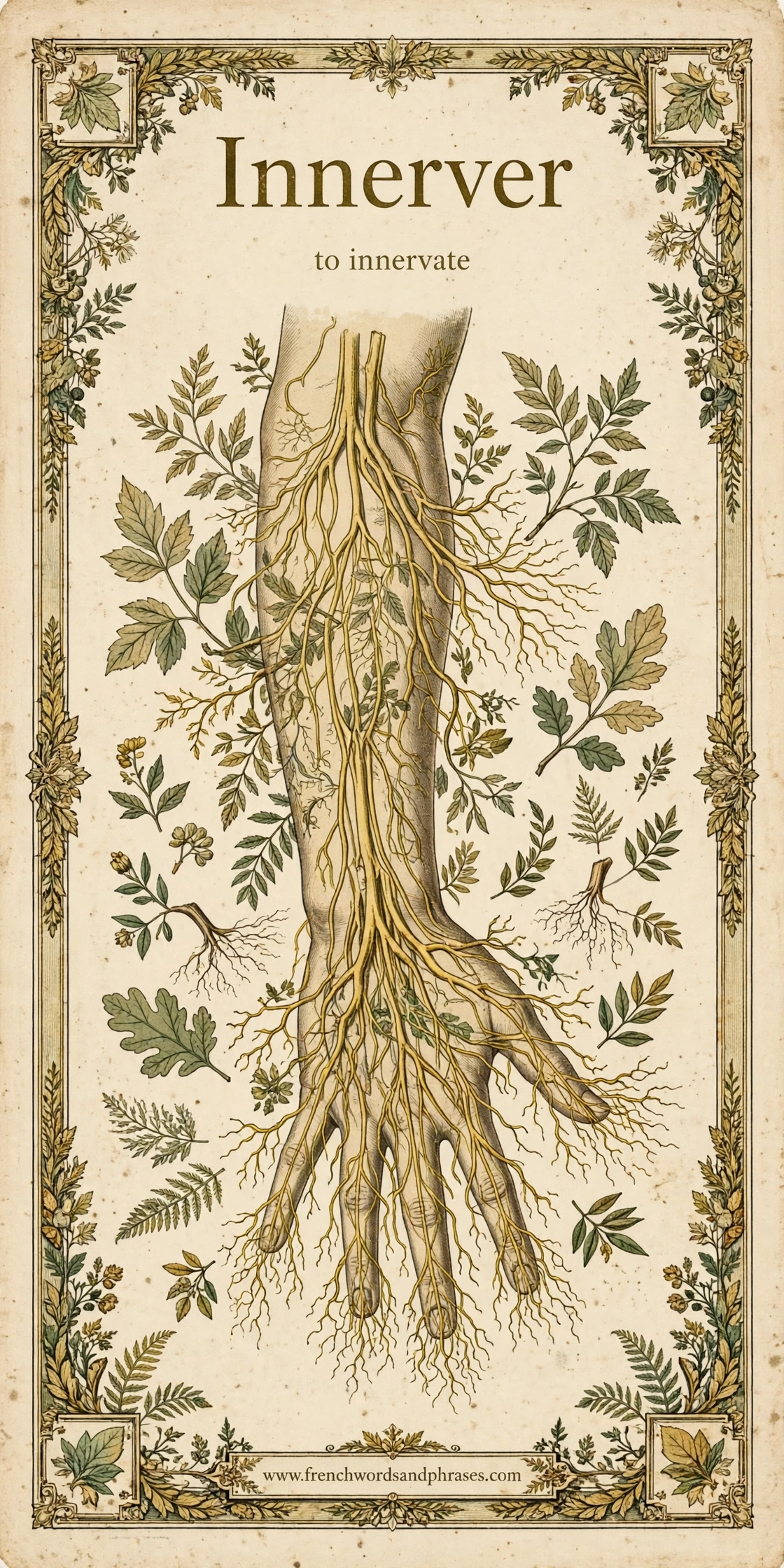
A French Word to Live By
How to Conjugate Innerver in French
/i.nɛʁ.ve/
Innerver means to innervate — to supply a muscle or an organ with nerves, so that it can feel and move.
A nerve leaving the spinal cord and branching into the hand, a muscle waking up because a signal has arrived — innerver is the anatomist’s verb: wherever a nerve reaches and governs a part of the body, that part is innervé.
In this guide, you’ll learn how to conjugate innerver in all the major French tenses and moods. Explore complete conjugation tables, French examples, English translations, and practice quizzes.
Understanding the French Verb Innerver
Innerver is a regular French verb belonging to the first group of verbs, those ending in-er.
It means to innervate. It belongs to anatomy, neurology and medicine: nerves innervent muscles, skin, glands and organs, and doctors speak of un muscle bien innervé, a well-innervated muscle. Outside the clinic you will meet it in textbooks and in the noun l’innervation rather than in conversation.
Verb classification: First group (-er)
Auxiliary verb: Avoir
Past participle: innervé
Present participle: innervant
English equivalents: To innervate, to supply with nerves; un nerf qui innerve un muscle — a nerve that innervates a muscle; le nerf vague innerve le cœur — the vagus nerve innervates the heart; un territoire innervé — an innervated area; l’innervation — innervation (the noun).
One important warning: innerver is not énerver. Innerver, with its double n, is the calm medical verb built on le nerf, the nerve — it means to supply with nerves. Énerver, with one n, means to annoy or get on someone’s nerves: ce bruit m’énerve. The two verbs are false friends separated by a single letter. Innerver itself is perfectly regular: j’innerve, nous innervons, ils innervent, past participle innervé.
Experience the Word
Innerver is the verb of the body’s wiring — the nerve arrives, and the muscle can answer.
Imagine an anatomy lesson. The professor lifts a fine grey cord with her forceps: « Ce nerf innerve les muscles de la main. » Without it, the hand would be a glove of flesh; with it, fingers play the piano.
No signal, no movement. The nerve has innervated the muscle — innervé — and the body is connected.
How to Conjugate Innerver: Complete French Conjugation Guide
Let’s explore every major conjugation of innerver, beginning with the indicative mood.
How to Conjugate Innerver in the Indicative Mood
The indicative mood is used to express facts, observations, actions, and events.
How to Conjugate Innerver in the Present Tense (Présent)
Used for actions happening now, habitual actions, and general truths.
| Subject | Conjugation |
|---|---|
| je | innerve |
| tu | innerves |
| il / elle | innerve |
| nous | innervons |
| vous | innervez |
| ils / elles | innervent |
Example
Ce nerf innerve les muscles de la main.
This nerve innervates the muscles of the hand.
Quick Quiz 1
Complete the sentence:
Nous ______ la main avec trois nerfs principaux.
Reveal the answer
innervons
Nous innervons la main avec trois nerfs principaux.
We innervate the hand with three main nerves.
How to Conjugate Innerver in the Passé Composé
Used for completed actions in the past. Innerver takes the auxiliary verb avoir.
| Subject | Conjugation |
|---|---|
| j’ | ai innervé |
| tu | as innervé |
| il / elle | a innervé |
| nous | avons innervé |
| vous | avez innervé |
| ils / elles | ont innervé |
Example
Les chercheurs ont montré quel nerf a innervé ce muscle.
The researchers showed which nerve innervated this muscle.
How to Conjugate Innerver in the Imparfait (Imperfect Tense)
Used for habitual past actions, descriptions, and ongoing situations in the past.
| Subject | Conjugation |
|---|---|
| je | innervais |
| tu | innervais |
| il / elle | innervait |
| nous | innervions |
| vous | innerviez |
| ils / elles | innervaient |
Example
Autrefois, on croyait qu’un seul nerf innervait tout le bras.
People used to believe that a single nerve innervated the whole arm.
Quick Quiz 2
Choose the correct form:
This nerve innervates the foot.
Ce nerf ______ le pied. (a innervé / est innervé)
Reveal the answer
a innervé
Ce nerf a innervé le pied.
Innerver takes avoir in compound tenses.
How to Conjugate Innerver in the Plus-que-parfait
Used to describe an action that had already been completed before another past event.
| Subject | Conjugation |
|---|---|
| j’ | avais innervé |
| tu | avais innervé |
| il / elle | avait innervé |
| nous | avions innervé |
| vous | aviez innervé |
| ils / elles | avaient innervé |
Example
Le chirurgien avait vérifié les nerfs qui avaient innervé la zone opérée.
The surgeon had checked the nerves that had innervated the operated area.
How to Conjugate Innerver in the Passé Simple
Primarily used in formal writing, literature, and historical narratives. It is rarely used in everyday conversation.
| Subject | Conjugation |
|---|---|
| je | innervai |
| tu | innervas |
| il / elle | innerva |
| nous | innervâmes |
| vous | innervâtes |
| ils / elles | innervèrent |
Example
Dans son traité, l’anatomiste décrivit le nerf qui innerva la langue.
In his treatise, the anatomist described the nerve that innervated the tongue.
How to Conjugate Innerver in the Passé Antérieur
A literary tense used to express an action completed immediately before another past action, generally in the passé simple.
| Subject | Conjugation |
|---|---|
| j’ | eus innervé |
| tu | eus innervé |
| il / elle | eut innervé |
| nous | eûmes innervé |
| vous | eûtes innervé |
| ils / elles | eurent innervé |
Example
Quand le nerf eut innervé le muscle greffé, le patient bougea le doigt.
When the nerve had innervated the grafted muscle, the patient moved his finger.
How to Conjugate Innerver in the Future Tense (Futur Simple)
Used to describe actions that will take place in the future.
| Subject | Conjugation |
|---|---|
| je | innerverai |
| tu | innerveras |
| il / elle | innervera |
| nous | innerverons |
| vous | innerverez |
| ils / elles | innerveront |
Example
Après l’opération, un nouveau nerf innervera la main.
After the operation, a new nerve will innervate the hand.
How to Conjugate Innerver in the Futur Antérieur (Future Perfect)
Used for an action that will have been completed before a particular point in the future.
| Subject | Conjugation |
|---|---|
| j’ | aurai innervé |
| tu | auras innervé |
| il / elle | aura innervé |
| nous | aurons innervé |
| vous | aurez innervé |
| ils / elles | auront innervé |
Example
Dans six mois, le nerf aura innervé tout le muscle.
In six months, the nerve will have innervated the whole muscle.
How to Conjugate Innerver in the Near Future (Futur Proche)
Used to describe something that is going to happen soon. Formed with aller + infinitive.
| Subject | Conjugation |
|---|---|
| je | vais innerver |
| tu | vas innerver |
| il / elle | va innerver |
| nous | allons innerver |
| vous | allez innerver |
| ils / elles | vont innerver |
Example
Ce rameau nerveux va innerver les doigts.
This nerve branch is going to innervate the fingers.
How to Conjugate Innerver in the Conditional Mood
The conditional mood expresses what would happen under certain circumstances. It is also frequently used to make polite requests or express wishes.
How to Conjugate Innerver in the Present Conditional
| Subject | Conjugation |
|---|---|
| je | innerverais |
| tu | innerverais |
| il / elle | innerverait |
| nous | innerverions |
| vous | innerveriez |
| ils / elles | innerveraient |
Example
Sans ce nerf, rien n’innerverait les muscles du pied.
Without this nerve, nothing would innervate the muscles of the foot.
How to Conjugate Innerver in the Past Conditional
| Subject | Conjugation |
|---|---|
| j’ | aurais innervé |
| tu | aurais innervé |
| il / elle | aurait innervé |
| nous | aurions innervé |
| vous | auriez innervé |
| ils / elles | auraient innervé |
Example
Une autre branche aurait innervé la main si la première avait échoué.
Another branch would have innervated the hand if the first had failed.
Innerver in the Literary Past Conditional Form
This less common literary form uses the imperfect subjunctive of avoir.
| Subject | Conjugation |
|---|---|
| j’ | eusse innervé |
| tu | eusses innervé |
| il / elle | eût innervé |
| nous | eussions innervé |
| vous | eussiez innervé |
| ils / elles | eussent innervé |
Example
Le traité supposait que ce nerf innervât la langue entière.
The treatise supposed that this nerve innervated the whole tongue.
How to Conjugate Innerver in the Subjunctive Mood
The subjunctive is used to express wishes, emotions, doubts, necessity, and uncertainty. It frequently follows expressions such as il faut que (it is necessary that) or bien que (although).
How to Conjugate Innerver in the Present Subjunctive
| Subject | Conjugation |
|---|---|
| que je | innerve |
| que tu | innerves |
| qu’il / qu’elle | innerve |
| que nous | innervions |
| que vous | innerviez |
| qu’ils / qu’elles | innervent |
Example
Il faut que ce nerf innerve correctement le muscle.
This nerve must innervate the muscle correctly.
Quick Quiz 3
Complete the sentence using the subjunctive:
Il faut que vous ______ ce muscle avec soin.
Reveal the answer
innerviez
Il faut que vous innerviez ce muscle avec soin.
You must innervate this muscle carefully.
How to Conjugate Innerver in the Imperfect Subjunctive
A literary tense, rarely encountered in modern spoken French.
| Subject | Conjugation |
|---|---|
| que je | innervasse |
| que tu | innervasses |
| qu’il / qu’elle | innervât |
| que nous | innervassions |
| que vous | innervassiez |
| qu’ils / qu’elles | innervassent |
Example
Le professeur expliquait que le nerf innervât les doigts un à un.
The professor explained that the nerve innervated the fingers one by one.
How to Conjugate Innerver in the Pluperfect Subjunctive
A literary construction used to express an action completed before another past action.
| Subject | Conjugation |
|---|---|
| que j’ | eusse innervé |
| que tu | eusses innervé |
| qu’il / qu’elle | eût innervé |
| que nous | eussions innervé |
| que vous | eussiez innervé |
| qu’ils / qu’elles | eussent innervé |
Example
On doutait que le nerf eût innervé le muscle greffé si vite.
People doubted that the nerve had innervated the grafted muscle so quickly.
How to Conjugate Innerver in the Past Subjunctive
| Subject | Conjugation |
|---|---|
| que j’ | aie innervé |
| que tu | aies innervé |
| qu’il / qu’elle | ait innervé |
| que nous | ayons innervé |
| que vous | ayez innervé |
| qu’ils / qu’elles | aient innervé |
Example
Je suis content que le nerf ait innervé la main à nouveau.
I am glad the nerve has innervated the hand again.
How to Conjugate Innerver in the Imperative
The imperative is used to give commands, instructions, invitations, or suggestions. Subject pronouns are omitted.
How to Conjugate Innerver in the Present Imperative
| Person | Conjugation |
|---|---|
| (tu) | innerve |
| (nous) | innervons |
| (vous) | innervez |
Example
Sur ce schéma, innervez chaque muscle avec le bon nerf !
On this diagram, innervate each muscle with the right nerve!
Quick Quiz 4
How would you say Innervate this muscle (tu form)?
Reveal the answer
Innerve ce muscle !
French Participles of Innerver
Participles are verb forms that can be used in compound tenses and other grammatical constructions.
Present Participle of Innerver
innervant
En innervant la main, ce nerf rend les mouvements fins possibles.
By innervating the hand, this nerve makes fine movements possible.
Past Participle of Innerver
innervé
Innervé par trois nerfs, ce muscle réagit très vite.
Innervated by three nerves, this muscle reacts very quickly.
Innerver in Everyday French: Real-Life Examples
Now that you know the conjugations, let’s see how innerver appears in everyday French.
Example 1 — Present
Ce nerf innerve les muscles de la main.
This nerve innervates the muscles of the hand.
Example 2 — Passé composé
Le nerf a innervé le muscle greffé.
The nerve innervated the grafted muscle.
Example 3 — Imparfait
Un seul nerf innervait tout le bras.
A single nerve innervated the whole arm.
Example 4 — Future
Un nouveau nerf innervera la main.
A new nerve will innervate the hand.
Example 5 — Conditional
Rien n’innerverait le pied sans ce nerf.
Nothing would innervate the foot without this nerve.
Example 6 — Imperative
Innervez chaque muscle sur le schéma !
Innervate each muscle on the diagram!
Beyond Translation: The Meaning of Innerver
English innervate is the exact twin — same Latin root, nervus, the nerve.
But French keeps a trap next door.
Énerver, one n short, is what noise does to your patience; innerver, double n, is what nerves do to your muscles. Learn the pair together and you will never tell a doctor that a muscle annoys you.
How to Remember the French Verb Innerver
Remember it this way: Innerver is about the nerve arriving in the muscle — the body’s wiring switched on.
- Double n, medical calm: innerver = to supply with nerves; énerver (one n) = to annoy.
- Its home ground: un nerf innerve un muscle, un organe, la peau.
- Regular -er: j’innerve, nous innervons, past participle innervé.
The key idea is the nerve arriving in the muscle — the body’s wiring switched on.
Test Your Knowledge of Innerver
Let’s see how much you’ve learned. Try answering these questions before revealing the answers.
Question 1
What is the difference between innerver and énerver?
Reveal the answer
Innerver (double n) is medical — to supply with nerves; énerver (one n) means to annoy.
Question 2
How do you say This nerve innervates the hand in French?
Reveal the answer
Ce nerf innerve la main.
Question 3
Translate: The vagus nerve innervates the heart.
Reveal the answer
Le nerf vague innerve le cœur.
Question 4
What is the past participle of innerver?
Reveal the answer
Innervé.
Question 5
Complete the sentence:
Il faut que ce nerf ______ correctement le muscle.
Reveal the answer
innerve
Il faut que ce nerf innerve correctement le muscle.
This nerve must innervate the muscle correctly.
Your Final Challenge
Can You Use It?
How would you say this in French?
Each nerve innervates its own territory, and the whole body responds like a well-wired orchestra.
Reveal the answer
Chaque nerf innerve son territoire, et le corps entier répond comme un orchestre bien câblé.
Each nerve innervates its own territory, and the whole body responds like a well-wired orchestra.
A little French. A little curiosity. A richer everyday life.
LEARN FRENCH ONE WORD AT A TIME




