
A French Word to Live By
How to Conjugate Inférer in French
/ɛ̃.fe.ʁe/
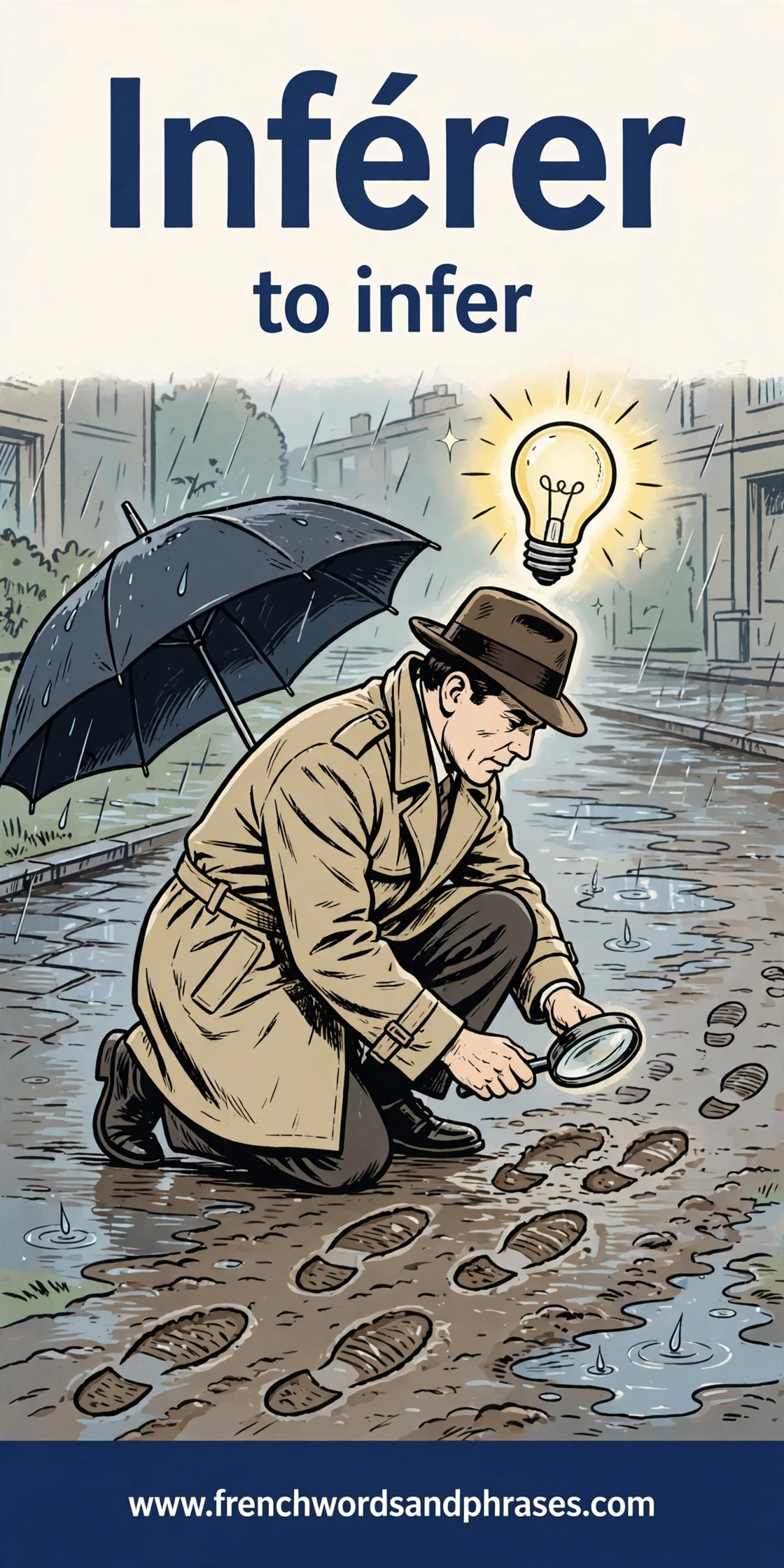
Inférer means to infer — to draw a conclusion from facts, signs or words, the way a detective reads a room.
A wet umbrella by the door, a chair still warm, a train ticket on the table — inférer is the verb of the conclusion drawn: from what is seen, the mind builds what is not.
In this guide, you’ll learn how to conjugate inférer in all the major French tenses and moods. Explore complete conjugation tables, French examples, English translations, and practice quizzes.
Understanding the French Verb Inférer
Inférer is a regular French verb belonging to the first group of verbs, those ending in-er.
It means to infer. It belongs to careful, written French — essays, reports, detective work and philosophy — where conclusions must show their working. The structure is almost always inférer quelque chose de quelque chose, or inférer que + a clause: from the evidence, the conclusion; from the silence, the answer.
Verb classification: First group (-er)
Auxiliary verb: Avoir
Past participle: inféré
Present participle: inférant
English equivalents: To infer, to deduce; inférer de — to infer from; que peut-on inférer de ces faits ? — what can be inferred from these facts?; on peut en inférer que… — it may be inferred that…; inférer une conclusion — to draw a conclusion.
One important detail: inférer is an espérer-type verb — the é of the stem opens to è in the present singular and third plural, in the subjunctive singular and third plural, and in the tu imperative: j’infère, tu infères, il infère, ils infèrent. But watch the future and conditional: there the é stays — j’inférerai, j’inférerais, never with è. Its faithful partner is the preposition de: one infère something de the facts — qu’infères-tu de ce silence ?
Experience the Word
Inférer is the verb of the detective’s pause — the moment scattered facts click into a single story.
Imagine a landlady entering a tenant’s silent flat. The coat is gone, the suitcase is gone, but the plants have been watered and the cat has fresh food. Elle en infère aussitôt la vérité: he has left for a week, not for ever — somebody is coming back for that cat.
Nobody told her anything. She has inferred it — lu dans les signes, as a detective reads a room.
How to Conjugate Inférer: Complete French Conjugation Guide
Let’s explore every major conjugation of inférer, beginning with the indicative mood.
How to Conjugate Inférer in the Indicative Mood
The indicative mood is used to express facts, observations, actions, and events.
How to Conjugate Inférer in the Present Tense (Présent)
Used for actions happening now, habitual actions, and general truths.
| Subject | Conjugation |
|---|---|
| je | infère |
| tu | infères |
| il / elle | infère |
| nous | inférons |
| vous | inférez |
| ils / elles | infèrent |
Example
De ce silence, j’infère qu’il est d’accord.
From this silence, I infer that he agrees.
Quick Quiz 1
Complete the sentence:
Nous ______ de son sourire qu’elle accepte.
Reveal the answer
inférons
Nous inférons de son sourire qu’elle accepte.
We infer from her smile that she accepts.
How to Conjugate Inférer in the Passé Composé
Used for completed actions in the past. Inférer takes the auxiliary verb avoir.
| Subject | Conjugation |
|---|---|
| j’ | ai inféré |
| tu | as inféré |
| il / elle | a inféré |
| nous | avons inféré |
| vous | avez inféré |
| ils / elles | ont inféré |
Example
Le détective a inféré la vérité de trois petits détails.
The detective inferred the truth from three small details.
How to Conjugate Inférer in the Imparfait (Imperfect Tense)
Used for habitual past actions, descriptions, and ongoing situations in the past.
| Subject | Conjugation |
|---|---|
| je | inférais |
| tu | inférais |
| il / elle | inférait |
| nous | inférions |
| vous | infériez |
| ils / elles | inféraient |
Example
Autrefois, on inférait le temps des nuages et du vent.
In the old days, people inferred the weather from the clouds and the wind.
Quick Quiz 2
Choose the correct form:
The detective inferred the truth.
Le détective ______ la vérité. (a inféré / est inféré)
Reveal the answer
a inféré
Le détective a inféré la vérité.
Inférer takes avoir.
How to Conjugate Inférer in the Plus-que-parfait
Used to describe an action that had already been completed before another past event.
| Subject | Conjugation |
|---|---|
| j’ | avais inféré |
| tu | avais inféré |
| il / elle | avait inféré |
| nous | avions inféré |
| vous | aviez inféré |
| ils / elles | avaient inféré |
Example
Elle avait inféré son départ de la valise disparue.
She had inferred his departure from the missing suitcase.
How to Conjugate Inférer in the Passé Simple
Primarily used in formal writing, literature, and historical narratives. It is rarely used in everyday conversation.
| Subject | Conjugation |
|---|---|
| je | inférai |
| tu | inféras |
| il / elle | inféra |
| nous | inférâmes |
| vous | inférâtes |
| ils / elles | inférèrent |
Example
Le juge inféra des témoignages une tout autre histoire.
The judge inferred a quite different story from the testimonies.
How to Conjugate Inférer in the Passé Antérieur
A literary tense used to express an action completed immediately before another past action, generally in the passé simple.
| Subject | Conjugation |
|---|---|
| j’ | eus inféré |
| tu | eus inféré |
| il / elle | eut inféré |
| nous | eûmes inféré |
| vous | eûtes inféré |
| ils / elles | eurent inféré |
Example
Quand il eut inféré la réponse de son sourire, il se détendit.
When he had inferred the answer from her smile, he relaxed.
How to Conjugate Inférer in the Future Tense (Futur Simple)
Used to describe actions that will take place in the future.
| Subject | Conjugation |
|---|---|
| je | inférerai |
| tu | inféreras |
| il / elle | inférera |
| nous | inférerons |
| vous | inférerez |
| ils / elles | inféreront |
Example
Le lecteur inférera la fin bien avant la dernière page.
The reader will infer the ending well before the last page.
How to Conjugate Inférer in the Futur Antérieur (Future Perfect)
Used for an action that will have been completed before a particular point in the future.
| Subject | Conjugation |
|---|---|
| j’ | aurai inféré |
| tu | auras inféré |
| il / elle | aura inféré |
| nous | aurons inféré |
| vous | aurez inféré |
| ils / elles | auront inféré |
Example
À la fin de l’enquête, ils auront inféré le mobile du crime.
By the end of the investigation, they will have inferred the motive for the crime.
How to Conjugate Inférer in the Near Future (Futur Proche)
Used to describe something that is going to happen soon. Formed with aller + infinitive.
| Subject | Conjugation |
|---|---|
| je | vais inférer |
| tu | vas inférer |
| il / elle | va inférer |
| nous | allons inférer |
| vous | allez inférer |
| ils / elles | vont inférer |
Example
De son retard, je vais inférer qu’il a manqué le train.
From his lateness, I am going to infer that he missed the train.
How to Conjugate Inférer in the Conditional Mood
The conditional mood expresses what would happen under certain circumstances. It is also frequently used to make polite requests or express wishes.
How to Conjugate Inférer in the Present Conditional
| Subject | Conjugation |
|---|---|
| je | inférerais |
| tu | inférerais |
| il / elle | inférerait |
| nous | inférerions |
| vous | inféreriez |
| ils / elles | inféreraient |
Example
Sans preuve, on n’inférerait rien de sérieux.
Without proof, one would infer nothing serious.
How to Conjugate Inférer in the Past Conditional
| Subject | Conjugation |
|---|---|
| j’ | aurais inféré |
| tu | aurais inféré |
| il / elle | aurait inféré |
| nous | aurions inféré |
| vous | auriez inféré |
| ils / elles | auraient inféré |
Example
Elle aurait inféré la vérité si elle avait vu la lettre.
She would have inferred the truth if she had seen the letter.
Inférer in the Literary Past Conditional Form
This less common literary form uses the imperfect subjunctive of avoir.
| Subject | Conjugation |
|---|---|
| j’ | eusse inféré |
| tu | eusses inféré |
| il / elle | eût inféré |
| nous | eussions inféré |
| vous | eussiez inféré |
| ils / elles | eussent inféré |
Example
Il eût inféré son départ de la porte entrouverte.
He would have inferred her departure from the half-open door.
How to Conjugate Inférer in the Subjunctive Mood
The subjunctive is used to express wishes, emotions, doubts, necessity, and uncertainty. It frequently follows expressions such as il faut que (it is necessary that) or bien que (although).
How to Conjugate Inférer in the Present Subjunctive
| Subject | Conjugation |
|---|---|
| que je | infère |
| que tu | infères |
| qu’il / qu’elle | infère |
| que nous | inférions |
| que vous | infériez |
| qu’ils / qu’elles | infèrent |
Example
Il est possible qu’on infère de ces chiffres une reprise.
It is possible that one may infer a recovery from these figures.
Quick Quiz 3
Complete the sentence using the subjunctive:
Il est possible que vous ______ la bonne conclusion.
Reveal the answer
infériez
Il est possible que vous infériez la bonne conclusion.
It is possible that you may infer the right conclusion.
How to Conjugate Inférer in the Imperfect Subjunctive
A literary tense, rarely encountered in modern spoken French.
| Subject | Conjugation |
|---|---|
| que je | inférasse |
| que tu | inférasses |
| qu’il / qu’elle | inférât |
| que nous | inférassions |
| que vous | inférassiez |
| qu’ils / qu’elles | inférassent |
Example
Je doutais qu’il inférât quoi que ce soit de ce seul indice.
I doubted he would infer anything at all from that single clue.
How to Conjugate Inférer in the Pluperfect Subjunctive
A literary construction used to express an action completed before another past action.
| Subject | Conjugation |
|---|---|
| que j’ | eusse inféré |
| que tu | eusses inféré |
| qu’il / qu’elle | eût inféré |
| que nous | eussions inféré |
| que vous | eussiez inféré |
| qu’ils / qu’elles | eussent inféré |
Example
On admirait qu’elle eût inféré tant de choses d’un simple regard.
People admired that she had inferred so much from a simple glance.
How to Conjugate Inférer in the Past Subjunctive
| Subject | Conjugation |
|---|---|
| que j’ | aie inféré |
| que tu | aies inféré |
| qu’il / qu’elle | ait inféré |
| que nous | ayons inféré |
| que vous | ayez inféré |
| qu’ils / qu’elles | aient inféré |
Example
Je suis surpris qu’ils aient inféré cela de mes paroles.
I am surprised they inferred that from my words.
How to Conjugate Inférer in the Imperative
The imperative is used to give commands, instructions, invitations, or suggestions. Subject pronouns are omitted.
How to Conjugate Inférer in the Present Imperative
| Person | Conjugation |
|---|---|
| (tu) | infère |
| (nous) | inférons |
| (vous) | inférez |
Example
Infère de ces faits ce que tu peux, mais ne devine pas !
Infer from these facts what you can, but do not guess!
Quick Quiz 4
How would you say Infer what you can from these facts (tu form)?
Reveal the answer
Infère de ces faits ce que tu peux !
French Participles of Inférer
Participles are verb forms that can be used in compound tenses and other grammatical constructions.
Present Participle of Inférer
inférant
En inférant trop vite, on risque de se tromper lourdement.
By inferring too quickly, one risks being badly mistaken.
Past Participle of Inférer
inféré
Inféré de trois indices, le mobile du crime restait fragile.
Inferred from three clues, the motive for the crime remained shaky.
Inférer in Everyday French: Real-Life Examples
Now that you know the conjugations, let’s see how inférer appears in everyday French.
Example 1 — Present
De ce silence, j’infère qu’il est d’accord.
From this silence, I infer that he agrees.
Example 2 — Passé composé
Le détective a inféré la vérité de trois détails.
The detective inferred the truth from three details.
Example 3 — Imparfait
On inférait le temps des nuages.
People inferred the weather from the clouds.
Example 4 — Future
Le lecteur inférera la fin avant la dernière page.
The reader will infer the ending before the last page.
Example 5 — Conditional
Sans preuve, on n’inférerait rien.
Without proof, one would infer nothing.
Example 6 — Imperative
Infère de ces faits ce que tu peux !
Infer from these facts what you can!
Beyond Translation: The Meaning of Inférer
English infer is the same Latin traveller — inferre, to bring in: the conclusion is carried into the mind from outside evidence.
Inférer shows its working.
Where deviner guesses and conclure simply concludes, inférer insists on the path: the facts first, the conclusion after, joined by the little word de — inférer la vérité de trois détails.
How to Remember the French Verb Inférer
Remember it this way: Inférer is about the detective’s pause — facts clicking into a story.
- Espérer-type spelling: j’infère with è in the present, but j’inférerai with é in the future.
- Its partner is de: inférer quelque chose de quelque chose — to infer something from something.
- Past participle inféré: une conclusion inférée des faits.
The key idea is the detective’s pause — facts clicking into a story.
Test Your Knowledge of Inférer
Let’s see how much you’ve learned. Try answering these questions before revealing the answers.
Question 1
Why does je infère have a grave accent but je inférerai an acute one?
Reveal the answer
The espérer-type rule — é becomes è in the present and subjunctive stems, but the future and conditional keep é: je inférerai.
Question 2
How do you say From this silence, I infer that he agrees in French?
Reveal the answer
De ce silence, j’infère qu’il est d’accord.
Question 3
Translate: The detective inferred the truth from three small details.
Reveal the answer
Le détective a inféré la vérité de trois petits détails.
Question 4
What is the past participle of inférer?
Reveal the answer
Inféré.
Question 5
Complete the sentence:
Il est possible qu’on ______ de ces chiffres une reprise.
Reveal the answer
infère
Il est possible qu’on infère de ces chiffres une reprise.
It is possible that one may infer a recovery from these figures.
Your Final Challenge
Can You Use It?
How would you say this in French?
From the missing suitcase and the fed cat, she inferred the truth: he will be back in a week.
Reveal the answer
De la valise disparue et du chat nourri, elle a inféré la vérité : il reviendra dans une semaine.
From the missing suitcase and the fed cat, she inferred the truth: he will be back in a week.
A little French. A little curiosity. A richer everyday life.
LEARN FRENCH ONE WORD AT A TIME




