
A French Word to Live By
How to Conjugate Infecter in French
/ɛ̃.fɛk.te/
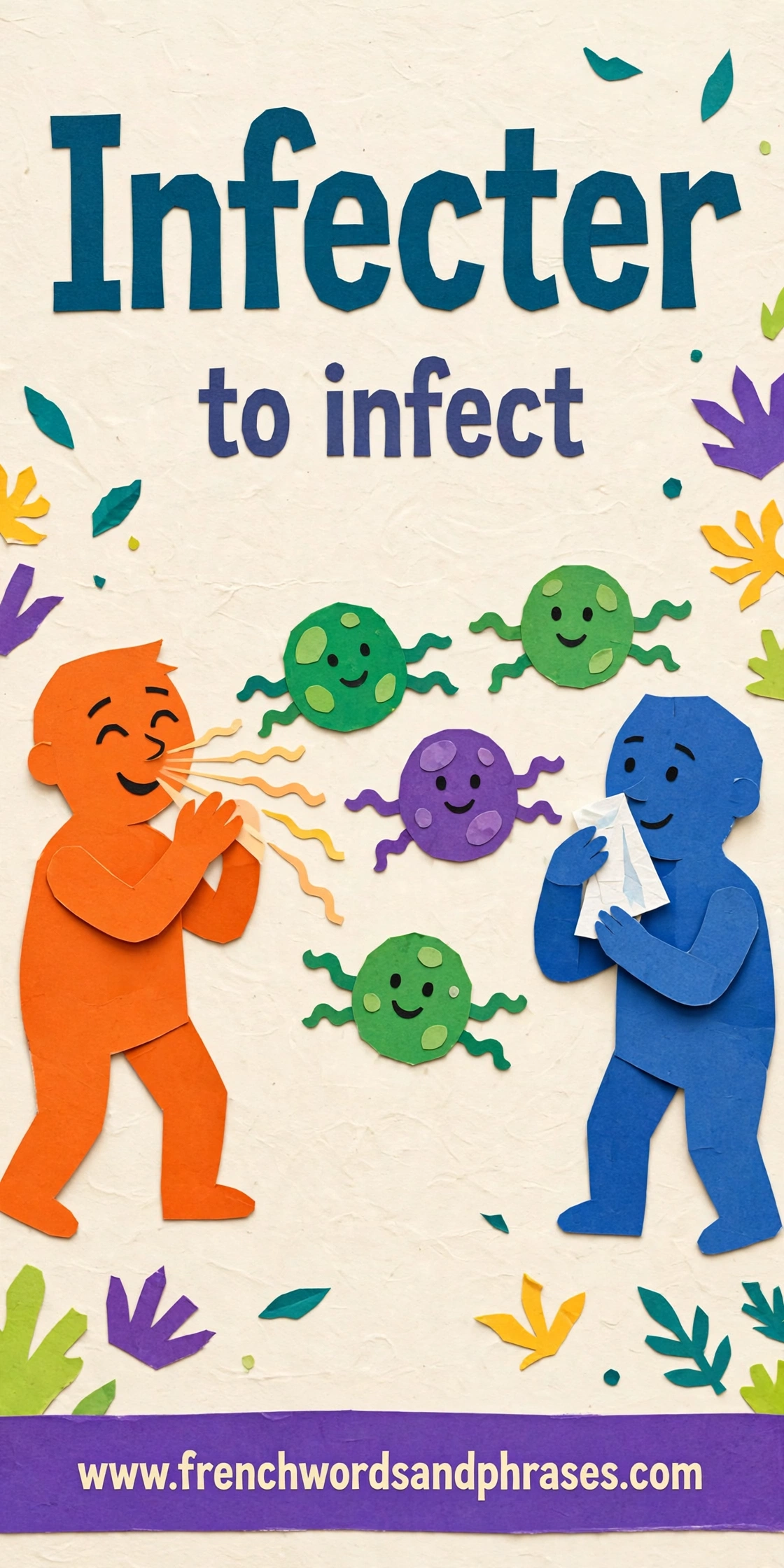
Infecter means to infect, to contaminate — to pass germs into a body, a wound, a water supply, and nowadays a computer.
A cut finger left unwashed, a village well too close to the stable, a file that poisons a whole network — infecter is the verb of contamination spreading from one host to the next, in flesh and in machines alike.
In this guide, you’ll learn how to conjugate infecter in all the major French tenses and moods. Explore complete conjugation tables, French examples, English translations, and practice quizzes.
Understanding the French Verb Infecter
Infecter is a regular French verb belonging to the first group of verbs, those ending in-er.
It means to infect, to contaminate. It covers the whole chain of contamination: microbes infect wounds and bodies, polluted water and food are infectés, and in computing un virus infecte un ordinateur, leaving fichiers infectés behind it. The adjective infecté is the everyday form — une plaie infectée needs a doctor, un lien infecté needs deleting.
Verb classification: First group (-er)
Auxiliary verb: Avoir
Past participle: infecté
Present participle: infectant
English equivalents: To infect, to contaminate; infecter une plaie — to infect a wound; infecter l’eau — to contaminate the water; s’infecter — to become infected (of a wound); un fichier infecté — an infected file; une plaie infectée — an infected wound.
One important detail: infecter has a reflexive twin for the patient’s side of the story — a wound s’infecte, becomes infected: la plaie s’est infectée. The plain verb names the aggressor (le virus infecte, l’eau infecte), the reflexive names the victim. Do not confuse infecter with its smelly cousin infect, foul — an adjective that shares the Latin root but not the meaning. The conjugation is regular: j’infecte, nous infectons, ils infectent.
Experience the Word
Infecter is the verb of the unwelcome traveller — the germ that crosses from the world into the body.
Imagine a gardener who pricks her thumb on a rusty nail and thinks nothing of it. Two days later the thumb is red, hot and swollen: la saleté a infecté la plaie. A tiny door, left open for a second, and the whole household of the body is on alert.
The wound was almost nothing. It has been infected — and now it commands the whole hand.
How to Conjugate Infecter: Complete French Conjugation Guide
Let’s explore every major conjugation of infecter, beginning with the indicative mood.
How to Conjugate Infecter in the Indicative Mood
The indicative mood is used to express facts, observations, actions, and events.
How to Conjugate Infecter in the Present Tense (Présent)
Used for actions happening now, habitual actions, and general truths.
| Subject | Conjugation |
|---|---|
| je | infecte |
| tu | infectes |
| il / elle | infecte |
| nous | infectons |
| vous | infectez |
| ils / elles | infectent |
Example
Ce virus infecte les ordinateurs par les pièces jointes.
This virus infects computers through attachments.
Quick Quiz 1
Complete the sentence:
Nous savons que ce virus ______ les fichiers en quelques minutes.
Reveal the answer
infecte
Nous savons que ce virus infecte les fichiers en quelques minutes.
We know this virus infects files within minutes.
How to Conjugate Infecter in the Passé Composé
Used for completed actions in the past. Infecter takes the auxiliary verb avoir.
| Subject | Conjugation |
|---|---|
| j’ | ai infecté |
| tu | as infecté |
| il / elle | a infecté |
| nous | avons infecté |
| vous | avez infecté |
| ils / elles | ont infecté |
Example
La saleté a infecté la plaie du jardinier.
The dirt infected the gardener’s wound.
How to Conjugate Infecter in the Imparfait (Imperfect Tense)
Used for habitual past actions, descriptions, and ongoing situations in the past.
| Subject | Conjugation |
|---|---|
| je | infectais |
| tu | infectais |
| il / elle | infectait |
| nous | infections |
| vous | infectiez |
| ils / elles | infectaient |
Example
Autrefois, l’eau des puits infectait des villages entiers.
In the old days, well water used to infect whole villages.
Quick Quiz 2
Choose the correct form:
The dirt infected the wound.
La saleté ______ la plaie. (a infecté / est infecté)
Reveal the answer
a infecté
La saleté a infecté la plaie.
Infecter takes avoir.
How to Conjugate Infecter in the Plus-que-parfait
Used to describe an action that had already been completed before another past event.
| Subject | Conjugation |
|---|---|
| j’ | avais infecté |
| tu | avais infecté |
| il / elle | avait infecté |
| nous | avions infecté |
| vous | aviez infecté |
| ils / elles | avaient infecté |
Example
Le virus avait infecté tout le réseau avant l’alerte.
The virus had infected the whole network before the alert.
How to Conjugate Infecter in the Passé Simple
Primarily used in formal writing, literature, and historical narratives. It is rarely used in everyday conversation.
| Subject | Conjugation |
|---|---|
| je | infectai |
| tu | infectas |
| il / elle | infecta |
| nous | infectâmes |
| vous | infectâtes |
| ils / elles | infectèrent |
Example
La peste infecta le port en quelques semaines.
The plague infected the port within a few weeks.
How to Conjugate Infecter in the Passé Antérieur
A literary tense used to express an action completed immediately before another past action, generally in the passé simple.
| Subject | Conjugation |
|---|---|
| j’ | eus infecté |
| tu | eus infecté |
| il / elle | eut infecté |
| nous | eûmes infecté |
| vous | eûtes infecté |
| ils / elles | eurent infecté |
Example
Quand le microbe eut infecté la plaie, la fièvre monta.
When the germ had infected the wound, the fever rose.
How to Conjugate Infecter in the Future Tense (Futur Simple)
Used to describe actions that will take place in the future.
| Subject | Conjugation |
|---|---|
| je | infecterai |
| tu | infecteras |
| il / elle | infectera |
| nous | infecterons |
| vous | infecterez |
| ils / elles | infecteront |
Example
Sans désinfection, les bactéries infecteront la coupure.
Without disinfection, the bacteria will infect the cut.
How to Conjugate Infecter in the Futur Antérieur (Future Perfect)
Used for an action that will have been completed before a particular point in the future.
| Subject | Conjugation |
|---|---|
| j’ | aurai infecté |
| tu | auras infecté |
| il / elle | aura infecté |
| nous | aurons infecté |
| vous | aurez infecté |
| ils / elles | auront infecté |
Example
À ce rythme, le virus aura infecté tous les fichiers demain.
At this rate, the virus will have infected all the files by tomorrow.
How to Conjugate Infecter in the Near Future (Futur Proche)
Used to describe something that is going to happen soon. Formed with aller + infinitive.
| Subject | Conjugation |
|---|---|
| je | vais infecter |
| tu | vas infecter |
| il / elle | va infecter |
| nous | allons infecter |
| vous | allez infecter |
| ils / elles | vont infecter |
Example
Dépêche-toi, cette écharde va infecter ton doigt.
Hurry, that splinter is going to infect your finger.
How to Conjugate Infecter in the Conditional Mood
The conditional mood expresses what would happen under certain circumstances. It is also frequently used to make polite requests or express wishes.
How to Conjugate Infecter in the Present Conditional
| Subject | Conjugation |
|---|---|
| je | infecterais |
| tu | infecterais |
| il / elle | infecterait |
| nous | infecterions |
| vous | infecteriez |
| ils / elles | infecteraient |
Example
Une eau sale infecterait tout le quartier.
Dirty water would infect the whole neighbourhood.
How to Conjugate Infecter in the Past Conditional
| Subject | Conjugation |
|---|---|
| j’ | aurais infecté |
| tu | aurais infecté |
| il / elle | aurait infecté |
| nous | aurions infecté |
| vous | auriez infecté |
| ils / elles | auraient infecté |
Example
Le virus aurait infecté le réseau sans le pare-feu.
The virus would have infected the network without the firewall.
Infecter in the Literary Past Conditional Form
This less common literary form uses the imperfect subjunctive of avoir.
| Subject | Conjugation |
|---|---|
| j’ | eusse infecté |
| tu | eusses infecté |
| il / elle | eût infecté |
| nous | eussions infecté |
| vous | eussiez infecté |
| ils / elles | eussent infecté |
Example
La peste eût infecté la ville entière sans la quarantaine.
The plague would have infected the whole town without quarantine.
How to Conjugate Infecter in the Subjunctive Mood
The subjunctive is used to express wishes, emotions, doubts, necessity, and uncertainty. It frequently follows expressions such as il faut que (it is necessary that) or bien que (although).
How to Conjugate Infecter in the Present Subjunctive
| Subject | Conjugation |
|---|---|
| que je | infecte |
| que tu | infectes |
| qu’il / qu’elle | infecte |
| que nous | infections |
| que vous | infectiez |
| qu’ils / qu’elles | infectent |
Example
Le médecin craint que la plaie n’infecte le sang.
The doctor fears the wound may infect the blood.
Quick Quiz 3
Complete the sentence using the subjunctive:
Je crains que cette eau n’______ les enfants.
Reveal the answer
infecte
Je crains que cette eau n’infecte les enfants.
I fear this water may infect the children.
How to Conjugate Infecter in the Imperfect Subjunctive
A literary tense, rarely encountered in modern spoken French.
| Subject | Conjugation |
|---|---|
| que je | infectasse |
| que tu | infectasses |
| qu’il / qu’elle | infectât |
| que nous | infectassions |
| que vous | infectassiez |
| qu’ils / qu’elles | infectassent |
Example
On craignait que l’eau infectât les enfants du village.
People feared the water might infect the village children.
How to Conjugate Infecter in the Pluperfect Subjunctive
A literary construction used to express an action completed before another past action.
| Subject | Conjugation |
|---|---|
| que j’ | eusse infecté |
| que tu | eusses infecté |
| qu’il / qu’elle | eût infecté |
| que nous | eussions infecté |
| que vous | eussiez infecté |
| qu’ils / qu’elles | eussent infecté |
Example
On racontait que le virus eût infecté tous les ordinateurs de la banque.
People said the virus had infected all the bank’s computers.
How to Conjugate Infecter in the Past Subjunctive
| Subject | Conjugation |
|---|---|
| que j’ | aie infecté |
| que tu | aies infecté |
| qu’il / qu’elle | ait infecté |
| que nous | ayons infecté |
| que vous | ayez infecté |
| qu’ils / qu’elles | aient infecté |
Example
Je suis inquiet que cette coupure ait infecté ton doigt.
I am worried that this cut has infected your finger.
How to Conjugate Infecter in the Imperative
The imperative is used to give commands, instructions, invitations, or suggestions. Subject pronouns are omitted.
How to Conjugate Infecter in the Present Imperative
| Person | Conjugation |
|---|---|
| (tu) | infecte |
| (nous) | infectons |
| (vous) | infectez |
Example
N’infecte pas la plaie, mets des gants propres !
Do not infect the wound, put on clean gloves!
Quick Quiz 4
How would you say Do not infect the wound (tu form)?
Reveal the answer
N’infecte pas la plaie !
French Participles of Infecter
Participles are verb forms that can be used in compound tenses and other grammatical constructions.
Present Participle of Infecter
infectant
En infectant l’eau, la fuite a rendu tout le village malade.
By contaminating the water, the leak made the whole village ill.
Past Participle of Infecter
infecté
Infectée par une écharde, la plaie a dû être soignée.
Infected by a splinter, the wound had to be treated.
Infecter in Everyday French: Real-Life Examples
Now that you know the conjugations, let’s see how infecter appears in everyday French.
Example 1 — Present
Ce virus infecte les ordinateurs.
This virus infects computers.
Example 2 — Passé composé
La saleté a infecté la plaie.
The dirt infected the wound.
Example 3 — Imparfait
L’eau des puits infectait des villages entiers.
Well water used to infect whole villages.
Example 4 — Future
Les bactéries infecteront la coupure.
The bacteria will infect the cut.
Example 5 — Conditional
Une eau sale infecterait tout le quartier.
Dirty water would infect the whole neighbourhood.
Example 6 — Imperative
N’infecte pas la plaie !
Do not infect the wound!
Beyond Translation: The Meaning of Infecter
English infect is the same word, but French infecter happily crosses into computing without changing its coat.
Germs and viruses obey one grammar.
Whether the host is a thumb or a server, the story is identical: something small gets in, spreads quietly, and is discovered late — which is why infecté is the adjective of both the wound and the file.
How to Remember the French Verb Infecter
Remember it this way: Infecter is about the gardener’s thumb — a tiny door left open to germs.
- The aggressor infecte (le virus infecte la plaie); the victim s’infecte (la plaie s’est infectée).
- Two worlds, one verb: bodies and wounds, but also un ordinateur infecté, un fichier infecté.
- Regular -er: j’infecte, nous infectons, past participle infecté.
The key idea is the gardener’s thumb — a tiny door left open to germs.
Test Your Knowledge of Infecter
Let’s see how much you’ve learned. Try answering these questions before revealing the answers.
Question 1
How do you say The wound has become infected in French?
Reveal the answer
La plaie s’est infectée.
— the reflexive s’infecter names the victim’s side.
Question 2
How do you say This virus infects computers in French?
Reveal the answer
Ce virus infecte les ordinateurs.
Question 3
Translate: The dirt infected the gardener’s wound.
Reveal the answer
La saleté a infecté la plaie du jardinier.
Question 4
What is the past participle of infecter?
Reveal the answer
Infecté — une plaie infectée, un fichier infecté.
Question 5
Complete the sentence:
Le médecin craint que la plaie n’______ le sang.
Reveal the answer
infecte
Le médecin craint que la plaie n’infecte le sang.
The doctor fears the wound may infect the blood.
Your Final Challenge
Can You Use It?
How would you say this in French?
A simple splinter infected his finger, and the gardener understood that even the smallest wounds must be disinfected.
Reveal the answer
Une simple écharde a infecté son doigt, et le jardinier a compris qu’il fallait désinfecter même les plus petites plaies.
A simple splinter infected his finger, and the gardener understood that even the smallest wounds must be disinfected.
A little French. A little curiosity. A richer everyday life.
LEARN FRENCH ONE WORD AT A TIME




