
A French Word to Live By
How to Conjugate Individualiser in French
/ɛ̃.di.vi.dɥa.li.ze/
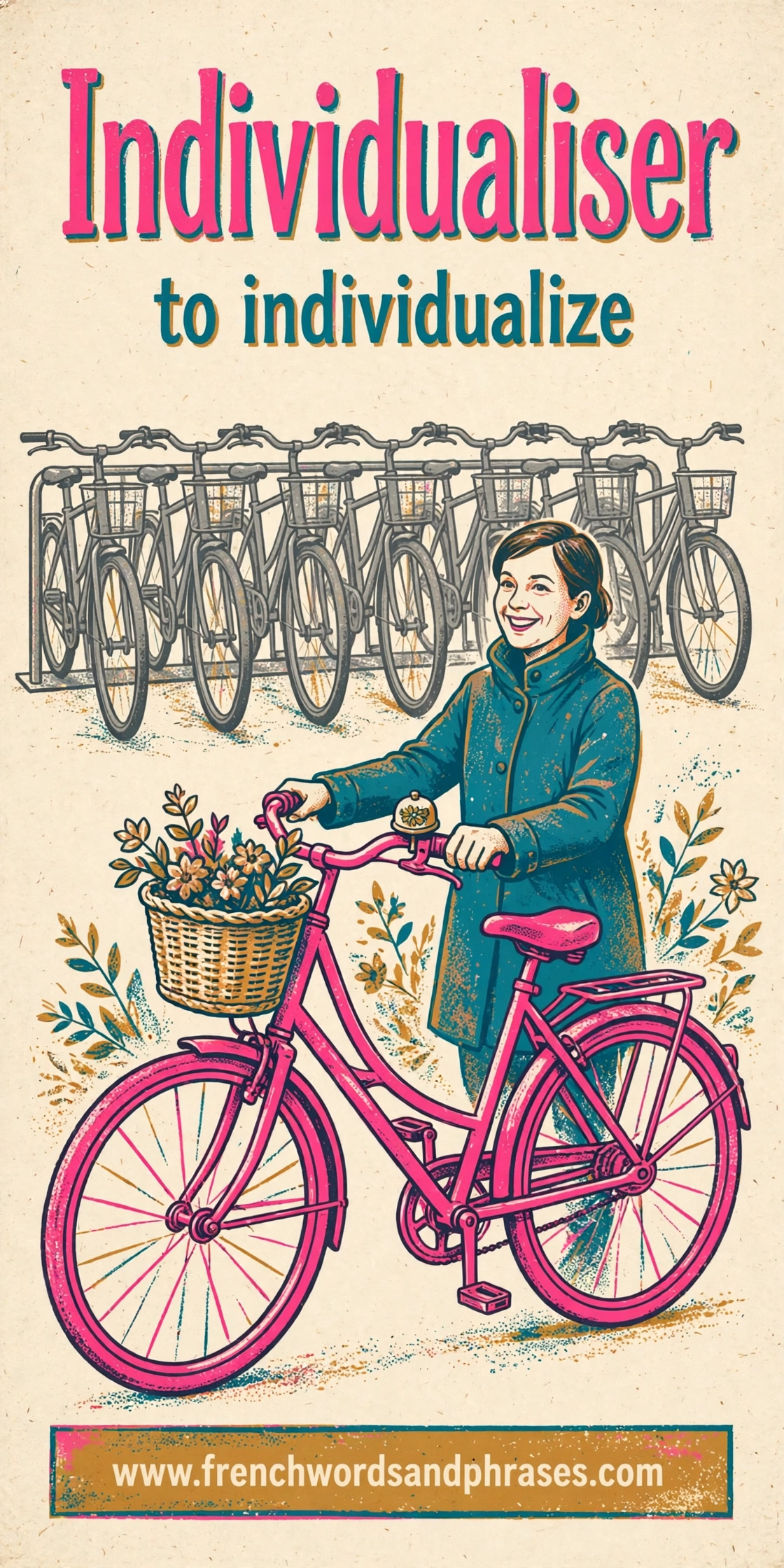
Individualiser means to individualize — to give something a character of its own, made for one person and no other.
A standard programme bent to fit one pupil, a standard room made unmistakably yours — individualiser is the verb of the personal touch: it takes the general and signs it with a single name.
In this guide, you’ll learn how to conjugate individualiser in all the major French tenses and moods. Explore complete conjugation tables, French examples, English translations, and practice quizzes.
Understanding the French Verb Individualiser
Individualiser is a regular French verb belonging to the first group of verbs, those ending in-er.
It means to individualize. It belongs to the language of education, medicine and design — anywhere a standard offer is adapted to a single person: individualiser les apprentissages, un suivi individualisé. The reflexive use is more philosophical: a person, a style or a generation s’individualise when it becomes recognisably itself.
Verb classification: First group (-er)
Auxiliary verb: Avoir
Past participle: individualisé
Present participle: individualisant
English equivalents: To individualize, to personalize; individualiser un enseignement — to individualize teaching; individualiser une chambre — to give a room its own character; s’individualiser — to acquire an identity of one’s own, to stand out; un traitement individualisé — a personalized treatment.
One important detail: individualiser has a reflexive twin with a life of its own — s’individualiser means to acquire an identity of one’s own, to stand out from the group: à l’adolescence, chacun s’individualise. The plain verb stays transitive: you individualize a programme, a treatment, a room. The spelling is regular throughout: j’individualise, nous individualisons, ils individualisent.
Experience the Word
Individualiser is the verb of the signature — the moment the standard model becomes someone’s own.
Imagine two identical flats in the same building. In one, everything is still catalogue-white. In the other, there are plants, a red wall, books in piles, a grandfather’s clock — la locataire a individualisé son appartement, and you could name its owner from the doorway.
Same walls, same floor. One has been individualized — signed, quietly, by a single life.
How to Conjugate Individualiser: Complete French Conjugation Guide
Let’s explore every major conjugation of individualiser, beginning with the indicative mood.
How to Conjugate Individualiser in the Indicative Mood
The indicative mood is used to express facts, observations, actions, and events.
How to Conjugate Individualiser in the Present Tense (Présent)
Used for actions happening now, habitual actions, and general truths.
| Subject | Conjugation |
|---|---|
| je | individualise |
| tu | individualises |
| il / elle | individualise |
| nous | individualisons |
| vous | individualisez |
| ils / elles | individualisent |
Example
Ce professeur individualise son enseignement pour chaque élève.
This teacher individualizes his teaching for each pupil.
Quick Quiz 1
Complete the sentence:
Nous ______ les programmes pour les débutants.
Reveal the answer
individualisons
Nous individualisons les programmes pour les débutants.
We individualize the programmes for the beginners.
How to Conjugate Individualiser in the Passé Composé
Used for completed actions in the past. Individualiser takes the auxiliary verb avoir.
| Subject | Conjugation |
|---|---|
| j’ | ai individualisé |
| tu | as individualisé |
| il / elle | a individualisé |
| nous | avons individualisé |
| vous | avez individualisé |
| ils / elles | ont individualisé |
Example
Elle a individualisé sa chambre avec des photos et des plantes.
She gave her room its own character with photos and plants.
How to Conjugate Individualiser in the Imparfait (Imperfect Tense)
Used for habitual past actions, descriptions, and ongoing situations in the past.
| Subject | Conjugation |
|---|---|
| je | individualisais |
| tu | individualisais |
| il / elle | individualisait |
| nous | individualisions |
| vous | individualisiez |
| ils / elles | individualisaient |
Example
Autrefois, l’école individualisait rarement les programmes.
In the old days, schools rarely individualized their programmes.
Quick Quiz 2
Choose the correct form:
She gave her room its own character.
Elle ______ sa chambre. (a individualisé / est individualisé)
Reveal the answer
a individualisé
Elle a individualisé sa chambre.
Individualiser takes avoir.
How to Conjugate Individualiser in the Plus-que-parfait
Used to describe an action that had already been completed before another past event.
| Subject | Conjugation |
|---|---|
| j’ | avais individualisé |
| tu | avais individualisé |
| il / elle | avait individualisé |
| nous | avions individualisé |
| vous | aviez individualisé |
| ils / elles | avaient individualisé |
Example
Le médecin avait individualisé le traitement avant l’opération.
The doctor had personalized the treatment before the operation.
How to Conjugate Individualiser in the Passé Simple
Primarily used in formal writing, literature, and historical narratives. It is rarely used in everyday conversation.
| Subject | Conjugation |
|---|---|
| je | individualisai |
| tu | individualisas |
| il / elle | individualisa |
| nous | individualisâmes |
| vous | individualisâtes |
| ils / elles | individualisèrent |
Example
L’architecte individualisa chaque maison du lotissement.
The architect gave each house in the development its own character.
How to Conjugate Individualiser in the Passé Antérieur
A literary tense used to express an action completed immediately before another past action, generally in the passé simple.
| Subject | Conjugation |
|---|---|
| j’ | eus individualisé |
| tu | eus individualisé |
| il / elle | eut individualisé |
| nous | eûmes individualisé |
| vous | eûtes individualisé |
| ils / elles | eurent individualisé |
Example
Quand elle eut individualisé son bureau, elle s’y sentit chez elle.
When she had made her office her own, she felt at home in it.
How to Conjugate Individualiser in the Future Tense (Futur Simple)
Used to describe actions that will take place in the future.
| Subject | Conjugation |
|---|---|
| je | individualiserai |
| tu | individualiseras |
| il / elle | individualisera |
| nous | individualiserons |
| vous | individualiserez |
| ils / elles | individualiseront |
Example
La nouvelle méthode individualisera le suivi des élèves.
The new method will individualize the monitoring of pupils.
How to Conjugate Individualiser in the Futur Antérieur (Future Perfect)
Used for an action that will have been completed before a particular point in the future.
| Subject | Conjugation |
|---|---|
| j’ | aurai individualisé |
| tu | auras individualisé |
| il / elle | aura individualisé |
| nous | aurons individualisé |
| vous | aurez individualisé |
| ils / elles | auront individualisé |
Example
À la rentrée, nous aurons individualisé tous les parcours.
By the start of term, we will have individualized all the pathways.
How to Conjugate Individualiser in the Near Future (Futur Proche)
Used to describe something that is going to happen soon. Formed with aller + infinitive.
| Subject | Conjugation |
|---|---|
| je | vais individualiser |
| tu | vas individualiser |
| il / elle | va individualiser |
| nous | allons individualiser |
| vous | allez individualiser |
| ils / elles | vont individualiser |
Example
Je vais individualiser ce programme pour les débutants.
I am going to individualize this programme for the beginners.
How to Conjugate Individualiser in the Conditional Mood
The conditional mood expresses what would happen under certain circumstances. It is also frequently used to make polite requests or express wishes.
How to Conjugate Individualiser in the Present Conditional
| Subject | Conjugation |
|---|---|
| je | individualiserais |
| tu | individualiserais |
| il / elle | individualiserait |
| nous | individualiserions |
| vous | individualiseriez |
| ils / elles | individualiseraient |
Example
Un bon formateur individualiserait les exercices.
A good trainer would individualize the exercises.
How to Conjugate Individualiser in the Past Conditional
| Subject | Conjugation |
|---|---|
| j’ | aurais individualisé |
| tu | aurais individualisé |
| il / elle | aurait individualisé |
| nous | aurions individualisé |
| vous | auriez individualisé |
| ils / elles | auraient individualisé |
Example
Elle aurait individualisé sa tenue avec un foulard rouge.
She would have given her outfit its own touch with a red scarf.
Individualiser in the Literary Past Conditional Form
This less common literary form uses the imperfect subjunctive of avoir.
| Subject | Conjugation |
|---|---|
| j’ | eusse individualisé |
| tu | eusses individualisé |
| il / elle | eût individualisé |
| nous | eussions individualisé |
| vous | eussiez individualisé |
| ils / elles | eussent individualisé |
Example
Il eût individualisé chaque chambre de l’hôtel.
He would have given each room of the hotel its own character.
How to Conjugate Individualiser in the Subjunctive Mood
The subjunctive is used to express wishes, emotions, doubts, necessity, and uncertainty. It frequently follows expressions such as il faut que (it is necessary that) or bien que (although).
How to Conjugate Individualiser in the Present Subjunctive
| Subject | Conjugation |
|---|---|
| que je | individualise |
| que tu | individualises |
| qu’il / qu’elle | individualise |
| que nous | individualisions |
| que vous | individualisiez |
| qu’ils / qu’elles | individualisent |
Example
Il faut que le médecin individualise le traitement.
The doctor must personalize the treatment.
Quick Quiz 3
Complete the sentence using the subjunctive:
Il faut que vous ______ le suivi de chaque élève.
Reveal the answer
individualisiez
Il faut que vous individualisiez le suivi de chaque élève.
You must individualize the monitoring of each pupil.
How to Conjugate Individualiser in the Imperfect Subjunctive
A literary tense, rarely encountered in modern spoken French.
| Subject | Conjugation |
|---|---|
| que je | individualisasse |
| que tu | individualisasses |
| qu’il / qu’elle | individualisât |
| que nous | individualisassions |
| que vous | individualisassiez |
| qu’ils / qu’elles | individualisassent |
Example
On souhaitait que l’école individualisât davantage les parcours.
People wanted the school to individualize pathways more.
How to Conjugate Individualiser in the Pluperfect Subjunctive
A literary construction used to express an action completed before another past action.
| Subject | Conjugation |
|---|---|
| que j’ | eusse individualisé |
| que tu | eusses individualisé |
| qu’il / qu’elle | eût individualisé |
| que nous | eussions individualisé |
| que vous | eussiez individualisé |
| qu’ils / qu’elles | eussent individualisé |
Example
On admirait qu’elle eût individualisé son style si jeune.
People admired that she had made her style her own so young.
How to Conjugate Individualiser in the Past Subjunctive
| Subject | Conjugation |
|---|---|
| que j’ | aie individualisé |
| que tu | aies individualisé |
| qu’il / qu’elle | ait individualisé |
| que nous | ayons individualisé |
| que vous | ayez individualisé |
| qu’ils / qu’elles | aient individualisé |
Example
Je suis content que tu aies individualisé ton bureau.
I am glad you have made your office your own.
How to Conjugate Individualiser in the Imperative
The imperative is used to give commands, instructions, invitations, or suggestions. Subject pronouns are omitted.
How to Conjugate Individualiser in the Present Imperative
| Person | Conjugation |
|---|---|
| (tu) | individualise |
| (nous) | individualisons |
| (vous) | individualisez |
Example
Individualise ton travail, ne copie pas les autres !
Make your work your own, do not copy the others!
Quick Quiz 4
How would you say Make your work your own (tu form)?
Reveal the answer
Individualise ton travail !
French Participles of Individualiser
Participles are verb forms that can be used in compound tenses and other grammatical constructions.
Present Participle of Individualiser
individualisant
En individualisant les exercices, le professeur aide chacun.
By individualizing the exercises, the teacher helps everyone.
Past Participle of Individualiser
individualisé
Individualisé avec soin, ce programme convient à chaque élève.
Carefully individualized, this programme suits every pupil.
Individualiser in Everyday French: Real-Life Examples
Now that you know the conjugations, let’s see how individualiser appears in everyday French.
Example 1 — Present
Ce professeur individualise son enseignement.
This teacher individualizes his teaching.
Example 2 — Passé composé
Elle a individualisé sa chambre.
She gave her room its own character.
Example 3 — Imparfait
L’école individualisait rarement les programmes.
Schools rarely individualized their programmes.
Example 4 — Future
La méthode individualisera le suivi des élèves.
The method will individualize pupil monitoring.
Example 5 — Conditional
Un bon formateur individualiserait les exercices.
A good trainer would individualize the exercises.
Example 6 — Imperative
Individualise ton travail !
Make your work your own!
Beyond Translation: The Meaning of Individualiser
English individualize is the exact twin, but French individualiser keeps a philosophical echo — l’individu is the individual as a thinker would discuss him.
To individualize is to refuse the average.
That is why its reflexive, s’individualiser, describes the great work of adolescence and of artists alike: becoming someone in particular, rather than anyone at all.
How to Remember the French Verb Individualiser
Remember it this way: Individualiser is about the catalogue-white flat, signed by a single life.
- Transitive: individualiser un programme, un traitement, une chambre — to make it fit one person.
- Reflexive twin: s’individualiser — to acquire an identity of one’s own, to stand out.
- Regular -er: j’individualise, nous individualisons, past participle individualisé.
The key idea is the catalogue-white flat, signed by a single life.
Test Your Knowledge of Individualiser
Let’s see how much you’ve learned. Try answering these questions before revealing the answers.
Question 1
What does s’individualiser mean?
Reveal the answer
To acquire an identity of one’s own — to stand out and become recognisably oneself.
Question 2
How do you say This teacher individualizes his teaching in French?
Reveal the answer
Ce professeur individualise son enseignement.
Question 3
Translate: She gave her room its own character with photos.
Reveal the answer
Elle a individualisé sa chambre avec des photos.
Question 4
What is the past participle of individualiser?
Reveal the answer
Individualisé.
Question 5
Complete the sentence:
Il faut que le médecin ______ le traitement.
Reveal the answer
individualise
Il faut que le médecin individualise le traitement.
The doctor must personalize the treatment.
Your Final Challenge
Can You Use It?
How would you say this in French?
Every pupil now progresses at their own pace since the teacher individualizes the class exercises.
Reveal the answer
Chaque élève avance à son rythme depuis que le professeur individualise les exercices de la classe.
Every pupil now progresses at their own pace since the teacher individualizes the class exercises.
A little French. A little curiosity. A richer everyday life.
LEARN FRENCH ONE WORD AT A TIME




