
A French Word to Live By
How to Conjugate Indisposer in French
/ɛ̃.dis.po.ze/
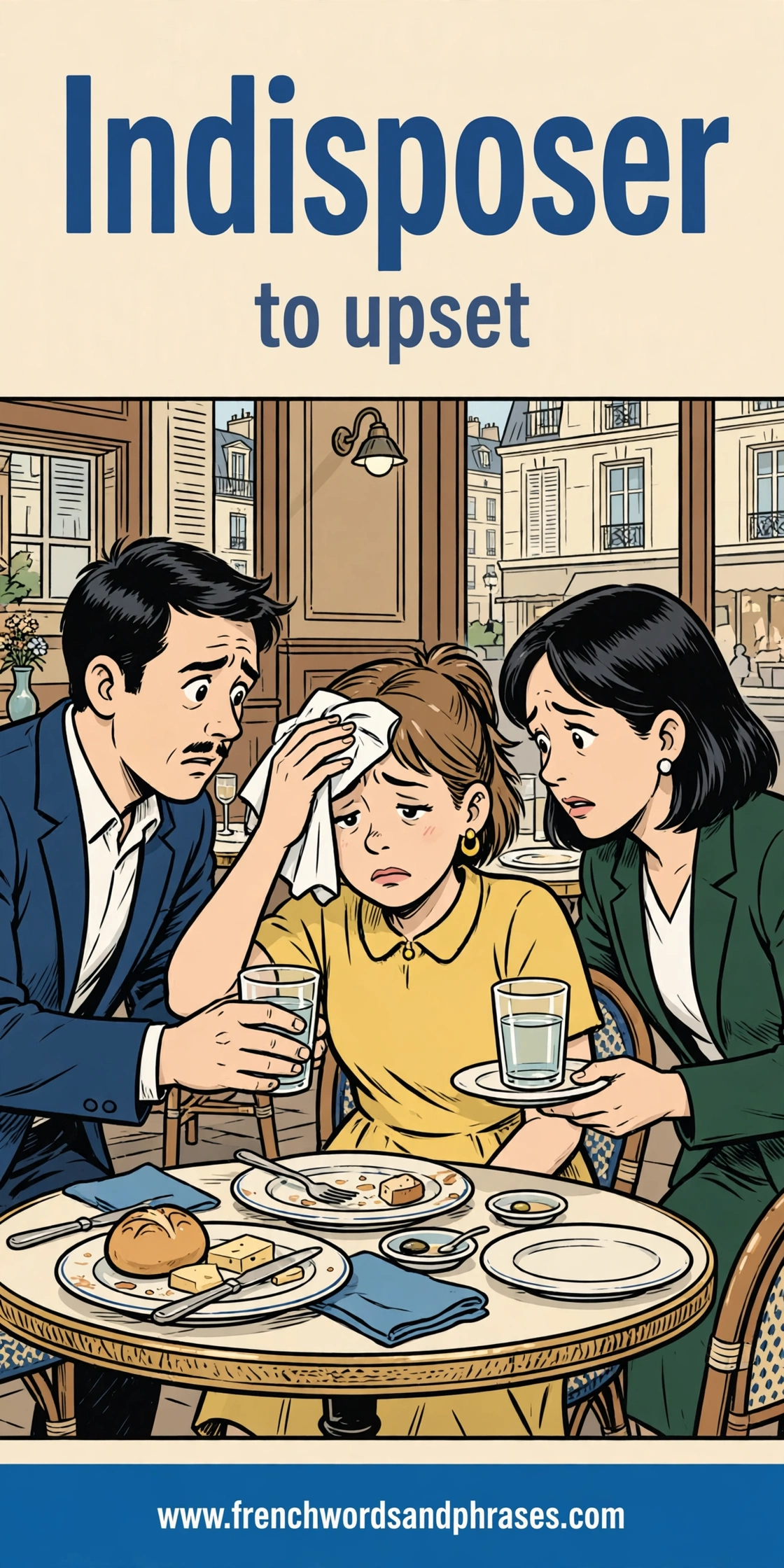
Indisposer means to upset — to disturb someone’s comfort, temper or digestion just enough to put them out of sorts.
A draught that gives you a headache, a smell that turns your stomach, a remark that ruins your evening — indisposer is the verb of the mild disturbance: nothing serious, but the day is spoiled and so is your mood.
In this guide, you’ll learn how to conjugate indisposer in all the major French tenses and moods. Explore complete conjugation tables, French examples, English translations, and practice quizzes.
Understanding the French Verb Indisposer
Indisposer is a regular French verb belonging to the first group of verbs, those ending in-er.
It means to upset. It is used for small physical discomforts — heat, smells, heavy food, noise — and for the irritation they cause; the boundary between body and temper is deliberately blurred, which is exactly why être indisposé became the all-purpose polite excuse for not being at one’s best.
Verb classification: First group (-er)
Auxiliary verb: Avoir
Past participle: indisposé
Present participle: indisposant
English equivalents: To upset, to put out, to make slightly unwell; indisposer quelqu’un — to upset someone; être indisposé — to be indisposed, slightly unwell; la chaleur m’indispose — the heat upsets me; un repas qui indispose — a meal that disagrees with you.
One important detail: indisposer lives two lives. Transitively it upsets a person — ce bruit m’indispose, this noise gets on my nerves — but its past participle has a second career as the polite word for unwell: être indisposé means to be slightly ill, off-colour, not yourself, and elle est indisposée is also the traditional euphemism for a woman having her period. The verb itself is perfectly regular: j’indispose, nous indisposons, ils indisposent.
Experience the Word
Indisposer is the verb of the spoiled comfort — too small for illness, too real to ignore.
Imagine a long train journey in August. The carriage is hot, the sandwich was a mistake, and the man opposite is clipping his nails. Rien de grave — but by Lyon you are thoroughly indisposé: headache rising, temper short, stomach turning.
Nothing is actually wrong with you. You have simply been upset — indisposé, body and mood together.
How to Conjugate Indisposer: Complete French Conjugation Guide
Let’s explore every major conjugation of indisposer, beginning with the indicative mood.
How to Conjugate Indisposer in the Indicative Mood
The indicative mood is used to express facts, observations, actions, and events.
How to Conjugate Indisposer in the Present Tense (Présent)
Used for actions happening now, habitual actions, and general truths.
| Subject | Conjugation |
|---|---|
| je | indispose |
| tu | indisposes |
| il / elle | indispose |
| nous | indisposons |
| vous | indisposez |
| ils / elles | indisposent |
Example
La chaleur lourde indispose les voyageurs.
The heavy heat upsets the travellers.
Quick Quiz 1
Complete the sentence:
Nous ______ les voisins avec notre musique.
Reveal the answer
indisposons
Nous indisposons les voisins avec notre musique.
We are upsetting the neighbours with our music.
How to Conjugate Indisposer in the Passé Composé
Used for completed actions in the past. Indisposer takes the auxiliary verb avoir.
| Subject | Conjugation |
|---|---|
| j’ | ai indisposé |
| tu | as indisposé |
| il / elle | a indisposé |
| nous | avons indisposé |
| vous | avez indisposé |
| ils / elles | ont indisposé |
Example
Ce repas trop riche m’a indisposé toute la soirée.
That over-rich meal upset me all evening.
How to Conjugate Indisposer in the Imparfait (Imperfect Tense)
Used for habitual past actions, descriptions, and ongoing situations in the past.
| Subject | Conjugation |
|---|---|
| je | indisposais |
| tu | indisposais |
| il / elle | indisposait |
| nous | indisposions |
| vous | indisposiez |
| ils / elles | indisposaient |
Example
Autrefois, l’odeur du tabac indisposait ma grand-mère.
In the old days, the smell of tobacco used to upset my grandmother.
Quick Quiz 2
Choose the correct form:
That meal upset me.
Ce repas ______ . (m’a indisposé / m’est indisposé)
Reveal the answer
m’a indisposé
Ce repas m’a indisposé.
Indisposer takes avoir.
How to Conjugate Indisposer in the Plus-que-parfait
Used to describe an action that had already been completed before another past event.
| Subject | Conjugation |
|---|---|
| j’ | avais indisposé |
| tu | avais indisposé |
| il / elle | avait indisposé |
| nous | avions indisposé |
| vous | aviez indisposé |
| ils / elles | avaient indisposé |
Example
Le bruit des travaux l’avait indisposé avant même le petit déjeuner.
The noise of the roadworks had put him out before breakfast had even begun.
How to Conjugate Indisposer in the Passé Simple
Primarily used in formal writing, literature, and historical narratives. It is rarely used in everyday conversation.
| Subject | Conjugation |
|---|---|
| je | indisposai |
| tu | indisposas |
| il / elle | indisposa |
| nous | indisposâmes |
| vous | indisposâtes |
| ils / elles | indisposèrent |
Example
La fumée indisposa plusieurs invités, qui sortirent prendre l’air.
The smoke upset several guests, who went out for air.
How to Conjugate Indisposer in the Passé Antérieur
A literary tense used to express an action completed immediately before another past action, generally in the passé simple.
| Subject | Conjugation |
|---|---|
| j’ | eus indisposé |
| tu | eus indisposé |
| il / elle | eut indisposé |
| nous | eûmes indisposé |
| vous | eûtes indisposé |
| ils / elles | eurent indisposé |
Example
Quand la chaleur eut indisposé les enfants, on arrêta la promenade.
When the heat had upset the children, the walk was called off.
How to Conjugate Indisposer in the Future Tense (Futur Simple)
Used to describe actions that will take place in the future.
| Subject | Conjugation |
|---|---|
| je | indisposerai |
| tu | indisposeras |
| il / elle | indisposera |
| nous | indisposerons |
| vous | indisposerez |
| ils / elles | indisposeront |
Example
Ce vent froid indisposera les plus fragiles.
This cold wind will upset the most delicate.
How to Conjugate Indisposer in the Futur Antérieur (Future Perfect)
Used for an action that will have been completed before a particular point in the future.
| Subject | Conjugation |
|---|---|
| j’ | aurai indisposé |
| tu | auras indisposé |
| il / elle | aura indisposé |
| nous | aurons indisposé |
| vous | aurez indisposé |
| ils / elles | auront indisposé |
Example
À midi, le soleil aura indisposé la moitié des touristes.
By midday, the sun will have upset half the tourists.
How to Conjugate Indisposer in the Near Future (Futur Proche)
Used to describe something that is going to happen soon. Formed with aller + infinitive.
| Subject | Conjugation |
|---|---|
| je | vais indisposer |
| tu | vas indisposer |
| il / elle | va indisposer |
| nous | allons indisposer |
| vous | allez indisposer |
| ils / elles | vont indisposer |
Example
Ferme la fenêtre, ce courant d’air va m’indisposer.
Shut the window, this draught is going to upset me.
How to Conjugate Indisposer in the Conditional Mood
The conditional mood expresses what would happen under certain circumstances. It is also frequently used to make polite requests or express wishes.
How to Conjugate Indisposer in the Present Conditional
| Subject | Conjugation |
|---|---|
| je | indisposerais |
| tu | indisposerais |
| il / elle | indisposerait |
| nous | indisposerions |
| vous | indisposeriez |
| ils / elles | indisposeraient |
Example
Un peu moins de bruit n’indisposerait personne.
A little less noise would upset nobody.
How to Conjugate Indisposer in the Past Conditional
| Subject | Conjugation |
|---|---|
| j’ | aurais indisposé |
| tu | aurais indisposé |
| il / elle | aurait indisposé |
| nous | aurions indisposé |
| vous | auriez indisposé |
| ils / elles | auraient indisposé |
Example
Ce fromage l’aurait indisposé s’il en avait mangé.
That cheese would have upset him if he had eaten any.
Indisposer in the Literary Past Conditional Form
This less common literary form uses the imperfect subjunctive of avoir.
| Subject | Conjugation |
|---|---|
| j’ | eusse indisposé |
| tu | eusses indisposé |
| il / elle | eût indisposé |
| nous | eussions indisposé |
| vous | eussiez indisposé |
| ils / elles | eussent indisposé |
Example
La fumée eût indisposé les invités sans les fenêtres ouvertes.
The smoke would have upset the guests without the open windows.
How to Conjugate Indisposer in the Subjunctive Mood
The subjunctive is used to express wishes, emotions, doubts, necessity, and uncertainty. It frequently follows expressions such as il faut que (it is necessary that) or bien que (although).
How to Conjugate Indisposer in the Present Subjunctive
| Subject | Conjugation |
|---|---|
| que je | indispose |
| que tu | indisposes |
| qu’il / qu’elle | indispose |
| que nous | indisposions |
| que vous | indisposiez |
| qu’ils / qu’elles | indisposent |
Example
Je regrette que cette odeur vous indispose.
I am sorry this smell upsets you.
Quick Quiz 3
Complete the sentence using the subjunctive:
Je regrette que le bruit vous ______ .
Reveal the answer
indispose
Je regrette que le bruit vous indispose.
I am sorry the noise upsets you.
How to Conjugate Indisposer in the Imperfect Subjunctive
A literary tense, rarely encountered in modern spoken French.
| Subject | Conjugation |
|---|---|
| que je | indisposasse |
| que tu | indisposasses |
| qu’il / qu’elle | indisposât |
| que nous | indisposassions |
| que vous | indisposassiez |
| qu’ils / qu’elles | indisposassent |
Example
Il craignait que la chaleur indisposât les vieillards.
He feared the heat might upset the old people.
How to Conjugate Indisposer in the Pluperfect Subjunctive
A literary construction used to express an action completed before another past action.
| Subject | Conjugation |
|---|---|
| que j’ | eusse indisposé |
| que tu | eusses indisposé |
| qu’il / qu’elle | eût indisposé |
| que nous | eussions indisposé |
| que vous | eussiez indisposé |
| qu’ils / qu’elles | eussent indisposé |
Example
On racontait que le repas eût indisposé toute la famille.
People said the meal had upset the whole family.
How to Conjugate Indisposer in the Past Subjunctive
| Subject | Conjugation |
|---|---|
| que j’ | aie indisposé |
| que tu | aies indisposé |
| qu’il / qu’elle | ait indisposé |
| que nous | ayons indisposé |
| que vous | ayez indisposé |
| qu’ils / qu’elles | aient indisposé |
Example
Je suis désolé que ce bruit ait indisposé les voisins.
I am sorry this noise has upset the neighbours.
How to Conjugate Indisposer in the Imperative
The imperative is used to give commands, instructions, invitations, or suggestions. Subject pronouns are omitted.
How to Conjugate Indisposer in the Present Imperative
| Person | Conjugation |
|---|---|
| (tu) | indispose |
| (nous) | indisposons |
| (vous) | indisposez |
Example
N’indispose pas les invités avec tes histoires !
Do not upset the guests with your stories!
Quick Quiz 4
How would you say Do not upset the guests (tu form)?
Reveal the answer
N’indispose pas les invités !
French Participles of Indisposer
Participles are verb forms that can be used in compound tenses and other grammatical constructions.
Present Participle of Indisposer
indisposant
En indisposant les voisins, sa musique lui a valu une plainte.
By upsetting the neighbours, his music earned him a complaint.
Past Participle of Indisposer
indisposé
Indisposé par la chaleur, il est allé s’allonger.
Upset by the heat, he went to lie down.
Indisposer in Everyday French: Real-Life Examples
Now that you know the conjugations, let’s see how indisposer appears in everyday French.
Example 1 — Present
La chaleur indispose les voyageurs.
The heat upsets the travellers.
Example 2 — Passé composé
Ce repas m’a indisposé.
That meal upset me.
Example 3 — Imparfait
L’odeur du tabac indisposait ma grand-mère.
The smell of tobacco used to upset my grandmother.
Example 4 — Future
Ce vent indisposera les plus fragiles.
This wind will upset the most delicate.
Example 5 — Conditional
Moins de bruit n’indisposerait personne.
Less noise would upset nobody.
Example 6 — Imperative
N’indispose pas les invités !
Do not upset the guests!
Beyond Translation: The Meaning of Indisposer
English indisposed is the same word wearing a suit — a formal, slightly old-fashioned way of saying unwell or unwilling.
French keeps the two halves joined.
Indisposer never quite separates the stomach from the temper: a smell, a meal or a remark can all indisposer, and the person who is indisposé is simply, politely, not at their best — no details given, none required.
How to Remember the French Verb Indisposer
Remember it this way: Indisposer is about the hot carriage — body and mood upset together.
- Two lives: indisposer quelqu’un (to upset someone) and être indisposé (to be slightly unwell).
- Its favourite culprits are small ones: la chaleur, une odeur, un repas trop riche, le bruit.
- Regular -er: j’indispose, nous indisposons, past participle indisposé.
The key idea is the hot carriage — body and mood upset together.
Test Your Knowledge of Indisposer
Let’s see how much you’ve learned. Try answering these questions before revealing the answers.
Question 1
What does être indisposé mean?
Reveal the answer
To be slightly unwell — off-colour, not at one’s best; the polite all-purpose excuse.
Question 2
How do you say The heat upsets the travellers in French?
Reveal the answer
La chaleur indispose les voyageurs.
Question 3
Translate: That meal upset me all evening.
Reveal the answer
Ce repas m’a indisposé toute la soirée.
Question 4
What is the past participle of indisposer?
Reveal the answer
Indisposé.
Question 5
Complete the sentence:
Je regrette que cette odeur vous ______ .
Reveal the answer
indispose
Je regrette que cette odeur vous indispose.
I am sorry this smell upsets you.
Your Final Challenge
Can You Use It?
How would you say this in French?
The heat upsets the travellers, but the train speeds towards the sea and everyone soon forgets their discomfort.
Reveal the answer
La chaleur indispose les voyageurs, mais le train file vers la mer et tout le monde oublie vite son malaise.
The heat upsets the travellers, but the train speeds towards the sea and everyone soon forgets their discomfort.
A little French. A little curiosity. A richer everyday life.
LEARN FRENCH ONE WORD AT A TIME




