
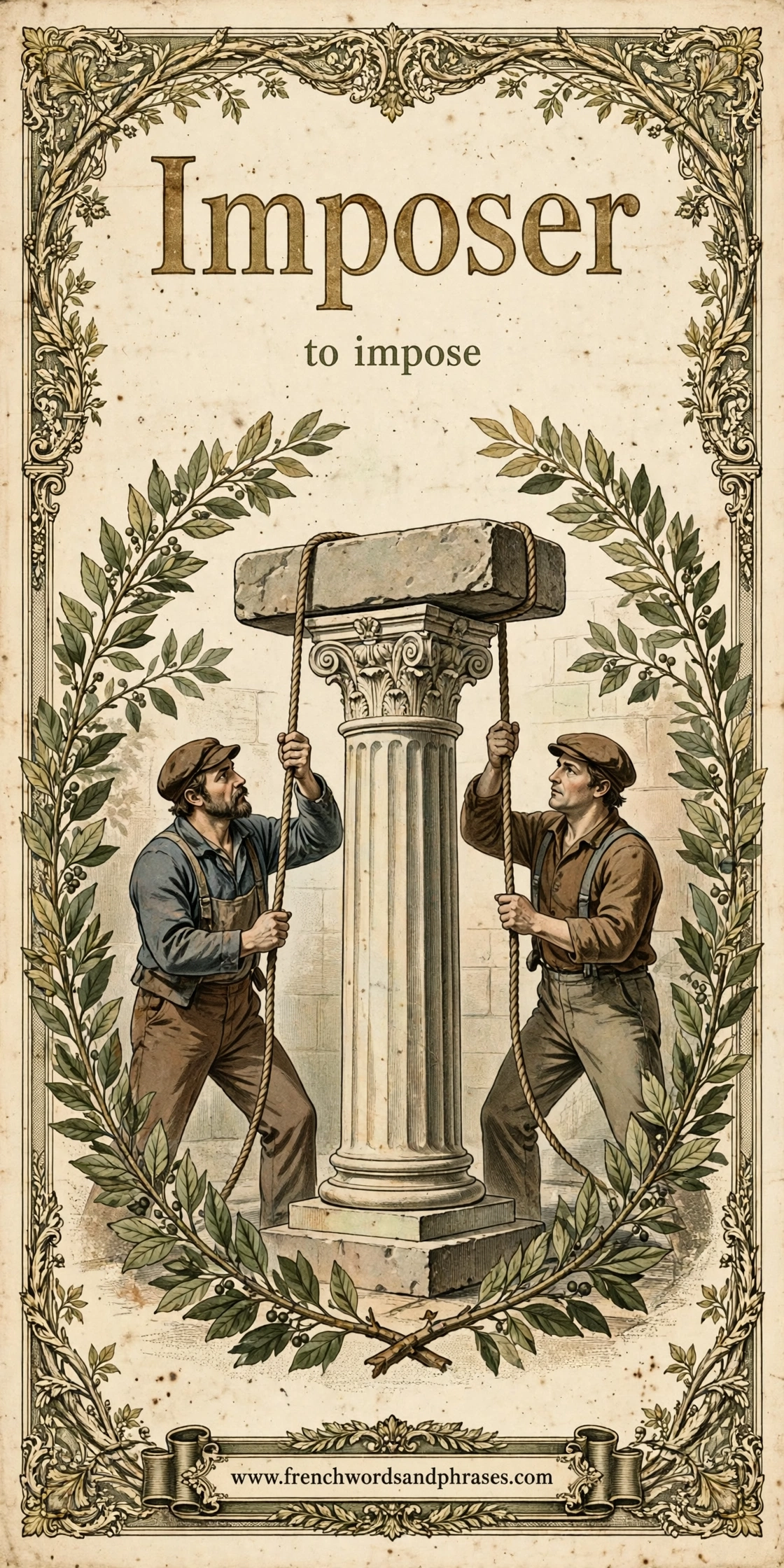
A French Word to Live By
How to Conjugate Imposer in French
/ɛ̃.po.ze/
Imposer means to impose, to tax — to lay down a rule, a tax or your will on others, and have it stick.
A government imposing a new tax, a champion imposing his rhythm on a race, a silence that imposes itself in a cathedral — imposer is the verb of weight laid on: rules, taxes, respect, and sometimes simply presence.
In this guide, you’ll learn how to conjugate imposer in all the major French tenses and moods. Explore complete conjugation tables, French examples, English translations, and practice quizzes.
Understanding the French Verb Imposer
Imposer is a regular French verb belonging to the first group of verbs, those ending in-er.
It means to impose, to tax. Governments imposent taxes and rules; winners imposent their rhythm and their style; impressive people imposent le respect without asking for it. S’imposer is the form you will meet most in careful French: un repos s’impose, a rest is called for; des mesures s’imposent, measures are needed.
Verb classification: First group (-er)
Auxiliary verb: Avoir
Past participle: imposé
Present participle: imposant
English equivalents: To impose, to tax; imposer une taxe — to impose a tax; imposer ses conditions — to impose one’s conditions; imposer le respect — to command respect; imposer un délai — to set a deadline; s’imposer — to be essential, to impose oneself: il s’impose de partir — it is essential to leave; elle s’est imposée dans l’équipe — she established herself in the team.
One important detail: imposer carries the Latin poser, to lay down — what is imposed is laid on top of people: a tax, a rule, a condition. Its reflexive s’imposer splits in two: impersonally, il s’impose de + infinitive means it is essential, called for (une visite chez le médecin s’impose — a visit to the doctor is in order); personally, it means to impose yourself or win your place (elle s’est imposée comme la meilleure). Do not confuse imposer with the noun un impôt, a tax. The verb is regular: j’impose, nous imposons.
Experience the Word
Imposer is the verb of the hand laid flat on the table — what it sets down stays down.
Imagine a small town council voting a new tax on market stalls at midnight. The mayor signs, the paper is posted on the door of the mairie, and by morning the whole market knows: le conseil a imposé une nouvelle taxe, and no amount of grumbling will lift it before spring.
The decision has weight because it was laid down from above. It has been imposed — imposée, signed, posted, in force.
How to Conjugate Imposer: Complete French Conjugation Guide
Let’s explore every major conjugation of imposer, beginning with the indicative mood.
How to Conjugate Imposer in the Indicative Mood
The indicative mood is used to express facts, observations, actions, and events.
How to Conjugate Imposer in the Present Tense (Présent)
Used for actions happening now, habitual actions, and general truths.
| Subject | Conjugation |
|---|---|
| je | impose |
| tu | imposes |
| il / elle | impose |
| nous | imposons |
| vous | imposez |
| ils / elles | imposent |
Example
Le gouvernement impose une nouvelle taxe sur le tabac.
The government is imposing a new tax on tobacco.
Quick Quiz 1
Complete the sentence:
Nous ______ un délai de deux semaines.
Reveal the answer
imposons
Nous imposons un délai de deux semaines.
We are setting a two-week deadline.
How to Conjugate Imposer in the Passé Composé
Used for completed actions in the past. Imposer takes the auxiliary verb avoir.
| Subject | Conjugation |
|---|---|
| j’ | ai imposé |
| tu | as imposé |
| il / elle | a imposé |
| nous | avons imposé |
| vous | avez imposé |
| ils / elles | ont imposé |
Example
Elle a imposé son rythme dès le début de la course.
She imposed her rhythm from the start of the race.
How to Conjugate Imposer in the Imparfait (Imperfect Tense)
Used for habitual past actions, descriptions, and ongoing situations in the past.
| Subject | Conjugation |
|---|---|
| je | imposais |
| tu | imposais |
| il / elle | imposait |
| nous | imposions |
| vous | imposiez |
| ils / elles | imposaient |
Example
Le directeur imposait des règles très strictes.
The director used to impose very strict rules.
Quick Quiz 2
Choose the correct form:
She imposed her rhythm on the race.
Elle ______ son rythme à la course. (a imposé / est imposé)
Reveal the answer
a imposé
Elle a imposé son rythme à la course.
Imposer takes avoir.
How to Conjugate Imposer in the Plus-que-parfait
Used to describe an action that had already been completed before another past event.
| Subject | Conjugation |
|---|---|
| j’ | avais imposé |
| tu | avais imposé |
| il / elle | avait imposé |
| nous | avions imposé |
| vous | aviez imposé |
| ils / elles | avaient imposé |
Example
Le traité avait imposé des frontières nouvelles.
The treaty had imposed new borders.
How to Conjugate Imposer in the Passé Simple
Primarily used in formal writing, literature, and historical narratives. It is rarely used in everyday conversation.
| Subject | Conjugation |
|---|---|
| je | imposai |
| tu | imposas |
| il / elle | imposa |
| nous | imposâmes |
| vous | imposâtes |
| ils / elles | imposèrent |
Example
Le roi imposa un impôt sur le sel.
The king imposed a tax on salt.
How to Conjugate Imposer in the Passé Antérieur
A literary tense used to express an action completed immediately before another past action, generally in the passé simple.
| Subject | Conjugation |
|---|---|
| j’ | eus imposé |
| tu | eus imposé |
| il / elle | eut imposé |
| nous | eûmes imposé |
| vous | eûtes imposé |
| ils / elles | eurent imposé |
Example
Quand le conseil eut imposé la taxe, les marchands protestèrent.
When the council had imposed the tax, the merchants protested.
How to Conjugate Imposer in the Future Tense (Futur Simple)
Used to describe actions that will take place in the future.
| Subject | Conjugation |
|---|---|
| je | imposerai |
| tu | imposeras |
| il / elle | imposera |
| nous | imposerons |
| vous | imposerez |
| ils / elles | imposeront |
Example
Ce silence imposera le respect à toute la salle.
This silence will command the room’s respect.
How to Conjugate Imposer in the Futur Antérieur (Future Perfect)
Used for an action that will have been completed before a particular point in the future.
| Subject | Conjugation |
|---|---|
| j’ | aurai imposé |
| tu | auras imposé |
| il / elle | aura imposé |
| nous | aurons imposé |
| vous | aurez imposé |
| ils / elles | auront imposé |
Example
À la fin du match, elle aura imposé son style de jeu.
By the end of the match, she will have imposed her style of play.
How to Conjugate Imposer in the Near Future (Futur Proche)
Used to describe something that is going to happen soon. Formed with aller + infinitive.
| Subject | Conjugation |
|---|---|
| je | vais imposer |
| tu | vas imposer |
| il / elle | va imposer |
| nous | allons imposer |
| vous | allez imposer |
| ils / elles | vont imposer |
Example
On va imposer un délai de deux semaines.
We are going to set a two-week deadline.
How to Conjugate Imposer in the Conditional Mood
The conditional mood expresses what would happen under certain circumstances. It is also frequently used to make polite requests or express wishes.
How to Conjugate Imposer in the Present Conditional
| Subject | Conjugation |
|---|---|
| je | imposerais |
| tu | imposerais |
| il / elle | imposerait |
| nous | imposerions |
| vous | imposeriez |
| ils / elles | imposeraient |
Example
Sans l’accord du parlement, on n’imposerait rien.
Without parliament’s agreement, nothing would be imposed.
How to Conjugate Imposer in the Past Conditional
| Subject | Conjugation |
|---|---|
| j’ | aurais imposé |
| tu | aurais imposé |
| il / elle | aurait imposé |
| nous | aurions imposé |
| vous | auriez imposé |
| ils / elles | auraient imposé |
Example
Il aurait imposé ses conditions si on l’avait laissé faire.
He would have imposed his conditions if he had been allowed to.
Imposer in the Literary Past Conditional Form
This less common literary form uses the imperfect subjunctive of avoir.
| Subject | Conjugation |
|---|---|
| j’ | eusse imposé |
| tu | eusses imposé |
| il / elle | eût imposé |
| nous | eussions imposé |
| vous | eussiez imposé |
| ils / elles | eussent imposé |
Example
Le ministre eût imposé la réforme sans les grèves.
The minister would have imposed the reform without the strikes.
How to Conjugate Imposer in the Subjunctive Mood
The subjunctive is used to express wishes, emotions, doubts, necessity, and uncertainty. It frequently follows expressions such as il faut que (it is necessary that) or bien que (although).
How to Conjugate Imposer in the Present Subjunctive
| Subject | Conjugation |
|---|---|
| que je | impose |
| que tu | imposes |
| qu’il / qu’elle | impose |
| que nous | imposions |
| que vous | imposiez |
| qu’ils / qu’elles | imposent |
Example
Je ne crois pas qu’il impose quoi que ce soit.
I do not think he is imposing anything at all.
Quick Quiz 3
Complete the sentence using the subjunctive:
Je ne crois pas que vous ______ vos idées à tout le monde.
Reveal the answer
imposiez
Je ne crois pas que vous imposiez vos idées à tout le monde.
I do not think you are imposing your ideas on everyone.
How to Conjugate Imposer in the Imperfect Subjunctive
A literary tense, rarely encountered in modern spoken French.
| Subject | Conjugation |
|---|---|
| que je | imposasse |
| que tu | imposasses |
| qu’il / qu’elle | imposât |
| que nous | imposassions |
| que vous | imposassiez |
| qu’ils / qu’elles | imposassent |
Example
On craignait que le roi imposât un nouvel impôt.
People feared the king might impose a new tax.
How to Conjugate Imposer in the Pluperfect Subjunctive
A literary construction used to express an action completed before another past action.
| Subject | Conjugation |
|---|---|
| que j’ | eusse imposé |
| que tu | eusses imposé |
| qu’il / qu’elle | eût imposé |
| que nous | eussions imposé |
| que vous | eussiez imposé |
| qu’ils / qu’elles | eussent imposé |
Example
On racontait que le traité eût imposé des frontières injustes.
People said the treaty had imposed unjust borders.
How to Conjugate Imposer in the Past Subjunctive
| Subject | Conjugation |
|---|---|
| que j’ | aie imposé |
| que tu | aies imposé |
| qu’il / qu’elle | ait imposé |
| que nous | ayons imposé |
| que vous | ayez imposé |
| qu’ils / qu’elles | aient imposé |
Example
Je suis content qu’elle ait imposé son point de vue.
I am glad she imposed her point of view.
How to Conjugate Imposer in the Imperative
The imperative is used to give commands, instructions, invitations, or suggestions. Subject pronouns are omitted.
How to Conjugate Imposer in the Present Imperative
| Person | Conjugation |
|---|---|
| (tu) | impose |
| (nous) | imposons |
| (vous) | imposez |
Example
N’impose pas tes idées aux autres !
Do not impose your ideas on others!
Quick Quiz 4
How would you say Do not impose your ideas on others (tu form)?
Reveal the answer
N’impose pas tes idées aux autres !
French Participles of Imposer
Participles are verb forms that can be used in compound tenses and other grammatical constructions.
Present Participle of Imposer
imposant
En imposant ce délai, on évite les retards.
By setting this deadline, we avoid delays.
Past Participle of Imposer
imposé
Imposée en une nuit, la taxe a surpris tout le monde.
Imposed overnight, the tax surprised everyone.
Imposer in Everyday French: Real-Life Examples
Now that you know the conjugations, let’s see how imposer appears in everyday French.
Example 1 — Present
Le gouvernement impose une nouvelle taxe.
The government is imposing a new tax.
Example 2 — Passé composé
Elle a imposé son rythme à la course.
She imposed her rhythm on the race.
Example 3 — Imparfait
Le directeur imposait des règles strictes.
The director used to impose strict rules.
Example 4 — Future
On imposera un délai de deux semaines.
A two-week deadline will be set.
Example 5 — Conditional
On n’imposerait rien sans accord.
Nothing would be imposed without agreement.
Example 6 — Imperative
N’impose pas tes idées aux autres !
Do not impose your ideas on others!
Beyond Translation: The Meaning of Imposer
English impose is the same word wearing a suit; French imposer adds the reflexive jewel s’imposer.
Some things impose themselves.
Un repos s’impose after a long illness, une évidence s’impose in an argument — French loves this polite fiction that necessity, not a person, is doing the imposing, and it softens a thousand official decisions every day.
How to Remember the French Verb Imposer
Remember it this way: Imposer is about the hand laid flat on the table — taxes, rules and respect.
- What is imposed is laid on: taxes, rules, conditions, deadlines — imposer une taxe, imposer un délai.
- S’imposer, impersonal: il s’impose de partir — it is essential to leave; un repos s’impose — a rest is called for.
- S’imposer, personal: to win your place — elle s’est imposée dans l’équipe.
The key idea is the hand laid flat on the table — taxes, rules and respect.
Test Your Knowledge of Imposer
Let’s see how much you’ve learned. Try answering these questions before revealing the answers.
Question 1
What does s’imposer mean in « Une visite chez le médecin s’impose »?
Reveal the answer
It is essential / called for — a visit to the doctor is in order; nobody is imposing themselves.
Question 2
How do you say The government is imposing a new tax in French?
Reveal the answer
Le gouvernement impose une nouvelle taxe.
Question 3
Translate: She imposed her rhythm from the start of the race.
Reveal the answer
Elle a imposé son rythme dès le début de la course.
Question 4
What is the past participle of imposer?
Reveal the answer
Imposé.
Question 5
Complete the sentence:
On craignait que le roi ______ un nouvel impôt.
Reveal the answer
imposât
On craignait que le roi imposât un nouvel impôt.
People feared the king might impose a new tax.
Your Final Challenge
Can You Use It?
How would you say this in French?
After weeks of tiredness, a long rest is called for, and even the boss agrees.
Reveal the answer
Après des semaines de fatigue, un long repos s’impose, et même le directeur est d’accord.
After weeks of tiredness, a long rest is called for, and even the boss agrees.
A little French. A little curiosity. A richer everyday life.
LEARN FRENCH ONE WORD AT A TIME




